Sigma and Pi Bonds Explained | A-Level Chemistry
Revise A-Level Chemistry sigma and pi bonds with orbital overlap, single, double and triple bonds, rotation, common mistakes and practice.
Sigma and pi bonds are two ways orbitals overlap to form covalent bonds. In CAIE A-Level Chemistry, the fastest way to separate them is to look at the direction of overlap: a sigma bond forms by direct end-to-end overlap along the internuclear axis, while a pi bond forms by sideways overlap of parallel p orbitals. This difference explains bond rotation, bond strength and the structure of double and triple bonds.
Quick Answer
- Every single covalent bond contains one sigma bond.
- A sigma bond has electron density along the internuclear axis.
- A pi bond has electron density above and below the internuclear axis.
- A double bond contains one sigma and one pi bond.
- A triple bond contains one sigma and two pi bonds.
What Is a Sigma Bond?
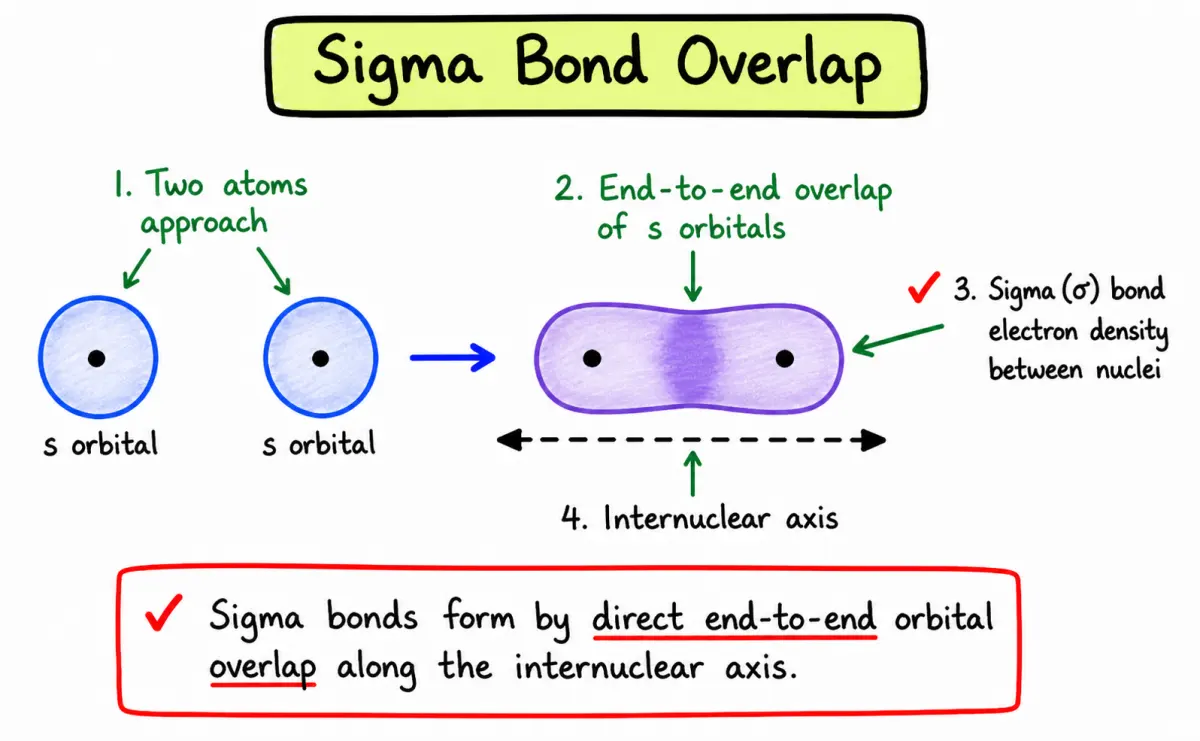
A sigma bond forms when orbitals overlap directly along the line joining the two nuclei. The overlap can involve s orbitals, p orbitals or hybrid orbitals. The shared electron density is concentrated between the nuclei, along the internuclear axis.
Sigma overlap is usually stronger than pi overlap because the orbitals meet directly. A single bond is therefore a sigma bond, and the sigma bond is the first bond formed between two atoms.
What Is a Pi Bond?
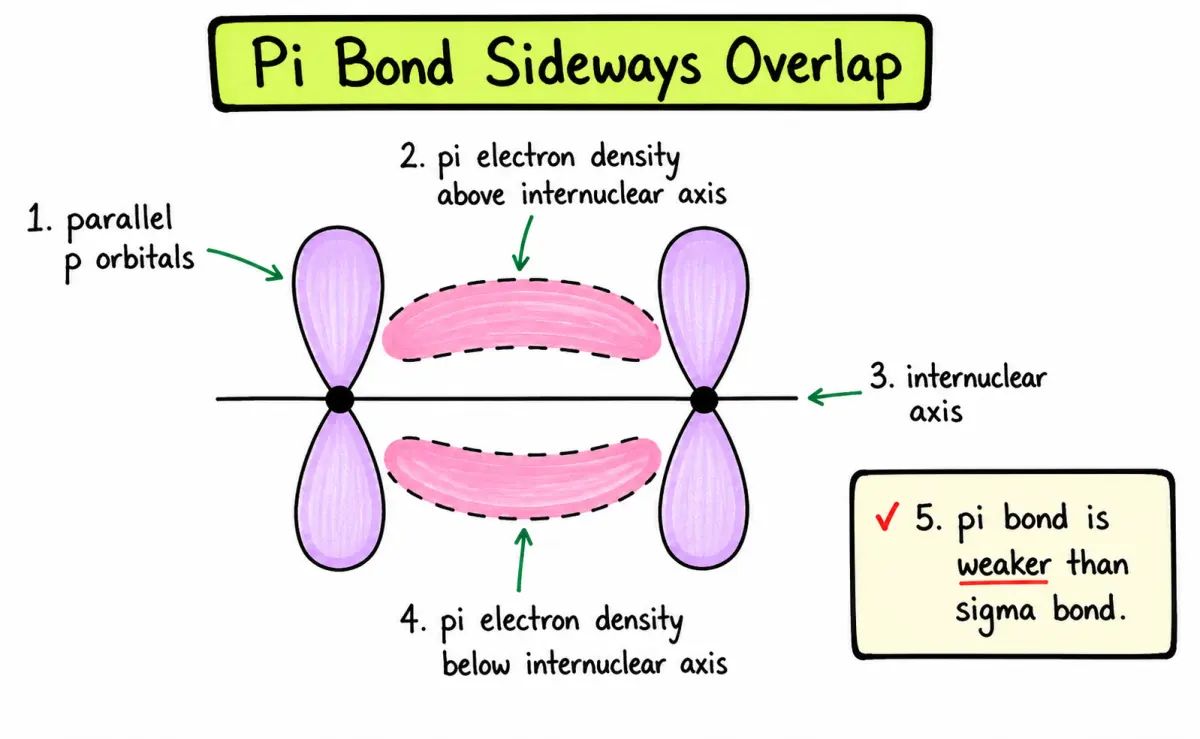
A pi bond forms when two parallel p orbitals overlap sideways. The electron density is found in two regions, one above and one below the internuclear axis. The sideways overlap is less direct, so a pi bond is weaker than a sigma bond.
Single, Double and Triple Bonds
| Covalent bond | Sigma bonds | Pi bonds | Total bond components |
|---|---|---|---|
| Single | 1 | 0 | 1 |
| Double | 1 | 1 | 2 |
| Triple | 1 | 2 | 3 |
The first bond between two atoms is always sigma. Additional bonds must be pi bonds because a second direct overlap along the same axis is not possible.
For example, an alkene C=C double bond contains one sigma bond from direct overlap and one pi bond from sideways p-orbital overlap. An alkyne C≡C triple bond contains one sigma and two pi bonds.
Why Pi Bonds Restrict Rotation
Free rotation around a single sigma bond does not destroy the direct overlap. A pi bond is different: rotating one atom around the bond axis would reduce or remove the sideways overlap of the parallel p orbitals. That is why double bonds are more rigid than single bonds and can produce different geometric arrangements.
Worked Example
Question: State the number of sigma and pi bonds in a carbon-carbon triple bond.
Answer: A triple bond contains one sigma bond and two pi bonds. The first overlap between the carbon atoms is direct end-to-end overlap, giving one sigma bond. The two remaining overlaps are sideways p-orbital overlaps, giving two pi bonds.
Common Exam Mistakes
| Mistake | Better wording |
|---|---|
| Saying a double bond contains two sigma bonds | It contains one sigma and one pi bond |
| Saying pi electron density lies between the nuclei on the axis | Pi density lies above and below the internuclear axis |
| Saying pi bonds allow free rotation | Sideways overlap must remain aligned, so rotation is restricted |
| Forgetting the sigma bond in a triple bond | Every multiple bond contains one sigma bond first |
| Calling the sideways overlap stronger | Direct sigma overlap is generally stronger |
Mini Practice
How many sigma and pi bonds are present in a molecule containing one C=C bond and one C≡C bond?
Answer guide: The C=C bond contributes one sigma and one pi bond. The C≡C bond contributes one sigma and two pi bonds. The total is two sigma bonds and three pi bonds.
Practice This Topic
Try this exam-style question: Explain how sigma and pi bonds form, then use the explanation to describe the bonding in a C=C double bond.
Answer guide:
- Sigma bonding comes from direct end-to-end overlap along the internuclear axis.
- Pi bonding comes from sideways overlap of parallel p orbitals.
- A double bond contains one sigma and one pi bond.
- The pi bond has electron density above and below the axis and restricts rotation.
Practise A-Level Chemistry covalent bonding questions.
FAQ
Does every covalent bond contain a sigma bond?
Yes. A single bond is one sigma bond, and a double or triple bond begins with one sigma bond before the additional pi bonds are added.
Why is a pi bond weaker than a sigma bond?
A sigma bond uses direct end-to-end overlap along the internuclear axis. A pi bond uses sideways overlap, which is less effective, so its overlap is weaker.
Why do double bonds restrict rotation?
Rotation would disturb the parallel p-orbital alignment needed for sideways overlap. Breaking that alignment would weaken or remove the pi bond.
Related Study Links
- Open the full revision Study Hub
- A-Level Chemistry covalent bonding questions
- A-Level Chemistry Notes
- A-Level Chemistry Bonding: Covalent and Intermolecular Forces
- A-Level Chemistry organic mechanisms
Final Takeaway
Remember the direction of overlap: sigma is direct and along the axis; pi is sideways and above or below the axis. That rule unlocks multiple-bond structure, strength and rotation questions.
Put sigma bonds back into your full A-Level CAIE Chemistry AS study plan.
Return to the complete course overview, or move directly into the most relevant study tool.
Related articles
More course notes, updates and study resources from the EduNinja blog.

IB Chemistry SL 2025 Syllabus Changes: Assessment Guide
A practical IB Chemistry SL guide to the 2025 syllabus and assessment model: structure and reactivity, Paper 1A and 1B, Paper 2, scientific investigation and revision strategy.
Electron Domains and Molecular Geometry | A-Level Chemistry
Revise A-Level Chemistry electron domains, VSEPR shapes, lone pairs, bond angles, molecular geometry and common exam mistakes.
Salt Bridge Explained | A-Level Chemistry
Learn the function of a salt bridge in A-Level Chemistry, including ion movement, electrical neutrality, cell circuits and exam mistakes.