Question 1
Ethane-1,2-diol, , has a wide variety of uses including the removal of ice from aircraft and heat transfer in a solar cell.
Question 1(c)
Explain why the boiling point of ethane-1,2-diol is significantly greater than that of ethene.
EduNinjaEthane-1,2-diol, HOCH2CH2OH, has a wide variety of uses including the removal of ice from aircraft and heat transfer in a solar cell.
Explain why the boiling point of ethane-1,2-diol is significantly greater than that of ethene.
Alkanes are commonly occurring organic compounds.
The first four straight chain alkanes are gases at room temperature.

Boiling points of straight chain alkanes
Explain why the boiling point increases from methane to propane.
Chlorine undergoes many reactions.
Predict, giving a reason, whether ethane or chloroethane is more reactive.
Ethanedioic acid is a diprotic acid. A student determined the value of x in the formula of hydrated ethanedioic acid, HOOC−COOH∙×H2O, by titrating a known mass of the acid with a 0.100 moldm−3 solution of NaOH(aq).
0.795 g of ethanedioic acid was dissolved in distilled water and made up to a total volume of 250 cm3 in a volumetric flask.
25 cm3 of this ethanedioic acid solution was pipetted into a flask and titrated against aqueous sodium hydroxide using phenolphthalein as an indicator.
The titration was then repeated twice to obtain the results below.

Identify the strongest intermolecular force in solid ethanedioic acid.
Deduce the Lewis (electron dot) structure of ethanedioic acid, HOOC-COOH.
The absorption of infrared (IR) radiation by molecules in the atmosphere affects global temperatures.

Graph of IR absorbances for oxygen and ozone molecules
The following data has been compiled for a range of molecules that may be found in the atmosphere.

*Integrated IR intensity is a measure of the extent to which the molecule absorbs infrared radiation passing through the atmosphere.
**GWP: The global warming potential (GWP) is a relative measure of the total contribution of the compound to global warming over the specified time period. It is compared to the same mass of CO2, which has a GWP of 1 .
Explain the increase in molecular dipole moment as one chlorine atom in CCl4 is replaced with fluorine to produce CCl3 F.
Two groups of students (Group A and Group B) carried out a project* on the chemistry of some group 7 elements (the halogens) and their compounds.
Although the molar masses of ICl and Br2 are very similar, the boiling point of ICl is 97.4∘C and that of Br2 is 58.8∘C. Explain the difference in these boiling points in terms of the intermolecular forces present in each liquid.
In order to determine the oil content of different types of potato crisps (chips), a student weighed 5.00 g of crushed crisps and mixed them with 20.0 cm3 of non-polar solvent.
She assumed all the oil in the crisps dissolved in the solvent.
The student then filtered the mixture to remove any solids, and gently heated the solution on a hot plate to evaporate the solvent.
She measured the mass of the oil that remained from each type of crisps.
Suggest why a non-polar solvent was needed.
Phosphine (IUPAC name phosphane) is a hydride of phosphorus, with the formula PH3.
Draw a Lewis (electron dot) structure of phosphine.
Outline whether you expect the bonds in phosphine to be polar or non-polar, giving a brief reason.
Explain why the phosphine molecule is not planar.
Phosphine has a much greater molar mass than ammonia. Explain why phosphine has a significantly lower boiling point than ammonia.
Phosphine is usually prepared by heating white phosphorus, one of the allotropes of phosphorus, with concentrated aqueous sodium hydroxide. The equation for the reaction is:
Identify one other element that has allotropes and list two of its allotropes.
Element:
Allotrope 1:
Allotrope 2:
Phosphorus is an element that is an essential part of the biological molecules involved in both respiration and photosynthesis.
7.75 g of phosphorus was combusted in a limited supply of oxygen, the mass of the oxide produced was 13.75 g .
This oxide of phosphorus has a melting point of 296.9 K .
Outline, with reference to structure and bonding, the reasons why the melting point of this oxide is low.
Describe the nature of the bond between oxygen and phosphorus. Use sections 9 and 17 of the data booklet.
Another compound of phosphorus is phosphine, PH3, it forms a phosphonium ion, PH4+.
State the types of bonds present in the phosphonium ion, PH4+, and explain how these bonds are formed.
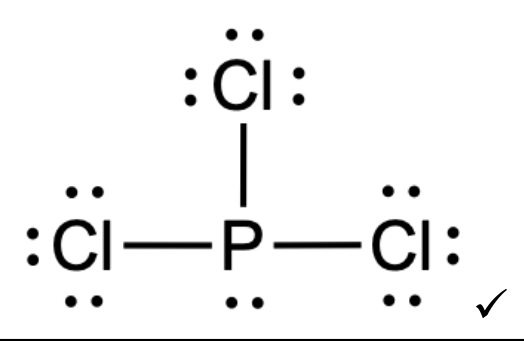
Phosphorus trichloride, PCl3, is a common compound of phosphorus.
Deduce the Lewis formula of PCl3.
The equations show steps in the formation and decomposition of ozone in the stratosphere, some of which absorb ultraviolet light.
Step 1O2→2O⋅
Step 2O∙+O2→O3
Step 3O3→O∙+O2
Step 4O∙+O3→2O2
Draw the Lewis structures of oxygen, O2, and ozone, O3.
Discuss how the different bond strengths between the oxygen atoms in O2 and O3 in the ozone layer affect radiation reaching the Earth's surface.