EduNinja

IB Chemistry SL1.3 Electron configurationsQuestion Bank

Question 1

[Maximum number: 1]

Iron may be extracted from iron (II) sulfide, FeS.

Question 1(c)

(a)

Iron (II) sulfide, FeS , is ionically bonded.

[ 1 ]

Question 1(c)(ii)

(i)

State the full electron configuration of the sulfide ion.

[ 1 ]

Question 1

[Maximum number: 4]

Phosphorus is an element that is an essential part of the biological molecules involved in both respiration and photosynthesis.

Question 1(a)

Question 1(a)(i)

(a)
(i)

Draw the orbital diagram of the phosphorus atom in the ground state by adding, filling and labelling the orbitals. Use section 7 of the data booklet.

Question image
[ 2 ]

Question 1(a)(ii)

(ii)

Sketch the shapes of two different orbital types in the second energy level and label each orbital.

Question image
[ 2 ]

Question 1

[Maximum number: 2]

There are many oxides of silver with the formula AgxOy\mathrm{Ag}_{\mathrm{x}} \mathrm{O}_{\mathrm{y}}. All of them decompose into their elements when heated strongly.

Question 1(d)

(a)

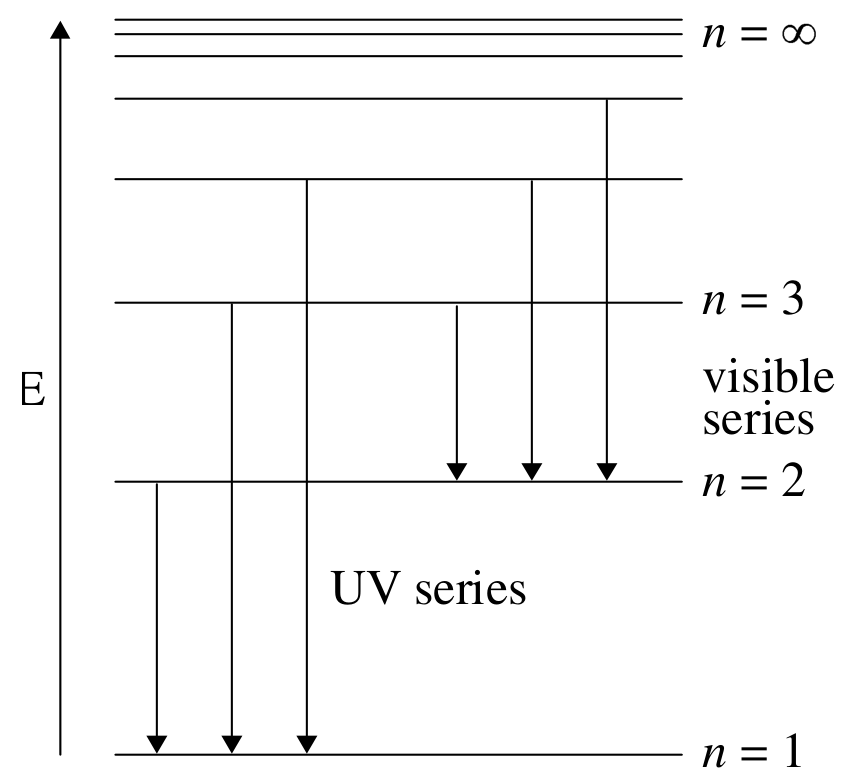
Outline the model of electron configuration deduced from the hydrogen line emission spectrum (Bohr's model).

[ 2 ]

Question 1

[Maximum number: 2]

Electromagnetic waves can transfer energy and carry information.

Question 1(a)

(a)

State the relationship between the energy of a wave and its wavelength.

[ 1 ]

Question 1(b)

(b)

Identify the region of the electromagnetic spectrum that can be used to obtain the concentration of Cr3+\mathrm{Cr}^{3+} ions in industrial waste waters.

[ 1 ]

Question 1

[Maximum number: 1]

Graphs showing the first ionization energy and first electron affinity of the elements in period 2 of the periodic table are shown.

First ionization energy

First ionization energy

First electron affinity

First electron affinity

Question 1(c)

(a)

The electron affinity of nitrogen is 6.8 kJ mol16.8 \mathrm{~kJ} \mathrm{~mol}^{-1}. Sketch the 2 s and 2 p orbital filling diagram that represents the electron arrangement of the species produced.

Question image
[ 1 ]

Question 1

[Maximum number: 4]

Modern analytical techniques are used widely for different purposes in everyday life.

Question 1(b)

(a)

Two types of spectroscopy are absorption and emission. Distinguish between each type of spectra, including how each is produced.
Absorption spectra:
Emission spectra:

[ 4 ]

Question 1

[Maximum number: 1]

Pasteurization is used to eliminate pathogenic bacteria. The concentration of vitamin C was monitored over a period of time in pasteurized and unpasteurized orange juice.

Question image

Question 1(b)

(a)

UV treatment is an alternative to pasteurization that minimizes loss of nutritional components.

[ 1 ]

Question 1(b)(i)

(i)

Deduce the type of electromagnetic radiation absorbed in the absorption spectrum of vitamin C . Use section 3 of the data booklet.

Question image
[ 1 ]

Question 1

Question 1(a)

(a)

Describe the essential difference between the emission spectrum of sodium and the absorption spectrum of sodium.

[ 1 ]

Question 1

[Maximum number: 1]

The equations show steps in the formation and decomposition of ozone in the stratosphere, some of which absorb ultraviolet light.

Step 1O22O1 \quad \mathrm{O}_{2} \rightarrow 2 \mathrm{O} \cdot

Step 2O+O2O32 \quad \mathrm{O} \bullet+\mathrm{O}_{2} \rightarrow \mathrm{O}_{3}

Step 3O3O+O23 \quad \mathrm{O}_{3} \rightarrow \mathrm{O} \bullet+\mathrm{O}_{2}

Step 4O+O32O24\quad{O} \bullet+\mathrm{O}_{3} \rightarrow 2 \mathrm{O}_{2}

Question 1(c)

(a)

Distinguish ultraviolet light from visible light in terms of wavelength and energy.

[ 1 ]

Question 1

[Maximum number: 1]

Chlorine undergoes many reactions.

Question 1(a)

Question 1(a)(i)

(a)
(i)

State the full electron configuration of the chlorine atom.

[ 1 ]
0 selected