IB Physics Electric Circuits: Current, Voltage, Resistance
Revise IB Physics electric circuits with current, potential difference, resistance, series and parallel rules, V = IR, and circuit mistakes.
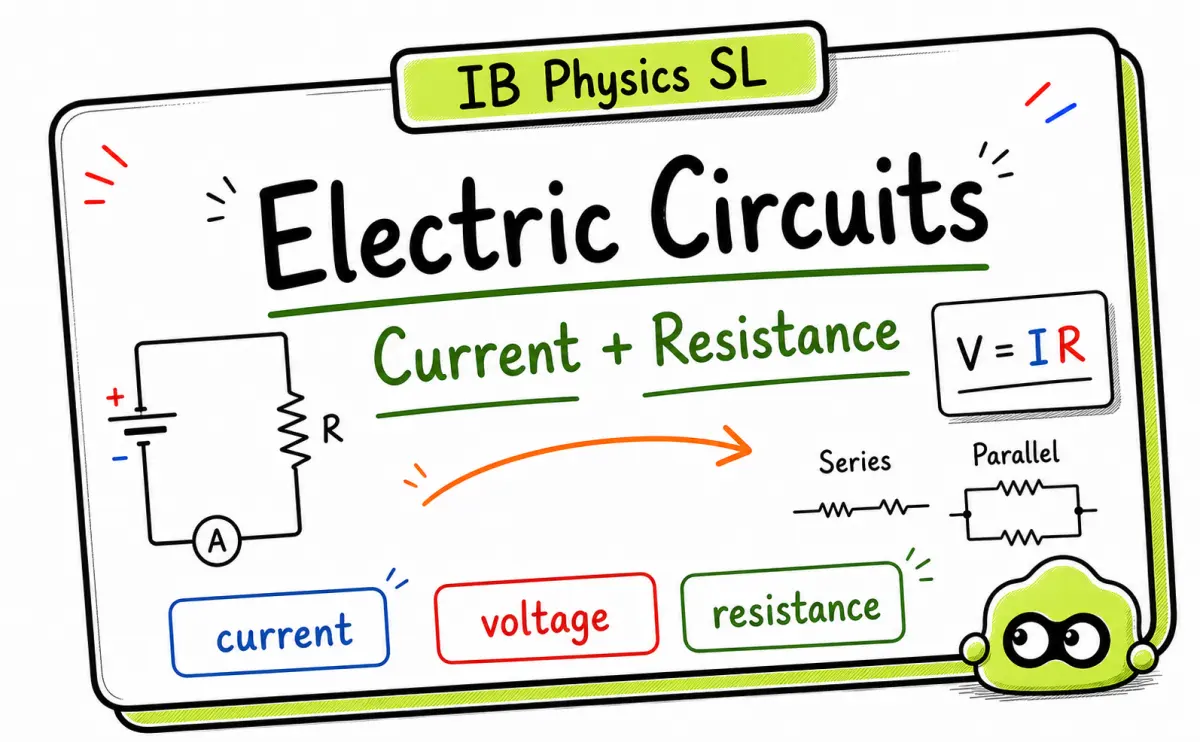
Electric circuits in IB Physics are not just formula substitution. The same equation can appear in a calculation question, an explanation question, or a graph question, and each one needs a slightly different answer.
Current syllabus map: This article is aligned to the IB Physics first assessment 2025 syllabus through the concepts of forces, energy and fields in electric circuits.
This guide keeps the focus on current, voltage, and resistance as physical ideas, not just letters in an equation.
Use the relevant EduNinja course pages as your base:
Do not open every link at once. Start with the notes or topic page, then move into question practice and use any PDF resource only when it helps clarify the exact idea you are revising.
Quick Answer
For IB Physics electric circuits, keep the model visible:
- Current is the rate of flow of charge.
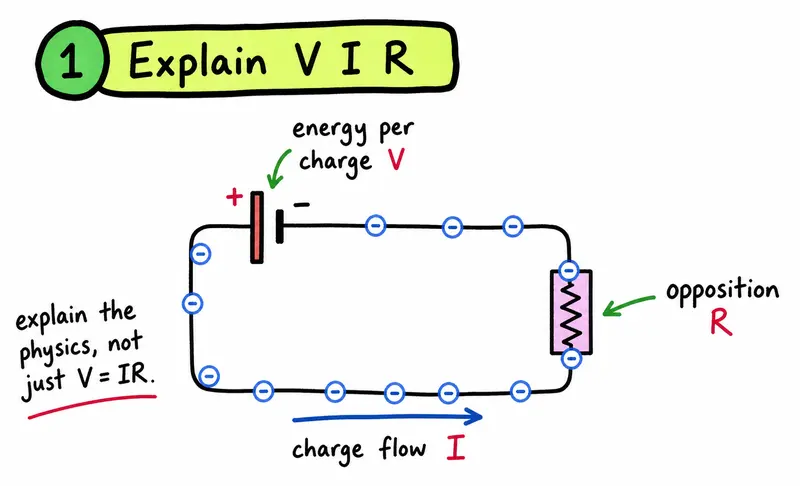
- Potential difference is energy transferred per unit charge.
- Resistance opposes current and links voltage to current through V = IR.
- Series and parallel circuits distribute current and voltage differently.
- Power questions often need P = IV or related substitutions.
- Explanation answers should describe what happens to charge or energy, not only quote an equation.
Core Concept That Gets Marks
IB circuit answers need both calculation and explanation. Define charge flow, energy transfer per charge, resistance, and power before using equations.
Turn Formula Knowledge Into IB Explanation
IB circuit questions often ask for a calculation and then an explanation. The explanation needs physics language, not only the equation.
| Quantity | IB-friendly meaning | Useful wording |
|---|---|---|
| Current | Charge passing per second | more charge flows per unit time |
| Potential difference | Energy transferred per unit charge | each coulomb transfers more energy |
| Resistance | Opposition to current | charge flow is reduced for the same potential difference |
| Power | Energy transferred per second | energy is dissipated at a greater rate |
If the command term is explain, write a cause-and-effect sentence. For example: increasing resistance at constant potential difference decreases current because charge flow is opposed more strongly.
IB Command-Term Frames for Circuits
Use different answer shapes for different command terms:
- State: give the equation, definition, or named quantity directly.
- Calculate: show substitution and unit, then round sensibly.
- Explain: describe the relationship and the physical reason.
- Compare: say what is the same and what is different between two circuits or components.
This is where many IB answers lose marks. A correct calculation does not automatically answer an explanation prompt.
Concept Check Before Question Practice
Before doing a timed set, answer these in words:
- What does a voltmeter measure in terms of energy and charge?
- Why does current decrease if resistance increases at constant voltage?
- What does higher power mean for energy transfer per second?
If those answers are clear, the equations become easier to use under pressure.
IB Physics Circuits: Explain Energy and Charge Clearly
For IB Physics, electric circuits questions often reward conceptual wording as much as calculation. Before using an equation, make sure you can explain what the quantities mean:
- Current is how much charge passes a point per second.
- Potential difference is energy transferred per unit charge.
- Resistance describes how strongly a component opposes current.
- Power is the rate at which energy is transferred.
- A circuit explanation should mention charge flow or energy transfer, not only a memorised formula.
When a command term says explain, do not stop at V = IR. Say what changes, why it changes, and what stays constant. For example, if resistance increases at constant potential difference, current decreases because the same energy-per-charge is driving charge through a larger opposition.
What Makes This Topic Different
Electric circuits combine definitions with diagnosis. A formula answer may calculate the right number, but explanation questions often ask why current changes, why a component gets dimmer, or why resistance affects power.
Use two columns when practising: left column for calculation, right column for physical explanation. This trains you to move between equations and circuit behaviour instead of treating them as separate topics.
Worked Example 1
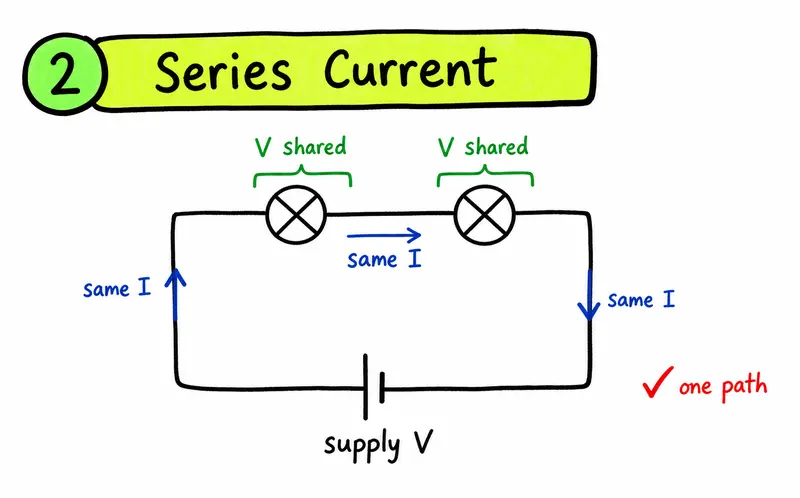
Worked Example 1: Current in a Series Circuit
Question: Two lamps are connected in series. What happens to current through each lamp?
Worked answer: The current is the same through each component in a series circuit because there is only one path for charge to flow. The potential difference is shared, but current is not split.
Markscheme-style answer:
- Series circuit has one path.
- Current is the same through each component.
- Potential difference may be shared between components.
Worked Example 2: Resistance from I-V Data
Question: A component has potential difference 4.0 V and current 0.20 A. Find resistance.
Worked answer: Use R = V / I. Resistance = 4.0 / 0.20 = 20 ohms. The unit matters because resistance is measured in ohms.
Markscheme-style answer:
- Selects R = V / I.
- Substitutes values correctly.
- Calculates 20 ohms.
- Includes correct unit.
Question-Type Breakdown
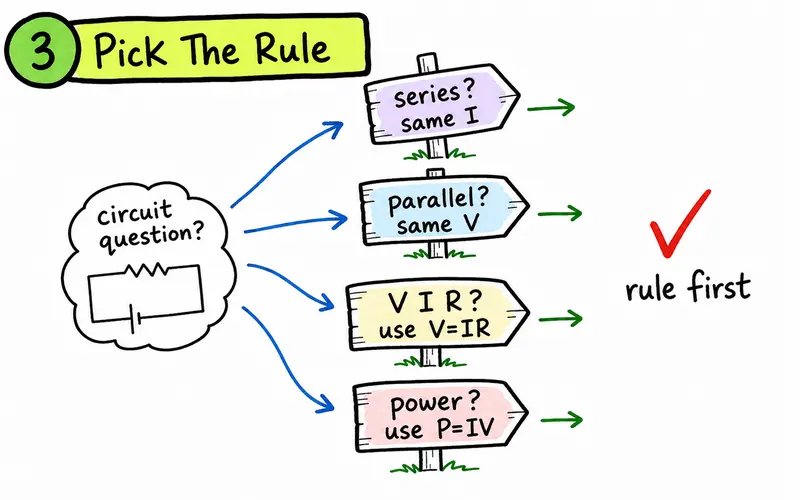
Circuit questions usually test one of three decisions: series or parallel, current or voltage, and resistance or power.
| Question type | What it is really asking | First move | Common trap |
|---|---|---|---|
| Series circuit | How quantities behave in one loop | Current is the same through components | Splitting current between series components |
| Parallel circuit | How branches behave | Potential difference is the same across branches | Adding voltages across parallel branches |
| Ohm's law | Connect V, I, and R | Rearrange V = IR | Using resistance without units |
| Power | Connect energy transfer to circuit values | Choose P = VI, P = I^2R, or P = V^2/R | Using the wrong voltage or current |
| Internal resistance | Explain terminal potential difference | Separate emf from lost volts | Treating emf and terminal pd as identical |
Worked Example 2
- Mark whether each part is series or parallel.
- Write what stays the same: current in series, voltage in parallel.
- Choose the formula only after the circuit rule is clear.
- Keep units visible until the final answer.
- Check whether the answer should increase or decrease when resistance changes.
Weak answer:
- More resistance means less electricity.
Mark-worthy answer:
- For a fixed potential difference, increasing resistance reduces current because current is inversely proportional to resistance in V = IR.
Topic-Specific Revision Route
Use this route when the topic feels too wide:
- Start with the meaning of current, potential difference, resistance, and power.
- Redraw the circuit and identify what is series or parallel.
- Use equations only after deciding what the number represents physically.
- For explanations, connect energy transfer to components and charge.
- Mark one calculation and one command-term answer in the same session.
Common Mistakes That Cost Marks
- Revising the notes without doing a topic-specific question.
- Writing a correct keyword but not linking it to the evidence in the question.
- Skipping the markscheme after a nearly correct answer.
- Letting one repeated mistake stay vague instead of turning it into a correction rule.
Exam-Ready Mini Checklist
| Check | What good work looks like |
|---|---|
| quantity defined | checked before moving on |
| circuit sections identified | checked before moving on |
| formula justified | checked before moving on |
| energy language used | checked before moving on |
| units checked | checked before moving on |
How EduNinja Helps
A clean revision loop is easier when the tools sit in one place. Rebuild the idea in EduNinja Notes, test it in the Questionbank, then turn every missed mark into a flashcard or a follow-up AI Tutor prompt. That keeps the article's method practical: learn the concept, answer a real question, mark it, and fix the exact weakness.
FAQ
What is the difference between current and potential difference?
Current is the rate of flow of charge, while potential difference is energy transferred per unit charge. In circuit questions, current tells you how charge moves; potential difference tells you how much energy is transferred across a component.
Why is current the same in a series circuit?
Current is the same in a series circuit because there is only one path for charge to flow. Charge does not get used up by components, so the same current passes through each component in the loop.
How do I know whether to use series or parallel rules?
Look at the path through the circuit. One loop means series rules; branches mean parallel rules. In series, current is the same. In parallel, potential difference is the same across each branch.
When should I use V = IR in IB Physics circuits?
Use V = IR when you are connecting potential difference, current, and resistance for an ohmic component or a stated circuit section. Always check whether the voltage and current belong to the same component or branch.
Related Study Links
- Explore the subject Study Hub
- IB Physics Question Bank
- B.5.13 Series and parallel circuits
- IB Physics Notes
- B.5 Current and circuits
- A.1.9 Fluid resistance on projectiles
Put electric circuits back into your full IB Physics SL study plan.
Return to the complete course overview, or move directly into the most relevant study tool.
Related articles
More course notes, updates and study resources from the EduNinja blog.

IB Physics SL 2025 Syllabus Changes: New Assessment Model
A practical IB Physics SL guide to the 2025 syllabus: the new Paper 1A and 1B structure, Paper 2, scientific investigation, no-options assessment and how to update old notes.
Energy Transformation Examples | Physics
Learn A-Level Physics energy transformations with energy stores, transfer pathways, Sankey diagrams, efficiency and common exam mistakes.
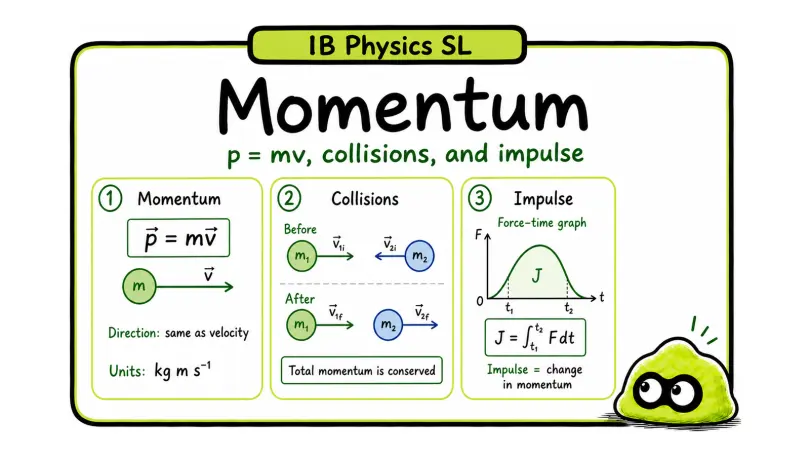
Momentum and Conservation of Momentum | IB Physics SL
Learn IB Physics SL momentum with p = mv, vector direction, conservation in collisions, impulse, force-time graphs and exam practice.