CAIE AS Physics Dynamics: Newton's Laws, Resultant Force, and Acceleration
A source-backed CAIE Physics guide for CAIE AS Physics dynamics, using EduNinja PDF notes, worked examples, and markscheme-style answers.
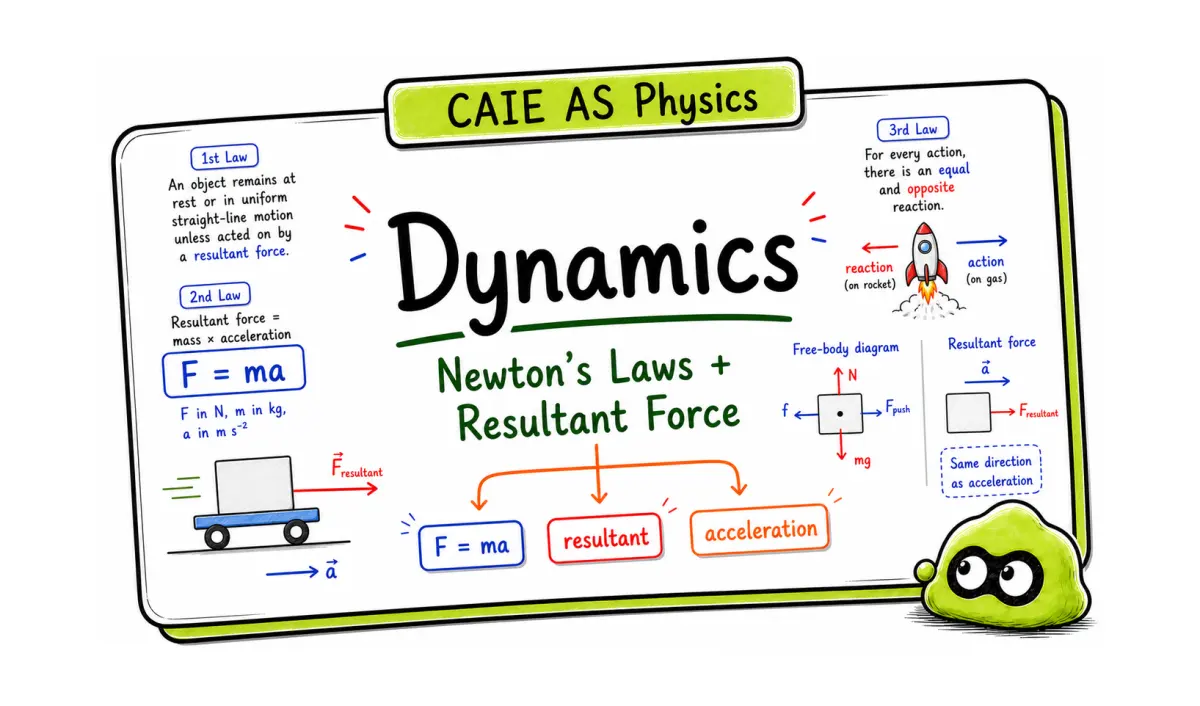
CAIE AS Physics dynamics questions often punish one small confusion: students treat force, velocity and acceleration as if they mean the same thing.
The rule is simple, but it has to be used carefully. Resultant force controls acceleration. Zero resultant force means zero acceleration, not zero velocity. A moving object can keep moving at constant velocity when the forces are balanced.
This guide covers Newton's laws, resultant force, free-body diagrams, F = ma, weight, friction, drag and common exam traps. Use it as a student revision guide, not as an official CAIE syllabus document.
Useful starting points:
- CAIE AS Physics Dynamics Question Bank
- CAIE AS Physics Concept pages
- AS CIE Physics Notes 2 - 1. Physical quantities and units
- AS CIE Physics Notes 2 - Dynamics
Start with notes if the vocabulary feels shaky. Move to questions when you can draw a free-body diagram before reaching for F = ma.
Quick answer
- Resultant force is the vector sum of all forces on an object.
- Acceleration is in the direction of the resultant force.
- F = ma links resultant force, mass and acceleration.
- Zero resultant force means zero acceleration.
- Zero acceleration means constant velocity or rest.
- Weight is W = mg and acts downward.
- Mass must be in kg before using F = ma.
- A free-body diagram should show forces acting on one object only.
- Friction and drag oppose motion or attempted motion.
- For connected bodies, connected objects usually share the same acceleration if the string is taut.
- In a velocity-time graph, gradient gives acceleration, so it links directly to resultant force.
- For terminal velocity graphs, describe how drag increases until it equals weight.
Always find the resultant force before calculating acceleration.
Newton's laws in exam wording
| Law | CAIE-friendly wording | Common mistake |
|---|---|---|
| First law | An object remains at rest or continues at constant velocity unless acted on by a resultant force | Saying balanced forces make a moving object stop |
| Second law | Resultant force equals mass times acceleration, F = ma | Using a single force instead of resultant force |
| Third law | If object A exerts a force on object B, object B exerts an equal and opposite force on object A | Putting the pair on the same object |
Newton's third law pairs act on different objects. That is why they do not cancel each other on a free-body diagram for one object.
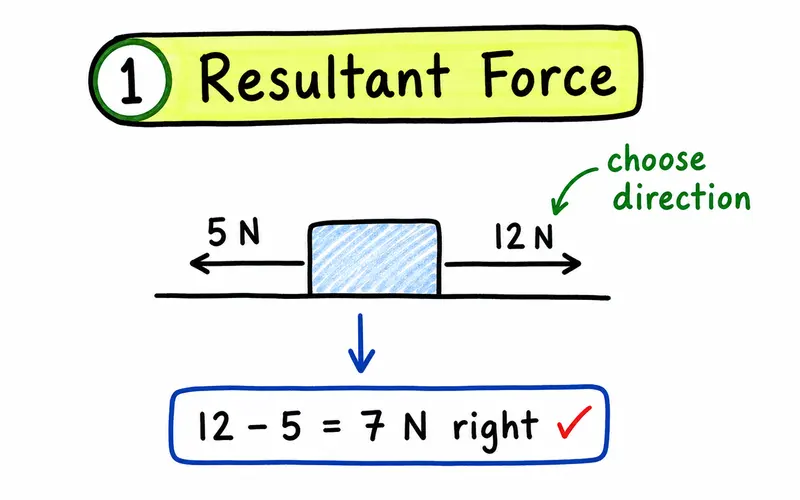
Resultant force: choose a direction first
Dynamics questions are vector questions. Choose a positive direction before adding forces.
If a car has 900 N driving force forward and 300 N resistive force backward:
resultant force = 900 - 300 = 600 N forward
If the resistive force becomes 900 N:
resultant force = 0 N, so acceleration = 0
That does not mean the car must be stationary. If it was already moving, it continues at constant velocity.
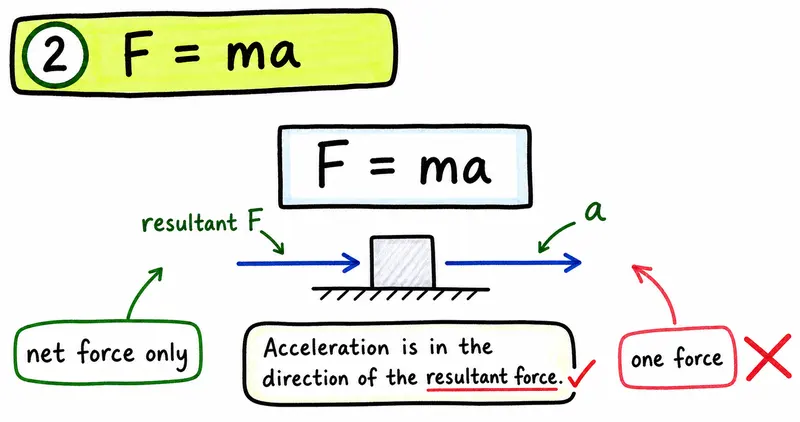
Worked example 1: F = ma
Question: A 2.0 kg object has a resultant force of 6.0 N. Find its acceleration.
Mark-worthy answer:
F = ma, so a = F / m
a = 6.0 / 2.0 = 3.0 m s-2
The acceleration is in the direction of the resultant force.
Why it works:
The answer uses resultant force, not just any force in the diagram.
Worked example 2: zero resultant force
Question: A moving object has zero resultant force. What happens to its motion?
Mark-worthy answer:
Its acceleration is zero. Since it is already moving, it continues at constant velocity.
Why it works:
The answer separates velocity from acceleration. Zero resultant force does not mean zero speed.
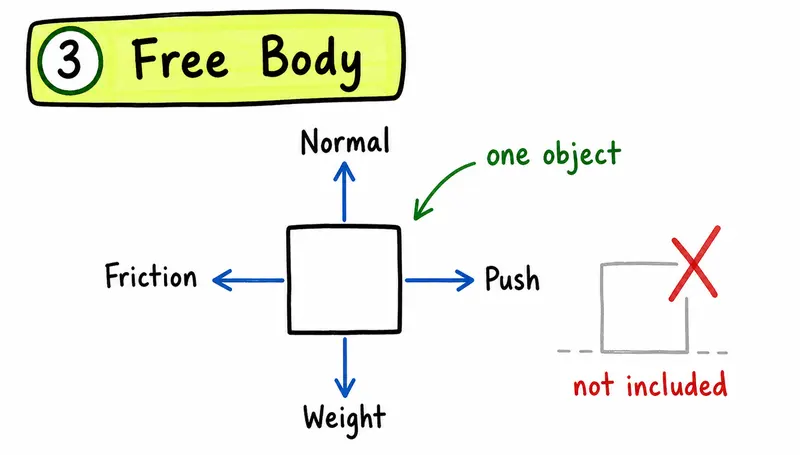
Free-body diagrams: draw forces on one object
A free-body diagram should show only the forces acting on the object you are analysing.
Common forces:
| Force | Direction |
|---|---|
| Weight | Downward |
| Normal contact force | Perpendicular to the surface |
| Friction | Opposes motion or attempted motion |
| Drag or air resistance | Opposes motion through air or fluid |
| Tension | Along the string or cable |
| Thrust or driving force | In the direction of propulsion |
Do not include forces that the object exerts on other objects. For example, if a book rests on a table, the free-body diagram for the book includes weight downward and normal contact force upward. It does not include the force the book exerts on the table.
Free-body diagram checklist
A free-body diagram should show only the forces acting on one object, not the forces the object exerts on other objects.
| Check | Why it matters |
|---|---|
| Choose one object only | Prevents mixing forces from different bodies |
| Show weight vertically downward | Weight acts towards the centre of the Earth |
| Show normal contact force perpendicular to the surface | This is often not the same direction as motion |
| Show friction or drag opposite the motion or attempted motion | This is a common CAIE mark point |
| Show tension along the string | Tension acts along the line of the string |
| Do not add "force of motion" | Motion does not require a forward force if resultant force is zero |
Weight, mass and gravitational field strength
Mass and weight are not the same quantity.
| Quantity | Meaning | Unit |
|---|---|---|
| Mass | Amount of matter and resistance to acceleration | kg |
| Weight | Gravitational force on a mass | N |
| Gravitational field strength | Force per unit mass | N kg-1 |
Use:
W = mg
If mass is given in grams, convert to kg before using W = mg or F = ma.
Worked example 3: weight
Question: Calculate the weight of a 0.75 kg object where g = 9.81 N kg-1.
Mark-worthy answer:
W = mg
W = 0.75 x 9.81 = 7.36 N
Why it works:
The answer gives weight in newtons and uses mass in kilograms.
Friction, drag and terminal velocity
Friction and drag are resistive forces. They act opposite to motion or attempted motion.
For a falling object:
- weight acts downward
- air resistance acts upward
- at first, weight is greater than air resistance, so the object accelerates downward
- as speed increases, air resistance increases
- terminal velocity is reached when air resistance equals weight
- resultant force is zero, so acceleration is zero
Terminal velocity does not mean the object has stopped. It means the object moves at constant velocity.
Worked example 4: terminal velocity
Question: Explain why a falling object reaches terminal velocity.
Mark-worthy answer:
As the object falls, its speed increases and air resistance increases. Weight acts downward and air resistance acts upward. When air resistance equals weight, the resultant force is zero, so acceleration is zero. The object continues falling at constant velocity.
Why it works:
The answer links changing drag to resultant force and acceleration.
Connected bodies: system first, tension second
For connected bodies, a useful method is to treat both objects as one system first. External forces decide the acceleration of the whole system. Then look at one object separately to find the tension.
If the string is light and taut, the connected bodies have the same acceleration. Tension is internal when both objects are treated as one system, but it becomes important when you isolate one object.
A useful route:
- Draw a free-body diagram for each object.
- Choose a positive direction.
- Write F = ma for each object or for the whole system.
- Use the same acceleration if the objects are connected by a taut string.
Do not assume tension equals weight unless the object is in equilibrium.
Worked example 5: connected bodies and tension
Question: A 10 N force pulls a 3.0 kg block along a smooth horizontal surface. The 3.0 kg block is connected by a light string to a 2.0 kg block behind it. Find the acceleration and the tension in the string.
Mark-worthy answer:
Total mass = 3.0 + 2.0 = 5.0 kg
Resultant force on the system = 10 N
a = F / m = 10 / 5.0 = 2.0 m s-2
For the 2.0 kg block, the only horizontal force is tension.
T = ma = 2.0 x 2.0 = 4.0 N
So the acceleration is 2.0 m s-2 and the tension is 4.0 N.
Why it works:
The answer treats both blocks as one system to find acceleration, then isolates one block to find tension.
Motion graphs and resultant force
Dynamics questions can be linked to motion graphs.
| Graph feature | Acceleration | Resultant force |
|---|---|---|
| Horizontal line on a velocity-time graph | Zero | Zero |
| Straight sloping line | Constant | Constant non-zero |
| Increasing gradient | Increasing acceleration | Increasing resultant force |
| Decreasing gradient | Decreasing acceleration | Decreasing resultant force |
| Curving towards a horizontal line | Acceleration decreases to zero | Resultant force decreases to zero |
If acceleration is zero, resultant force is zero. If acceleration is not zero, there is a resultant force in the direction of acceleration.
Terminal velocity graph wording
For a falling object, the speed-time graph usually starts with a steep gradient because weight is much larger than drag. As speed increases, drag increases. The resultant downward force becomes smaller, so the acceleration decreases and the graph becomes less steep.
At terminal velocity, drag equals weight. The resultant force is zero, acceleration is zero, and the speed-time graph becomes horizontal.
Common mistakes that cost marks
- Saying zero resultant force means zero velocity.
- Using a single force instead of resultant force in F = ma.
- Forgetting to convert grams to kilograms.
- Drawing action-reaction pairs on the same free-body diagram.
- Saying Newton's third law forces cancel on one object.
- Treating mass and weight as the same quantity.
- Forgetting direction in resultant force.
- Assuming tension always equals weight.
- Saying terminal velocity means the object stops.
The repair is to write the missing physics sentence. For example: "The resultant force is zero, so acceleration is zero, but velocity may be constant and non-zero."
Exam question types
| Question type | First move | Common trap |
|---|---|---|
| F = ma calculation | Find resultant force | Using one force from the diagram |
| Equilibrium explanation | State resultant force is zero | Saying object must be at rest |
| Free-body diagram | Choose one object | Including forces on other objects |
| Weight calculation | Use W = mg | Leaving mass in grams |
| Terminal velocity | Compare weight and drag | Saying no forces act |
| Connected bodies | Draw separate diagrams | Treating tension incorrectly |
| Motion graph | Find acceleration | Forgetting link to resultant force |
A short revision route
- State Newton's three laws in your own words.
- Practise one resultant force calculation.
- Draw three free-body diagrams.
- Practise one W = mg question.
- Explain terminal velocity in four sentences.
- Practise one velocity-time graph link to F = ma.
- Mark the first missing direction or unit.
How to use EduNinja for this topic
Use notes to rebuild the core laws and force types. Then use the question bank for free-body diagrams, F = ma calculations and motion graph questions.
Good next links:
- A-Level Physics Question Bank
- AS CIE Physics Notes 2 - Dynamics
- AS CIE Physics Notes 2 - 1. Physical quantities and units
- CAIE AS Physics electricity
Related Study Links
FAQ
Does zero resultant force mean an object is stationary?
No. Zero resultant force means zero acceleration. The object may be stationary, or it may keep moving at constant velocity if it was already moving.
What is the difference between mass and weight?
Mass is measured in kg and describes inertia. Weight is a force measured in N and is calculated using W = mg.
Why is resultant force a vector?
Forces have direction as well as magnitude. Opposite directions must be treated with signs or vector addition before using F = ma.
What should a free-body diagram include?
It should include only the forces acting on the object being analysed. Do not include forces the object exerts on other objects.
What is terminal velocity?
Terminal velocity is constant velocity reached when the resistive force equals weight, so resultant force and acceleration are zero.
How are motion graphs linked to dynamics?
The gradient of a velocity-time graph gives acceleration. If acceleration is non-zero, there is a resultant force in the same direction.
Why do connected bodies have the same acceleration?
If two objects are connected by a taut string and move together, they share the same acceleration. The string keeps their motion linked.
Should tension appear on a whole-system force diagram?
Usually no. If both connected objects are treated as one system, tension is an internal force. Use tension when you isolate one object.
How do I link a velocity-time graph to resultant force?
Use the gradient. The gradient of a velocity-time graph gives acceleration. Then use F = ma to connect acceleration to resultant force.
Closing
Dynamics becomes manageable when you start with forces, not motion guesses. Draw the object, add the forces, find the resultant, then use F = ma.
Put CAIE back into your full A-Level CAIE Physics AS study plan.
Return to the complete course overview, or move directly into the most relevant study tool.
Related articles
More course notes, updates and study resources from the EduNinja blog.

IB Physics SL 2025 Syllabus Changes: New Assessment Model
A practical IB Physics SL guide to the 2025 syllabus: the new Paper 1A and 1B structure, Paper 2, scientific investigation, no-options assessment and how to update old notes.
Energy Transformation Examples | Physics
Learn A-Level Physics energy transformations with energy stores, transfer pathways, Sankey diagrams, efficiency and common exam mistakes.
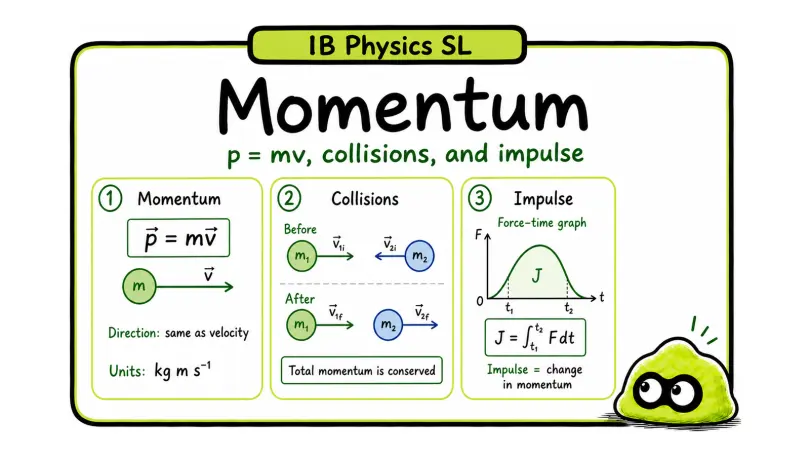
Momentum and Conservation of Momentum | IB Physics SL
Learn IB Physics SL momentum with p = mv, vector direction, conservation in collisions, impulse, force-time graphs and exam practice.