A-Level Physics Dynamics: Newtons Laws and F = ma Guide
Revise A-Level Physics dynamics with Newton's laws, resultant force, F = ma, weight, friction, connected particles, and force diagram habits.
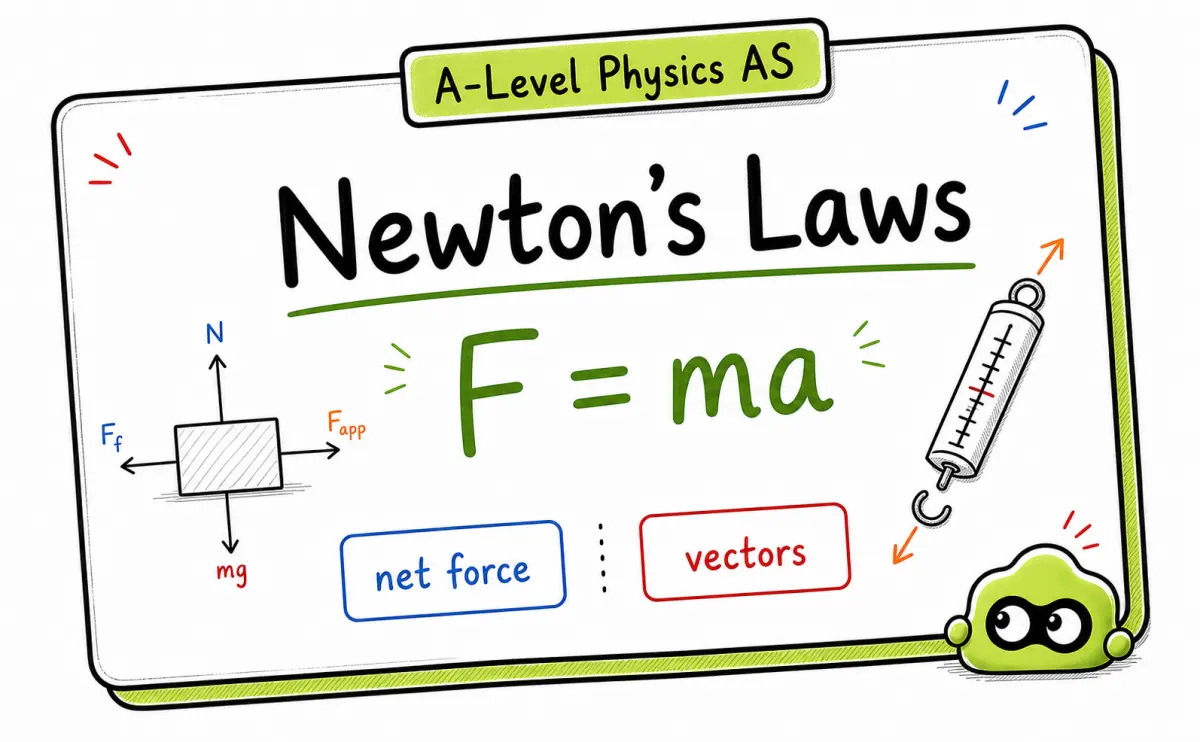
In A-Level Physics dynamics, F = ma only works when F means resultant force. Start by drawing the forces on the object, choose a positive direction, then combine forces along the line of motion. If the resultant force is zero, acceleration is zero. If forces are unbalanced, the object accelerates in the direction of the resultant force. The equation is simple; the diagram and signs are where most marks are won or lost.
Useful starting points:
Quick Answer
- In
F = ma,Fmeans resultant force, not just the largest force. - Draw a free-body diagram before substituting numbers.
- Choose a positive direction and keep signs consistent.
- If resultant force is zero, acceleration is zero.
- Balanced forces can still act on a moving object at constant velocity.
- Always give acceleration with the correct unit and direction when needed.
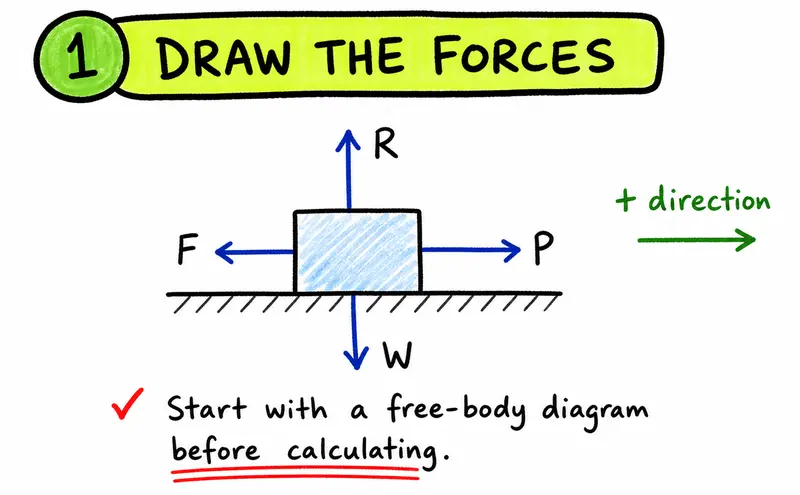
Start With The Free-Body Diagram
Before using a formula, draw:
- weight acting down
- normal reaction acting up if there is a contact surface
- friction or drag opposing motion
- tension, thrust, or driving force in the direction it acts
Then choose a positive direction. The sign convention should be visible in your working.
What Resultant Force Means
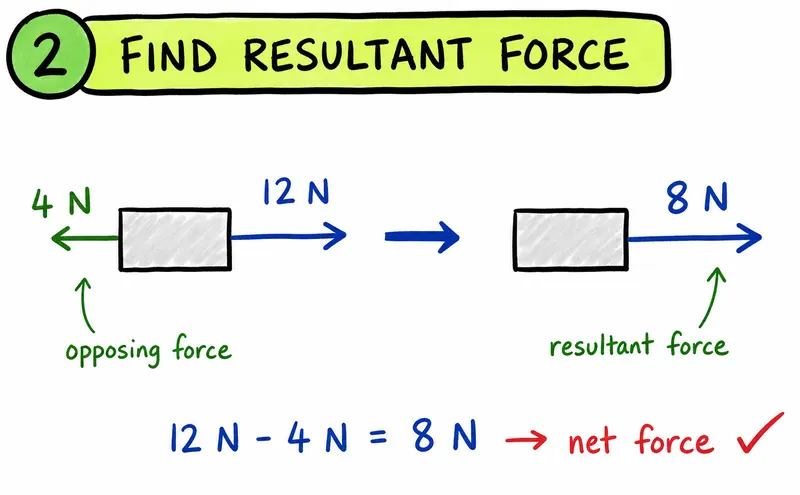
Resultant force is the single net force after combining all forces in a chosen direction.
Use this wording:
Formula: resultant force = force in chosen positive direction - opposing force
Then apply:
Formula: F_resultant = ma
Do not put the applied force into F = ma unless it is the only unbalanced force in that direction.
When F = ma Is The Right Equation
Use F = ma when the question connects force, mass, and acceleration. Do not use it as a substitute for every mechanics question. If the question is about energy, momentum, or circular motion, check whether another principle is more direct.
| Question clue | Likely first method |
|---|---|
| force, mass, acceleration | resultant force and F = ma |
| speed, distance, time, constant acceleration | SUVAT equations |
| work done, kinetic energy, potential energy | energy method |
| collision or explosion | momentum conservation |
Worked Example: Block Pulled Across a Rough Surface
Question: A 2.0 kg block is pulled with a horizontal force of 12 N. Friction is 4 N. Find the acceleration.
Markscheme-style answer:
Formula: F_resultant = 12 - 4 = 8 N
Formula: a = (F) / (m) = (8) / (2.0) = 4.0 m s^-2
Why this works: It uses the net force, not the applied force. It also keeps the unit for acceleration.
Trap: Using 12 N directly in F = ma would ignore friction and overestimate the acceleration.
Mistake: Using One Force Instead of Net Force
Weak answer:
12 = 2a, soa = 6 m s^-2.
Better answer:
- The resultant force is
12 - 4 = 8 N, soa = 8 / 2.0 = 4.0 m s^-2.
In longer questions, the same mistake can happen with tension, drag, thrust, or weight. Always ask: what is the net force in the chosen direction?
What Examiners Want to See
For dynamics questions, examiners usually reward:
- a correct force diagram or clear force identification
- a correct resultant force equation
- substitution using mass in kg
- acceleration with the correct unit and direction if needed
If a question says "explain," do not stop at the number. Link the resultant force to acceleration and motion.
Special Case: Balanced Forces Still Have Forces
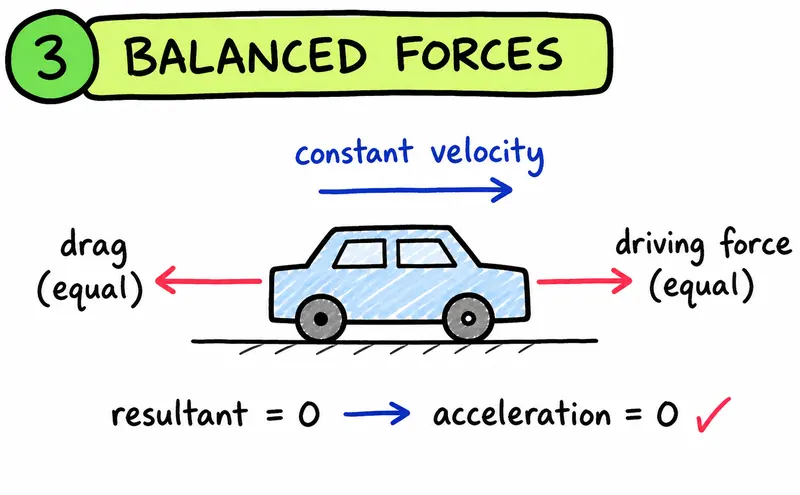
If an object moves at constant velocity, the resultant force is zero. That does not mean no forces act. It means the forces balance.
For terminal velocity:
Formula: weight downward = drag upward -> resultant force = 0 -> acceleration = 0
This distinction is common in explanation questions. A moving object does not need a resultant force to keep moving at constant velocity.
Practise free-body diagrams before using full dynamics calculations in the Question Bank. If your final number is wrong, check whether the error came from the diagram, the resultant equation, or the unit.
Dynamics Practice Routine
Use this routine for every dynamics question:
- Draw the body as a simple box or point.
- Add all external forces.
- Choose a positive direction.
- Write a resultant force equation.
- Substitute into
F = ma. - Check unit and direction.
Related Mechanics Links
- A-Level Physics Notes
- A-Level Physics Question Bank
- A-Level Physics Study Library
- A-Level Physics kinematics guide
FAQ
What does F mean in F = ma?
F means resultant force. Combine the forces in the chosen direction before substituting into the equation.
What is the difference between mass and weight?
Mass is measured in kilograms. Weight is a force measured in newtons and is calculated using W = mg.
Can an object move if resultant force is zero?
Yes. If resultant force is zero, acceleration is zero. The object may be stationary or moving at constant velocity.
<!-- backend-minimal-fix-applied -->
Worked Example: Resultant Force on a Slope-Free Question
Question: A trolley of mass 3.0 kg is pulled forward with 18 N. Friction is 6 N. Find the acceleration.
Mark-worthy answer:
- Resultant force = 18 - 6 = 12 N
- F = ma
- 12 = 3.0a
- a = 4.0 m s^-2
The key step is not the substitution. It is deciding that the 18 N pull is not the resultant force. The friction force must be included before using Newton's second law.
How EduNinja Helps with Dynamics Practice
Use EduNinja Notes to rebuild the rule, then move straight to the Question Bank for force diagrams and F = ma practice. After each missed question, label the error as one of four types:
| Error type | What it means | Fix |
|---|---|---|
| Diagram error | A force is missing or in the wrong direction | Redraw before calculating |
| Resultant error | You used one force instead of net force | Write a force equation first |
| Unit error | Mass or acceleration unit is wrong | Check kg, N, and m s^-2 |
| Explanation error | Number is right but reasoning is weak | Add direction and motion wording |
This keeps revision active. Dynamics improves fastest when you correct the first wrong decision, not only the final number.
<!-- backend-minimal-top-up-applied -->
One More Exam Check: Direction Matters
If a question asks for direction, include it in the final answer. For example, 4.0 m s^-2 to the right is stronger than only 4.0 m s^-2 when the force diagram has a chosen direction. Direction is especially important when friction, tension, or weight acts opposite to the motion.
Related Study Links
Put dynamics back into your full A-Level CAIE Physics AS study plan.
Return to the complete course overview, or move directly into the most relevant study tool.
Related articles
More course notes, updates and study resources from the EduNinja blog.

IB Physics SL 2025 Syllabus Changes: New Assessment Model
A practical IB Physics SL guide to the 2025 syllabus: the new Paper 1A and 1B structure, Paper 2, scientific investigation, no-options assessment and how to update old notes.
Energy Transformation Examples | Physics
Learn A-Level Physics energy transformations with energy stores, transfer pathways, Sankey diagrams, efficiency and common exam mistakes.
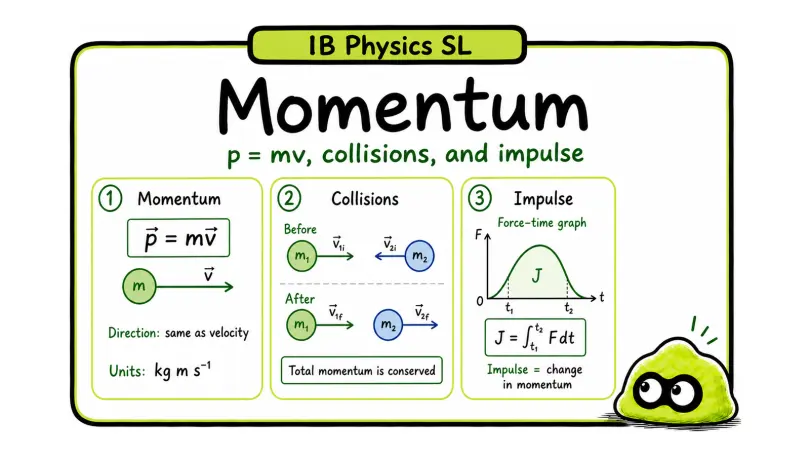
Momentum and Conservation of Momentum | IB Physics SL
Learn IB Physics SL momentum with p = mv, vector direction, conservation in collisions, impulse, force-time graphs and exam practice.