IB Biology A1.1 Water: Complete Revision Guide
A blog-based IB Biology A1.1 Water guide built from EduNinja study data: syllabus map, knowledge cards, question patterns, resource signals, and practice workflow.
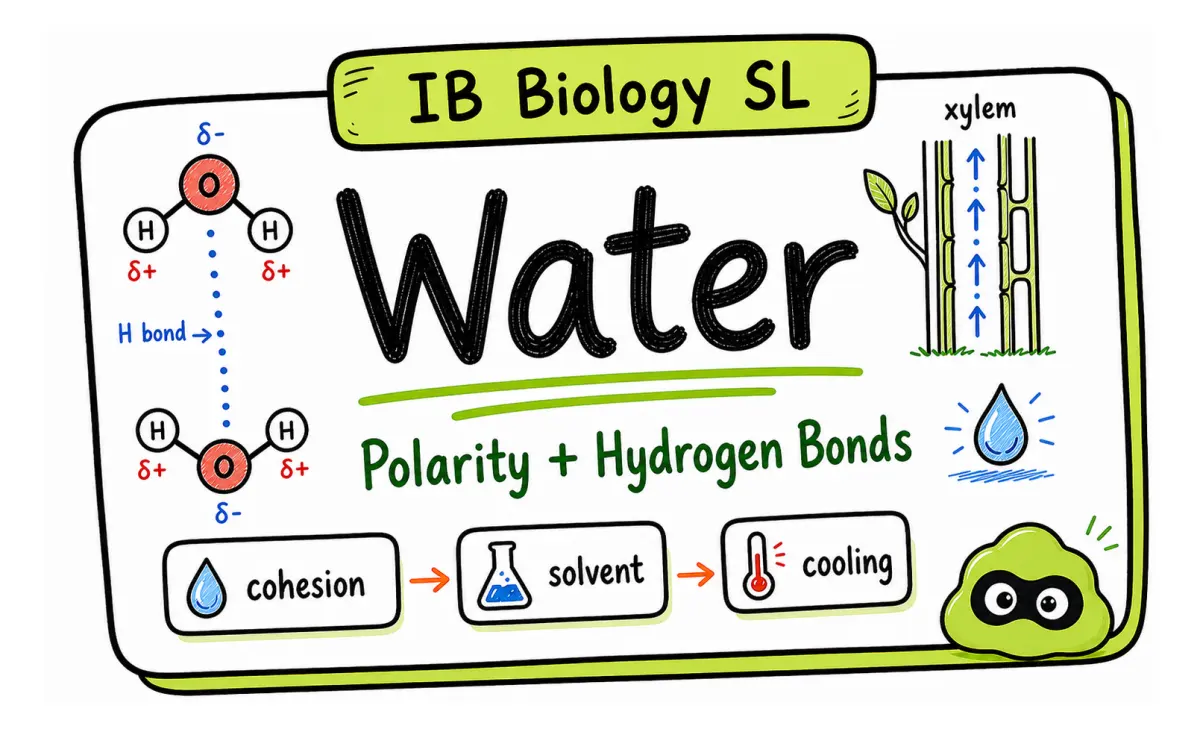
Water's properties in IB Biology come from one starting point: water is polar. Oxygen pulls shared electrons more strongly than hydrogen, so the oxygen end is slightly negative and the hydrogen ends are slightly positive. Because the molecule is bent, those partial charges do not cancel out. This polarity lets water molecules form hydrogen bonds with each other, which explains cohesion, adhesion, solvent behaviour, high specific heat capacity, and evaporative cooling.
Start With This Exam Answer
Water is polar because oxygen is more electronegative than hydrogen. The partial charges allow hydrogen bonds to form between water molecules. These hydrogen bonds explain water's biological properties, such as cohesion in xylem, adhesion to polar surfaces, solvent behaviour for ions and polar molecules, and temperature stability in aquatic environments.
In an exam, write it in this order:
- Name the property.
- Give the molecular reason.
- Add the biological example.
Example:
- Cohesion happens because hydrogen bonds form between water molecules, helping maintain a continuous water column in xylem.
Why Is Water Polar?
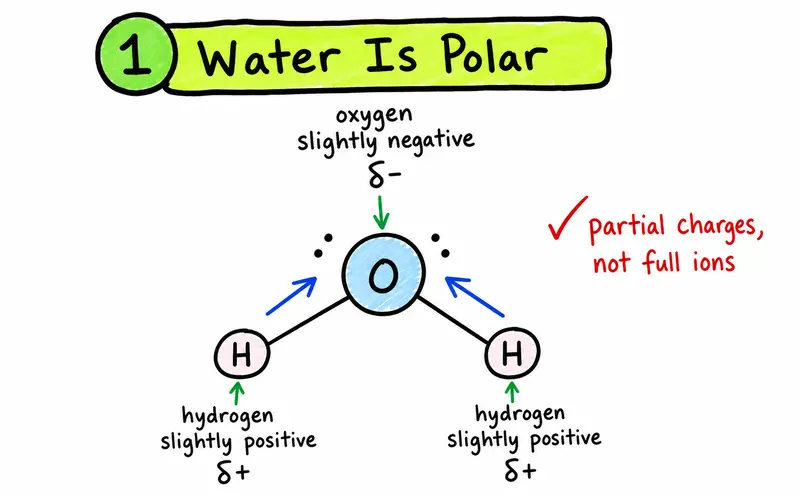
Inside one water molecule, oxygen and hydrogen are joined by covalent bonds. Oxygen attracts the shared electrons more strongly, so the oxygen side becomes slightly negative and the hydrogen sides become slightly positive.
That is polarity. Do not write that water is fully charged. It has partial charges.
| Part of water molecule | Exam wording |
|---|---|
| Oxygen atom | Slightly negative |
| Hydrogen atoms | Slightly positive |
| Whole molecule | Polar because the bent shape leaves uneven charge distribution |
This is the first sentence many water-property answers need.
How Do Hydrogen Bonds Create Water Properties?
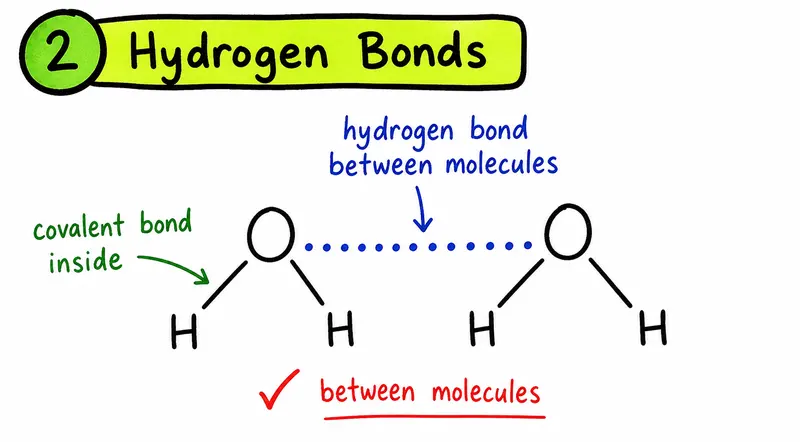
Hydrogen bonds form between neighbouring water molecules, not inside one water molecule. This is a common mark-losing detail.
| Bond or attraction | Where it is found | Why it matters |
|---|---|---|
| O-H covalent bond | Inside one water molecule | Holds oxygen and hydrogen atoms together |
| Hydrogen bond | Between neighbouring water molecules | Explains cohesion, surface tension, thermal properties, and solvent behaviour |
For a diagram question, draw several water molecules, show partial charges, use solid lines for covalent bonds, and use dotted lines for hydrogen bonds between molecules.
What Is Cohesion in Water?
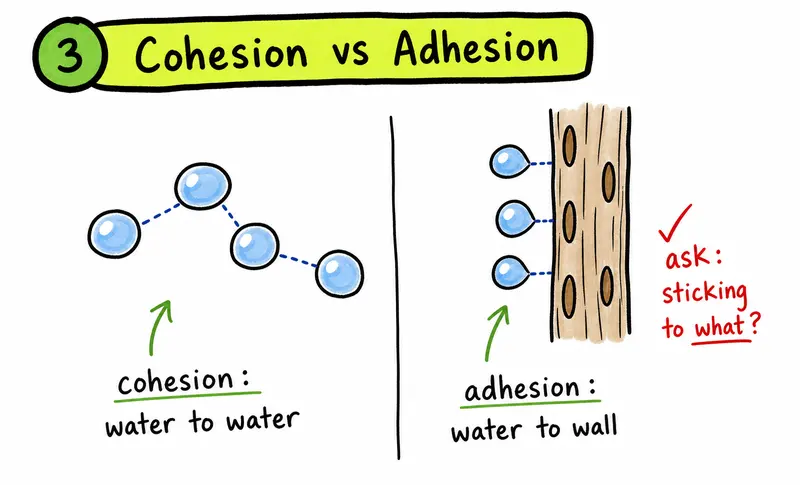
Cohesion is attraction between water molecules. In water, cohesion is caused by hydrogen bonding.
The IB Biology example to know is xylem. Cohesion helps water molecules stay together as a continuous column under tension during transpiration pull.
Weak answer:
- Water sticks together.
Better answer:
- Hydrogen bonds between water molecules cause cohesion, helping maintain a continuous water column in xylem.
What Is Adhesion in Water?
Adhesion is attraction between water and another polar or charged surface. In plants, adhesion helps water interact with xylem walls and narrow spaces.
Use this quick test:
| Term | What is sticking to what? | Biology example |
|---|---|---|
| Cohesion | Water to water | Continuous water column in xylem |
| Adhesion | Water to another surface | Water interacting with xylem walls |
| Surface tension | Water molecules at the surface | Small organisms supported on water |
If the question says water sticks to another surface, think adhesion. If it says water molecules stick to each other, think cohesion.
Why Is Water a Good Solvent?
Water dissolves many ions and polar molecules because its partial charges can interact with charged or polar solutes. Water molecules can surround ions in hydration shells and keep them dispersed in solution.
Biology examples:
- cytoplasm provides an aqueous environment for metabolic reactions
- blood plasma transports dissolved ions, glucose, amino acids, and carbon dioxide-related ions
- phloem sap transports dissolved sugars and mineral ions
Do not write that water dissolves everything. Non-polar substances are hydrophobic and usually have low solubility in water.
Hydrophilic, Hydrophobic, and Amphipathic
These words often appear when water connects to membranes and lipids.
| Term | Meaning | Example |
|---|---|---|
| Hydrophilic | Attracted to water | Ions, many carbohydrates |
| Hydrophobic | Repelled by water | Lipids, non-polar molecules |
| Amphipathic | Has hydrophilic and hydrophobic regions | Phospholipids |
This matters later in membrane structure. Phospholipid heads interact with water, while fatty acid tails avoid water.
How Does Water Help Temperature Control?
Water has a high specific heat capacity because energy is needed to disrupt hydrogen bonds before the temperature rises much. This helps aquatic environments stay more stable than they would if water changed temperature quickly.
Water also has a high latent heat of vaporization. When water evaporates, it removes heat energy from a surface.
Examples:
- sweating cools animals as water evaporates from the skin
- transpiration can cool plant leaves as water vapour leaves through stomata
- large bodies of water moderate temperature change
How This Appears in IB Biology Questions
Water questions usually test one of these skills:
| Question type | What to do first |
|---|---|
| Define polarity, cohesion, adhesion, or hydrophilic | Give the exact term before adding an example |
| Explain a water property | Link polarity to hydrogen bonding, then to a biological use |
| Draw water molecules | Label partial charges, covalent bonds, and hydrogen bonds |
| Compare cohesion and adhesion | State what water is attracted to in each case |
| Explain xylem transport | Mention hydrogen bonding, cohesion, and a continuous water column |
In an exam, avoid long introductions. Start with the property and the reason.
What Students Usually Miss
| Mistake | Better habit |
|---|---|
| Saying water is charged | Say water is polar, with partial charges |
| Saying hydrogen bonds are inside one molecule | Say hydrogen bonds form between water molecules |
| Mixing cohesion and adhesion | Ask what water is sticking to |
| Saying water dissolves everything | Say water dissolves many ionic and polar substances |
| Listing a property without an example | Add one biological use |
What the Markscheme Wants
A strong water answer usually has this chain:
property -> molecular reason -> biological example
For example:
- Water is polar.
- Polar water molecules form hydrogen bonds.
- Hydrogen bonding causes cohesion.
- Cohesion helps maintain a continuous water column in xylem.
That is much stronger than "water is useful for plants."
30-Minute EduNinja Study Route
Use this route if you are revising A1.1 Water today:
- Draw one water molecule and label partial charges.
- Draw two water molecules and add a hydrogen bond.
- Write one sentence for cohesion.
- Write one sentence for adhesion.
- Explain water as a solvent using ions or polar molecules.
- Answer one A1.1 Water question in the EduNinja Questionbank.
EduNinja is independently developed and is not endorsed by the International Baccalaureate Organization.
Related Study Links
FAQ
Why is water polar in IB Biology?
Oxygen attracts shared electrons more strongly than hydrogen, so water has partial charges. The bent shape means those charges do not cancel out.
Why do hydrogen bonds matter in water?
They explain cohesion, adhesion, surface tension, high specific heat capacity, and high latent heat of vaporization.
What is the difference between cohesion and adhesion?
Cohesion is attraction between water molecules. Adhesion is attraction between water and another polar or charged surface.
Is hydrophobic water-loving or water-hating?
Hydrophobic means water-repelling. Hydrophilic means water-attracting.
How should I answer water property questions?
Use a chain: property, molecular reason, biological example.
Related Resources
Put water back into your full IB Biology SL study plan.
Return to the complete course overview, or move directly into the most relevant study tool.
Related articles
More course notes, updates and study resources from the EduNinja blog.
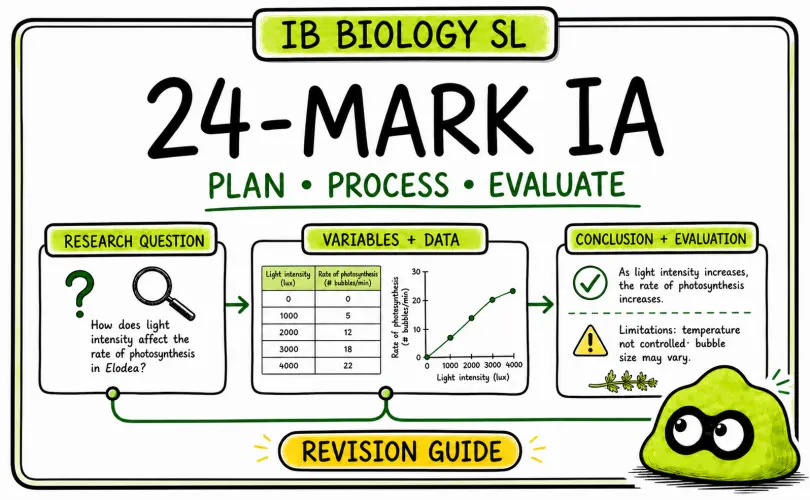
IB Biology Scientific Investigation Guide: How to Build a Strong 24-Mark IA
A practical IB Biology guide to the 24-mark Scientific Investigation: choose a workable research question, control variables, process data, draw a supported conclusion and evaluate limitations with specific improvements.
Abiotic Factors Explained | IB Biology SL
Revise IB Biology SL abiotic factors, tolerance ranges, limiting factors and how environmental variables affect distribution.
Active Transport vs Passive Transport | A-Level Biology
Revise A-Level Biology active and passive transport with concentration gradients, ATP, carrier proteins, examples, common mistakes and practice.