IB Biology 2016 vs 2025 Syllabus: What Changed?
See what changed between the IB Biology 2016 and 2025 syllabuses, including removed topics, reusable notes and revision priorities.
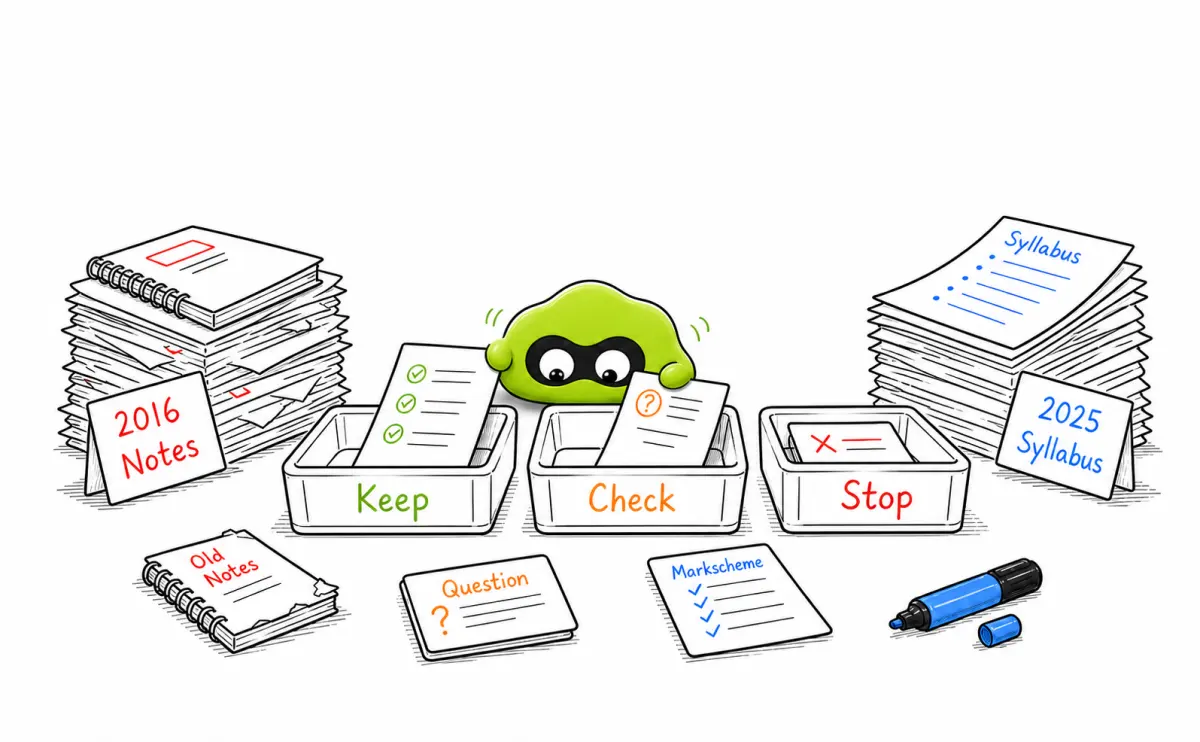
What changed? The 2016 Core, AHL and Options structure was reorganised into four themes, A-D, in the 2025 syllabus.
What was removed? The old Paper 3 structure and separate old options are no longer the current assessment route.
What should students revise now? Keep biology that maps to the 2025 themes, check older notes against current topic labels, and stop using old Paper 3 or option-only material as the main revision plan. First assessment 2025 is the key date.
What was removed? The old Paper 3 format and separate Option A-D routes were removed from the current assessment structure.
What should students revise now? Revise the four current themes, current Paper 1 and Paper 2 skills, and the investigation skills assessed through the investigation assessment. First assessment 2025 is the key date for using the new structure.
That is where many students get stuck. They do not know whether to keep an old 2016 syllabus folder, delete it, or rewrite the whole thing. The answer is less dramatic: keep what still matches the current syllabus, check anything written in old paper or option language, and stop prioritizing material that only belonged to the old route.
This article compares the IB Biology 2016 vs 2025 syllabus at a revision level. It is written for students who already have old notes, past papers, teacher slides, or question folders and need to know what changed, which topics were removed, and what still deserves time.
If you only remember one thing: do not delete all 2016 resources, but do stop using the 2016 syllabus structure as your revision plan. Paper 3 and the old options are no longer the route. Individual concepts may still be useful after you map them to the 2025 syllabus.
Useful starting points:
Start with one current topic page, then test the idea in the question bank. Do not open every old PDF at once. That usually creates more tabs than answers.
2016 vs 2025 at a Glance
| 2016 syllabus | 2025 syllabus |
|---|---|
| Core / AHL / Options | Themes A-D |
| Old Paper 3 structure | Current assessment structure |
| Old topic organization | Current syllabus mapping |
Older explanations can still help, but the current syllabus mapping decides what belongs in your revision plan.
Short answer: what changed from IB Biology 2016 to 2025?
The 2016 syllabus used core topics, AHL topics, and four options. The 2025 syllabus uses a different map built around four themes:
- A. Unity and diversity
- B. Form and function
- C. Interaction and interdependence
- D. Continuity and change
The old option structure was removed as a separate assessment route. Paper 3 is no longer the right folder for 2025 revision. Data analysis and experimental skills still matter, but they no longer sit inside the same old Paper 3 pathway.
Old notes can still help. Old organization can hurt. That distinction matters more than the age of the file.
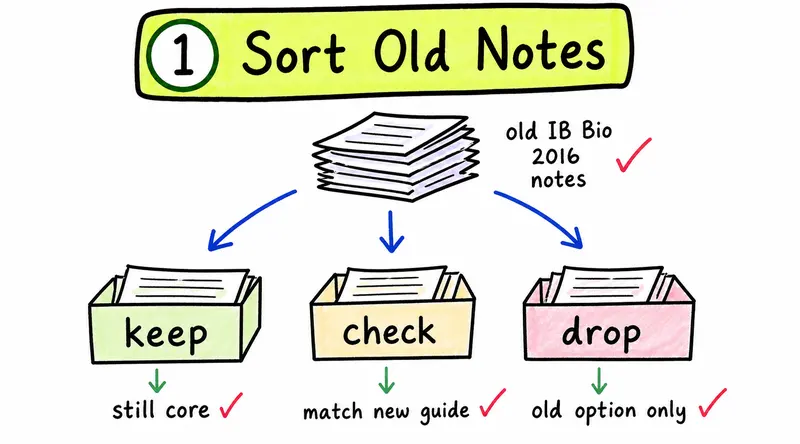
A quick way to sort old IB Biology resources
Before rewriting your notes, sort each old resource into one of three groups.
| Label | Meaning | Example |
|---|---|---|
| Keep | It matches a current 2025 syllabus point. | A water note that helps with A1.1 Water. |
| Check | It seems useful, but uses old topic, paper, or option wording. | An old ecology note from Option C. |
| Stop | It only prepares you for removed option or Paper 3 detail. | A question that depends on an old option-only pathway. |
This is a practical audit, not a perfect academic mapping exercise. You are trying to protect your revision time.
What the 2016 syllabus looked like
The IB Biology 2016 syllabus was easier to file into old-school folders. Students used core topics, additional higher level material, and options. A typical folder system might have looked like this:
- Cell Biology
- Molecular Biology
- Genetics
- Ecology
- Evolution
- Human Physiology
- Option A, B, C, or D
- Paper 3 practice
That layout made sense for the old course. It becomes risky when students carry it into the 2025 syllabus without checking the new structure.
For example, a folder called "Genetics" may still contain good explanations, but the new syllabus may place those ideas across a different theme or level of organization. A folder called "Human physiology" may contain useful content, but you should not revise it as if Option D still exists in the same way.
What the 2025 syllabus changed
The 2025 syllabus asks students to organize biology through themes and levels. The themes are not decoration. They affect how students should connect ideas in revision.
| 2025 theme | Revision meaning |
|---|---|
| A. Unity and diversity | Shared features of life, biodiversity, cells, molecules, and classification. |
| B. Form and function | How biological structures support specific functions. |
| C. Interaction and interdependence | Systems, regulation, relationships, and ecological interactions. |
| D. Continuity and change | Inheritance, variation, evolution, stability, and change. |
This means an old topic can be scientifically correct but still sit in the wrong place for your current revision plan. That is why old notes need mapping before memorizing.
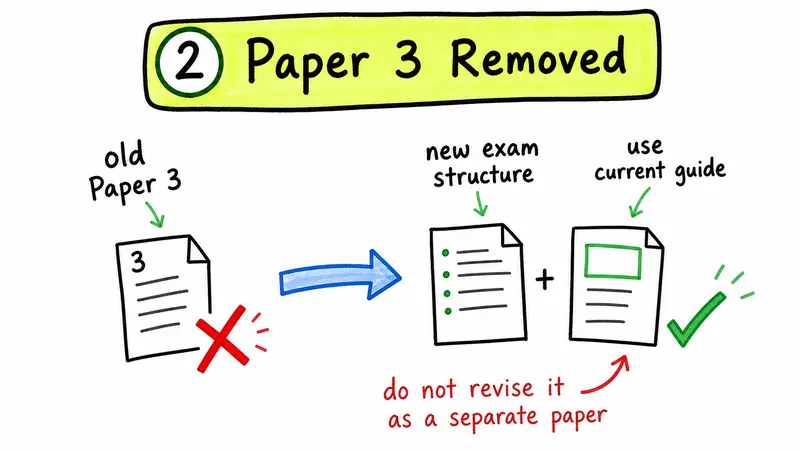
Was IB Biology Paper 3 removed?
For students preparing for the 2025 syllabus, yes, you should stop using Paper 3 as your main revision structure.
In the 2016 syllabus, Paper 3 had a clear job. It tested experimental skills, data analysis, and option content. Many old folders still reflect that. You may see file names such as "Paper 3 ecology", "Option D Paper 3", or "old Paper 3 data questions".
For the 2025 course, revise around the current assessment structure instead. Paper 1, Paper 2, and the investigation assessment should guide your practice. Experimental thinking and data interpretation still appear, but you should connect them to current topics instead of treating them as a separate old Paper 3 block.
A safer rule:
- Keep data-based practice if the biology still matches the 2025 syllabus.
- Keep experimental skill practice if it still trains a current skill.
- Do not prioritize questions that only make sense inside an old option-paper format.
If your teacher gave you a Paper 3 folder, use it as a source to check, not as a weekly revision plan.
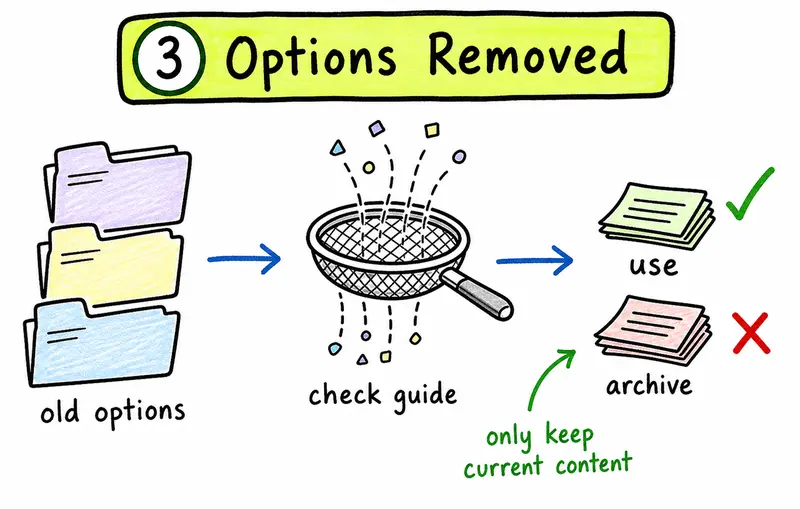
Were the old IB Biology options removed?
Yes. The old option route was removed as a separate pathway. That includes the old option labels many students still recognize:
| 2016 option | Old focus | How to treat it now |
|---|---|---|
| Option A | Neurobiology and behaviour | Check individual concepts against the 2025 syllabus. |
| Option B | Biotechnology and bioinformatics | Keep only ideas that map to current syllabus points. |
| Option C | Ecology and conservation | Keep relevant ecology, but stop treating it as an old option unit. |
| Option D | Human physiology | Map useful physiology ideas to current topics. |
The word "removed" causes confusion here. Removed from the option route does not mean every idea disappeared from biology. It means students should not revise the old options as stand-alone exam units.
Take Option C as an example. Ecology still matters in IB Biology. Conservation ideas may still help. But an old Option C folder may include examples, question styles, or details that no longer deserve priority. You need to check each subtopic.
What topics were removed from IB Biology?
Students often want a clean list of removed topics. A list can help, but it can also create false confidence. The 2025 syllabus changed the course structure, so some content moved, some content narrowed, and some old labels disappeared. When students search for IB Biology topics removed, they are often asking which old folders they can stop revising first.
The clearest removals for revision planning are the old Paper 3 route and the old Option A-D route, not necessarily every concept inside those folders.
This article is a student revision guide, not an official IB syllabus document. Always check your teacher's current syllabus guide or the latest IB subject guide when deciding whether a specific subtopic is examinable.
Use this as a cautious first filter, not as an official deletion list.
| Old 2016 area | 2025 status | Student action |
|---|---|---|
| Paper 3 as an option/data paper | No longer the revision route for the 2025 syllabus | Stop using it as a separate folder or weekly plan. |
| Option A-D as exam options | Removed as separate options | Map useful concepts individually before revising them. |
| Option-only examples | May not be a priority now | Check whether the example supports a current syllabus point. |
| Old topic-number order | Reorganized into new themes and levels | Relabel notes by 2025 themes instead of old topic numbers. |
| Old markscheme phrasing tied to options | May not match current assessment wording | Keep useful biological ideas, but rewrite answers in current language. |
Use these checks before deciding that a topic is gone:
- Does the idea appear under a current 2025 theme or subtopic?
- Does a current question-bank topic test the same skill?
- Does the old question depend on option-only wording?
- Does the markscheme use old paper language that students no longer need?
If the answer to the first two questions is yes, keep the resource. If the answer to the last two is yes, move it into Check or Stop.
How to use old IB Biology notes without wasting time
Pick one old folder. Do not audit your whole drive in one sitting.
Open the folder and look for old labels first: Paper 3, Option A, Option B, Option C, Option D, old topic numbers, or teacher comments tied to the 2016 syllabus. Those labels tell you where the risk sits.
Then match the content to the current syllabus. For example:
- Old water notes may help with A1.1 Water.
- Old nucleic acids notes may help with A1.2 Nucleic acids.
- Old ecology explanations may still help if they match a current interaction or systems topic.
- Old option-only examples should wait until you know they still support a current point.
Once you have mapped one section, answer a few current-style questions. If the old note helps you answer them, keep it. If you keep reading but still cannot answer the question, the note is not doing its job.
A 20-minute old-notes audit
Use this when your old folders feel messy.
- Choose one topic, such as water, nucleic acids, ecology, or human physiology.
- Open only one old folder.
- Mark any old labels: Paper 3, option, old topic number, or AHL note.
- Match each useful section to a current 2025 syllabus point.
- Move uncertain material into a Check list.
- Answer 3 to 5 current-style questions.
- Turn missed keywords into flashcards.
Twenty minutes is enough for one folder. It is not enough for the whole syllabus, and that is fine.
What students should stop doing first
If exams are not far away, stop the habits that waste the most time:
- Do not revise old Paper 3 folders as a separate exam route.
- Do not treat old option folders as complete 2025 units.
- Do not memorize old examples before checking whether the current syllabus needs them.
- Do not use old markschemes as your only source of wording.
- Do not revise by old topic numbers without mapping them to the new syllabus.
The aim is not to delete your old work. The aim is to stop old organization from choosing your revision order.
What you can usually keep from the 2016 syllabus
Some old resources are still useful, especially when they explain core biology clearly.
You can usually keep:
- Clear concept explanations.
- Diagrams that still match current syllabus content.
- Data-analysis practice tied to a current skill.
- Old questions that test current content.
- Markscheme phrases that still explain a process accurately.
- Teacher notes that you can map to a 2025 syllabus point.
Be careful with:
- Option-only detail.
- Old Paper 3 section practice.
- Examples memorized for a removed assessment route.
- Topic folders with no current syllabus mapping.
- Summary sheets that look complete but fail when you try questions.
Good old notes survive questions. Weak old notes only feel familiar.
Example: old water notes
Suppose you find a 2016 note on water. Do not ask, "Is this old?" Ask, "Can this help with A1.1 Water?"
Keep it if it helps you explain hydrogen bonding, cohesion, adhesion, solvent properties, and aquatic adaptations in current syllabus language. Check it if it includes extra examples that your teacher used for the old course. Stop using any section that only supports an old paper route and does not help with current questions.
Then test it. Use A1.1 Water questions or review IB Biology Notes. If your answer improves, the old note earned its place.
Example: old nucleic acids notes
Old notes on DNA, RNA, nucleotides, base pairing, and the genetic code can still be valuable. Many students already have good diagrams or flashcards from the 2016 course.
For the 2025 syllabus, match them to A1.2 Nucleic acids. Then practise with A1.2 Nucleic Acids questions or review A1.2 Nucleic acids notes.
Keep the parts that help you answer current questions. Rewrite any explanation that uses old topic labels or does not connect to the current wording.
How EduNinja fits into this revision process
EduNinja works best when you use it to test whether a note still performs.
Start with the current topic map. Pick one weak area. Use IB Biology Notes to rebuild the concept in current syllabus language. Then use the IB Biology Question Bank to check whether you can apply it.
After marking your answer, turn missed words into flashcards. That loop gives old notes a fair test. If the note helps you answer current questions, keep it. If it only makes you feel prepared, move it aside.
EduNinja is independently developed and is not endorsed by the International Baccalaureate Organization.
Worked example: mapping old Option C notes
Question: A student has old Option C ecology notes. What should they do before revising them?
Answer: Break the folder into smaller subtopics. Check each one against the 2025 syllabus. Keep ecology content that supports a current topic, put uncertain examples into Check, and stop revising old option-only exam framing.
Why it works: The student keeps useful ecology without treating Option C as a live exam unit.
Worked example: using old past papers
Question: Can old IB Biology past-paper questions still help?
Answer: Yes, when the content and skill still match the 2025 syllabus. Check the topic, command term, and markscheme idea before spending time on the question.
Why it works: The student uses past papers as practice, not as proof that the old syllabus structure still applies.
Common question types after the syllabus change
| Question type | What to practise | Common mistake |
|---|---|---|
| Define or state | Exact syllabus wording. | Giving a casual definition. |
| Explain | A clear cause-and-effect chain. | Listing facts without linking them. |
| Calculate or interpret | Data, diagrams, and units. | Using the right idea in the wrong context. |
| Compare | Paired differences in the same sentence or row. | Describing one side only. |
When you mark your work, look for missing links. Many Biology marks come from connecting the term, the mechanism, and the context in the question.
Final checklist for old IB Biology resources
Before you revise from an old 2016 syllabus resource, ask:
- Can I match it to a current 2025 syllabus point?
- Does it help with Paper 1, Paper 2, or the IA skills I need now?
- Does it use old option or Paper 3 framing?
- Can I answer current-style questions after using it?
- Did I keep the useful biology and remove the old exam route?
If a resource passes those checks, keep it. If it fails, do not let it control your revision time.
Practice This Topic
Try this exam-style question: A student has 2016 IB Biology notes labelled Paper 3 and Option C. What should they check before using those notes for the 2025 course?
Answer guide:
- Check whether the biology content maps to one of the four current themes.
- Do not revise the old Paper 3 or option route as if it were a current assessment paper.
- Keep transferable explanations only after checking them against the current syllabus and command terms.
- Practise current Paper 1 and Paper 2 question styles and investigation skills.
Review IB Biology Notes, then practise IB Biology A1.2 nucleic-acid questions.
Related Study Links
FAQ
Can I use 2016 IB Biology notes for 2025?
Yes. Map them first. Keep sections that match the 2025 syllabus and remove old option or Paper 3 framing that no longer fits.
Is Paper 3 still the right revision structure?
No. Use the current themes, topics, Paper 1, Paper 2, and IA guidance instead of organizing revision around old Paper 3 practice.
Were the old IB Biology options removed?
Yes. The old options were removed as a separate assessment route. Some ideas from those options may still help after you map them to the current syllabus.
What changed most in the IB Biology 2016 vs 2025 syllabus?
The course organization changed most. The old core, AHL, and options structure was replaced by a theme-based structure for first assessment 2025.
Are old past papers still useful?
Yes, but only after checking the topic and skill. Use old past papers for practice when they match the current syllabus. Skip questions that depend on removed option-only detail.
Should I still practise old IB Biology Paper 3 questions?
Only after checking the topic and skill. Do not use old Paper 3 as a main revision pathway for the 2025 syllabus.
Did IB Biology become harder in the 2025 syllabus?
Not simply harder or easier. The main change is organization and assessment focus, so students need to revise by current themes and question style rather than old topic folders.
Related study links
- nucleic acids questions
- water questions
- IB Biology Notes
- A1.2 Nucleic acids notes
- A1.1 Water notes
Related resources
- EduNinja Blog
- IB Biology Question Bank
- IB Biology Notes
- IB Biology water revision guide
- IB Biology DNA and RNA structure guide
Put syllabus update back into your full IB Biology SL study plan.
Return to the complete course overview, or move directly into the most relevant study tool.
Related articles
More course notes, updates and study resources from the EduNinja blog.
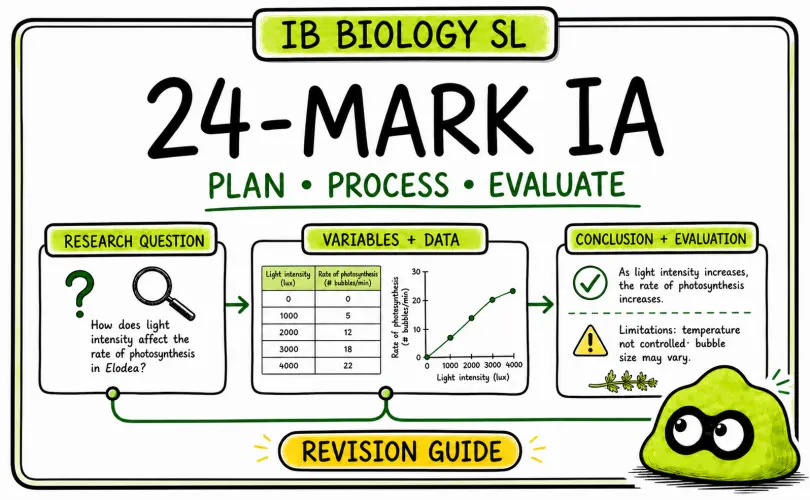
IB Biology Scientific Investigation Guide: How to Build a Strong 24-Mark IA
A practical IB Biology guide to the 24-mark Scientific Investigation: choose a workable research question, control variables, process data, draw a supported conclusion and evaluate limitations with specific improvements.

IB Biology SL Assessment and Grade Boundaries: How 55 + 50 + 24 Marks Become Your Final Grade
Learn how IB Biology SL Paper 1, Paper 2 and the scientific investigation combine through weighted assessment, how grade boundaries work and how to plan component-level revision.
Diploidy and Haploidy Explained
Revise diploid and haploid chromosome sets, meiosis, fertilisation and common IB Biology mistakes.