Gibbs Free Energy Explained | IB Chemistry HL
Learn Gibbs free energy for IB Chemistry HL with Delta G, enthalpy, entropy, temperature, spontaneity and exam-style examples.
If a reaction can release heat but still fail to proceed under some conditions, Gibbs free energy is the idea that explains why. In IB Chemistry HL, the question is usually not just whether a reaction is exothermic. You must connect enthalpy, entropy and temperature to decide whether a process is thermodynamically favourable.
Quick Answer
- Gibbs free energy is calculated with Delta G = Delta H - T Delta S.
- Use Kelvin for temperature and keep energy units consistent.
- Delta G < 0 means a process is thermodynamically favourable in the stated conditions.
- Delta G > 0 means it is not favourable in the forward direction under those conditions.
- Delta G = 0 represents equilibrium.
- A negative Delta G does not tell you how fast a reaction happens; kinetics and activation energy still matter.
What Gibbs Free Energy Means
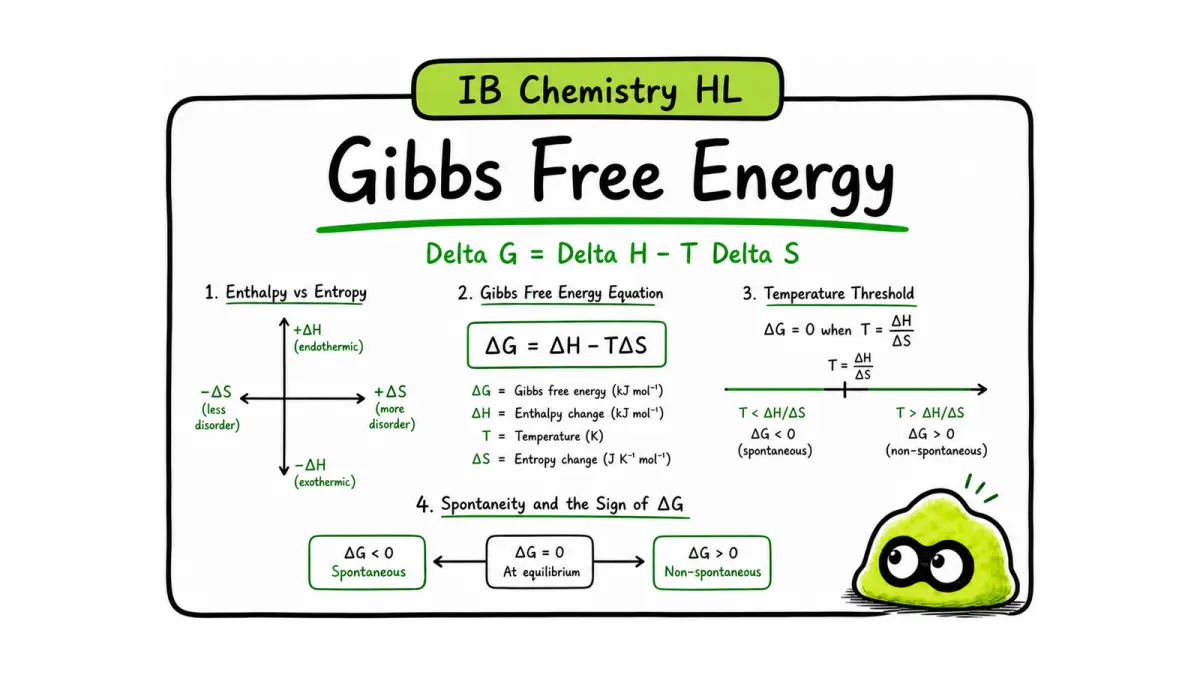
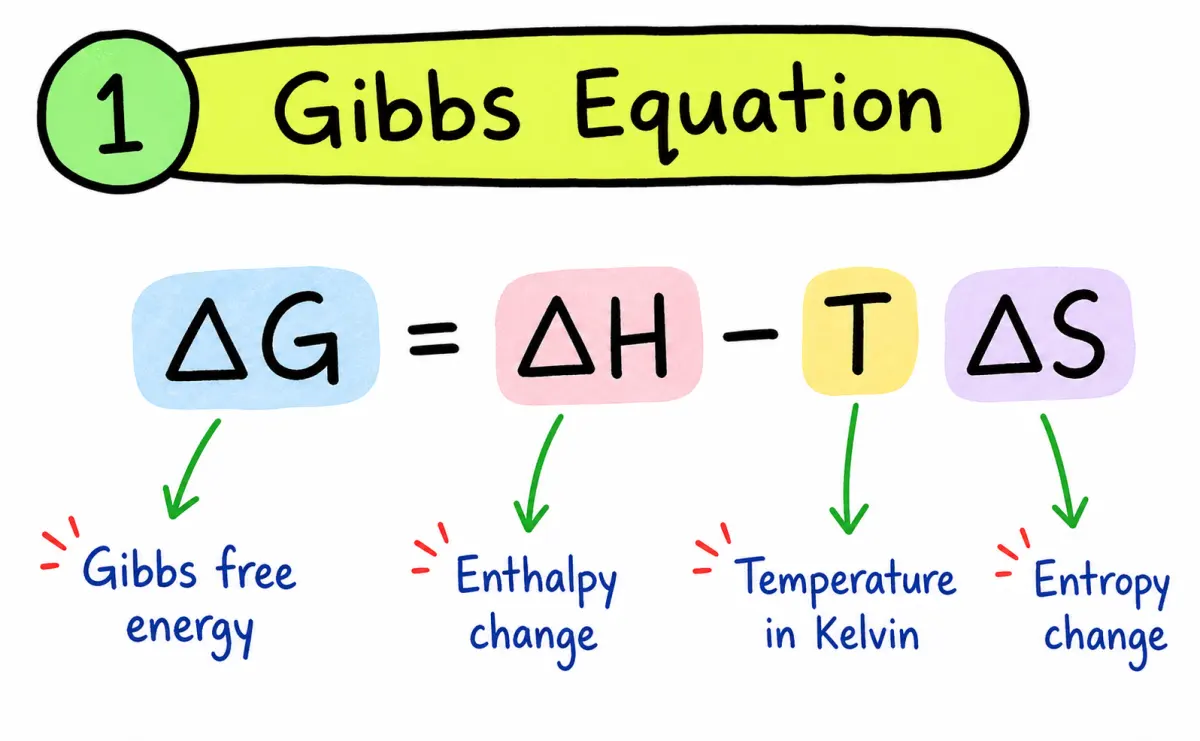
Gibbs free energy combines the enthalpy change of a reaction with its entropy change. Enthalpy describes heat-energy change, while entropy describes the dispersal of matter and energy. The Gibbs equation turns both effects into one value that can be used to discuss spontaneity.
For IB Chemistry HL:
Delta G = Delta H - T Delta S
The standard form is often written as Delta G degree = Delta H degree - T Delta S degree. The degree symbol indicates standard conditions. The equation itself does not mean that every reaction with negative Delta G will be visibly fast or complete.
How Temperature Changes the Sign
The sign of Delta G depends on the balance between Delta H and T Delta S. A reaction with negative Delta H and positive Delta S is favourable at all temperatures in the simple model because both terms support negative Delta G.
| Delta H | Delta S | Temperature effect on Delta G |
|---|---|---|
| Negative | Positive | Favourable at all temperatures |
| Positive | Negative | Unfavourable at all temperatures |
| Negative | Negative | More favourable at lower temperature |
| Positive | Positive | More favourable at higher temperature |
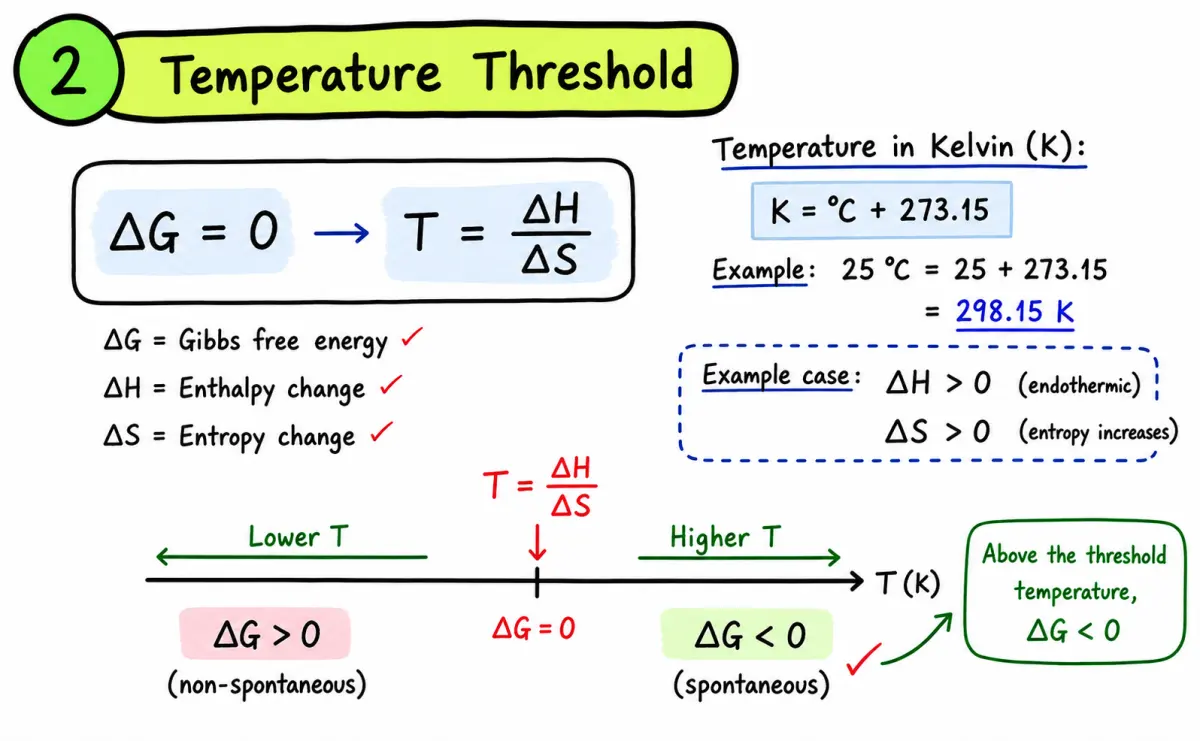
The mixed-sign cases are where temperature matters most. For a reaction with positive Delta H and positive Delta S, increasing T makes the subtractive T Delta S term larger. The reaction may therefore become favourable above a threshold temperature.
Worked Example: Finding a Threshold Temperature
Suppose a reaction has Delta H degree = +40.0 kJ mol-1 and Delta S degree = +120 J K-1 mol-1. At the boundary between favourable and unfavourable conditions, Delta G equals zero:
0 = Delta H - T Delta S
Rearrange:
T = Delta H / Delta S
Convert 40.0 kJ mol-1 to 40,000 J mol-1 before dividing:
T = 40,000 / 120 = 333 K
Above approximately 333 K, the positive entropy term is large enough for Delta G to become negative in this simplified calculation. A common exam error is mixing kilojoules with joules, which changes the answer by a factor of 1,000.
Spontaneity Is Not Reaction Speed
In exam answers, keep thermodynamics and kinetics separate. A negative Delta G indicates that the forward process is thermodynamically favourable under the stated conditions. It does not prove that the reaction will happen quickly.
A reaction can have a negative Delta G and still be slow because the activation energy is high. A catalyst can change the rate by providing a different pathway, but it does not change the overall Delta G for the reaction.
Gibbs Energy and Equilibrium
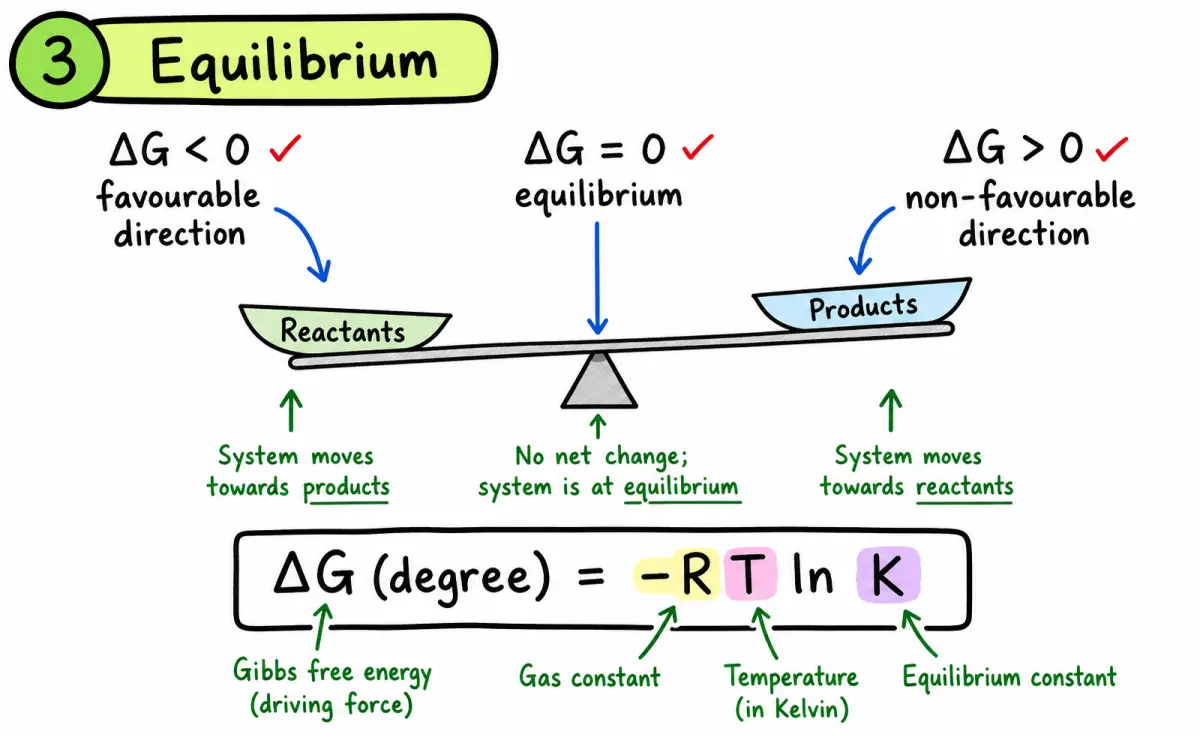
At equilibrium, the driving force for net change is zero, so Delta G equals zero. In the more general expression, Delta G = Delta G degree + RT ln Q. At equilibrium, Q equals K and the relationship becomes Delta G degree = -RT ln K.
This gives a useful interpretation: a large equilibrium constant is associated with a negative standard Gibbs energy change, while a small equilibrium constant is associated with a positive one. Always identify whether the question is asking about Delta G under current conditions or Delta G degree under standard conditions.
Common Mistakes
- Using Celsius instead of Kelvin.
- Mixing J mol-1 with kJ mol-1.
- Treating negative Delta G as proof of a fast reaction.
- Forgetting that Delta S can be positive or negative depending on particle and energy dispersal.
- Giving a temperature conclusion without stating the sign of Delta G.
Practice This Topic
Exam-style question: A reaction has Delta H degree = +25.0 kJ mol-1 and Delta S degree = +80.0 J K-1 mol-1. Estimate the temperature above which Delta G degree becomes negative.
Answer guide:
- Set Delta G degree to zero at the boundary.
- Convert Delta H degree to 25,000 J mol-1.
- Use T = Delta H / Delta S.
- T = 25,000 / 80.0 = 312.5 K, so the reaction becomes favourable above approximately 313 K in this model.
Practice the verified IB Chemistry HL Question Bank after working through the calculation.
FAQ
What does negative Gibbs free energy mean?
Negative Delta G means the forward process is thermodynamically favourable under the stated conditions. It does not guarantee a fast reaction or prove that every reactant molecule will react.
Why must temperature be in Kelvin?
The Gibbs equation uses absolute temperature because the temperature term represents the thermodynamic scale from absolute zero. Convert Celsius to Kelvin before calculating.
What is the difference between Delta G and Delta G degree?
Delta G refers to the Gibbs energy change under particular conditions. Delta G degree refers to the standard Gibbs energy change. The conditions and the reaction quotient determine the difference.
Does a catalyst change Gibbs free energy?
No. A catalyst changes the activation pathway and reaction rate, but it does not change the overall Gibbs energy difference between reactants and products.
Related Study Links
Put topic practice back into your full IB Chemistry HL study plan.
Return to the complete course overview, or move directly into the most relevant study tool.
Related articles
More course notes, updates and study resources from the EduNinja blog.

IB Chemistry SL 2025 Syllabus Changes: Assessment Guide
A practical IB Chemistry SL guide to the 2025 syllabus and assessment model: structure and reactivity, Paper 1A and 1B, Paper 2, scientific investigation and revision strategy.
Electron Domains and Molecular Geometry | A-Level Chemistry
Revise A-Level Chemistry electron domains, VSEPR shapes, lone pairs, bond angles, molecular geometry and common exam mistakes.
Salt Bridge Explained | A-Level Chemistry
Learn the function of a salt bridge in A-Level Chemistry, including ion movement, electrical neutrality, cell circuits and exam mistakes.