Fractional Distillation Explained | IGCSE Chemistry
Learn IGCSE Chemistry fractional distillation with boiling points, apparatus, fractionating columns, separation steps, mistakes and practice.
Fractional distillation separates a mixture of miscible liquids by taking advantage of different boiling points. For IGCSE Chemistry, the core idea is that the liquid with the lower boiling point forms vapour more readily, then the vapour is cooled and collected as a distillate. The fractionating column improves the separation when the boiling points are relatively close.
Quick Answer
- Heat the mixture so vapour forms.
- The lower-boiling component becomes richer in the vapour first.
- The fractionating column provides repeated evaporation and condensation.
- The thermometer helps identify which fraction is distilling.
- The vapour passes into a condenser, cools and is collected.
What Is Fractional Distillation?
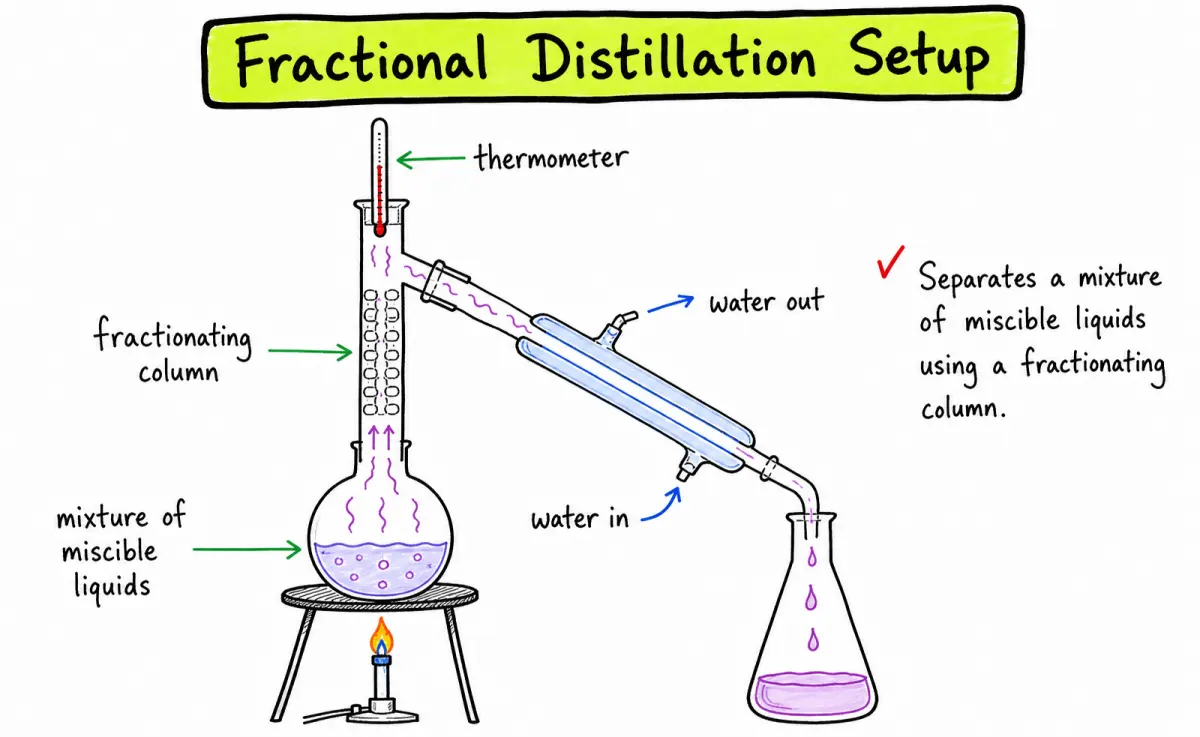
Fractional distillation is a separation technique for miscible liquids, meaning liquids that mix completely. It works because the liquids have different boiling points. The component with the lower boiling point is more volatile, so it contributes more to the vapour when the mixture is heated.
This differs from filtration, which separates an insoluble solid from a liquid. It also differs from separating immiscible liquids with a separating funnel. The method must match the type of mixture.
The Apparatus and Its Purpose
| Part | Purpose |
|---|---|
| Heated flask | Warms the liquid mixture |
| Fractionating column | Allows repeated evaporation and condensation |
| Thermometer | Measures the temperature of vapour leaving the column |
| Condenser | Cools vapour back into a liquid |
| Receiver | Collects the distillate |
Cooling water enters the condenser at the lower end and leaves at the upper end. This keeps the condenser jacket full and provides efficient cooling.
Step-by-Step Process
- Place the mixture in the flask and heat it gradually.
- Vapour rises into the fractionating column.
- Vapour condenses on the column surfaces and may evaporate again.
- Repeated cycles make the rising vapour richer in the lower-boiling liquid.
- The vapour reaches the condenser, where it cools into a liquid.
- Collect the fraction and monitor the temperature.
The fraction collected first is not necessarily pure. It is richer in the lower-boiling component, and further fractions may be collected at different temperature ranges.
Boiling Point and the First Fraction
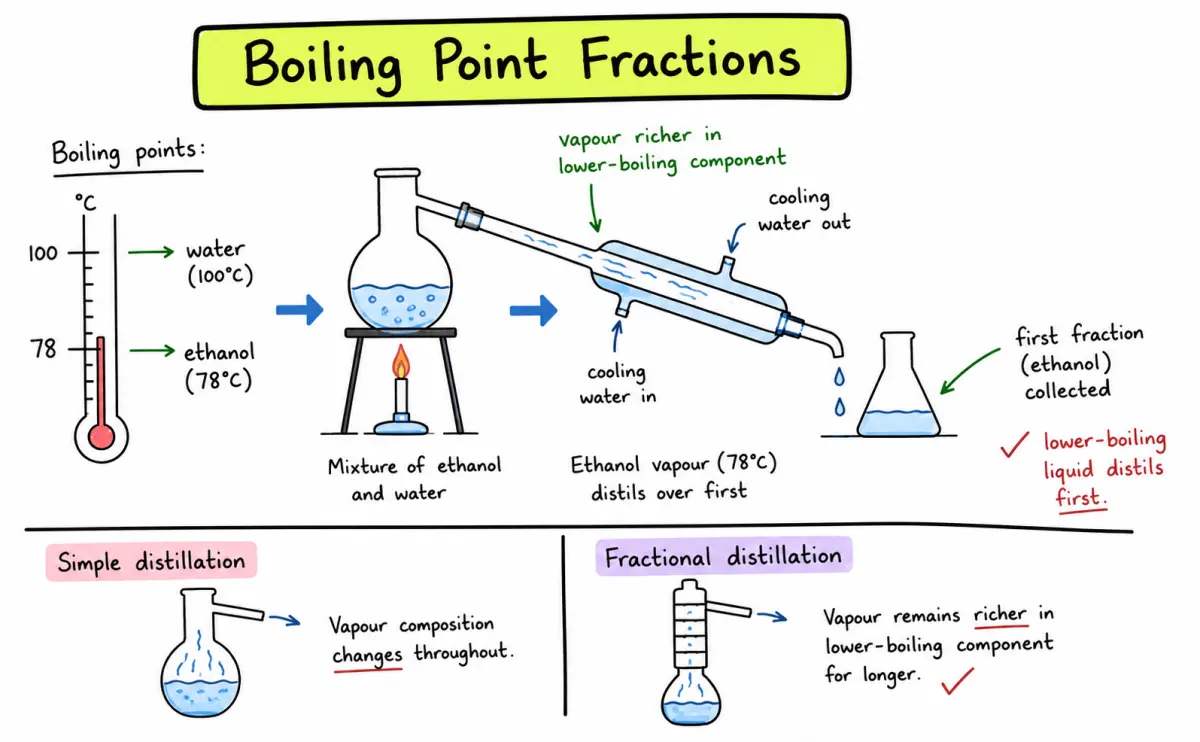
Consider a mixture of ethanol and water. Ethanol boils at about 78°C, while water boils at about 100°C. Ethanol is the lower-boiling component, so the first distillate is richer in ethanol.
The thermometer reading should be interpreted carefully. A temperature near the boiling point of the component currently distilling suggests which fraction is passing into the condenser. It does not mean the entire flask suddenly contains only one pure substance.
Fractional vs Simple Distillation
Simple distillation is more suitable when a liquid is being separated from a dissolved solid or when the boiling points are far apart. Fractional distillation is used for miscible liquids with closer boiling points because the column gives extra separation cycles.
| Feature | Simple distillation | Fractional distillation |
|---|---|---|
| Main use | Liquid from dissolved solid or widely separated boiling points | Miscible liquids with closer boiling points |
| Column | Usually absent | Fractionating column included |
| Separation | One main evaporation-condensation path | Repeated cycles improve separation |
| Example | Recovering water from salt solution | Separating ethanol and water |
Common Exam Mistakes
| Mistake | Better answer |
|---|---|
| Saying the liquid with the highest boiling point distils first | The lower-boiling, more volatile component is richer in the first vapour |
| Calling the liquids immiscible | Fractional distillation separates miscible liquids |
| Drawing cooling water in at the top | Water enters at the bottom and leaves at the top |
| Forgetting the fractionating column | Explain that repeated evaporation and condensation improve separation |
| Saying the first fraction is automatically pure | It is richer in the lower-boiling component, not necessarily pure |
Mini Practice
A mixture contains ethanol, boiling point 78°C, and water, boiling point 100°C.
- Which component is richer in the first distillate?
- Why is a fractionating column used?
- Where should cooling water enter the condenser?
Answer guide: Ethanol is richer in the first distillate because it has the lower boiling point. The column allows repeated evaporation and condensation. Cooling water enters at the bottom and leaves at the top.
Practice This Topic
Try this exam-style question: Explain how fractional distillation separates two miscible liquids with different boiling points, including the role of the fractionating column and condenser.
Answer guide:
- Heat the mixture so vapour forms.
- The lower-boiling component is richer in the vapour.
- Repeated evaporation and condensation occur in the fractionating column.
- The condenser cools the vapour into a collected liquid.
Practise IGCSE Chemistry separation and state-change questions.
FAQ
Why does the lower-boiling liquid distil first?
It is more volatile and forms vapour more readily at a given temperature. The first vapour is therefore richer in that component, although it may not be completely pure.
Why is a fractionating column needed?
It provides repeated evaporation and condensation, so the vapour becomes progressively richer in the lower-boiling component before reaching the condenser.
How is fractional distillation different from filtration?
Filtration separates an insoluble solid from a liquid using a filter. Fractional distillation separates miscible liquids using differences in boiling point.
Related Study Links
- IGCSE Chemistry Question Bank
- IGCSE Chemistry Notes
- IGCSE Chemistry particles and state changes
- Deposition in IGCSE Chemistry
Final Takeaway
Fractional distillation uses different boiling points, repeated evaporation and condensation, and a condenser to separate miscible liquids into richer fractions.
Choose a course and continue studying.
Pick your curriculum and subject, then continue into the right question bank or notes.
Related articles
More course notes, updates and study resources from the EduNinja blog.

IB Chemistry SL 2025 Syllabus Changes: Assessment Guide
A practical IB Chemistry SL guide to the 2025 syllabus and assessment model: structure and reactivity, Paper 1A and 1B, Paper 2, scientific investigation and revision strategy.
Electron Domains and Molecular Geometry | A-Level Chemistry
Revise A-Level Chemistry electron domains, VSEPR shapes, lone pairs, bond angles, molecular geometry and common exam mistakes.
Salt Bridge Explained | A-Level Chemistry
Learn the function of a salt bridge in A-Level Chemistry, including ion movement, electrical neutrality, cell circuits and exam mistakes.