A-Level Chemistry Energetics: Enthalpy and Hess Law Guide
Revise A-Level Chemistry energetics with enthalpy changes, calorimetry, Hess law, bond enthalpies, energy profiles, and sign mistakes. Includes examples and targeted FAQ.
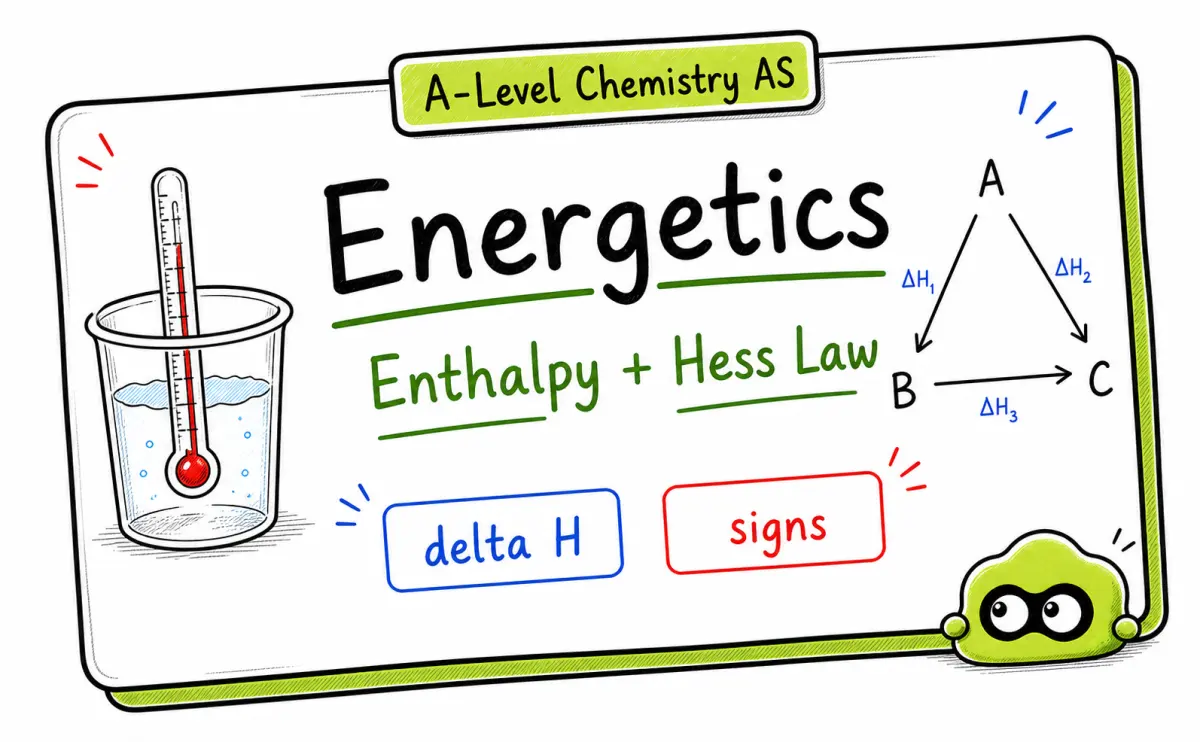
A-Level Chemistry energetics is a classic topic where students know the words exothermic and endothermic, but lose marks on signs, units, Hess cycles, and bond enthalpy calculations. The maths is usually manageable. The hard part is choosing the right route.
This guide gives you a practical framework for enthalpy questions so you can stop treating every calculation as a new puzzle.
Use the relevant EduNinja course pages as your base:
- A-Level Chemistry Question Bank
- A-Level Chemistry Notes
- AS CIE Chemistry Notes - Unit 3 Chemical bonding
Do not open every link at once. Start with the notes or topic page, then move into question practice and use any PDF resource only when it helps clarify the exact idea you are revising.
Quick Answer
For energetics, always track route, sign, and units.
- Exothermic reactions release energy and usually have negative enthalpy change.
- Endothermic reactions absorb energy and usually have positive enthalpy change.
- Hess law works because enthalpy change depends only on initial and final states.
- Calorimetry links temperature change to heat energy.
- Bond enthalpy calculations use bonds broken minus bonds formed.
- Units matter: usually kJ mol-1 for enthalpy change.
- Practise with the A-Level Chemistry Question Bank.
Core Concept That Gets Marks
Energetics is about energy-accounting. Decide whether the question uses direct measurement, Hess cycles, bond enthalpies, or reaction profiles before choosing the calculation.
What Energetics Tests
Energetics questions may ask for definitions, reaction profile diagrams, calorimetry calculations, Hess cycles, or bond enthalpy. The topic rewards clear bookkeeping.
Use A-Level Chemistry Notes for definitions, then practise enthalpy change questions.
Enthalpy Change and Reaction Profiles
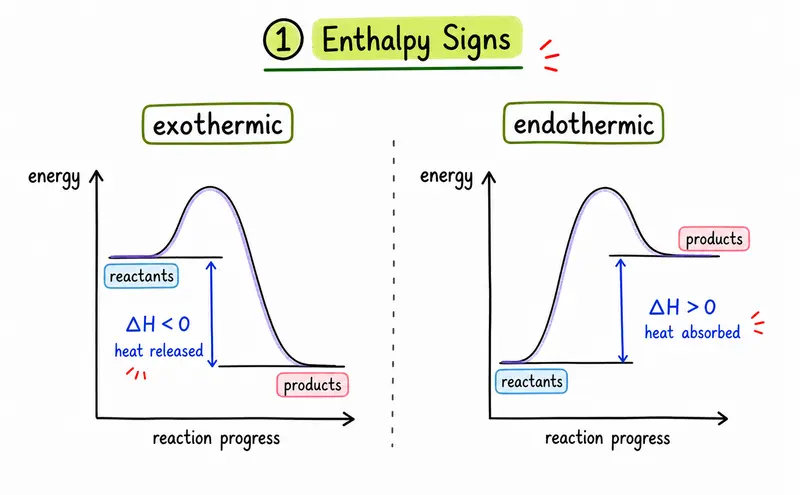
Enthalpy change is the energy change of a reaction under specified conditions. In an exothermic reaction, products are lower in energy than reactants. In an endothermic reaction, products are higher in energy.
| Reaction type | Sign | Energy profile |
|---|---|---|
| Exothermic | Negative | Products lower than reactants |
| Endothermic | Positive | Products higher than reactants |
The sign is not decoration. It tells the direction of energy transfer.
Calorimetry
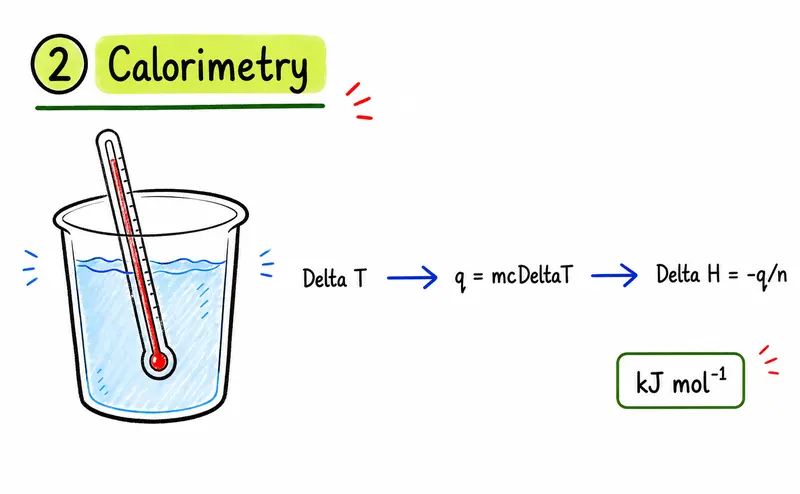
Calorimetry questions usually combine mass, specific heat capacity, and temperature change. The common equation is q = mc?T.
The calculation is only useful if you then convert to the enthalpy change per mole. Students often calculate energy in joules correctly, then forget to divide by moles or convert J to kJ.
Hess Law
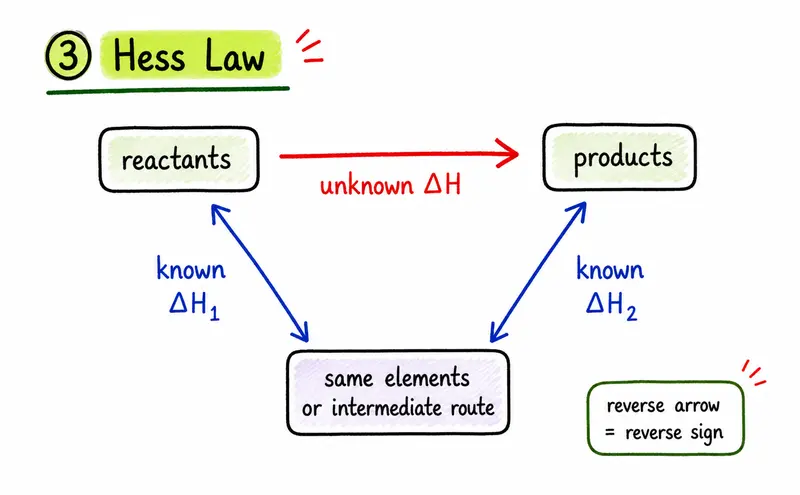
Hess law says the enthalpy change is independent of the route taken. This allows you to calculate an unknown enthalpy change using known enthalpy changes.
The safest method is to draw the cycle, align arrows carefully, reverse signs when reversing equations, and multiply enthalpy values when multiplying equations.
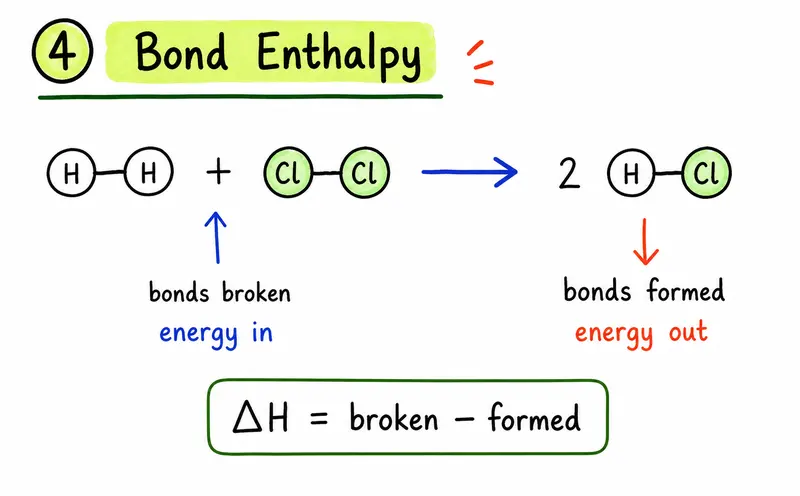
Bond Enthalpy
Bond enthalpy calculations use:
?H = bonds broken - bonds formed
Breaking bonds requires energy. Forming bonds releases energy. That is why the order matters. For focused practice, use bond energy questions.
Common Mistakes That Cost Marks
| Mistake | Fix |
|---|---|
| Forgetting signs | Write exothermic = negative, endothermic = positive |
| Leaving answer in J | Convert to kJ mol-1 if required |
| Reversing Hess arrows without changing sign | Reverse equation, reverse sign |
| Using products minus reactants for bond enthalpy | Use broken minus formed |
| Ignoring moles | Enthalpy change is often per mole |
Topic-Specific Revision Route
Spend five minutes on definitions, ten minutes on reaction profiles, ten minutes on Hess cycles, and ten minutes on bond enthalpy. Mark each error by type: sign, unit, mole conversion, cycle direction, or equation balance.
Useful resources include AS AQA Chemistry Note - 1.4 Energetics, A Level CIE Chemistry Notes with questions, and chemistry equation.
Worked Example 1
Worked Example 1: Turn the Topic Into a Marked Explanation
Question: A student writes a short answer about Energetics but loses marks. What is usually missing?
Worked answer: The answer often names the idea but does not connect it to particles, bonding, moles, energy, or observations. A stronger answer explains the chemical reason and uses the correct technical term.
Markscheme-style answer: Uses correct chemical terminology; identifies the relevant particles or quantities; links the idea to the observation or calculation; avoids vague phrases such as "it reacts more".
Worked Example 2: Check Units, State Symbols, or Conditions
Question: What should you check before moving on from a Energetics calculation or equation?
Worked answer: Check whether the answer needs moles, concentration, mass, energy, pH, or percentage. For equations, check balancing, charges, state symbols where required, and whether the question asks for observations or explanation.
Markscheme-style answer: Balanced chemistry is shown; units are consistent; the final quantity matches the question; explanation is linked to evidence from the reaction or data.
Question-Type Breakdown
Energetics questions are mostly about choosing the right route to an enthalpy change.
| Question type | What it is really asking | First move | Common trap |
|---|---|---|---|
| Calorimetry | Use temperature change to find energy | Use q = mcDeltaT | Forgetting to convert to kJ mol-1 |
| Hess cycle | Find an indirect enthalpy change | Draw arrows and match directions | Reversing signs incorrectly |
| Bond enthalpy | Compare bonds broken and made | Broken minus made | Using made minus broken |
| Exothermic/endothermic | Interpret sign and energy profile | Link sign to heat transfer | Saying negative means "less energy" only |
| Units and moles | Scale energy per mole | Identify the limiting amount | Reporting q without molar enthalpy |
Weak Answer vs Mark-Worthy Answer
Weak answer:
- The reaction is exothermic because energy goes down.
Mark-worthy answer:
- The reaction is exothermic because more energy is released when new bonds form than is absorbed to break bonds, giving a negative enthalpy change.
For calculation questions, write the unit journey: joules from q = mcDeltaT, then kilojoules, then kJ mol-1 if the question asks for enthalpy change per mole.
Exam-Ready Mini Checklist
| Check | What good work looks like |
|---|---|
| method classified | checked before moving on |
| sign convention checked | checked before moving on |
| cycle or bonds shown | checked before moving on |
| units included | checked before moving on |
| exothermic/endothermic sense checked | checked before moving on |
How EduNinja Helps
A clean revision loop is easier when the tools sit in one place. Rebuild the idea in EduNinja Notes, test it in the Questionbank, then turn every missed mark into a flashcard or a follow-up AI Tutor prompt. That keeps the article's method practical: learn the concept, answer a real question, mark it, and fix the exact weakness.
FAQ
What is the difference between exothermic and endothermic reactions?
Exothermic reactions release heat energy to the surroundings and have a negative enthalpy change. Endothermic reactions absorb heat energy and have a positive enthalpy change.
When do I use q = mcΔT in energetics?
Use q = mcΔT for calorimetry questions involving mass, specific heat capacity, and temperature change. Then convert to kilojoules and divide by moles if the question asks for enthalpy change per mole.
Why do Hess law signs go wrong?
Signs go wrong when arrows are reversed without changing the sign of the enthalpy change. Draw the cycle carefully and make each route start and finish at the same substances.
How do bond enthalpy calculations work?
Bond enthalpy calculations use energy absorbed to break bonds minus energy released when new bonds form. A common mistake is reversing this order.
Related Study Links
- Explore the subject Study Hub
- A-Level Chemistry Notes
- A-Level Chemistry Question Bank
- Enthalpy change practice
Exam Strategy
Energetics questions reward tidy working. Write the equation, identify the route, and keep signs visible. In Hess law questions, annotate every arrow with its enthalpy change before doing arithmetic. In calorimetry questions, show the temperature change, the energy calculation, the mole calculation, and the final enthalpy per mole as separate lines.
If a final answer looks right but the sign is wrong, the examiner usually cannot give full credit.
Put energetics back into your full A-Level CAIE Chemistry AS study plan.
Return to the complete course overview, or move directly into the most relevant study tool.
Related articles
More course notes, updates and study resources from the EduNinja blog.

IB Chemistry SL 2025 Syllabus Changes: Assessment Guide
A practical IB Chemistry SL guide to the 2025 syllabus and assessment model: structure and reactivity, Paper 1A and 1B, Paper 2, scientific investigation and revision strategy.
Electron Domains and Molecular Geometry | A-Level Chemistry
Revise A-Level Chemistry electron domains, VSEPR shapes, lone pairs, bond angles, molecular geometry and common exam mistakes.
Salt Bridge Explained | A-Level Chemistry
Learn the function of a salt bridge in A-Level Chemistry, including ion movement, electrical neutrality, cell circuits and exam mistakes.