EduNinja

IGCSE Physics8.16P Red-shift equationTopic Practice

8.16P Red-shift equation

Use the equation relating to change in wavelength, reference wavelength, velocity of a galaxy and the speed of light: wavelength in change = λ Δλ λ λλ

Question 6(a)

[Maximum number: 3]

Galaxies A, B and C are different distances from the Earth.
Galaxy A is moving away from the Earth with a velocity of 1.7×10⁴ km/s1.7 \times 10^{4} \mathrm{~km} / \mathrm{s}.

The reference wavelength for light arriving at the Earth from galaxy A is 506 nm.

Calculate the observed wavelength for the light arriving from galaxy A.
[speed of light = 3.0 x 10^5 km/s]

wavelength = ............ nm

Question 8

Question 8(a)(i)

(a)

A galaxy moves away from the Earth at a speed of 3.9 x 10^4 km/s.
The speed of light is 3.0 x 10^5 km/s.
Light from the galaxy is emitted with a wavelength of 6.2 x 10^-7 m.
Calculate the change in the wavelength of the light that is received by an observer on the Earth.

change in wavelength = ............ m

[ 3 ]

Question 8(a)(ii)

(b)

Calculate the wavelength of light that is received by an observer on the Earth.

wavelength = ............ m

[ 1 ]

Question 6(b)

[Maximum number: 4]

The Big Bang theory describes the evolution of the universe.

Hydrogen gas in a laboratory on Earth emits light with a wavelength of 605 nm.

A distant galaxy contains hydrogen which emits light of the same wavelength.
The wavelength of the light from the distant galaxy is measured as 683 nm on Earth.

Calculate the speed of the distant galaxy.

[speed of light = 3.0 x 10^8 m/s]

speed = ............ m/s

Question 8

[Maximum number: 2]

Diagram 1 shows two identical buzzers connected with springs.

Diagram 1

Diagram 1

Spring A is connected to a post.
A force acts on the apparatus for a short period of time, pulling both buzzers to the right. During this time, buzzer A moves 2 cm and buzzer B moves 4 cm .

Question 8(c)

(a)

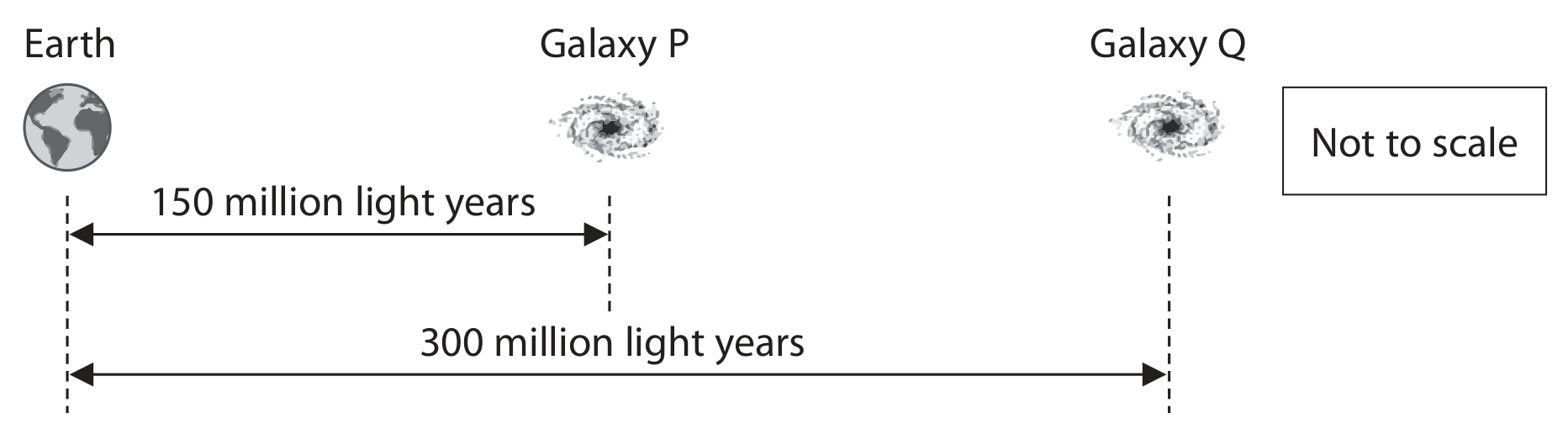
Diagram 3 shows two distant galaxies and the Earth.

Question image

Diagram 3

Light emitted from a nearby star has a wavelength of 590 nm.
The light from an identical star in galaxy P arrives at the Earth.
The wavelength of the light from the star in galaxy P is 600 nm.

[ 2 ]

Question 8(c)(i)

(i)

Calculate the change in wavelength for light from the star in galaxy P.

change in wavelength = ............ nm

[ 1 ]

Question 8(c)(iii)

(ii)

Suggest a value for the change in wavelength of light from an identical star in galaxy Q when the light arrives at the Earth.

change in wavelength = ............ nm

[ 1 ]

Question 8(b)(iii)

[Maximum number: 3]

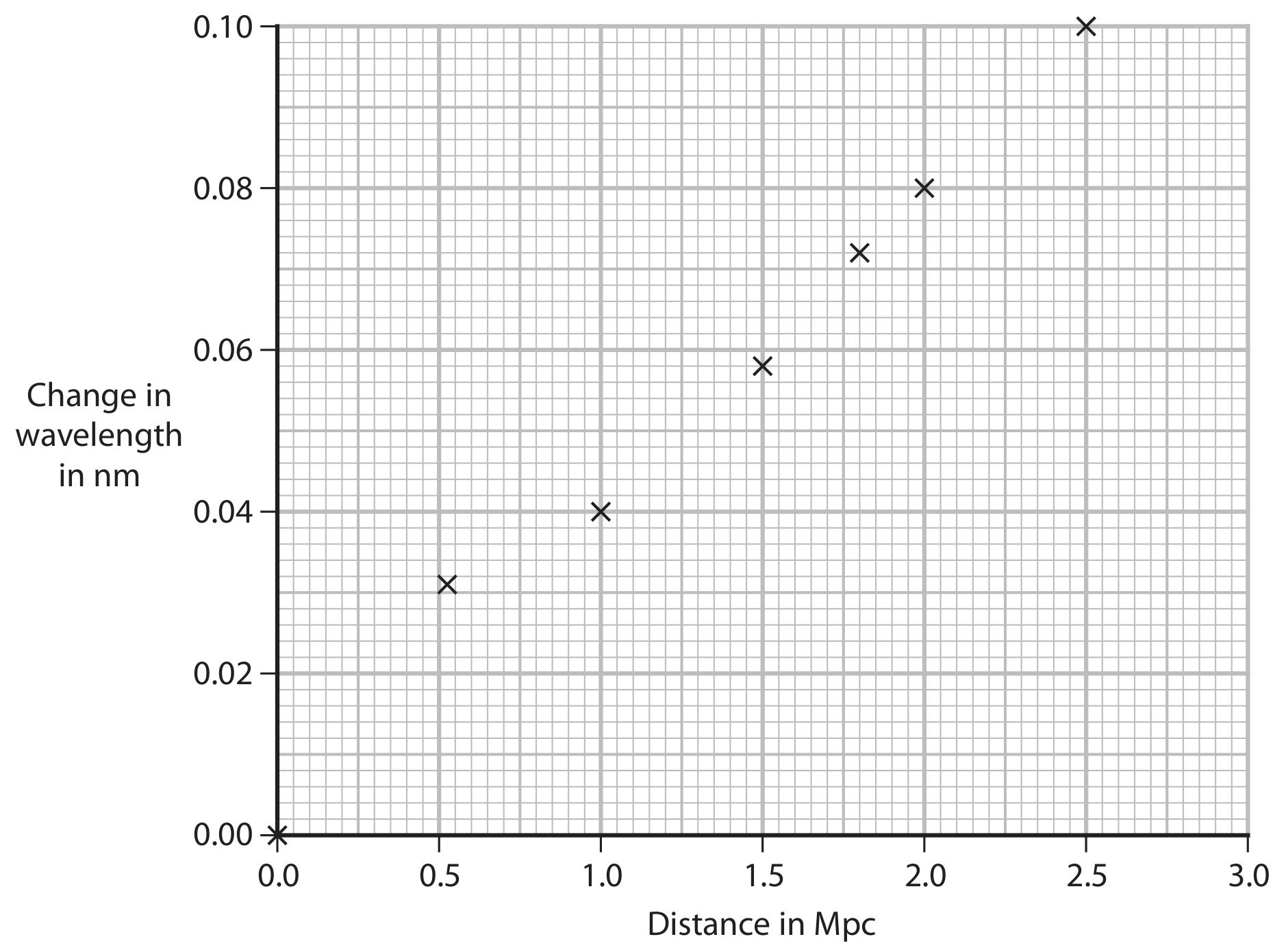
Between 1929 and 1931, physicists Hubble and Humason investigated the red-shift of light from galaxies at different distances from the Earth.

The distance unit they used is the megaparsec (Mpc).

The graph shows some of the results of their investigation.

Question image

The reference wavelength of the light used in this investigation is 660 nm.
Use information from the graph to determine the velocity of a galaxy at a distance of 0.75 Mpc.

[speed of light = 300000 km/s]

velocity = ............ km/s

Question 8(b)

[Maximum number: 4]

This question is about red-shift.

Light is received on Earth from a distant galaxy.

The longest wavelength of light arriving at Earth from the galaxy is 561 nm .
A lamp on Earth produces the same light with a wavelength of 550 nm .
Calculate the velocity of the galaxy.
[speed of light =3.0×10⁸ m/s=3.0 \times 10^{8} \mathrm{~m} / \mathrm{s} ] m/s

Question 8(b)

[Maximum number: 4]

This question is about cosmology.

The galaxy NGC 300 is moving away from the Earth at a speed of 1.44 x 10^5 m/s.

Hydrogen atoms in NGC 300 emit light with a reference wavelength of 4.3405 x 10^-7 m.

Calculate the wavelength of this light when it is detected at Earth.
Give your answer to five significant figures.
[speed of light in a vacuum, c = 3.00 x 10^8 m/s]

wavelength = ............ m

0 selected