Question 1(e)(ii)
[Maximum number: 1]
The diagram shows the particles in the atom of an element.
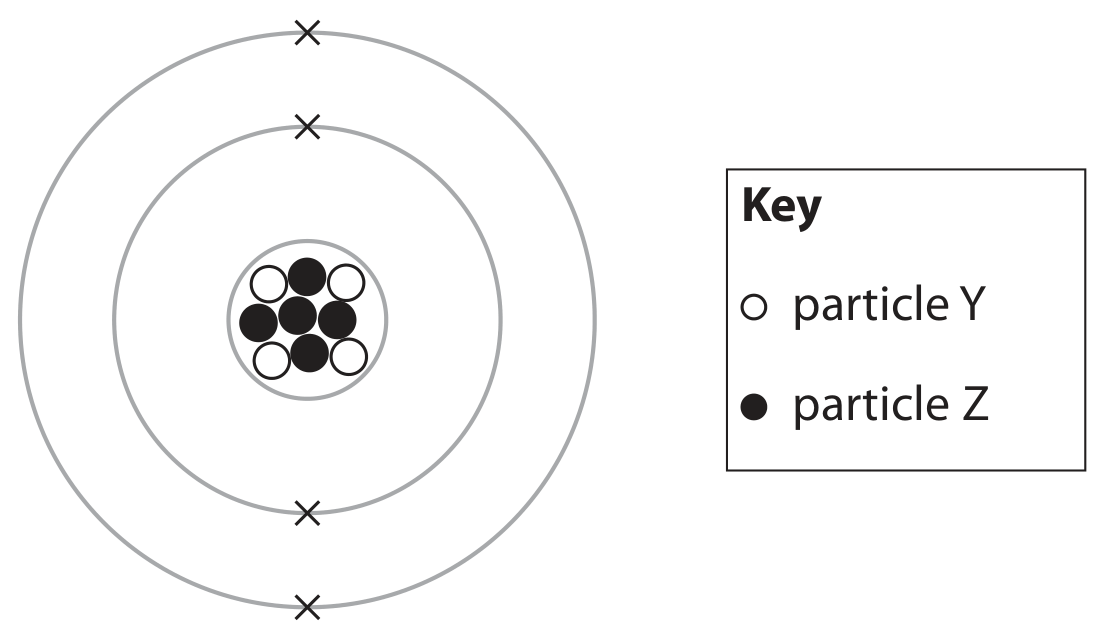
State what is formed when this atom loses its outer shell electrons.
 EduNinja
Edexcel IGCSE Chemistry (f) Ionic bonding question practice helps you revise this syllabus point with the course map in view. Use this page to focus on one topic, check the style of questions available, and connect each attempt back to the knowledge area it is testing.
EduNinja keeps Chemistry practice aligned to Edexcel, so you can move from topic review into exam-style question bank work without losing the syllabus structure. Start with a small set, mark the weak steps, then return to nearby topic links when a definition, graph, calculation, or explanation needs repair.
The diagram shows the particles in the atom of an element.
State what is formed when this atom loses its outer shell electrons.
This question is about chemical elements.
Use the Periodic Table to help you answer this question.
Give the name of the compound formed between oxygen and the element with atomic number 13
The diagram shows the electronic configuration of an atom of an element.
Give the charge on the ion formed from this atom.
The table gives information about four different species, W, X, Y and Z.
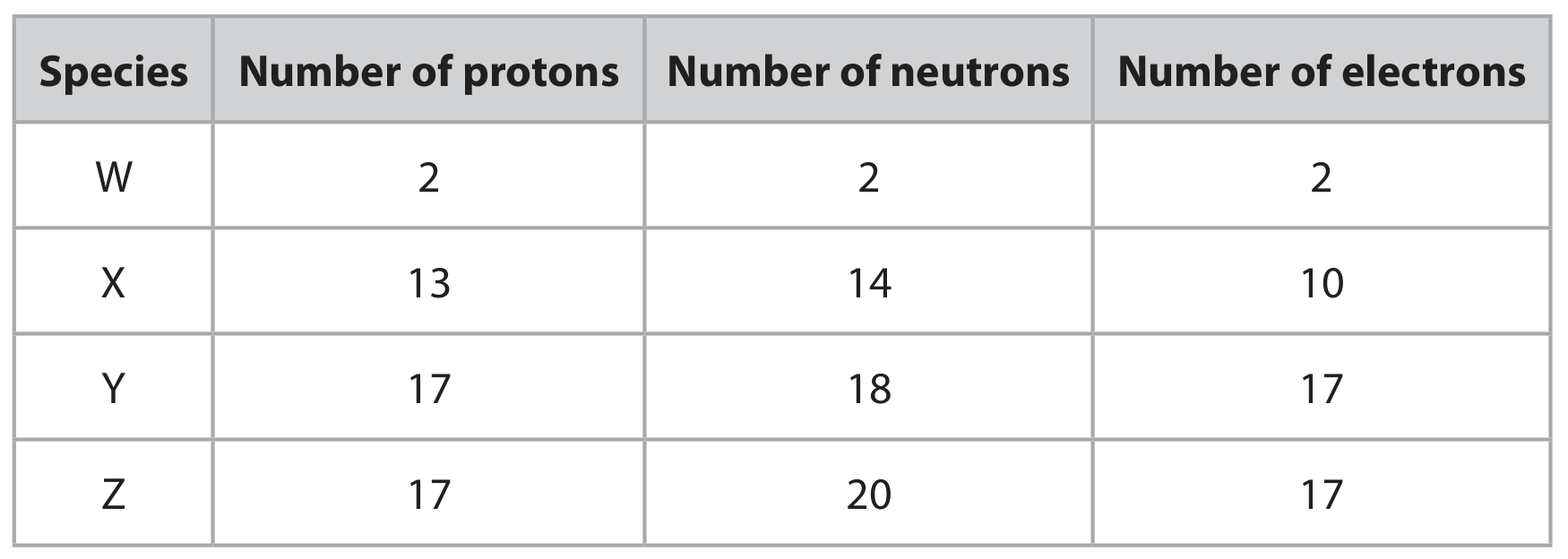
Give a reason why X has a 3+ charge.
This question is about Group 7, the halogens.
What is the charge on a bromide ion?
1-
1+
2-
2+
This question is about sulfur.
The diagram represents the electronic configuration of an atom of sulfur.
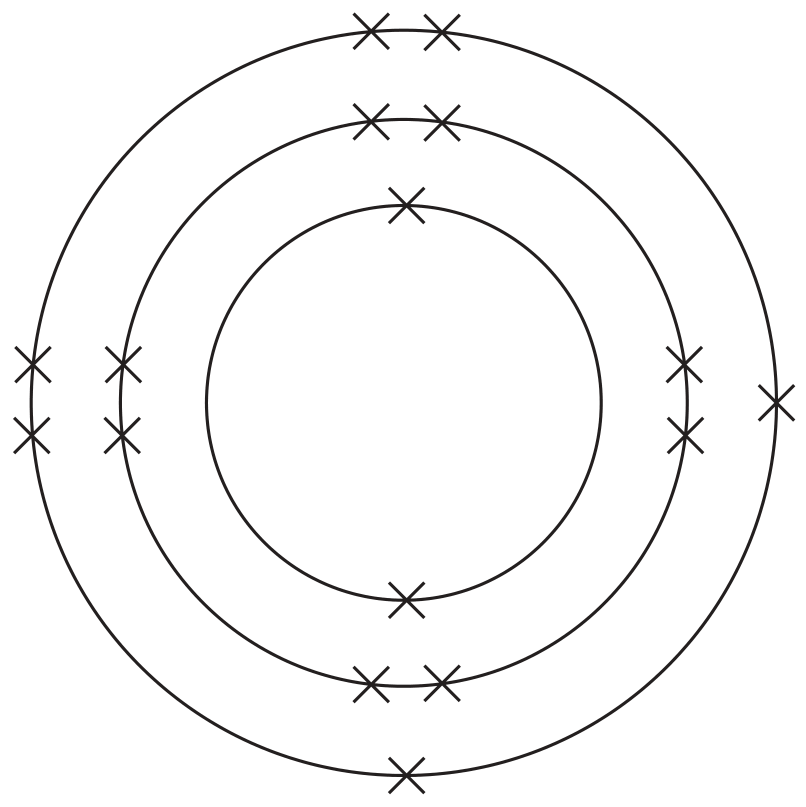
What is the charge on a sulfide ion?
1 +
2 +
1 -
2 -
The table shows the composition of five species that are either atoms or ions.
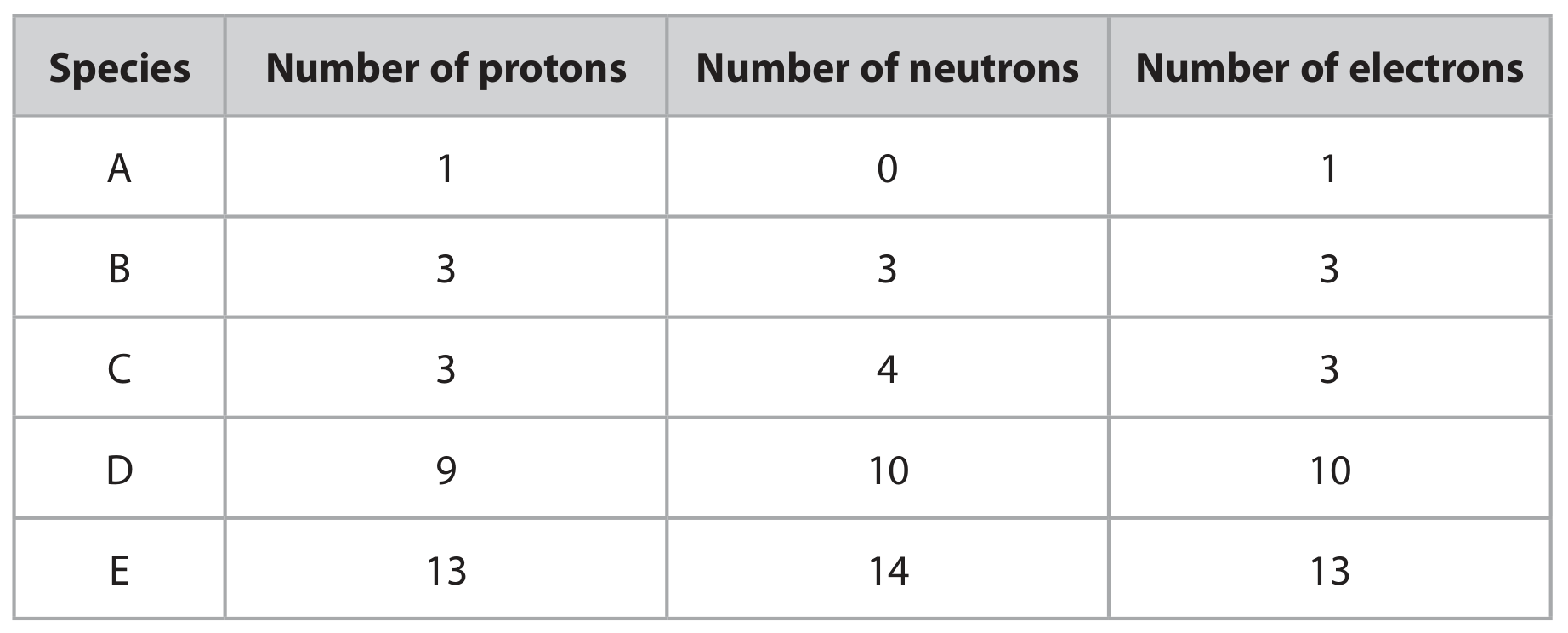
Use the table to answer these questions.
You may use each letter once, more than once, or not at all.
Give the letter of the species that is a negative ion.
Thallium, TI, is an element in Group 3 and Period 6 of the Periodic Table.
The atomic number of thallium is 81
A thallium ion has a charge of 3+
How many electrons are there in this thallium ion?
3
78
81
84
The table gives the melting and boiling points of four pure substances, W, X, Y and Z.
| Substance | Melting point in deg C | Boiling point in deg C |
|---|---|---|
| W | -7 | 60 |
| X | 660 | 2500 |
| Y | 180 | 1330 |
| Z | 115 | 445 |
Use data from the table to answer the questions.
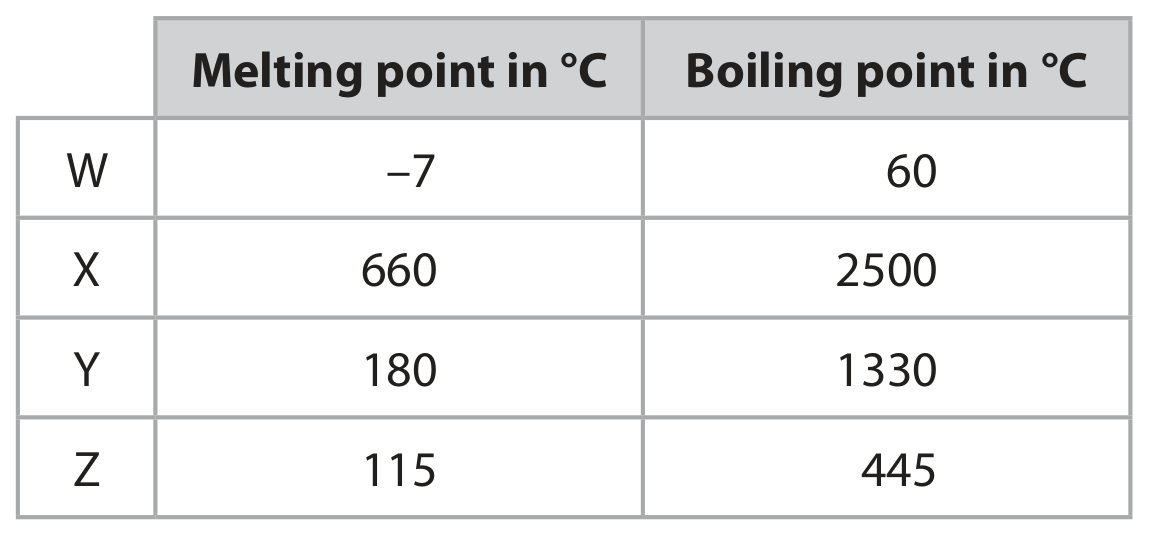
Substance Y does not conduct electricity when solid but does conduct electricity when molten.
Give the type of bonding in substance Y.
Table 2 shows the numbers of protons, neutrons and electrons in the species U, V, W, X, Y and Z.
| Species | Number of protons | Number of neutrons | Number of electrons |
|---|---|---|---|
| U | 8 | 10 | 8 |
| V | 9 | 10 | 10 |
| W | 11 | 12 | 10 |
| X | 11 | 12 | 11 |
| Y | 12 | 12 | 12 |
| Z | 12 | 13 | 12 |
Use the information in Table 2 to answer these questions.
Each species may be used once, more than once or not at all.
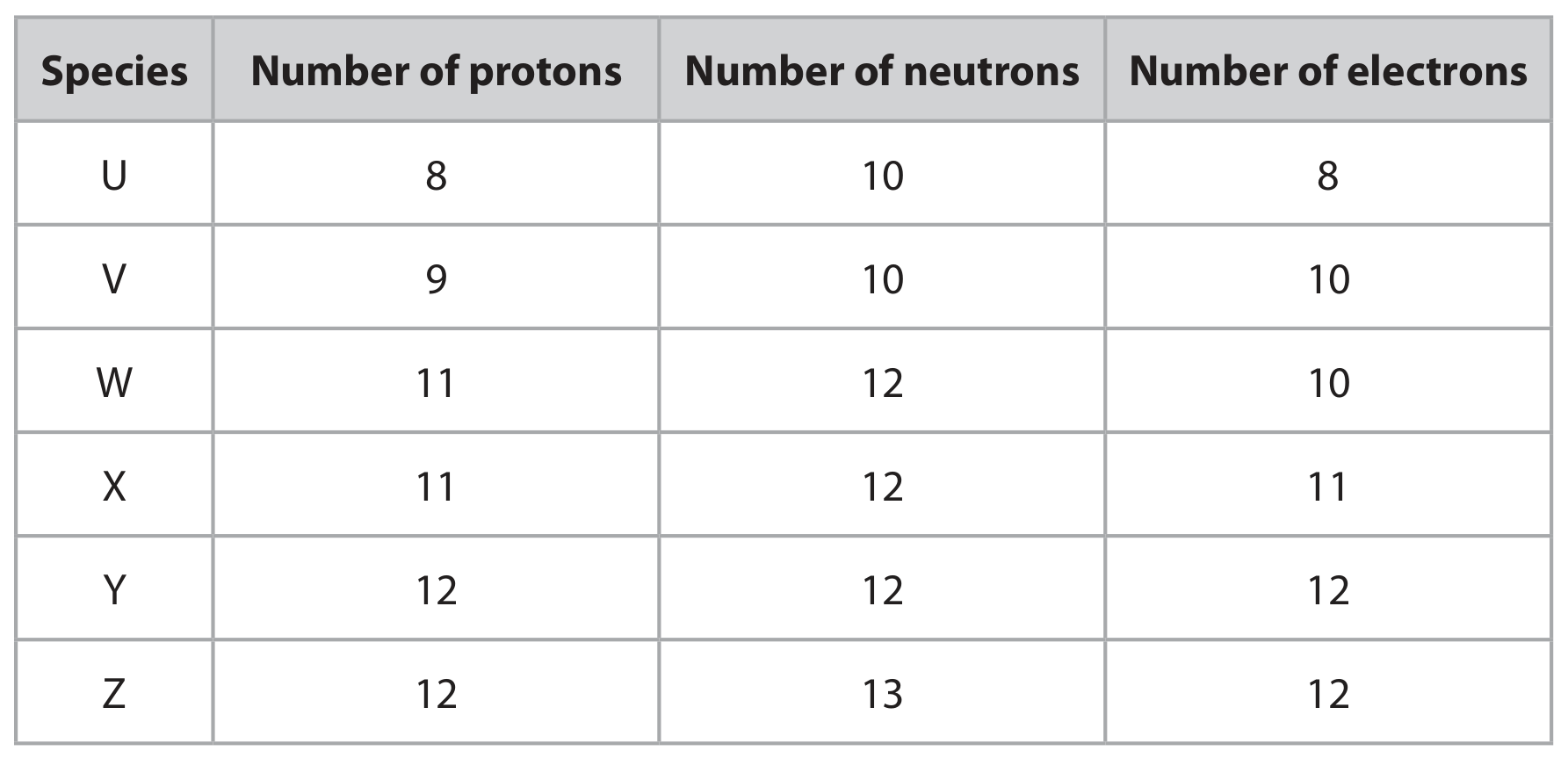
Give the letter of the species that is a positive ion.