
EduNinja

IGCSE Chemistry(g) Acids, bases and salt preparationsTopic Practice

(g) Acids, bases and salt preparations

Edexcel IGCSE Chemistry (g) Acids, bases and salt preparations question practice helps you revise this syllabus point with the course map in view. Use this page to focus on one topic, check the style of questions available, and connect each attempt back to the knowledge area it is testing.

EduNinja keeps Chemistry practice aligned to Edexcel, so you can move from topic review into exam-style question bank work without losing the syllabus structure. Start with a small set, mark the weak steps, then return to nearby topic links when a definition, graph, calculation, or explanation needs repair.

Question 3

[Maximum number: 3]

Solutions of silver nitrate and potassium chloride react together to make the insoluble salt, silver chloride.

A student uses this method to prepare a sample of silver chloride.
Step 1 add 25 cm325 \mathrm{~cm}^{3} of silver nitrate solution to a conical flask
Step 2 add potassium chloride solution to the flask
Step 3 filter off the silver chloride

Question 3(a)

(a)

What term is used for this reaction?

A

neutralisation

B

precipitation

C

redox

D

thermal decomposition

[ 1 ]

Question 3(b)

(b)

Give two more steps that will produce a pure, dry sample of silver chloride.

Step 4

Step 5

[ 2 ]
Question 3

[Maximum number: 4]

This question is about soluble salts and insoluble salts.

Question 3(a)

(a)

Which pair of solutions produces an insoluble salt when mixed?

A

sodium sulfate and potassium nitrate

B

potassium carbonate and calcium nitrate

C

sodium chloride and ammonium nitrate

D

sodium hydroxide and potassium sulfate

[ 1 ]

Question 3(b)

(b)

When solutions of lead nitrate and sodium sulfate are mixed, one product is solid lead sulfate.

This is the equation for the reaction.

Pb(NO3)2(aq)+Na2SO4(aq)PbSO4( s)+2NaNO3(aq)\mathrm{Pb}\left(\mathrm{NO}_{3}\right)_{2}(\mathrm{aq})+\mathrm{Na}_{2} \mathrm{SO}_{4}(\mathrm{aq}) \rightarrow \mathrm{PbSO}_{4}(\mathrm{~s})+2 \mathrm{NaNO}_{3}(\mathrm{aq})

Describe how a pure, dry sample of solid lead sulfate can be obtained from the mixture.

[ 3 ]

Question 3(c)(ii)

[Maximum number: 1]

This question is about magnesium metal and its compounds.

A student uses this method to make a solution of magnesium chloride.

Step 1. measure 25 cm325 \mathrm{~cm}^{3} of dilute hydrochloric acid into a beaker
Step 2 add magnesium powder a little at a time
Step 3 keep adding magnesium powder until it is in excess
Step 4 remove the excess magnesium powder by filtration

This is the equation for the reaction.

Give a reason why the student adds an excess of magnesium in step 3.

Question 3(b)

[Maximum number: 1]

This question is about Group 2 elements and their compounds.

Which of these compounds is an insoluble solid?

A

calcium nitrate

B

calcium sulfate

C

magnesium nitrate

D

magnesium sulfate

Question 4(b)(i)

[Maximum number: 1]

Sodium hydroxide dissolves in water, forming a strongly alkaline solution.
Ammonia dissolves in water, forming a slightly less alkaline solution.

When ammonia solution reacts with sulfuric acid, a neutralisation reaction occurs and ammonium sulfate forms.

How does the sulfuric acid act in this reaction?

A

as a neutron donor

B

as a neutron acceptor

C

as a proton donor

D

as a proton acceptor

Question 5(c)

[Maximum number: 5]

A student does some titrations to find the volume of dilute nitric acid needed to exactly neutralise 25.0 cm325.0 \mathrm{~cm}^{3} of sodium hydroxide solution.

This is the student's method.
Step 1 add 25.0 cm325.0 \mathrm{~cm}^{3} of sodium hydroxide solution to a conical flask
Step 2 add three drops of methyl orange indicator
Step 3 fill a burette with the acid
Step 4 add acid from the burette until the indicator changes colour
Step 5 record the volume of acid added

This is the equation for the reaction between dilute nitric acid and sodium hydroxide solution.

HNO3(aq)+NaOH(aq)NaNO3(aq)+H2O(l)\mathrm{HNO}_{3}(\mathrm{aq})+\mathrm{NaOH}(\mathrm{aq}) \rightarrow \mathrm{NaNO}_{3}(\mathrm{aq})+\mathrm{H}_{2} \mathrm{O}(\mathrm{l})

After the titration, the student knows the volume of acid needed to neutralise 25.0 cm325.0 \mathrm{~cm}^{3} of the sodium hydroxide solution.

Sodium nitrate decomposes at high temperatures.
Describe how the student could obtain pure, dry crystals of sodium nitrate from dilute nitric acid and sodium hydroxide solution.

Question 6(a)

[Maximum number: 3]

This question is about salts.

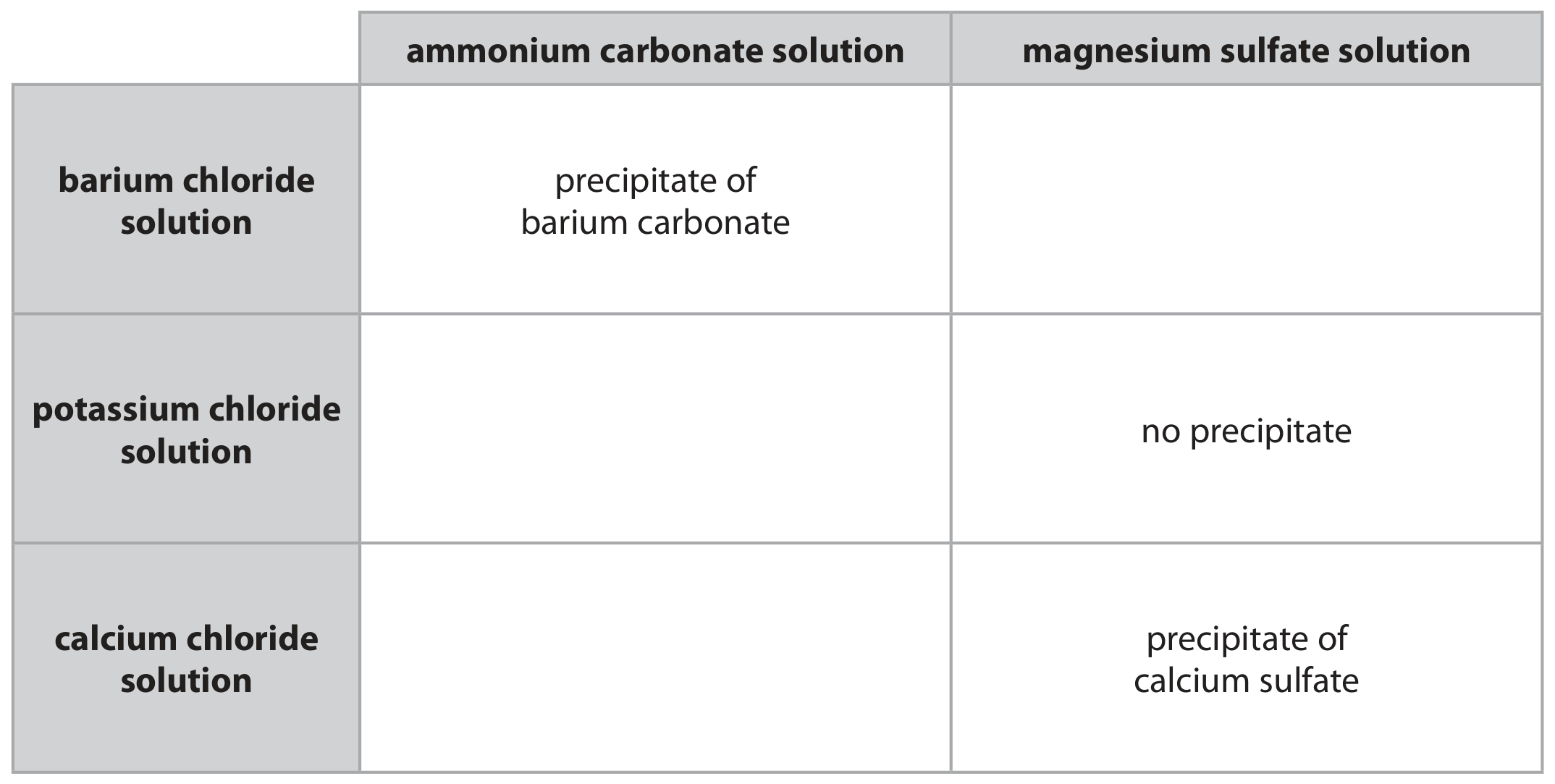
When solutions of salts are mixed together, precipitates sometimes form.

The insoluble salt barium carbonate forms as a precipitate when solutions of the soluble salts ammonium carbonate and barium chloride react together.

When solutions of the soluble salts potassium chloride and magnesium sulfate are mixed, no precipitate forms.

Complete the table to show the results of mixing solutions of some soluble salts.

ammonium carbonate solutionmagnesium sulfate solution
barium chloride solutionprecipitate of barium carbonate................................
potassium chloride solution................................no precipitate
calcium chloride solution................................precipitate of calcium sulfate
Table

Question 5(b)

[Maximum number: 4]

Sodium sulfate can be prepared by the reaction between sodium hydroxide solution and sodium hydrogensulfate ( NaHSO4\mathrm{NaHSO}_{4} ) solution.

This is the equation for the reaction.

NaOH(aq)+NaHSO4(aq)Na2SO4(aq)+H2O(l)\mathrm{NaOH}(\mathrm{aq})+\mathrm{NaHSO}_{4}(\mathrm{aq}) \rightarrow \mathrm{Na}_{2} \mathrm{SO}_{4}(\mathrm{aq})+\mathrm{H}_{2} \mathrm{O}(\mathrm{l})

Sodium hydrogensulfate solution is acidic.
A student adds 25.0 cm325.0 \mathrm{~cm}^{3} of sodium hydroxide solution to a conical flask and adds two drops of indicator.

The student does a titration.

The student repeats the titration without the indicator and forms a solution of sodium sulfate.

Describe how the student can obtain pure, dry crystals of hydrated sodium sulfate from the solution.

Question 5(a)

[Maximum number: 1]

This question is about displacement reactions.

A student uses this method to investigate what happens when excess metal is added to a solution of copper(II) sulfate.
- pour some copper(II) sulfate solution into a polystyrene cup and record the temperature
- add excess metal W to the polystyrene cup and stir the mixture
- record the maximum temperature reached
- calculate the temperature increase of the solution

The student repeats the method for metals X, Y and Z.
For each metal, the student records three sets of results.

Give a reason why the student could not use copper(II) carbonate instead of copper(II) sulfate.

Question 6

[Maximum number: 8]

A student uses the reaction between magnesium and dilute hydrochloric acid to prepare crystals of hydrated magnesium chloride.

The student adds excess magnesium powder to hydrochloric acid.
This is the equation for the reaction.

Mg( s)+2HCl(aq)MgCl2(aq)+H2( g)\mathrm{Mg}(\mathrm{~s})+2 \mathrm{HCl}(\mathrm{aq}) \rightarrow \mathrm{MgCl}_{2}(\mathrm{aq})+\mathrm{H}_{2}(\mathrm{~g})

Question 6(a)

(a)

How does hydrochloric acid behave when acting as an acid?

A

as an electron acceptor

B

as an electron donor

C

as a proton acceptor

D

as a proton donor

[ 1 ]

Question 6(b)

(b)

State one observation made during this reaction.

[ 1 ]

Question 6(c)

(c)

Give a reason why the student adds an excess of magnesium to the dilute hydrochloric acid.

[ 1 ]

Question 6(d)

(d)

Describe what the student should do to the mixture formed in (c) to produce pure, dry crystals of hydrated magnesium chloride.

[ 5 ]
0 selected