EduNinja

IGCSE Chemistry(e) AlcoholsTopic Practice

(e) Alcohols

Edexcel IGCSE Chemistry (e) Alcohols question practice helps you revise this syllabus point with the course map in view. Use this page to focus on one topic, check the style of questions available, and connect each attempt back to the knowledge area it is testing.

EduNinja keeps Chemistry practice aligned to Edexcel, so you can move from topic review into exam-style question bank work without losing the syllabus structure. Start with a small set, mark the weak steps, then return to nearby topic links when a definition, graph, calculation, or explanation needs repair.

Question 3(b)

[Maximum number: 1]

Methanol, ethanol, propanol and butanol are alcohols. They are all liquids that evaporate easily when warmed.

A student uses this apparatus to compare the time taken for the four liquids to evaporate.
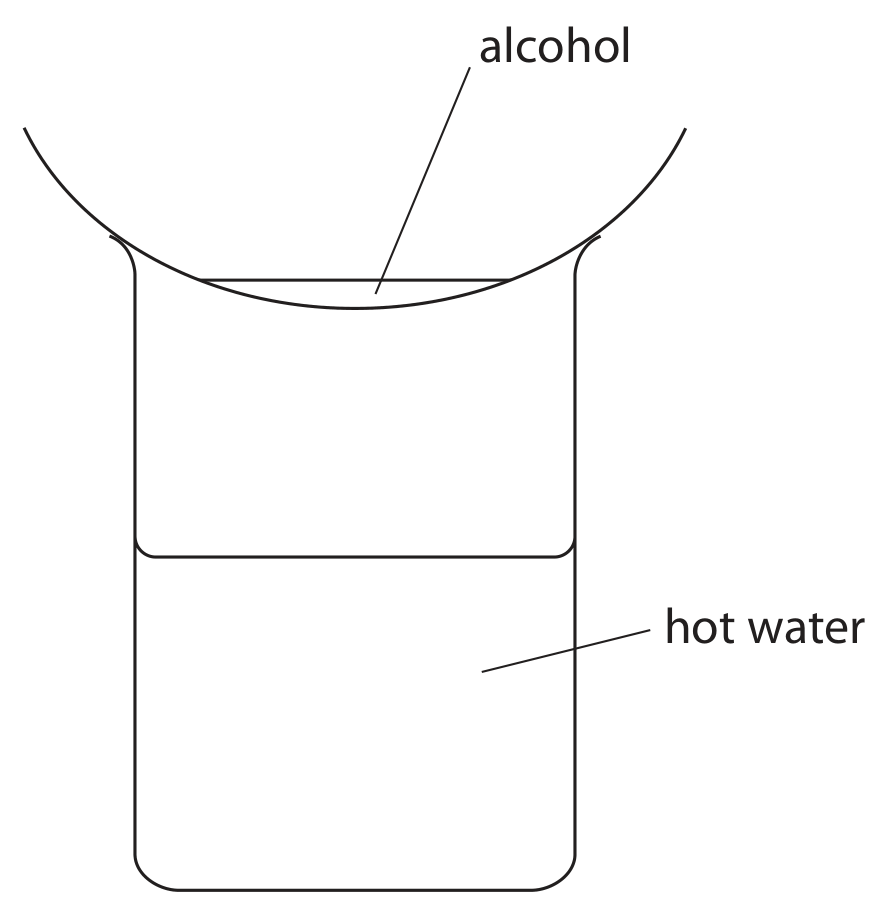
Question image

She uses this method.
- pour some methanol into an evaporating basin
- place the evaporating basin on top of a beaker containing hot water
- measure the time taken for the methanol to evaporate completely
- repeat the experiment with each of the other alcohols, using the same apparatus

State why it is not safe to heat the evaporating basin directly with a Bunsen flame.
Question 4

[Maximum number: 3]

This question is about alcohols, carboxylic acids and their reactions.

Question 4(b)

(a)

Ethanol can be oxidised to produce a carboxylic acid.

[ 3 ]

Question 4(b)(i)

(i)

Give the names of the two reagents used in this oxidation reaction.

1

2

[ 2 ]

Question 4(b)(ii)

(ii)

Which of these colour changes occurs during the reaction?

A

green to orange

B

orange to green

C

red to yellow

D

yellow to red

[ 1 ]

Question 4

Question 4(a)

(a)

Steam can be used to manufacture ethanol.

[ 3 ]

Question 4(a)(i)

(i)

Give the other reactant needed for this reaction.

[ 1 ]

Question 4(a)(ii)

(ii)

State the pressure and catalyst used for this reaction to manufacture ethanol.
pressure
catalyst

[ 2 ]

Question 4(b)

(b)

The glucose in grapes can be fermented to make ethanol.

[ 3 ]

Question 4(b)(i)

(i)

State the condition needed to prevent the formation of ethanoic acid.

[ 1 ]

Question 4(b)(ii)

(ii)

Explain why fermentation needs to happen in the range of 30C30^{\circ} \mathrm{C} to 40C40^{\circ} \mathrm{C}.

[ 2 ]

Question 4

[Maximum number: 5]

This question is about the manufacture of ethanol by the fermentation of glucose.

Question 4(a)

(a)

Fermentation needs to be done in the absence of air.

Give two other conditions needed for fermentation.

1 ................................
2 ................................

[ 2 ]

Question 4(b)

(b)

Explain why fermentation needs to be done in the absence of air.

[ 2 ]

Question 4(c)(i)

(c)

Complete the equation for fermentation.

[ 1 ]

Question 4

[Maximum number: 3]

This question is about the reactions of ethanol and ethanoic acid.

Question 4(a)(i)

(a)

Ethanol reacts with potassium dichromate(VI) to form ethanoic acid.

Name the other reagent needed in this reaction.

[ 1 ]

Question 4(a)(ii)

(b)

State the colour change that occurs when ethanol reacts with potassium dichromate(VI).
from to

[ 2 ]

Question 4

[Maximum number: 4]

This question is about alcohols, carboxylic acids and esters.

Question 4(a)

(a)

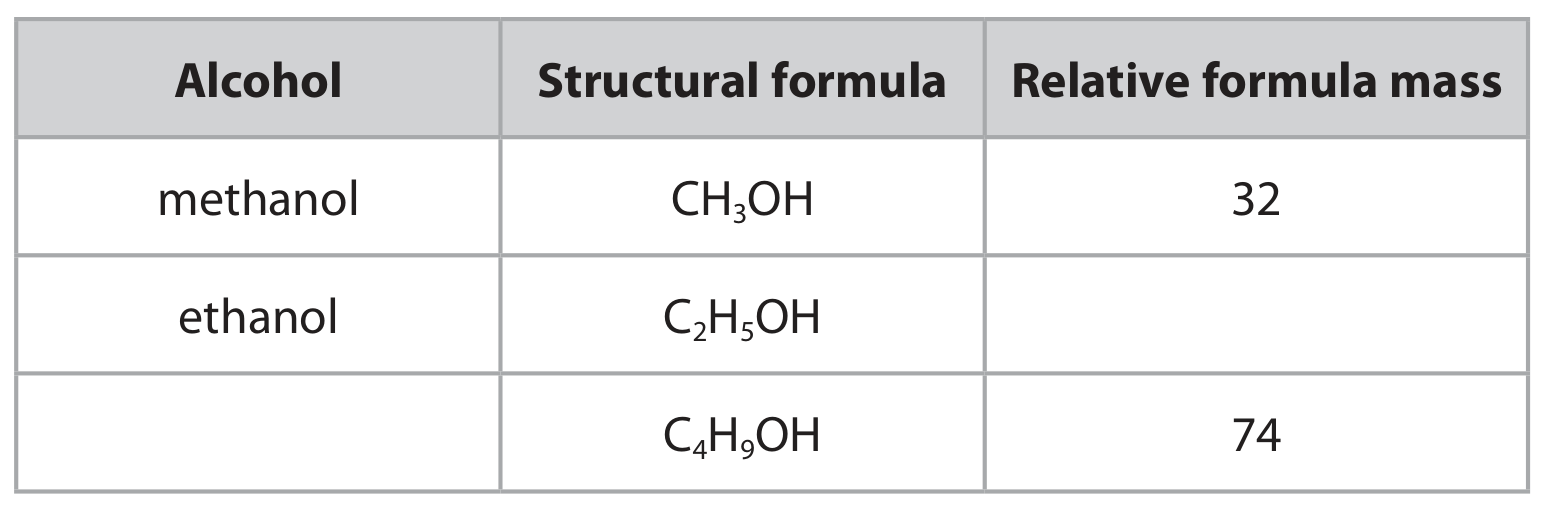
The table gives information about some alcohols.

AlcoholStructural formulaRelative formula mass
methanolCH3OH32
ethanolC2H5OH................................
................................C4H9OH74

Complete the table by giving the missing information.

Table
[ 2 ]

Question 4(b)

(b)

Ethanol can be oxidised to ethanoic acid by heating with potassium dichromate(VI) and another reagent.

[ 2 ]

Question 4(b)(i)

(i)

Name the other reagent.

[ 1 ]

Question 4(b)(ii)

(ii)

State the colour change that occurs during this reaction.
from to

[ 1 ]

Question 5

[Maximum number: 3]

Methanol, CH3OH\mathrm{CH}_{3} \mathrm{OH}, is the first member of the homologous series of alcohols.

Question 5(b)

(a)

Methanol is heated with potassium dichromate(VI) and one other reagent.

The methanol is oxidised to methanoic acid, HCOOH

[ 3 ]

Question 5(b)(i)

(i)

Give the formula of the other reagent.

[ 1 ]

Question 5(b)(ii)

(ii)

Give the colour change that occurs during the reaction.
from to

[ 2 ]

Question 6

[Maximum number: 9]

Some cars in Brazil use ethanol, C2H5OH\mathrm{C}_{2} \mathrm{H}_{5} \mathrm{OH}, as a fuel instead of petrol.
The ethanol is made by the fermentation of glucose which is obtained from sugar cane.
The sugar is extracted from the sugar cane and then dissolved in water to make a sugar solution.

Question 6(a)(i)

(a)

Name the substance that is added to the sugar solution that causes glucose to ferment.

[ 1 ]

Question 6(a)(ii)

(b)

Which temperature is the most suitable for fermentation?

A

0C0^{\circ} \mathrm{C}

B

10C10^{\circ} \mathrm{C}

C

30C30^{\circ} \mathrm{C}

D

80C80^{\circ} \mathrm{C}

[ 1 ]

Question 6(a)(iii)

(c)

Explain why fermentation is done in the absence of air.

[ 2 ]

Question 6(b)(ii)

(d)

Write a chemical equation for the complete combustion of ethanol in air.

[ 2 ]

Question 6(c)

(e)

Ethanol is also manufactured by reacting steam with ethene, C2H4.

The equation for this reaction is:
C2H4(g) + H2O(g) -> C2H5OH(g)

State the conditions of temperature and pressure used in this process.

temperature = ................................
pressure = ................................

[ 2 ]

Question 6(d)

(f)

When ethanol is heated with acidified potassium dichromate(VI), it is oxidised to ethanoic acid.

[ 1 ]

Question 6(d)(i)

(i)

State the colour change that occurs in the potassium dichromate(VI) during this reaction.

from ................................ to ................................

[ 1 ]

Question 5

[Maximum number: 4]

This question is about alcohols, carboxylic acids and esters.

Question 5(a)

(a)

Ethanol can be manufactured by the fermentation of a solution of glucose.

[ 4 ]

Question 5(a)(i)

(i)

Write a word equation for this reaction.

[ 1 ]

Question 5(a)(ii)

(ii)

State the substance that needs to be added for the reaction to occur.

[ 1 ]

Question 5(a)(iii)

(iii)

State two conditions needed for this reaction.

1
2

[ 2 ]

Question 5

[Maximum number: 12]

Ethanol, C2H5OH\mathrm{C}_{2} \mathrm{H}_{5} \mathrm{OH}, is a member of the homologous series of alcohols.

Question 5(b)

(a)

When ethanol is heated with potassium dichromate(VI) and one other reagent, the ethanol is oxidised to ethanoic acid, CH3COOH\mathrm{CH}_{3} \mathrm{COOH}

[ 5 ]

Question 5(b)(i)

(i)

Give the formula of the other reagent.

[ 1 ]

Question 5(b)(ii)

(ii)

State the colour change that occurs during this oxidation reaction.

from ................................ to ................................

[ 2 ]

Question 5(b)(iii)

(iii)

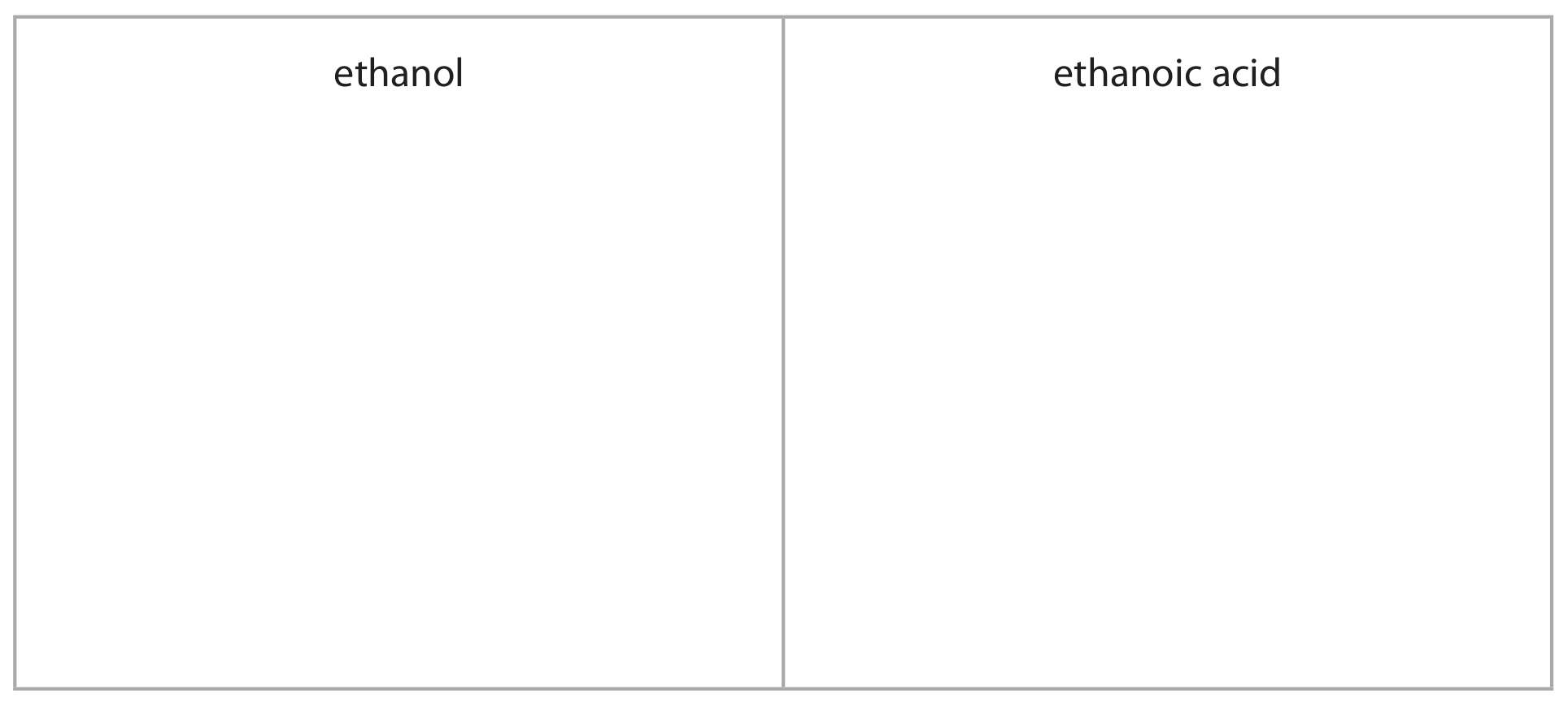
Draw the displayed formulae for ethanol and ethanoic acid in the boxes.

ethanolethanoic acid
Table
[ 2 ]

Question 5(c)

(b)

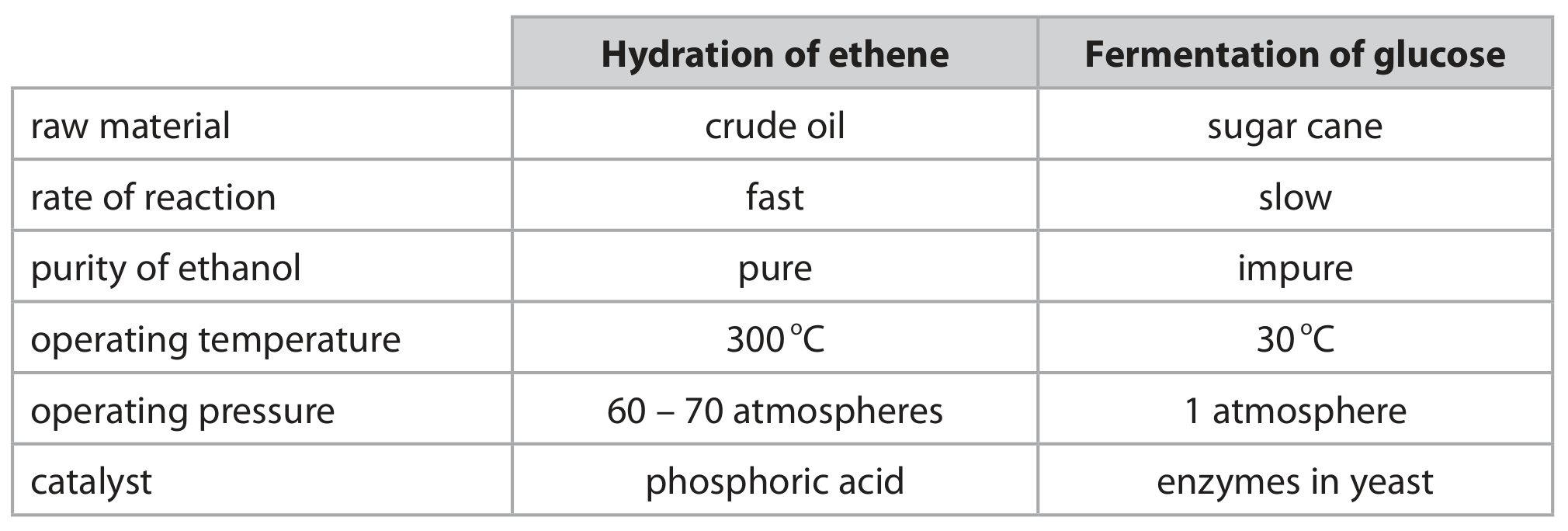
Ethanol can be manufactured by two different methods.

The table gives some information about the two methods.

Hydration of etheneFermentation of glucose
raw materialcrude oilsugar cane
rate of reactionfastslow
purity of ethanolpureimpure
operating temperature300 deg C30 deg C
operating pressure60-70 atmospheres1 atmosphere
catalystphosphoric acidenzymes in yeast
Table
[ 7 ]

Question 5(c)(i)

(i)

Discuss the advantages and disadvantages of these two methods, using information from the table.

[ 6 ]

Question 5(c)(ii)

(ii)

The word equation for the fermentation process is:

glucose -> ethanol + carbon dioxide

Complete the chemical equation for this reaction.

C6H12O6 -> ................................ + ................................

[ 1 ]
0 selected