EduNinja

IGCSE Chemistry1.42 Giant ionic latticesTopic Practice

1.42 Giant ionic lattices

Understand why compounds with giant ionic lattices have high melting and boiling points

Question 4(c)

[Maximum number: 5]

Caffeine is a stimulant found in coffee, tea and some soft drinks.

Calcium bromide is an ionic compound.

The table shows the formulae and melting points of caffeine and calcium bromide.
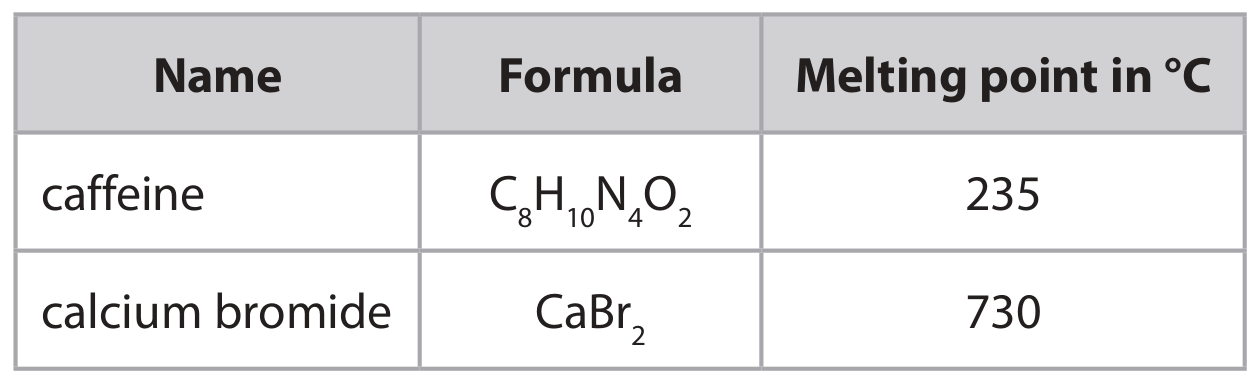
Table

The relative formula mass of calcium bromide is similar to the relative formula mass of caffeine.

Explain why calcium bromide has a much higher melting point than caffeine.
Question 5(d)(iii)

[Maximum number: 3]

This is a question about metals and their compounds.

In the absence of air, magnesium reacts with sulfur to form the ionic compound magnesium sulfide, MgS

Explain why magnesium sulfide has a very high melting point.

Question 5(e)

[Maximum number: 3]

This question is about the element phosphorus and some of its compounds.

Explain why calcium phosphide has a high melting point.

You should refer to structure and bonding in your answer.

Question 5(d)

[Maximum number: 5]

This question is about metals and metal compounds.

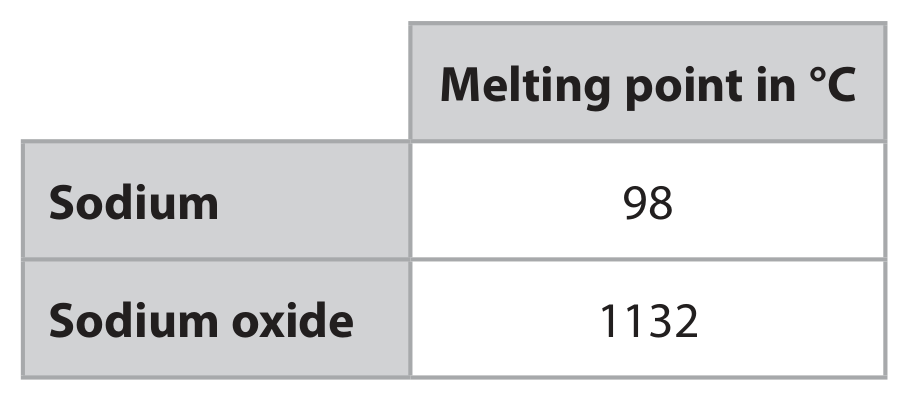
The table shows the melting points of sodium and sodium oxide.

Table

Explain why sodium and sodium oxide have different melting points.
In your answer you should refer to:
- the structures of sodium and sodium oxide
- the forces between the particles

Question 6(c)(ii)

[Maximum number: 4]

This question is about some of the Group 1 elements and their compounds.

Potassium sulfate (K2SO4)\left(\mathrm{K}_{2} \mathrm{SO}_{4}\right) is an ionic compound.

The melting point of potassium sulfate is 1069C1069^{\circ} \mathrm{C}.

Explain why potassium sulfate has a high melting point.
Refer to structure and bonding in your answer.

Question 8(b)(ii)

[Maximum number: 3]

This question is about ionic compounds.

The diagram shows the arrangement of electrons in atoms of lithium and in an atom of oxygen.

lithium atom

lithium atom

lithium atom

lithium atom

oxygen atom

oxygen atom

Lithium oxide has a giant ionic structure.

Explain why lithium oxide has a high melting point.

Question 9(b)(iii)

[Maximum number: 5]

Hydrogen chloride and magnesium chloride have different types of bonding and have different structures.

Explain why magnesium chloride has a much higher melting point than hydrogen chloride.

Refer to structure and bonding in your answer.

Question 8(b)

[Maximum number: 5]

This question is about ionic compounds.

Explain why magnesium oxide has a higher melting point than sodium chloride.

Refer to structure and bonding in your answer.

Question 11(a)(iv)

[Maximum number: 5]

This question is about the reactions of some compounds of lead.

Lead can be extracted from lead(II) sulfide, PbS , in two stages.

Stage 1 lead(II) sulfide is heated in air and reacts with oxygen to produce lead(II) oxide, PbO , and sulfur dioxide

Stage 2 lead(II) oxide is heated with carbon in a furnace

The diagram shows the structures of lead(II) sulfide and sulfur dioxide.

Lead(II) sulfide

Lead(II) sulfide

Question image
Question image
Sulfur dioxide

Sulfur dioxide

Explain, in terms of bonding and structure, why lead(II) sulfide is a solid with a very high melting point at room temperature and why sulfur dioxide is a gas at room temperature.
lead(II) sulfide
sulfur dioxide

0 selected