EduNinja

IGCSE Chemistry(c) Atomic structureTopic Practice

(c) Atomic structure

Edexcel IGCSE Chemistry (c) Atomic structure question practice helps you revise this syllabus point with the course map in view. Use this page to focus on one topic, check the style of questions available, and connect each attempt back to the knowledge area it is testing.

EduNinja keeps Chemistry practice aligned to Edexcel, so you can move from topic review into exam-style question bank work without losing the syllabus structure. Start with a small set, mark the weak steps, then return to nearby topic links when a definition, graph, calculation, or explanation needs repair.

Question 1

[Maximum number: 6]

The diagram shows the particles in an atom of an element.
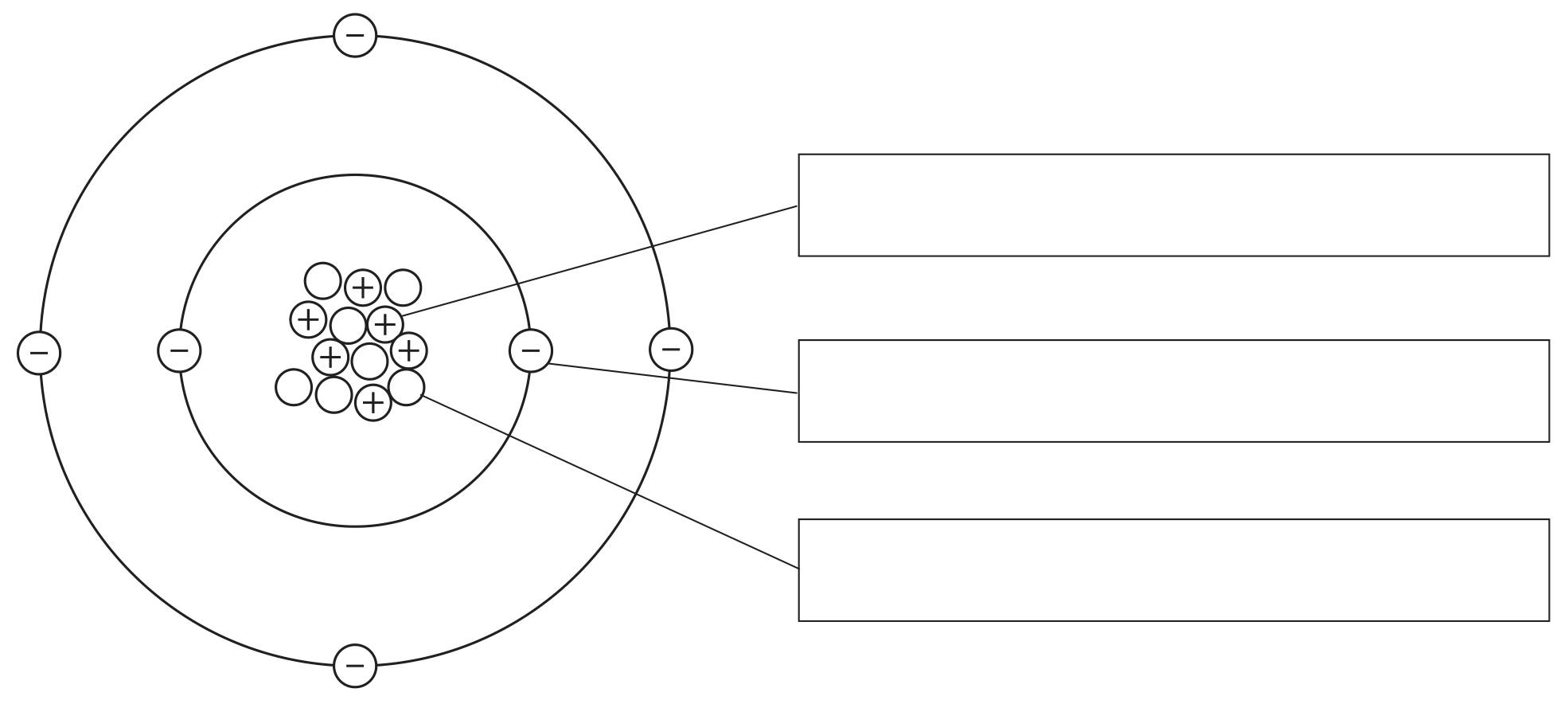
Question image

Question 1(a)

(a)

The box gives the names of some particles.

electron ion molecule neutron proton

Use words from the box to label the diagram.

Table
[ 3 ]

Question 1(b)

(b)

Give the mass number of this atom.

[ 1 ]

Question 1(c)

(c)

Complete the sentence about isotopes.

Isotopes are atoms that have the same number of ................................ but have a different number of ................................ .

[ 2 ]
Question 1

[Maximum number: 5]

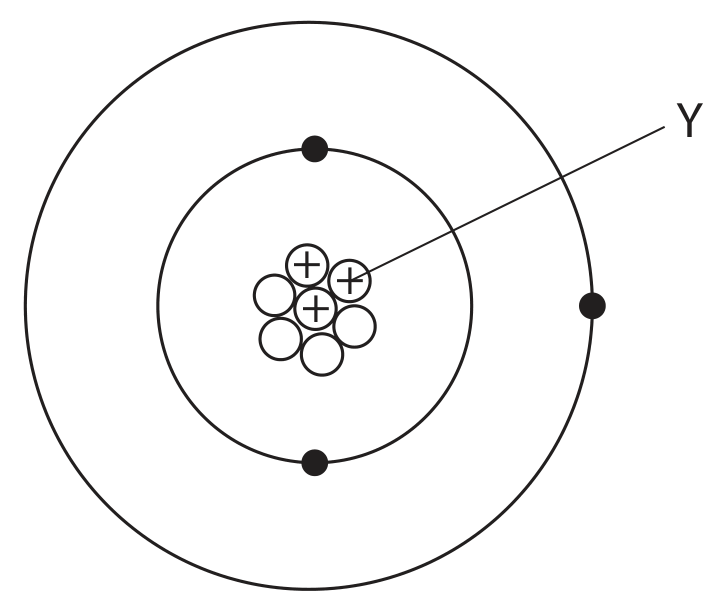
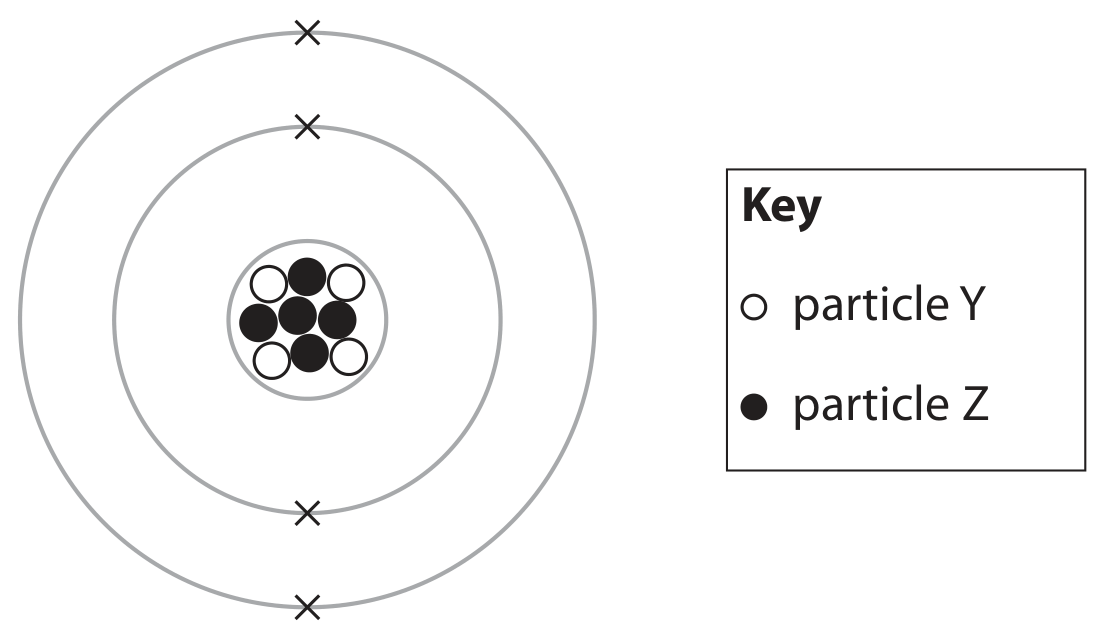
The diagram shows the particles in the atom of an element.

Question image

Question 1(a)

(a)

Particle Y is a proton.

What is particle Z ?

A

an electron

B

a molecule

C

a neutron

D

a nucleus

[ 1 ]

Question 1(b)

(b)

Which of these has the smallest mass?

A

an electron

B

a neutron

C

a nucleus

D

a proton

[ 1 ]

Question 1(c)

(c)

What is the mass number of this atom?

A

4

B

5

C

9

D

13

[ 1 ]

Question 1(d)

(d)

What is the atomic number of this atom?

A

4

B

5

C

9

D

13

[ 1 ]

Question 1(e)(i)

(e)

Identify the element that contains this atom.

[ 1 ]

Question 1(a)(iii)

[Maximum number: 1]

This question is about chemical elements.
Use the Periodic Table to help you answer this question.

Identify the element whose atoms contain 14 protons.

Question 1

[Maximum number: 5]

The diagram shows an atom of an element.

Atom diagram

Atom diagram

Question 1(a)(i)

(a)

What is the name of the particle labelled Y?

A

electron

B

ion

C

neutron

D

proton

[ 1 ]

Question 1(a)(ii)

(b)

Give the mass number of this atom.

mass number = ................................

[ 1 ]

Question 1(a)(iii)

(c)

Name this element.

Use the Periodic Table on page 2 to help you.

[ 1 ]

Question 1(b)

(d)

There are two isotopes of this element.

Give one way, in terms of sub-atomic particles, that these isotopes are the same and one way that they are different.

same ................................
different ................................

[ 2 ]

Question 1

[Maximum number: 2]

Use the Periodic Table to help you answer this question.

Question 1(a)(ii)

(a)

Name the element with a relative atomic mass of 11

[ 1 ]

Question 1(b)(i)

(b)

Determine the number of neutrons in a phosphorus atom with mass number 31

[ 1 ]

Question 1

[Maximum number: 2]

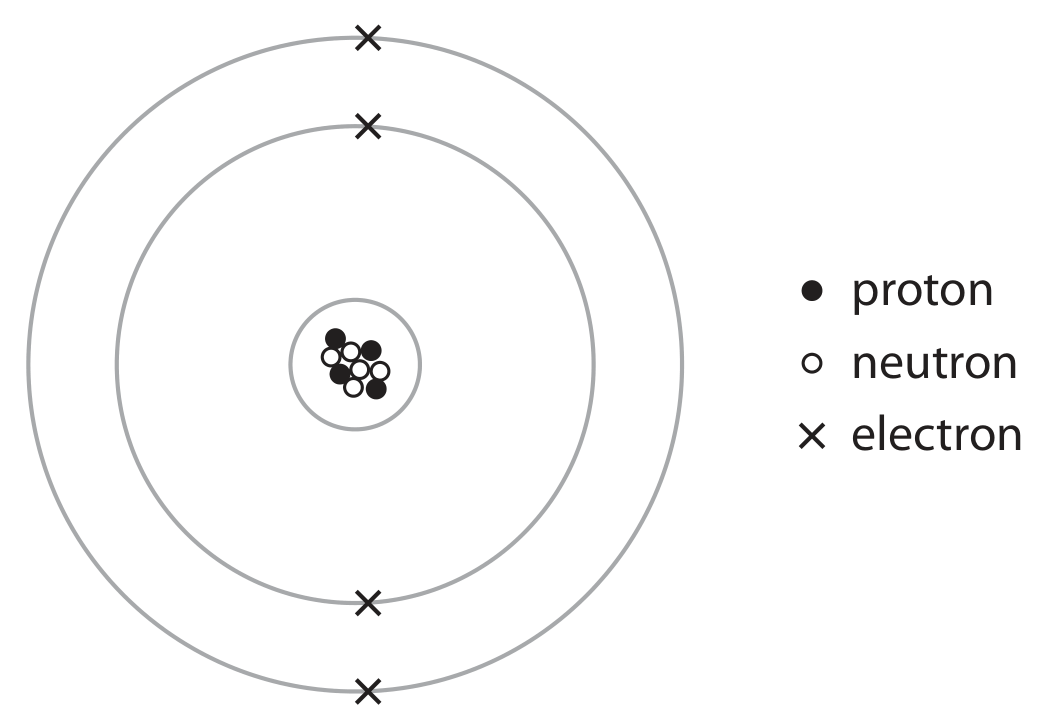
The diagram shows the electronic configuration of an atom of an element.

Question 1(a)

(a)

Name the part of the atom that contains the protons and neutrons.

Question image
[ 1 ]

Question 1(b)

(b)

Give the number of protons in this atom.

[ 1 ]

Question 1

Question 1(a)

(a)

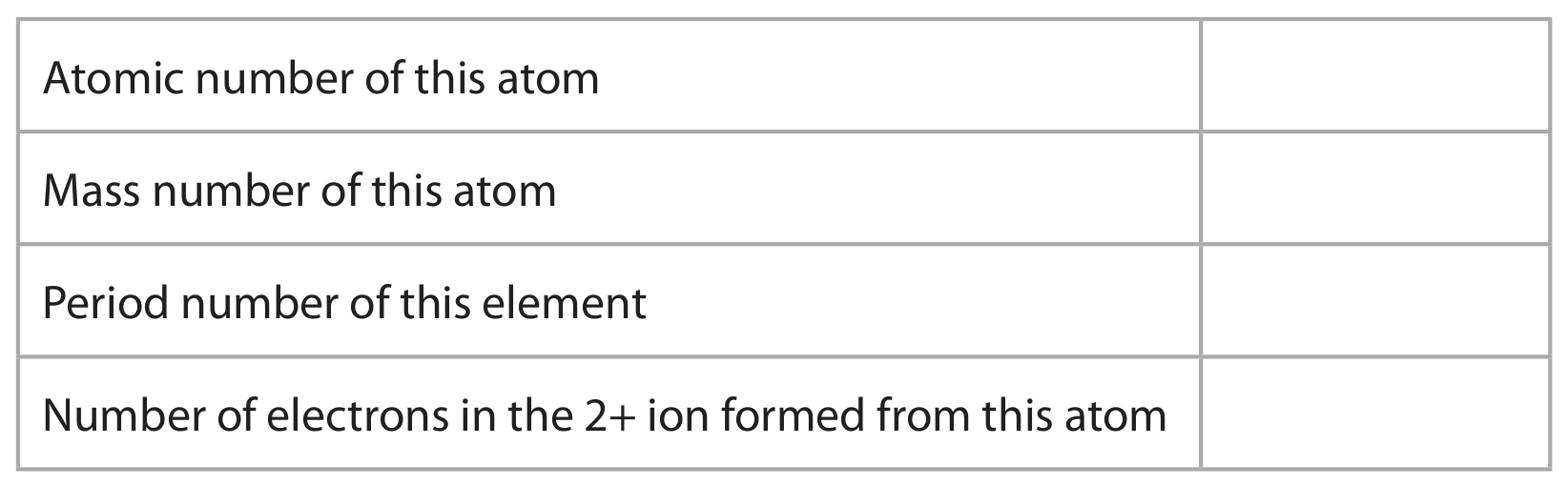
The diagram represents an atom of an element.

Use numbers from the box to complete the table.
You may use each number once, more than once or not at all.

2 4 5 9 10

PropertyValue
Atomic number of this atom................................
Mass number of this atom................................
Period number of this element................................
Number of electrons in the 2+ ion formed from this atom................................
Question image
Table
Table
[ 4 ]

Question 1(b)

(b)

In terms of sub-atomic particles, state a similarity and a difference for isotopes of the same element.

similarity ................................
difference ................................

[ 2 ]

Question 1

[Maximum number: 5]

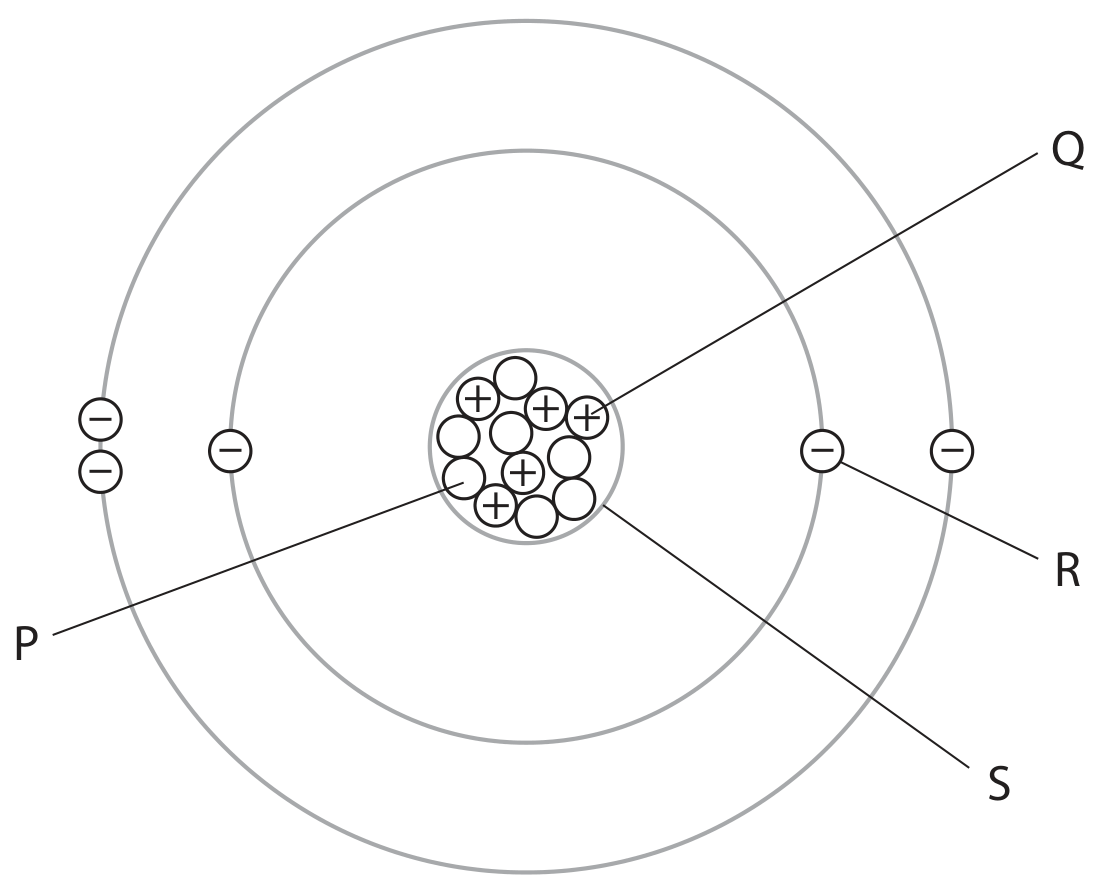
The diagram shows the sub-atomic particles in an atom of an element.

Question image

Question 1(a)(i)

(a)

Give the name of each of the sub-atomic particles labelled P, Q and R.

P
Q
R

[ 3 ]

Question 1(a)(ii)

(b)

Give the name of the part of the atom labelled S.

[ 1 ]

Question 1(b)

(c)

Give the name of this element.

[ 1 ]

Question 1

Question 1(b)

(a)

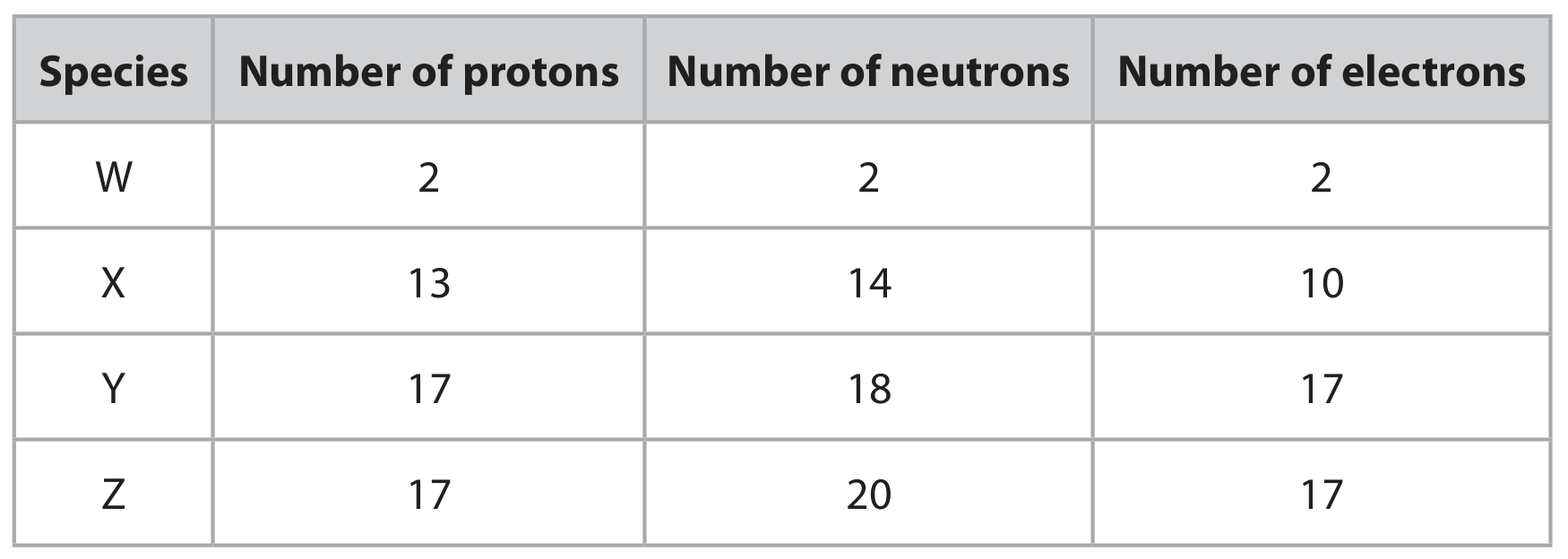
The table gives information about four different species, W, X, Y and Z.

Table
[ 3 ]

Question 1(b)(i)

(i)

Give the mass number of W .

[ 1 ]

Question 1(b)(iii)

(ii)

Explain why Y and Z are isotopes of the same element.

[ 2 ]

Question 1(a)

[Maximum number: 1]

This question is about Group 7, the halogens.

What is the total number of electrons in one fluorine atom?

A

7

B

9

C

10

D

19

0 selected