EduNinja

IGCSE Chemistry1.17 Relative atomic massTopic Practice

1.17 Relative atomic mass

Be able to calculate the relative atomic mass of an element (Ar) from isotopic abundances

Question 2(c)(ii)

[Maximum number: 3]

Thallium, TI, is an element in Group 3 and Period 6 of the Periodic Table.
The atomic number of thallium is 81

A sample of thallium contains two isotopes.

The table shows the mass number and percentage abundance of each isotope in the sample.

IsotopeMass numberPercentage abundance (%)
thallium-20320330.80
thallium-20520569.20
Table

Calculate the relative atomic mass of this sample of thallium.

Give your answer to one decimal place.
relative atomic mass =
Question 2(c)

[Maximum number: 3]

A sample of neon contains two isotopes, 20Ne{ }^{20} \mathrm{Ne} and 22Ne{ }^{22} \mathrm{Ne}

The relative abundances of the two isotopes in the sample are

20Ne91.2%22Ne8.80%{ }^{20} \mathrm{Ne} 91.2 \% \quad{ }^{22} \mathrm{Ne} 8.80 \%

Calculate the relative atomic mass of this sample of neon.
Give your answer to one decimal place.
(ii) Give the mass number of Z.
(iii) Give the letter of the species that is a positive ion. L

Question 2(b)

[Maximum number: 3]

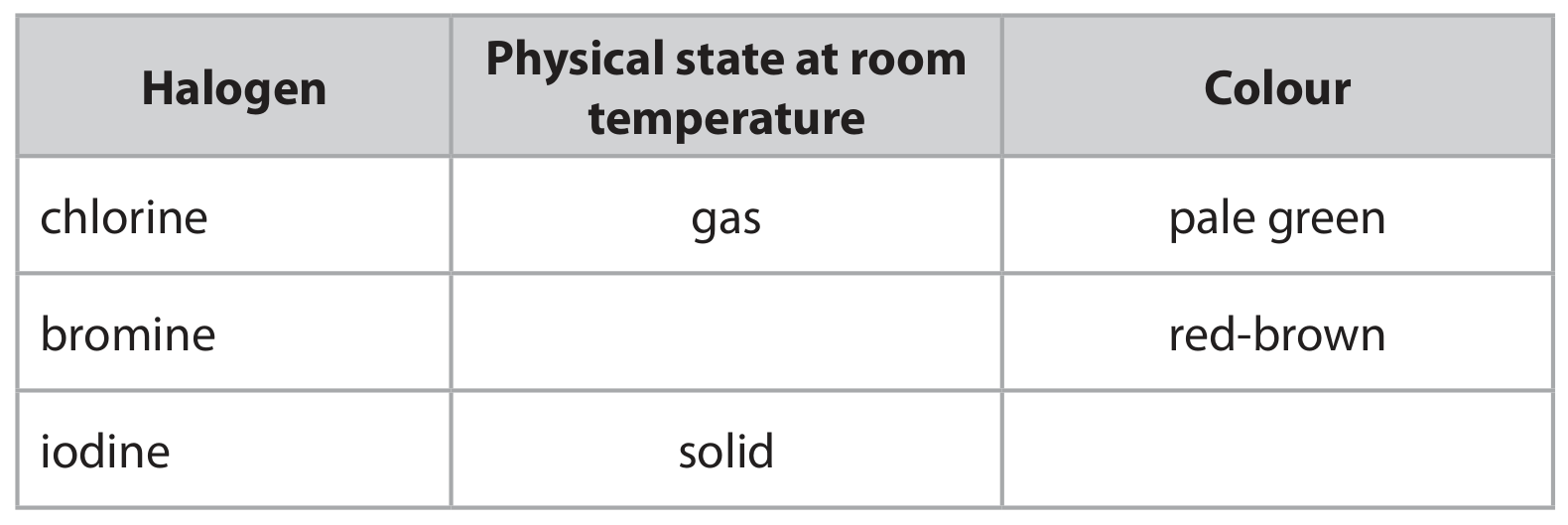
The table gives some information about the halogens, chlorine, bromine and iodine.

HalogenPhysical state at room temperatureColour
chlorinegaspale green
bromine................................red-brown
iodinesolid................................
Table

Chlorine has two isotopes of mass numbers 35 and 37.

The relative percentage of each isotope in a sample of chlorine is:
- chlorine-35: 77.78%
- chlorine-37: 22.22%

Calculate the relative atomic mass of this sample of chlorine.
Give your answer to one decimal place.

relative atomic mass = ................................
Question 2

[Maximum number: 6]

This question is about the halogens.

Question 2(c)

(a)

A sample of bromine atoms contains 42.0% bromine- 79 and 58.0% bromine- 81. Calculate the relative atomic mass of this sample of bromine atoms.

Give your answer to three significant figures.
relative atomic mass =

[ 3 ]

Question 2(d)

(b)

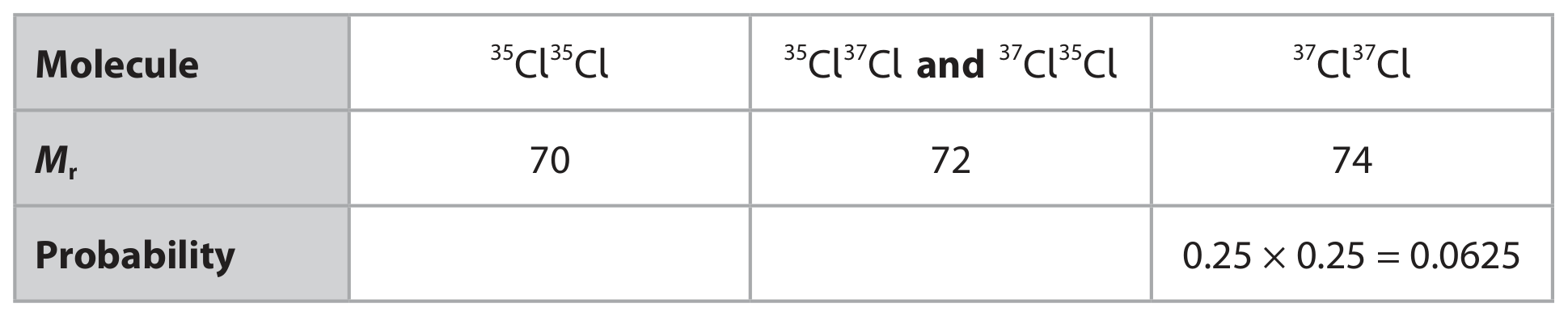
A sample of chlorine contains 0.75 mol of 35Cl{ }^{35} \mathrm{Cl} atoms and 0.25 mol of 37Cl{ }^{37} \mathrm{Cl} atoms.

The table gives the relative molecular masses ( MrM_{\mathrm{r}} ) of the different diatomic molecules of chlorine.

The table also gives the probability of having a molecule of 37Cl37Cl{ }^{37} \mathrm{Cl}^{37} \mathrm{Cl} in this sample.

Table
[ 3 ]

Question 2(d)(i)

(i)

Calculate the probability of having a molecule with an MrM_{r} of 70
probability =

[ 1 ]

Question 2(d)(ii)

(ii)

Explain why the probability of a molecule having an MrM_{\mathrm{r}} of 72 is not 0.1875

[ 2 ]

Question 2(b)

[Maximum number: 2]

The diagram represents an atom of boron.

Question image

Boron has two isotopes, boron-10 and boron-11.

A sample of boron contains 18.7% of boron-10 and 81.3% of boron-11.

Calculate the relative atomic mass of this sample of boron.

relative atomic mass = ................................

Question 2(c)(ii)

[Maximum number: 3]

Q and R represent isotopes of the same element.

A sample containing the isotopes Q and R has this percentage composition by mass.

Q = 20.6%
R = 79.4%

Calculate the relative atomic mass (Ar) of this sample of the element.
Give your answer to one decimal place.

Ar = ................................

Question 2(b)(ii)

[Maximum number: 2]

These are the symbols for the two isotopes of lithium.

A sample of lithium contains 7.5 % of 36Li{ }_{3}^{6} \mathrm{Li} and 92.5 % of 37Li{ }_{3}^{7} \mathrm{Li}

Calculate the relative atomic mass (Ar)\left(A_{\mathrm{r}}\right) of this sample of lithium.

Question 2(b)

[Maximum number: 3]

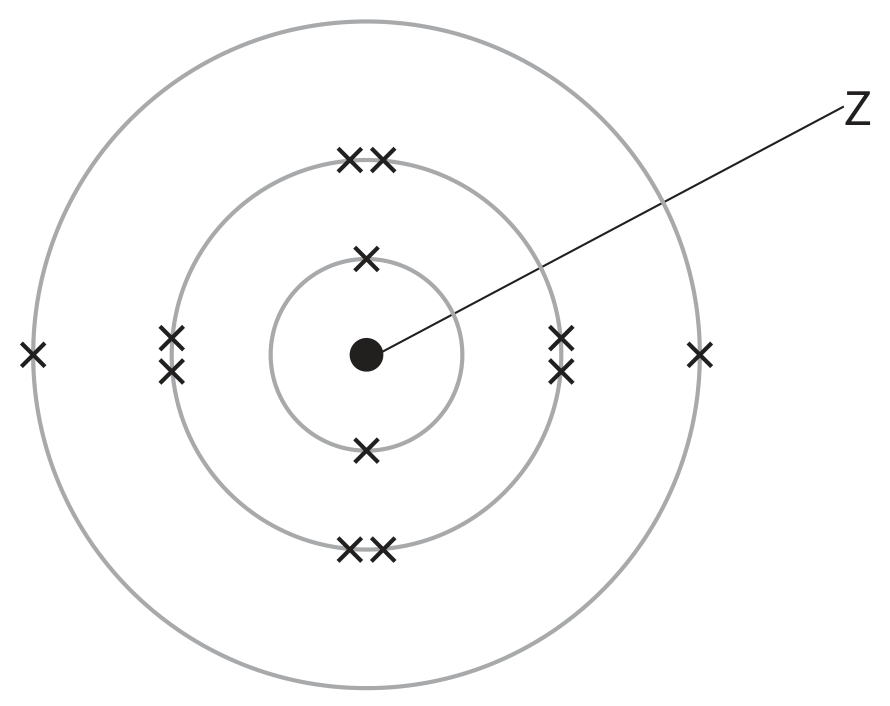
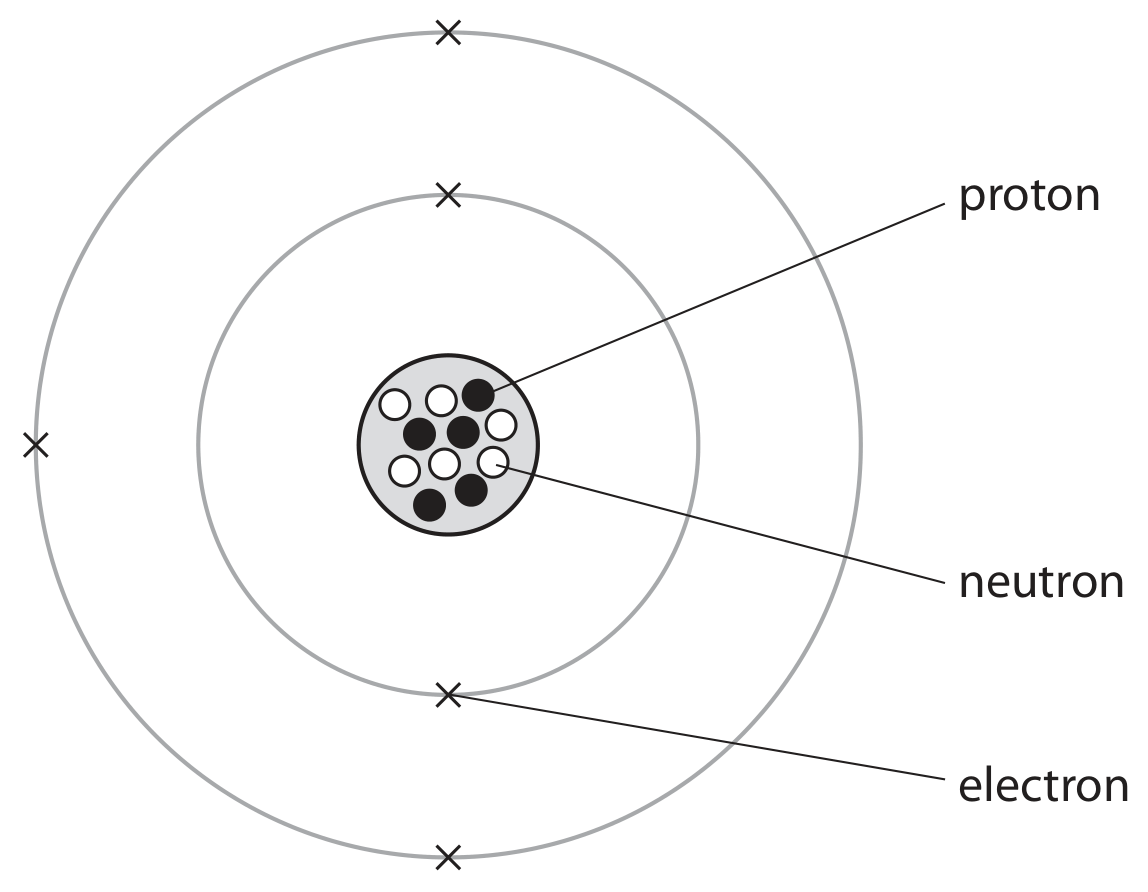
The diagram shows the electronic configuration of an atom of an element.

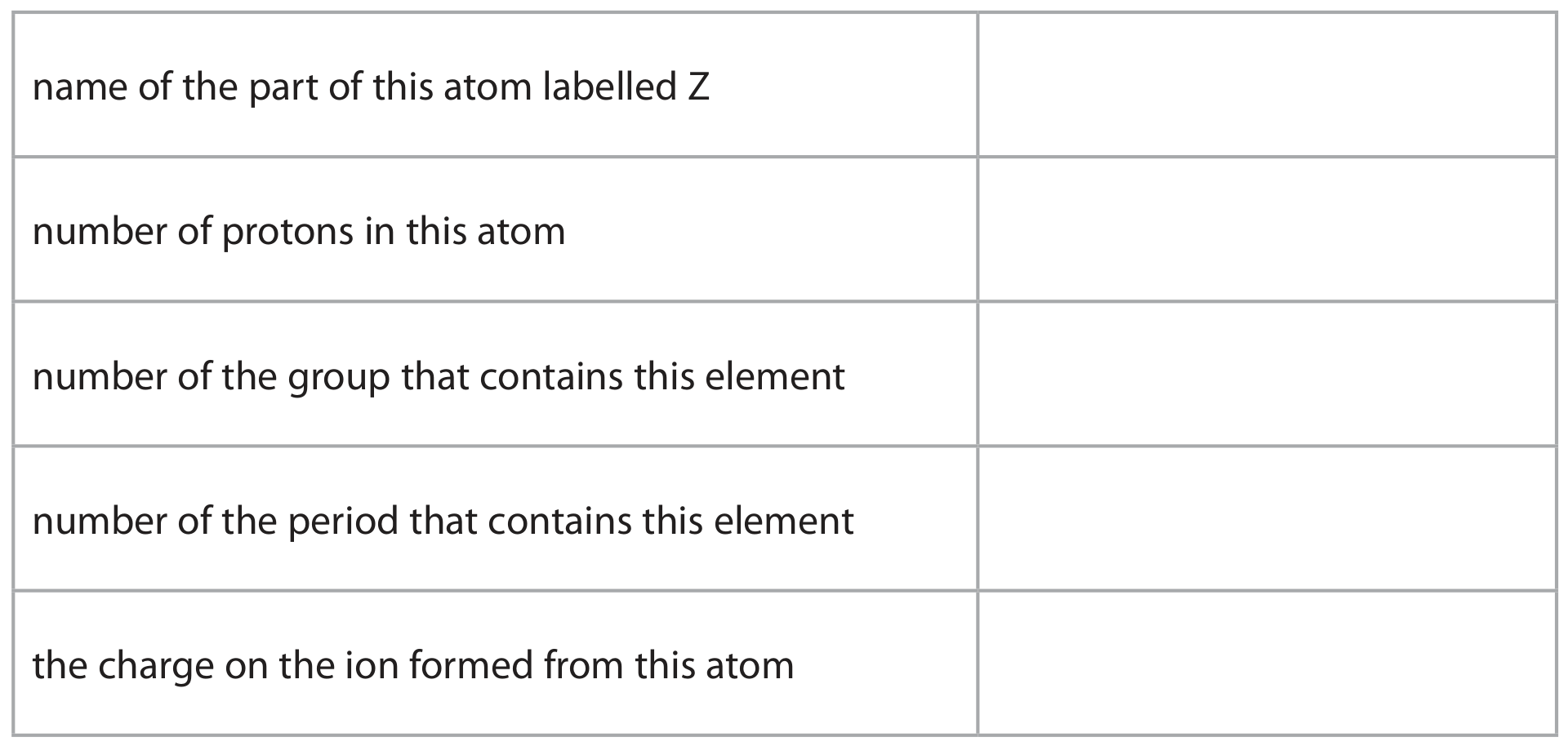
(a) Complete the table by giving the missing information about this atom.

InformationAnswer
name of the part of this atom labelled Z................................
number of protons in this atom................................
number of the group that contains this element................................
number of the period that contains this element................................
the charge on the ion formed from this atom................................
Question image
Table

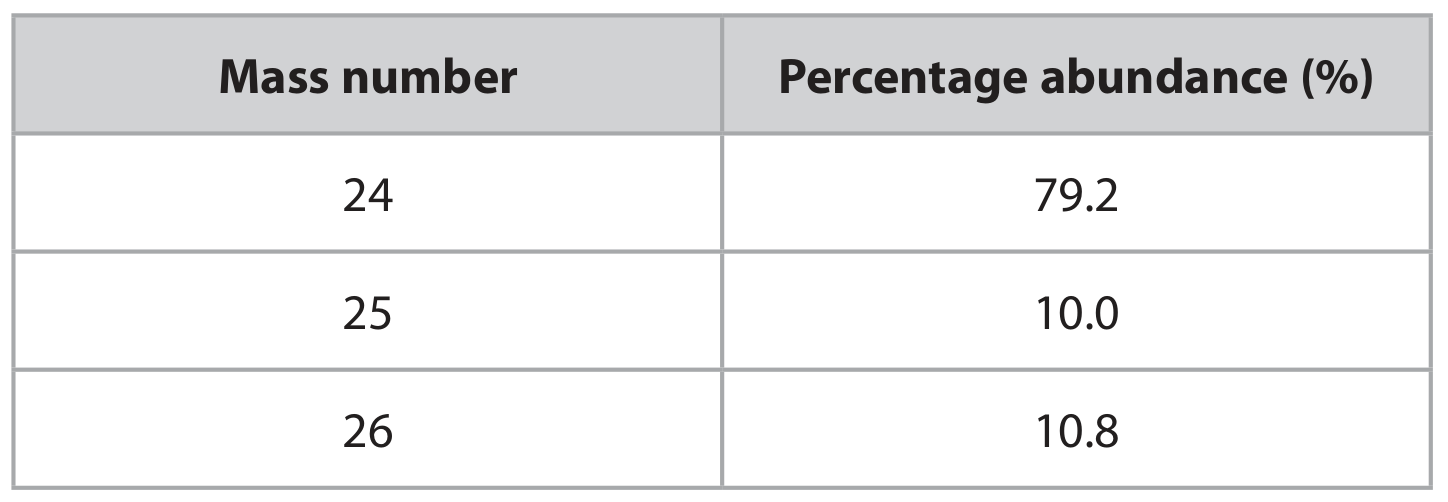
This element has three isotopes.

The table shows the mass number and percentage abundance of each isotope in a sample of this element.

Mass numberPercentage abundance (%)
2479.2
2510.0
2610.8

Calculate the relative atomic mass (Ar) of this element.
Give your answer to one decimal place.

relative atomic mass = ................................
Table

Question 3(a)(ii)

[Maximum number: 3]

This question is about Group 2 elements and their compounds.

A sample of magnesium contains three isotopes.

Table

Calculate the relative atomic mass (Ar)\left(A_{r}\right) of magnesium.

Give your answer to one decimal place.

Ar=A_{r}=

Question 4(c)

[Maximum number: 3]

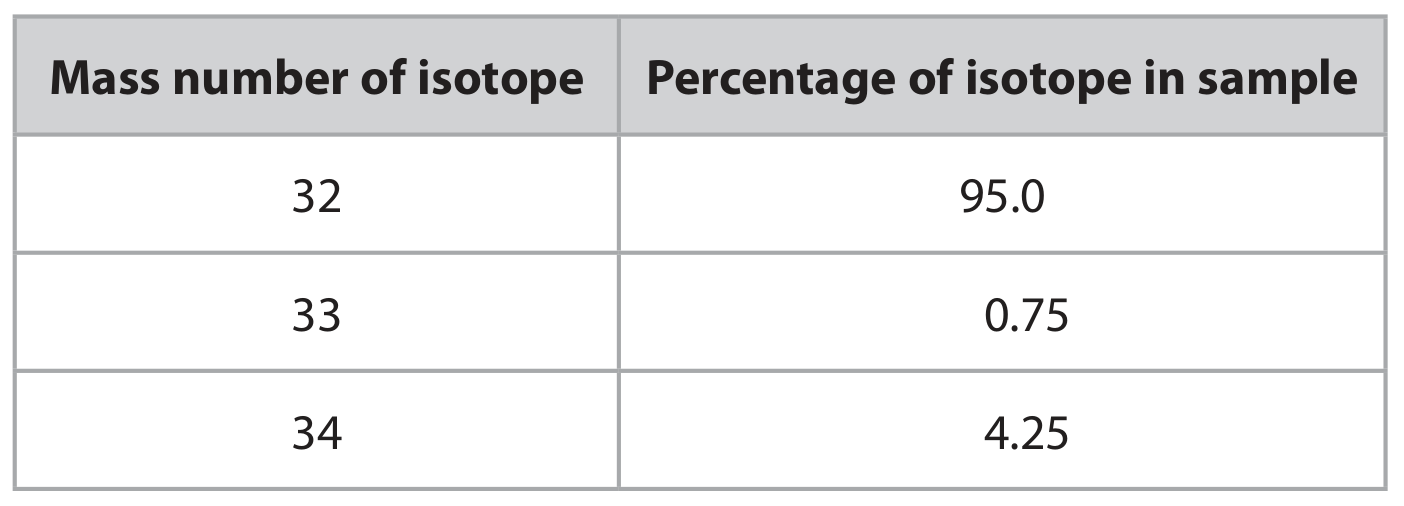
The table shows the composition of a sample of a different element, Y, containing three isotopes.

Mass number of isotopePercentage of isotope in sample
3295.0
330.75
344.25

Using information from the table, calculate the relative atomic mass (Ar) of this sample of element Y.

Give your answer to one decimal place.

Ar = ................................

Table
0 selected