
Edexcel IGCSE Chemistry Tangents and Rate of Change

Edexcel IGCSE Chemistry Tangents and Rate of Change
Edexcel IGCSE Chemistry syllabusChemistry 4CH1Issue 3 (2024)

Practise Edexcel IGCSE Chemistry tangents and rate of change by drawing tangents to curves and calculating reaction-rate gradients.

How this is tested

  • Draw a tangent to a reaction curve at a stated time before calculating the gradient.
  • Calculate rate of reaction from change in y divided by change in x on the tangent.
  • Give correct rate units from the graph axes, such as cm³/s, cm³/minute, g/s or g/minute.

Question 7(b)(iii)

[Maximum number: 3]

A student reacts small chips of calcium carbonate with an excess of dilute hydrochloric acid.

This is the student's method.
- add 5.00 g of small calcium carbonate chips to a conical flask
- add 30 cm330 \mathrm{~cm}^{3} of dilute hydrochloric acid which is in excess
- quickly add a cotton wool plug and place the conical flask on a balance
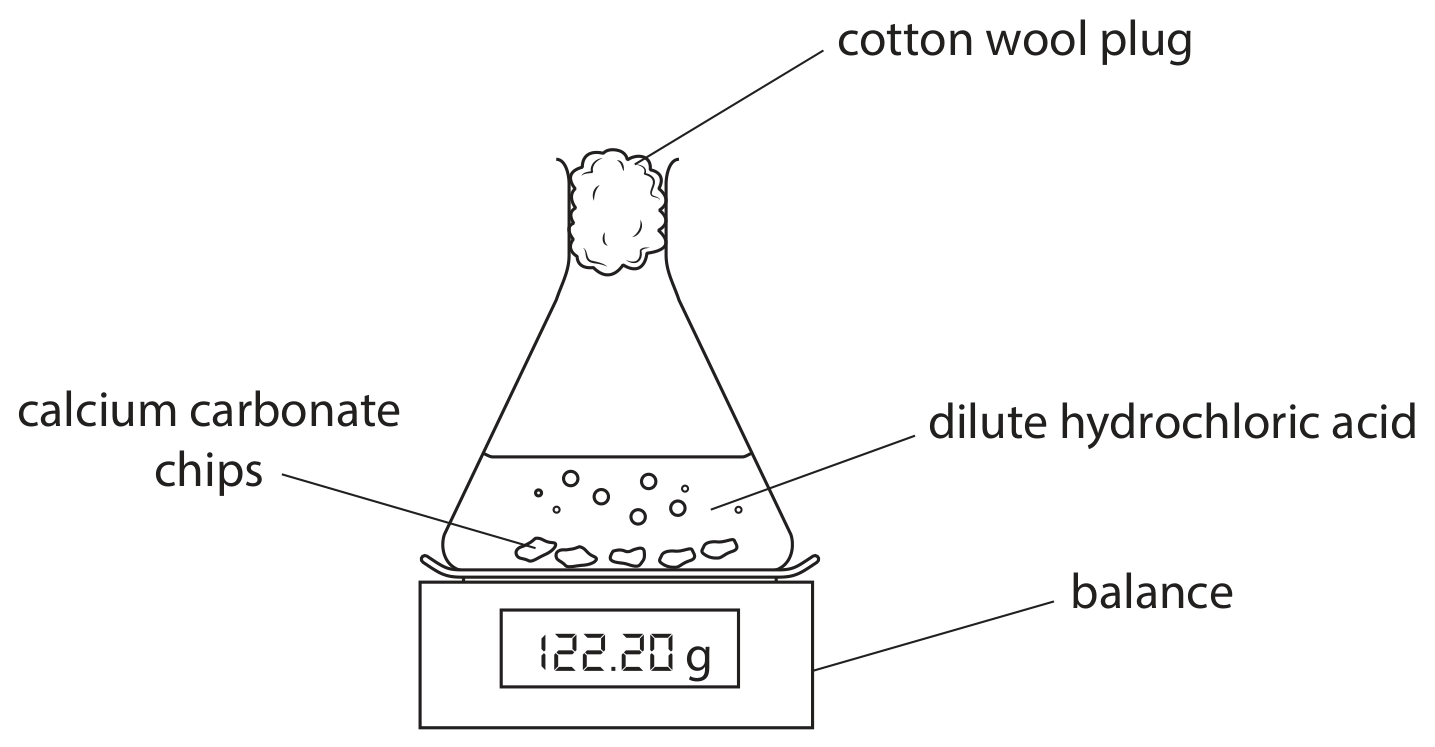
Figure for Question 7(b)(iii) — Edexcel IGCSE Chemistry

This is the equation for the reaction.

CaCO3( s)+2HCl(aq)CaCl2(aq)+H2O(l)+CO2( g)\mathrm{CaCO}_{3}(\mathrm{~s})+2 \mathrm{HCl}(\mathrm{aq}) \rightarrow \mathrm{CaCl}_{2}(\mathrm{aq})+\mathrm{H}_{2} \mathrm{O}(\mathrm{l})+\mathrm{CO}_{2}(\mathrm{~g})

The reading on the balance decreases as carbon dioxide gas is lost through the cotton wool plug.

The student repeats the experiment with a different mass of calcium carbonate and a different volume of dilute hydrochloric acid.
The hydrochloric acid is in excess.
The student records the total mass of carbon dioxide produced at 1-minute intervals for 8 minutes.

The table shows the student's results.
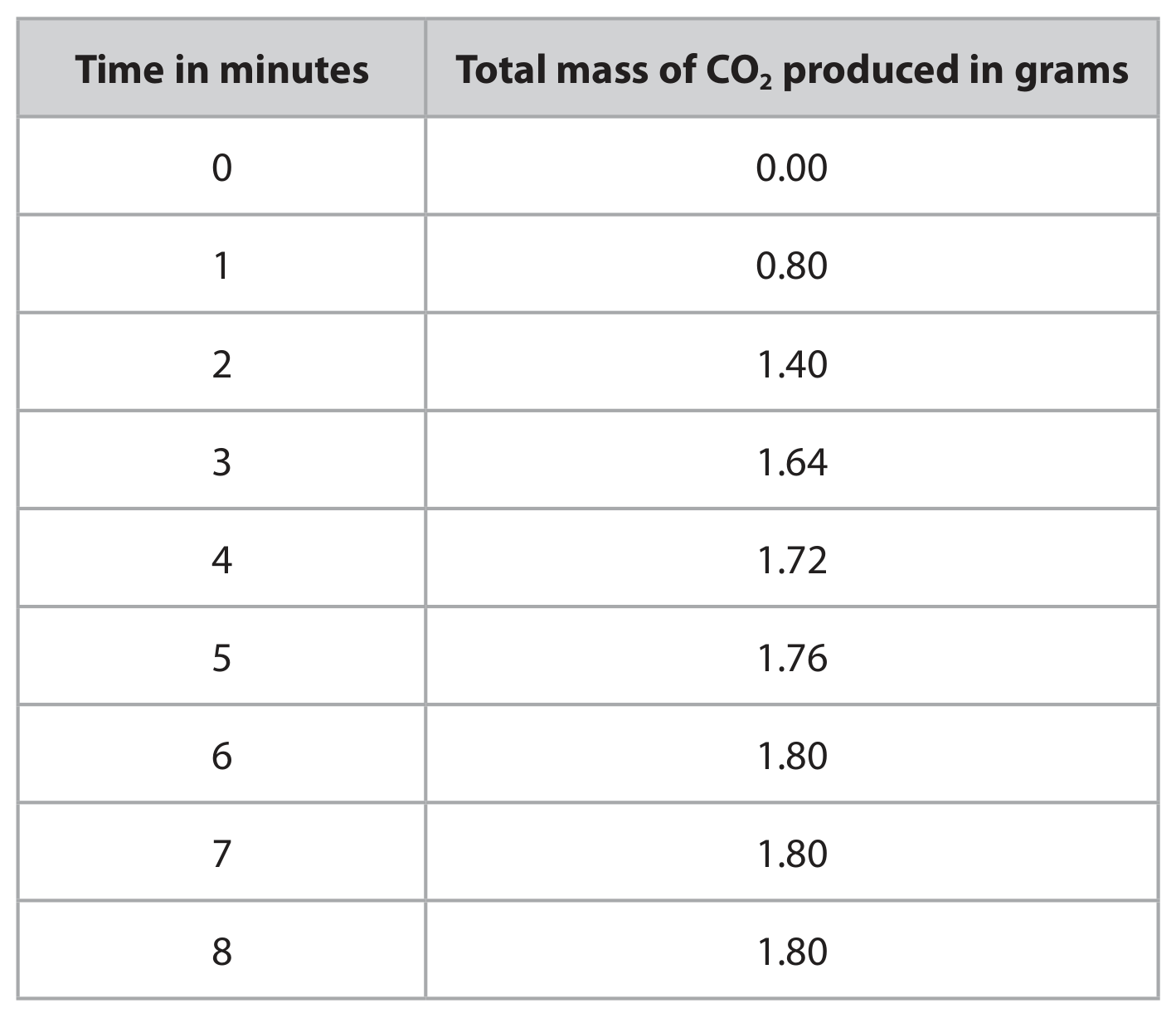
Table for Question 7(b)(iii) — Edexcel IGCSE Chemistry

Calculate the rate of reaction at 2 minutes by drawing a tangent to the curve and calculating the gradient of the tangent.

Give the units for the rate of reaction.