

Question 9(a)(i)
[Maximum number: 2]
This question is about rates of reaction.
A student uses this method to investigate the rate of reaction between iron(III) nitrate solution and sodium thiosulfate solution.
- pour 50 cm3 of iron(III) nitrate solution into a conical flask
- add one drop of catalyst solution
- add 50 cm3 of sodium thiosulfate solution to the conical flask
- record the time for the mixture to become colourless
The student repeats the method using different catalysts and also with no catalyst.
The table shows the student's results.
| Catalyst | Time for mixture to become colourless / s |
|---|---|
| no catalyst | 55 |
| cobalt(II) chloride solution | 32 |
| copper(II) sulfate solution | 8 |
| iron(II) sulfate solution | 27 |
| zinc nitrate solution | 75 |
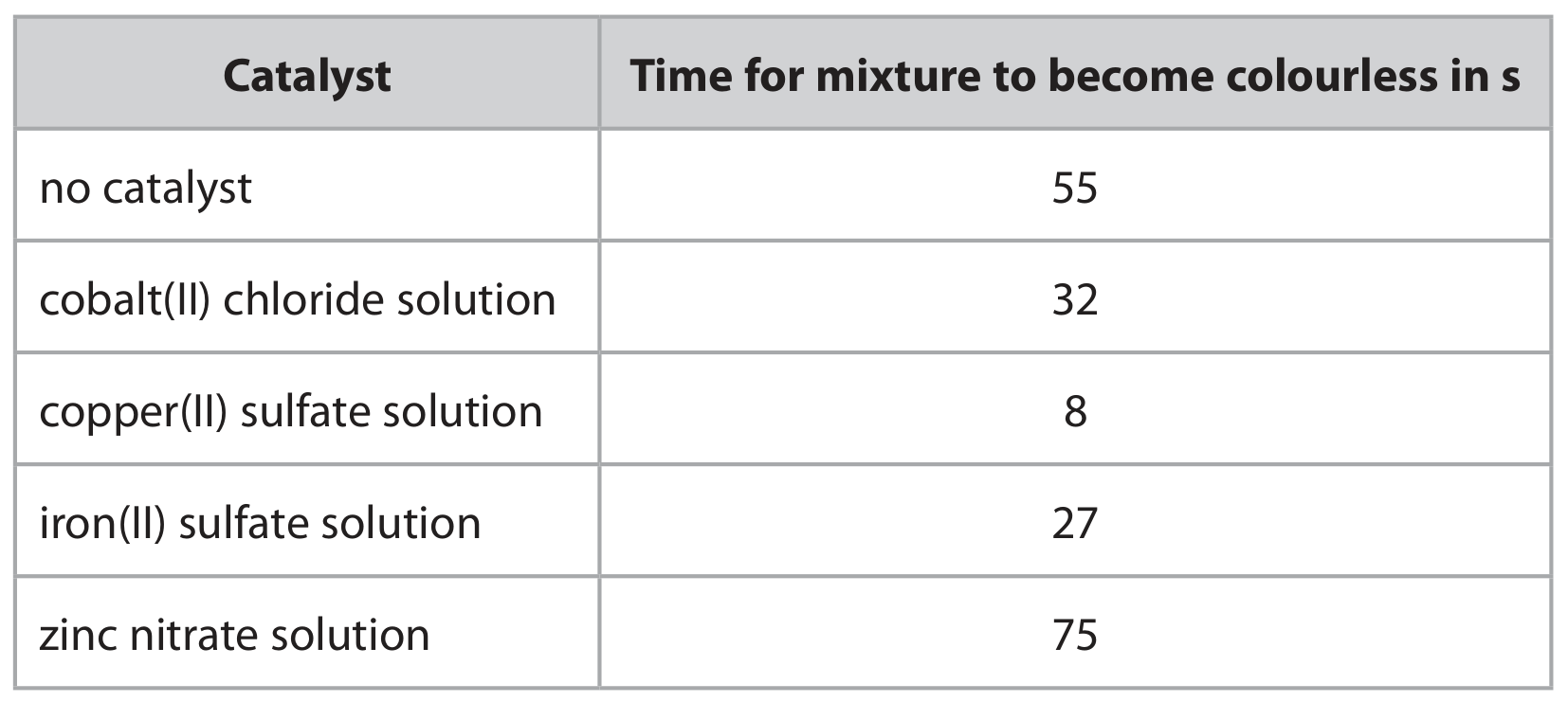
Explain which is the best catalyst for the reaction.