Question 1(a)
Read the passage below. Use the information in the passage and your own knowledge to answer the questions that follow.
Rivers - the arteries of the world
Rivers are important supplies of water for drinking, farming, industry, and leisure activities. Like our circulatory system, rivers are essential for transport, and have a homeostatic effect on nature. The biodiversity in rivers is high as they are the habitat for many different species. In many countries rivers are under threat from human impact, particularly the release of untreated sewage.
Flooding can cause untreated sewage to run into rivers from pipelines. Scientists estimated that in England and Wales during 2022, sewage was released into rivers for a total time of 300000 hours. This sewage came from 1200 different pipelines. Untreated sewage may contain fertilisers, pesticides, pathogenic bacteria, and pharmaceutical drugs.
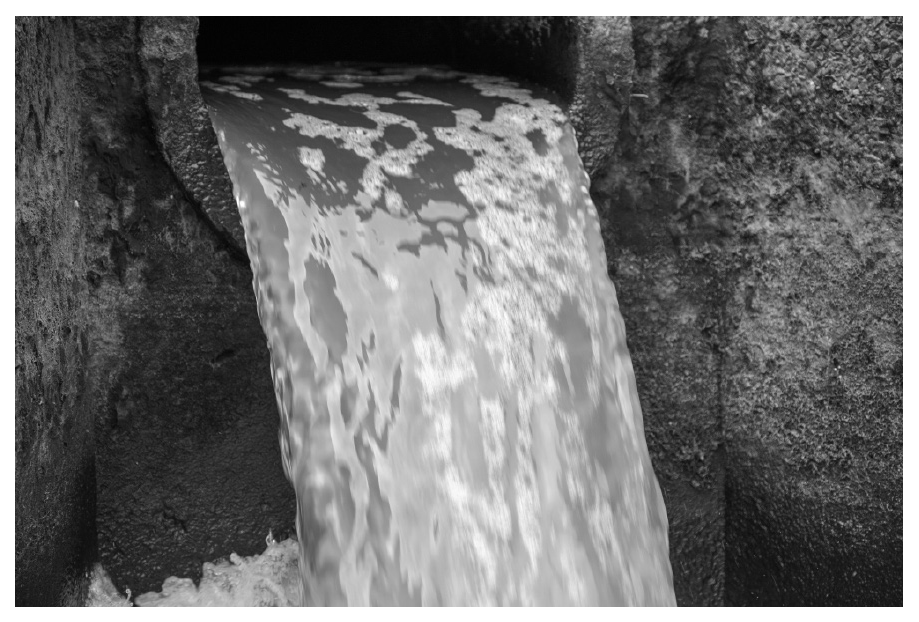
The photograph shows sewage being released into a river. The sewage causes the growth of something called 'sewage fungus'. Sewage fungus looks like fungus but is a solid collection of several types of anaerobic bacteria. Sewage fungus is common in rivers that are polluted with untreated sewage or are near to cattle and intensive crop farms. If sewage fungus is found in a river it often indicates that the biodiversity of the river will be low.
Pesticides from agriculture are also released into rivers, and these are frequently transferred through natural food chains. Even pharmaceutical drugs, such as those containing the hormones oestrogen and progesterone, have been found in polluted rivers. These drugs must have been consumed by humans, excreted and then released into the sewage flowing into rivers.
Untreated sewage can also contain pathogenic species of bacteria that then enter rivers. If humans are infected with these bacteria, the large intestine absorbs less water, causing diarrhoea. Some of the bacteria found in sewage are resistant to antibiotics.
Scientists are looking for ways to prevent river pollution. One way is to reduce the risk of pollution from fertilisers and from cattle urine and faeces. Woodchip bioreactors are being trialled in agricultural fields that are near to rivers. These bioreactors are pits filled with woodchips and denitrifying bacteria. Water drains through these bioreactors, which helps to remove nitrates before they reach the rivers. In some countries, efforts are being made to replant forests in areas upstream of rivers to reduce river flooding and the risk of untreated sewage release.
Rivers have a homeostatic effect on nature. This is similar to the role of homeostasis in humans.
State what is meant by the term homeostasis (lines 2 and 3).