EduNinja

IGCSE Biology(f) RespirationTopic Practice

(f) Respiration

Edexcel IGCSE Biology (f) Respiration question practice helps you revise this syllabus point with the course map in view. Use this page to focus on one topic, check the style of questions available, and connect each attempt back to the knowledge area it is testing.

EduNinja keeps Biology practice aligned to Edexcel, so you can move from topic review into exam-style question bank work without losing the syllabus structure. Start with a small set, mark the weak steps, then return to nearby topic links when a definition, graph, calculation, or explanation needs repair.

Question 1(c)

[Maximum number: 2]

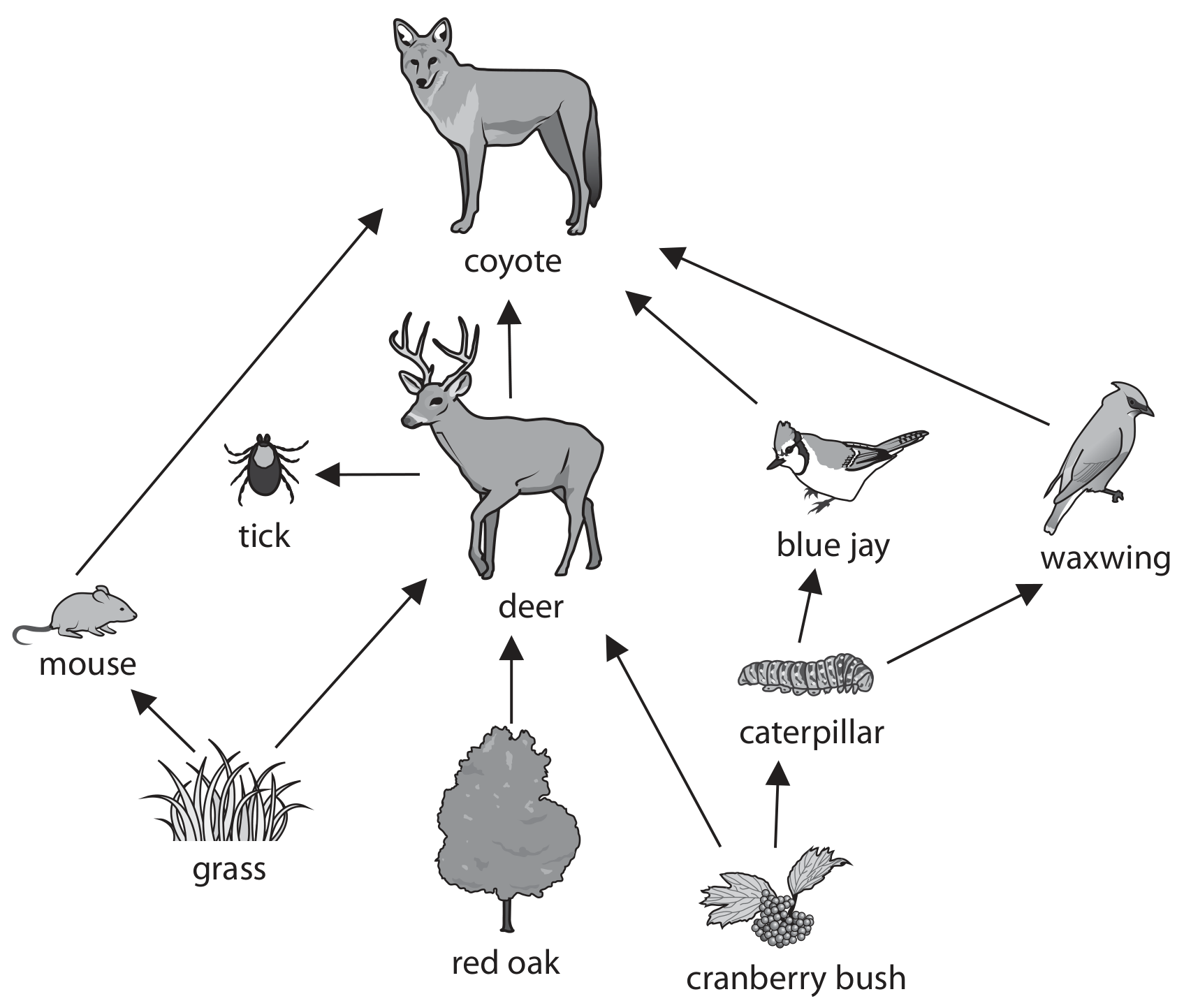
The diagram shows a forest food web.

Question image

The coyote will not catch the deer if too much lactic acid builds up in its muscles.

Explain why lactic acid builds up in the coyote's muscles when it runs.
(ii) A coyote runs 530 metres in 30.0 seconds trying to catch a deer.
Calculate the speed of this coyote in metres per second.

Question 1(c)

[Maximum number: 2]

Read the passage below. Use the information in the passage and your own knowledge to answer the questions that follow.

Physic Gardens

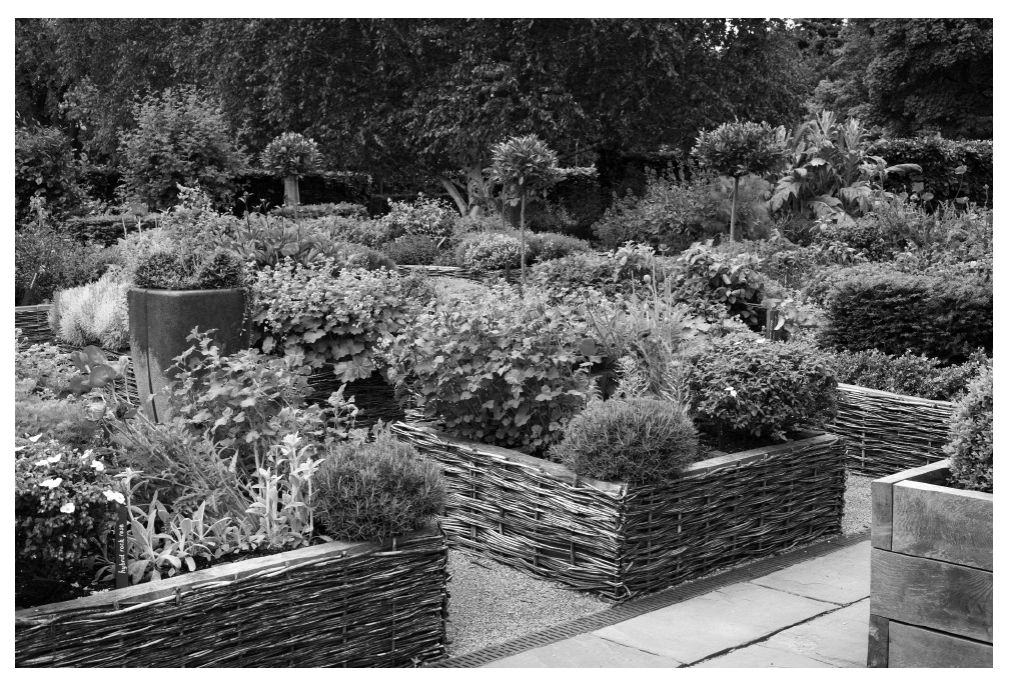
The photograph shows a physic garden. Physic gardens are places where people grow many types of plants that produce medicinal drugs.

Question image

People have grown medicinal plants in physic gardens for thousands of years. It was estimated in 2016 that out of 30000 plant species that are known to be useful to humans, 17000 of these plant species have medicinal uses.

Medicinal plants produce a wide range of types of drugs including alkaloids, glycosides, terpenes and polyphenols.

Alkaloids are bitter-tasting, alkaline chemicals found in many different plant species. Alkaloids are often toxic in high doses so care needs to be taken when using them. Examples of alkaloids are caffeine and quinine. Caffeine, found in tea and coffee, can stimulate the adrenal glands. Quinine from the bark of the cinchona tree has been used for many centuries to kill the parasite that causes malaria.

An example of a glycoside drug is senna. This drug is extracted from the Senna plant and is used to treat constipation. The drug affects muscles in the intestine.

Terpenes are chemicals that often have strong smells. Terpenes are thought to have evolved to prevent herbivore animals from eating certain plants. An example of a plant that produces terpenes is thyme. The terpenes in thyme have an antiseptic effect which means they can be used to sterilise wounds.

Phytoestrogens are molecules found in plants such as angelica and have been used for many years to treat problems with human fertility. Examples of polyphenols are phytoestrogens, taxol and curcumin. Polyphenols have many roles within plants and many are used as medicines. Taxol is a drug extracted from yew trees and is used to prevent cell division in human body cell tumours.

25 Curcumin is a drug produced by the turmeric plant. Curcumin can help widen the airways to the lungs so can help people with asthma breathe.

Scientists are looking to reproduce many of these drugs artificially. They are developing genetically modified bacteria containing genes that will allow these drugs to be mass produced in fermenters.

Explain how the drug senna helps to reduce constipation (lines 14 to 15).

Question 2(b)(i)

[Maximum number: 2]

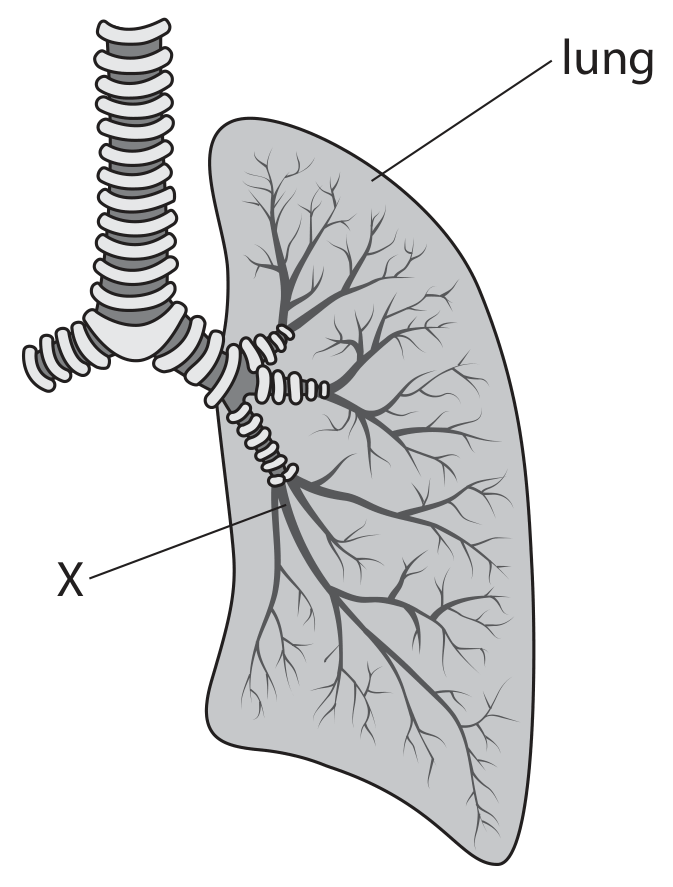
The diagram shows parts of the human respiratory system with some structures labelled.

Question image

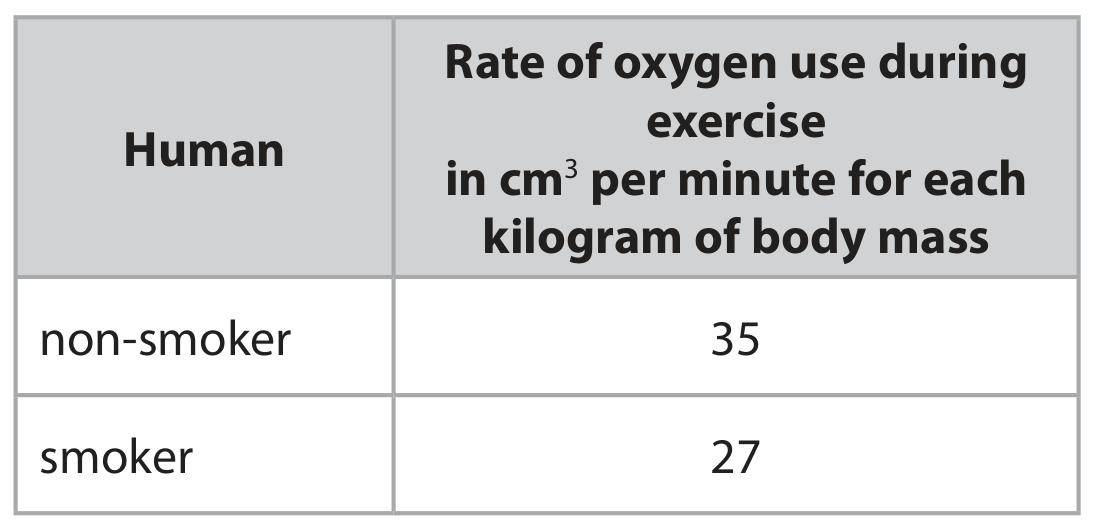
A scientist compared the rate at which oxygen is used during exercise by a person who is a non-smoker with a person who is a smoker.

The rate is measured in cm3\mathrm{cm}^{3} per minute for each kilogram of body mass.
The table shows the scientist's results.

Table

Calculate the volume of oxygen used in 30 minutes by a non-smoker with a mass of 70 kg .
volume = cm3\mathrm{cm}^{3}

Question 3

[Maximum number: 7]

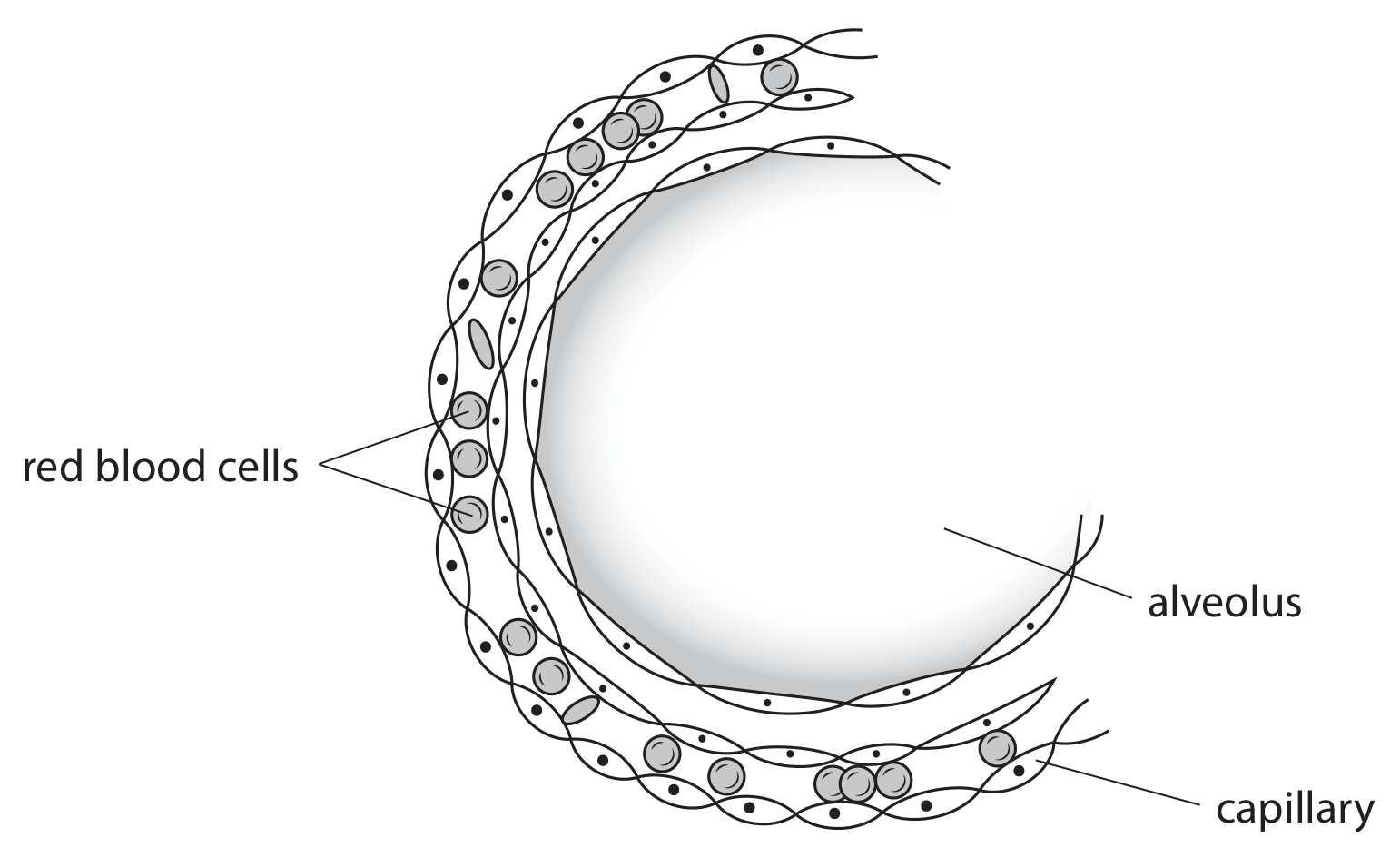
Alveoli are involved in gas exchange.
The diagram shows a section through one alveolus and its associated blood capillary.

Question image

Question 3(d)

(a)

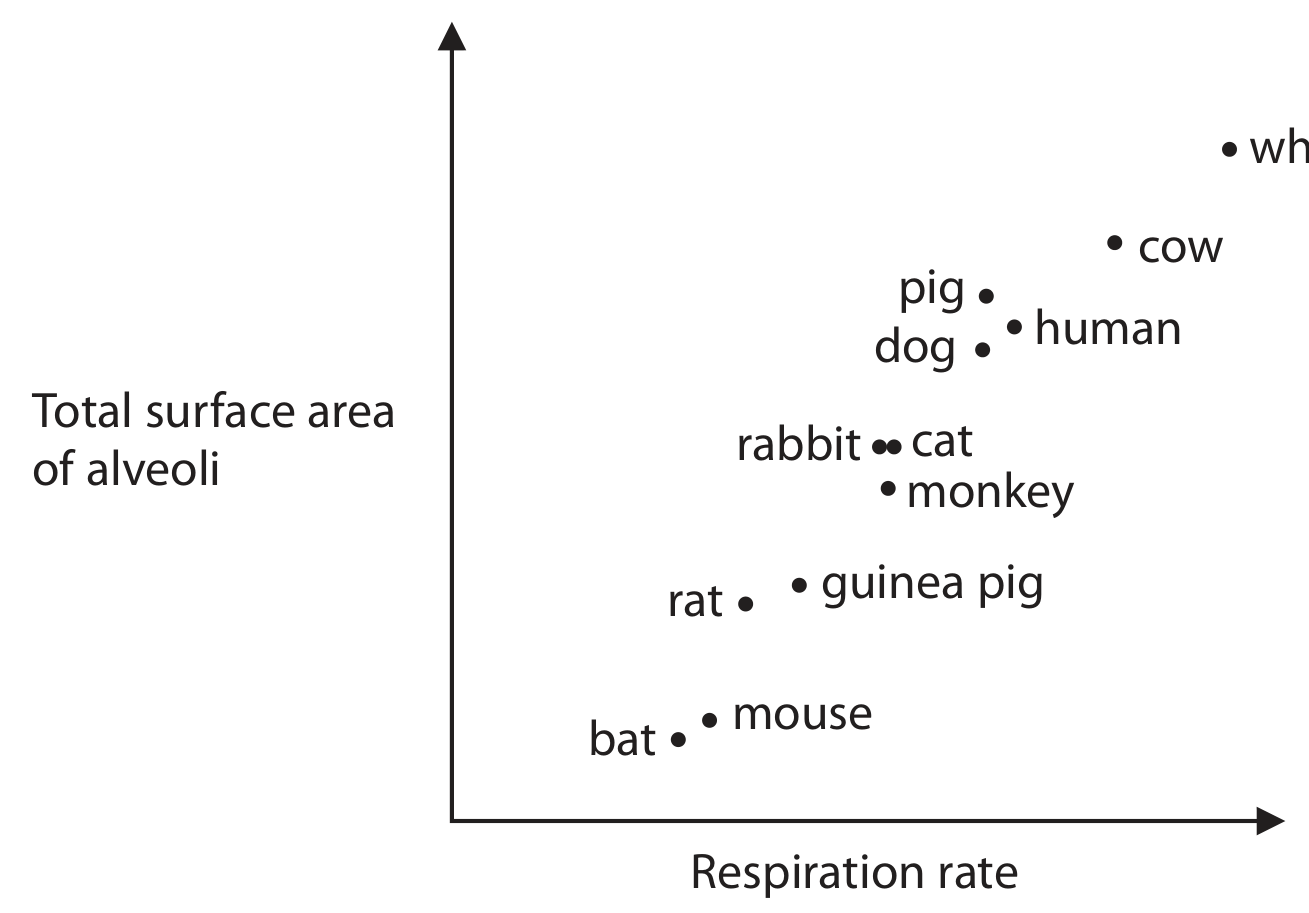
The graph shows the relationship between the total surface area of alveoli and the respiration rate in different sized animals.

Question image
[ 4 ]

Question 3(d)(i)

(i)

Give two conclusions that can be made from this graph.

1

2

[ 2 ]

Question 3(d)(ii)

(ii)

The respiration rate shown on the graph is measured in cm3\mathrm{cm}^{3} of oxygen used per minute.

When the respiration rate is measured in cm3\mathrm{cm}^{3} per minute, a human has a higher respiration rate than a mouse.

When the respiration rate is measured in cm3\mathrm{cm}^{3} per minute per gram of body mass, a human has a lower respiration rate than a mouse.

Explain why a human has a lower respiration rate than a mouse when the rate is measured in cm3\mathrm{cm}^{3} per minute per gram of body mass.

[ 2 ]

Question 3(e)

(b)

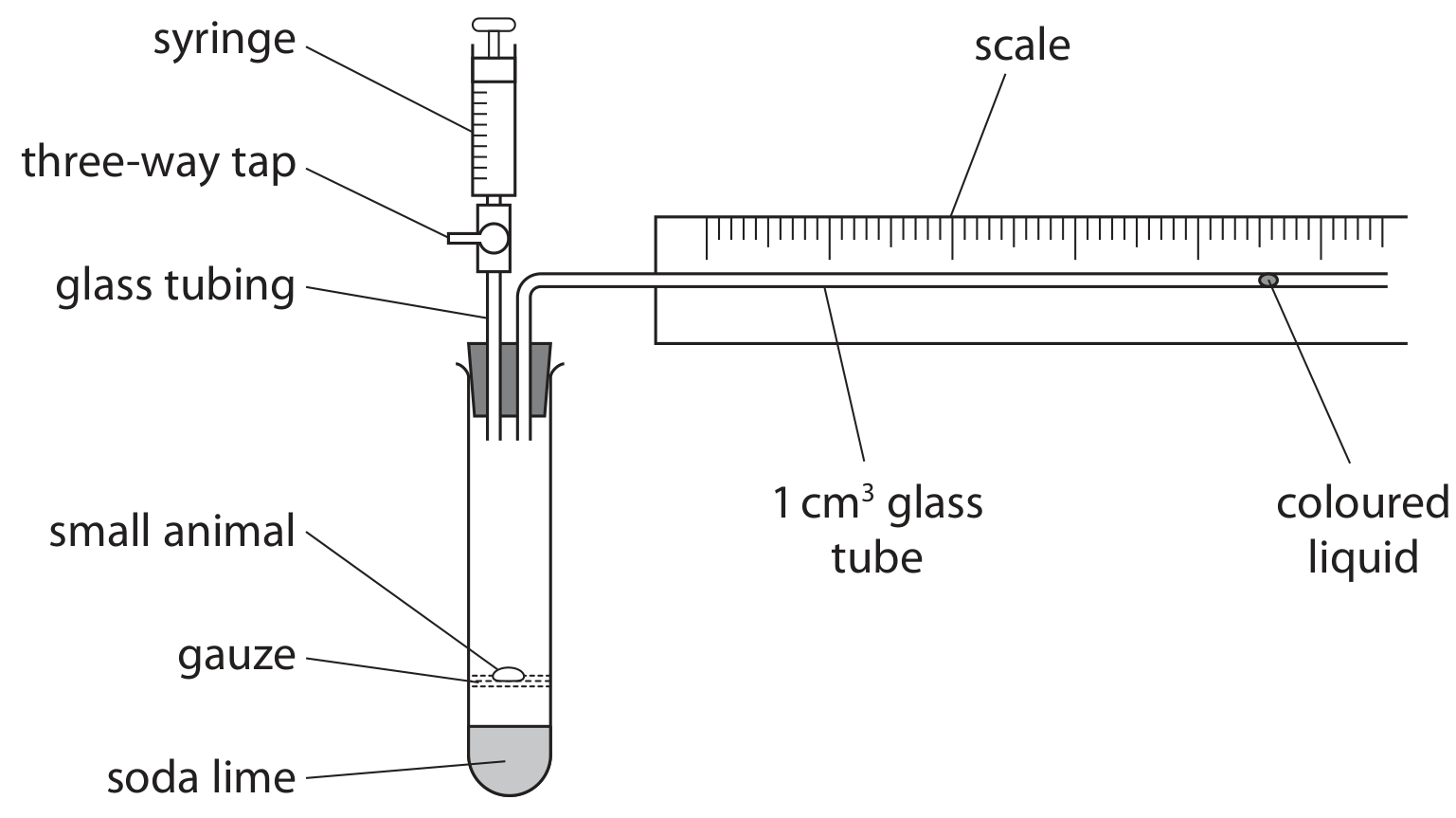
This apparatus can be used to measure the respiration rate of a small animal.

Question image

Explain how the apparatus should be used to obtain reliable data.

[ 3 ]

Question 3(c)(ii)

[Maximum number: 3]

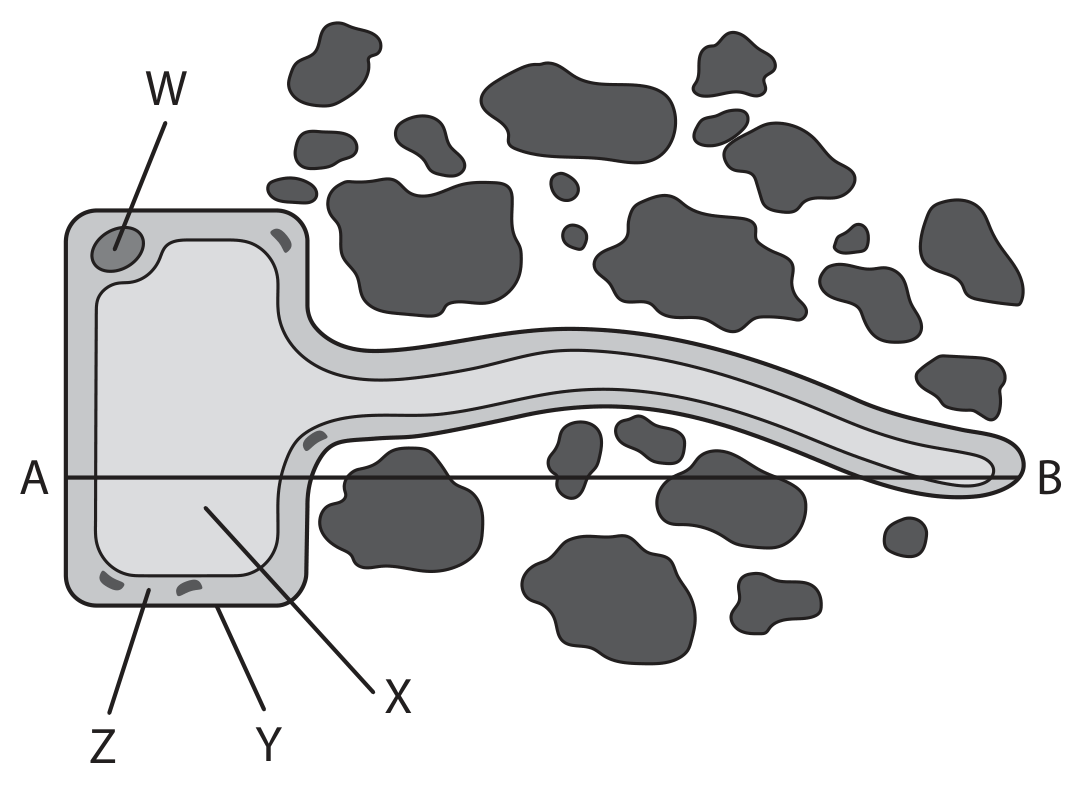
The diagram shows a magnified image of a root hair cell from a young plant.

Question image

Sometimes gardeners give their plants too much water. The water fills up the air spaces in the soil around the plant roots.

Explain how this can lead to plants failing to grow properly.

Question 5

[Maximum number: 8]

Wheat seeds contain stores of a large insoluble molecule.
This molecule is digested by amylase as the seeds germinate.

Question 5(b)

(a)

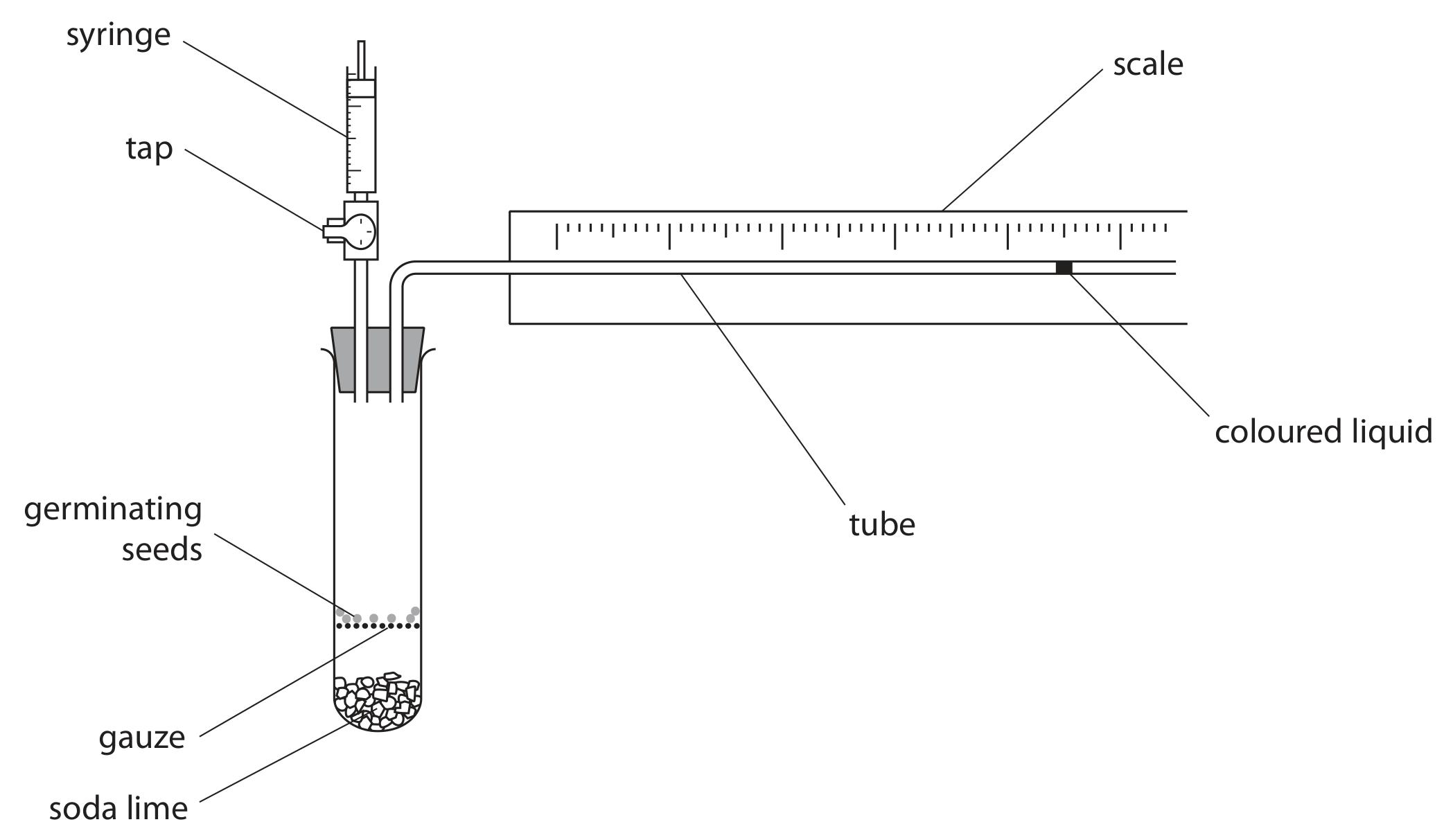
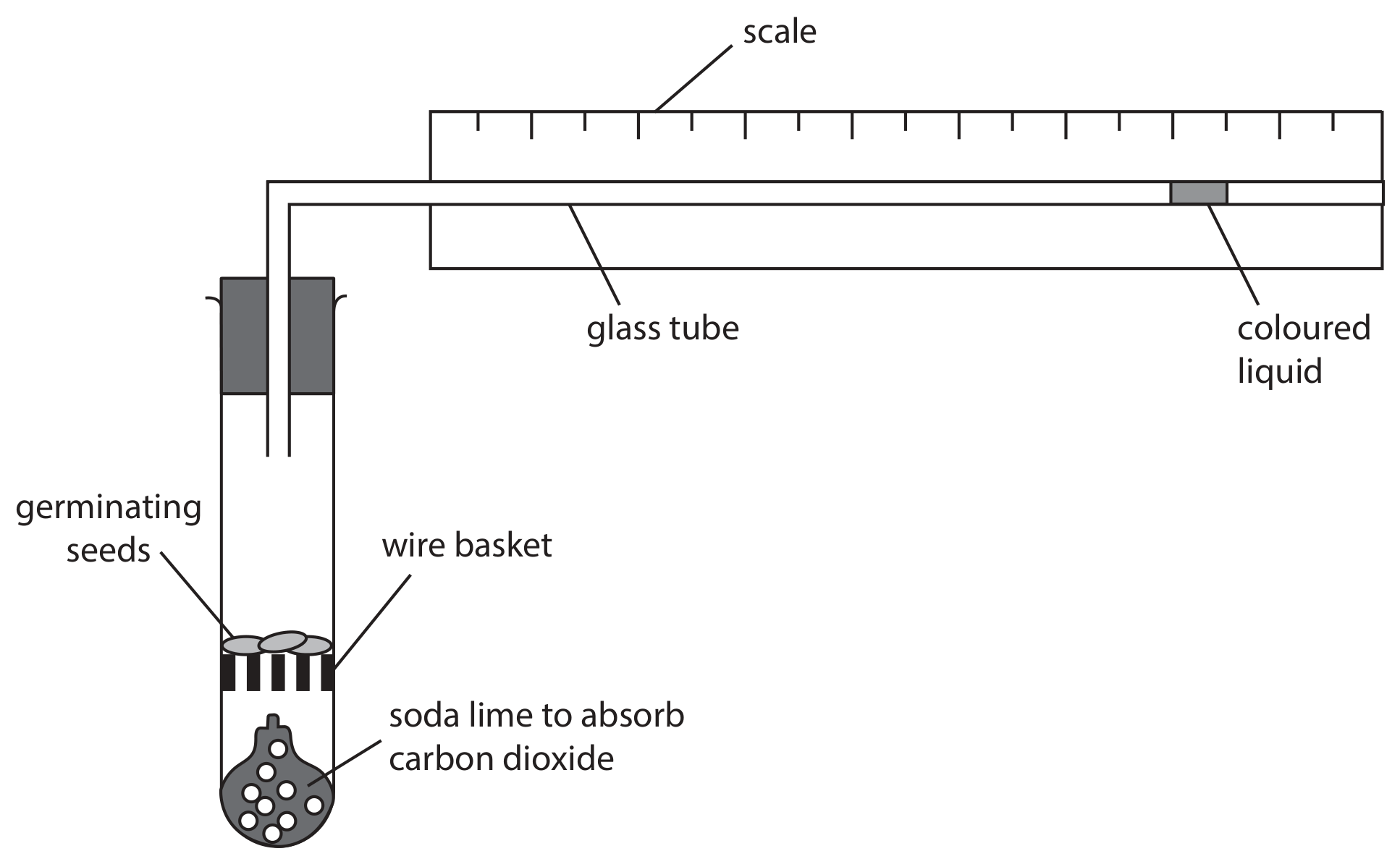
A student investigates the oxygen absorbed by germinating seeds at different temperatures.

The diagram shows some of the student's apparatus.

Question image
[ 6 ]

Question 5(b)(i)

(i)

Suggest why the student opens the tap after obtaining one set of results.

[ 2 ]

Question 5(b)(ii)

(ii)

What is the function of the soda lime?

A

it absorbs carbon dioxide

B

it absorbs oxygen

C

it releases carbon dioxide

D

it releases oxygen

[ 1 ]

Question 5(b)(iii)

(iii)

The student measures the distance moved by the coloured liquid and converts this to volume of oxygen absorbed.

The volume of oxygen absorbed can be calculated using the formula
volume =π×=\pi \times radius 2×^{2} \times distance
Calculate the volume of oxygen absorbed when the coloured liquid moves a distance of 6.0 mm.
[diameter of tube =1.0 mm=1.0 \mathrm{~mm} ]
volume = cm3\mathrm{cm}^{3}

[ 3 ]

Question 5(c)

(b)

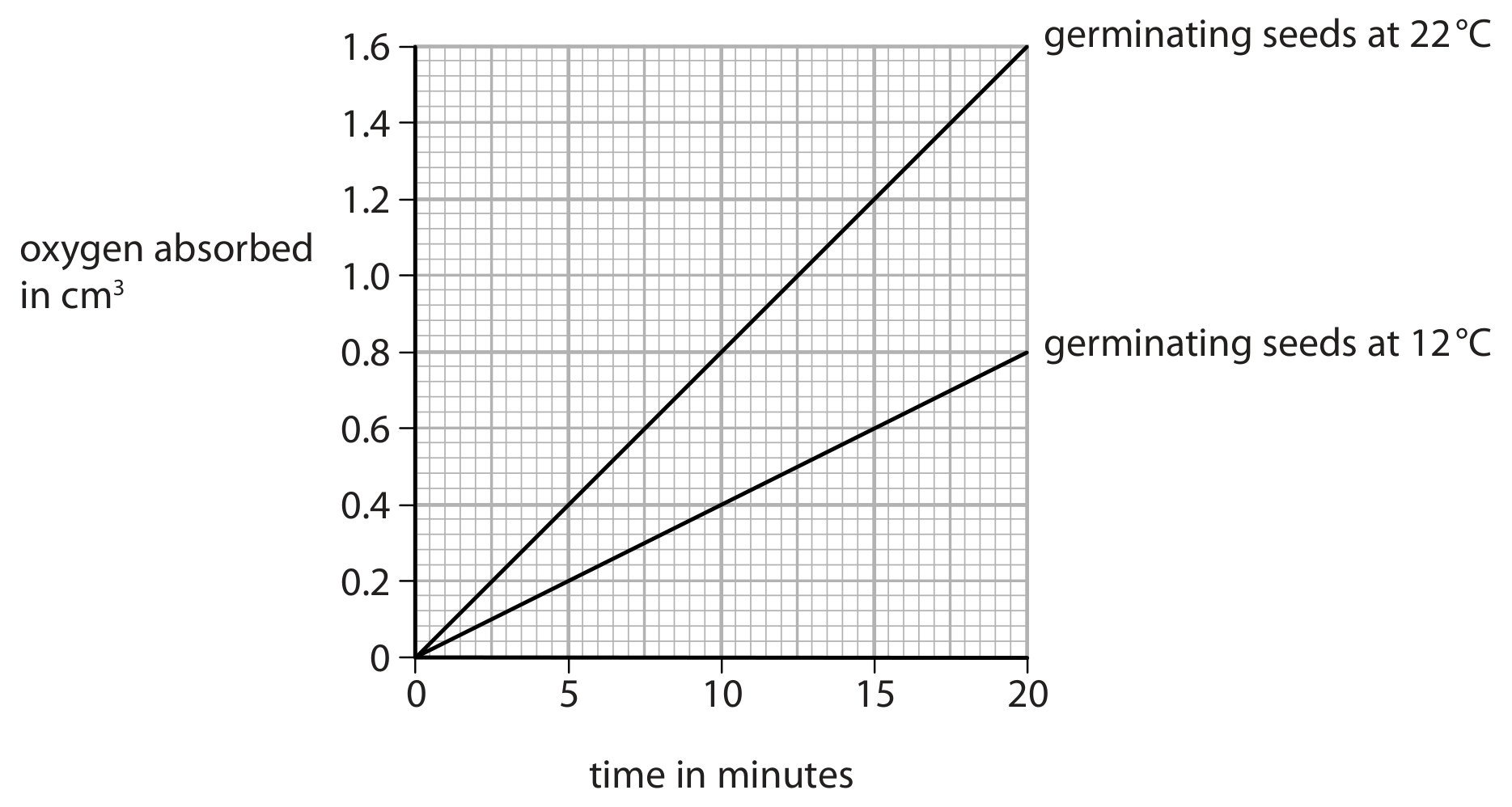
The graph shows the results of the student's investigation.

Question image
[ 2 ]

Question 5(c)(i)

(i)

Calculate the percentage increase in the rate of oxygen absorption at 22C22^{\circ} \mathrm{C} compared to the rate of oxygen absorption at 12C12^{\circ} \mathrm{C}.

[ 2 ]

Question 4

[Maximum number: 5]

A respirometer is a simple apparatus that can be used to measure the rate of respiration in small organisms.

A student uses the respirometer to investigate the rate of respiration in some germinating seeds.

Question image

Question 4(a)

(a)

Give the balanced chemical symbol equation for aerobic respiration.

[ 2 ]

Question 4(b)

(b)

The student measures the rate of respiration of 10 g of germinating seeds at 20C20^{\circ} \mathrm{C}. They then repeat this with another sample of 10 g of germinating seeds at 30C30^{\circ} \mathrm{C}.

The rate of respiration can be measured by recording the distance, in mm , the bubble of coloured liquid moves on the scale in one minute.

They measure the rate three times at each temperature.

[ 3 ]

Question 4(b)(i)

(i)

Explain why carbon dioxide needs to be absorbed by the soda lime when measuring the rate of aerobic respiration.

[ 2 ]

Question 4(b)(ii)

(ii)

State how the student could have changed the temperature in this investigation.

[ 1 ]

Question 4(c)

(c)

\section*{(c) The table shows the student's results. \\ (c) The table shows the student's results.}

Table

Question 4

[Maximum number: 10]

Respiration is the process that provides energy for cells.
Respiration can be aerobic or anaerobic.

Question 4(a)

(a)

Give the word equation for anaerobic respiration in plants.

[ 2 ]

Question 4(b)

(b)

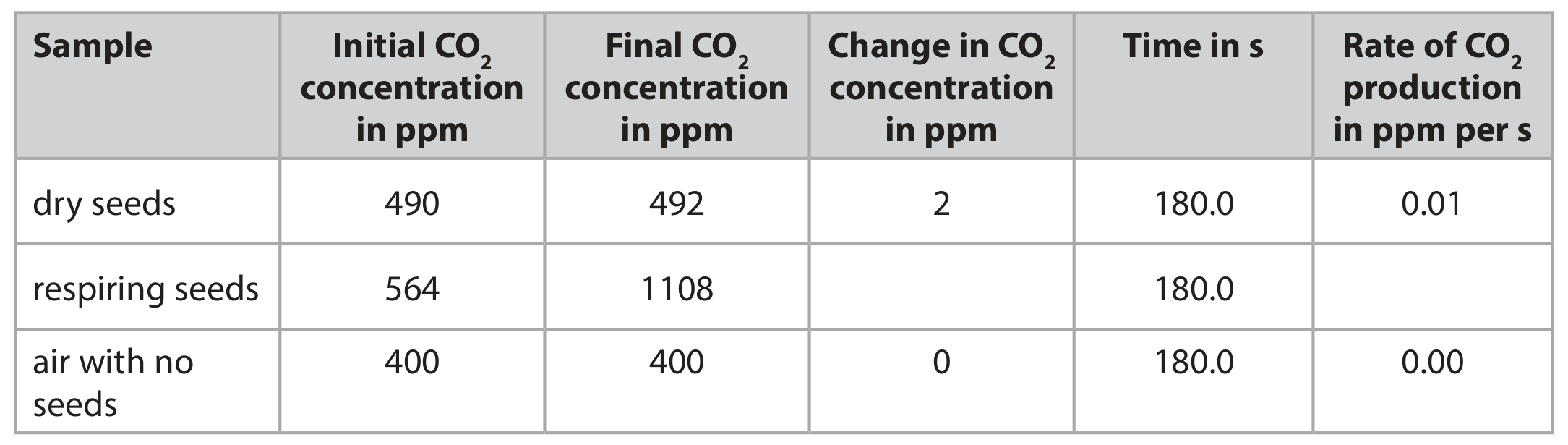
A scientist uses a gas sensor to investigate the carbon dioxide produced by a sample of dry seeds, and the carbon dioxide produced by a sample of respiring seeds.

The sensor measures the concentration of carbon dioxide in parts per million (ppm) in the air surrounding the seeds.

The scientist measures the initial and final concentration of carbon dioxide for dry seeds, for respiring seeds and for air with no seeds.

The table shows the scientist's results.

Table
[ 8 ]

Question 4(b)(i)

(i)

Give one biotic variable the scientist should keep constant in this investigation.

[ 1 ]

Question 4(b)(ii)

(ii)

Calculate the rate, in ppm per s, of CO2\mathrm{CO}_{2} production for the respiring seeds.
rate = ppm per s

[ 2 ]

Question 4(b)(iii)

(iii)

Comment on the scientist's method and results.

[ 5 ]

Question 6

[Maximum number: 13]

Aerobic respiration is a process in living organisms.

Question 6(a)

(a)

Which of these is the balanced chemical symbol equation for aerobic respiration?
AC6H12O6+6O26CO2A \mathrm{C}_{6} \mathrm{H}_{12} \mathrm{O}_{6}+6 \mathrm{O}_{2} \longrightarrow 6 \mathrm{CO}_{2}
BC6H12O62C2H5OH+2CO2B \mathrm{C}_{6} \mathrm{H}_{12} \mathrm{O}_{6} \longrightarrow 2 \mathrm{C}_{2} \mathrm{H}_{5} \mathrm{OH}+2 \mathrm{CO}_{2}
□ C C6H12O6+6CO26O2+6H2O\mathrm{C}_{6} \mathrm{H}_{12} \mathrm{O}_{6}+6 \mathrm{CO}_{2} \longrightarrow 6 \mathrm{O}_{2}+6 \mathrm{H}_{2} \mathrm{O}
□ D C6H12O6+6O26CO2+6H2O\mathrm{C}_{6} \mathrm{H}_{12} \mathrm{O}_{6}+6 \mathrm{O}_{2} \longrightarrow 6 \mathrm{CO}_{2}+6 \mathrm{H}_{2} \mathrm{O}

[ 1 ]

Question 6(b)

(b)

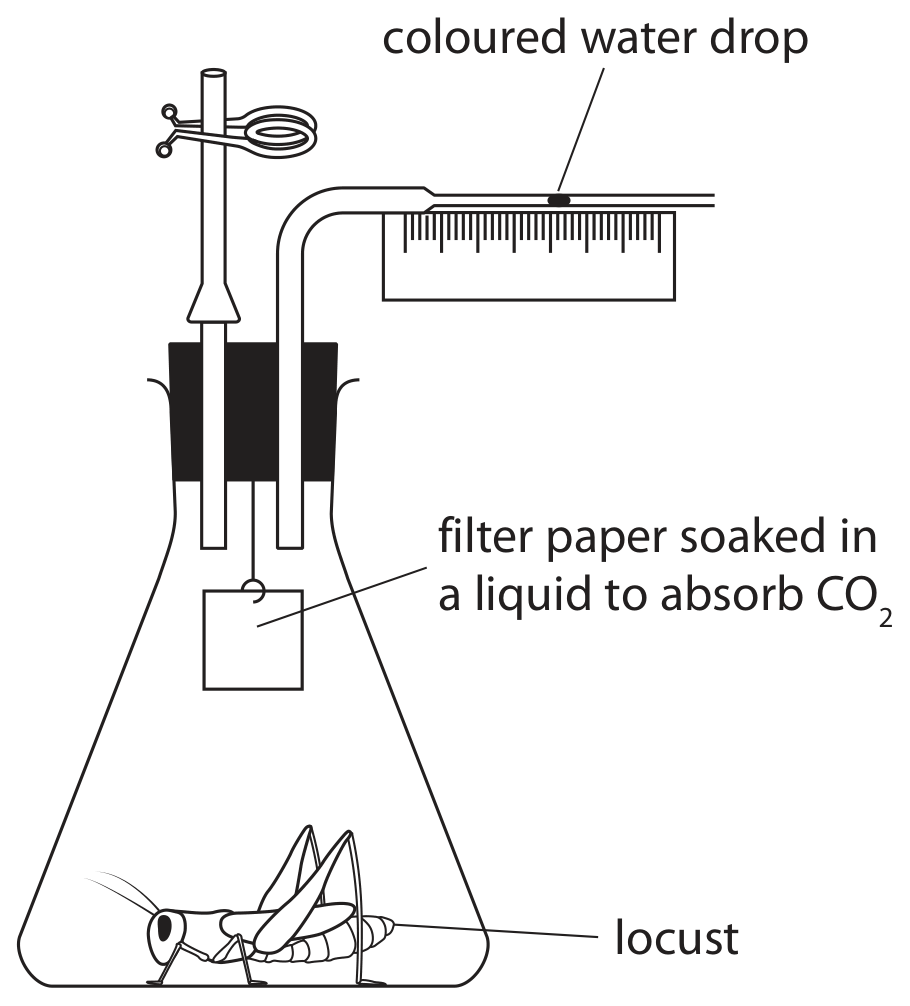
A student uses this apparatus to investigate aerobic respiration in a locust.

Question image
[ 8 ]

Question 6(b)(i)

(i)

The coloured water drop moves during the investigation.

Explain why the coloured water drop moves during the investigation.

[ 2 ]

Question 6(b)(ii)

(ii)

The student compares the aerobic respiration of male and female locusts.

He uses three male locusts and three female locusts.
He uses locusts of the same age and the same species.
Explain three other variables that the student needs to control.

1

2

3

[ 6 ]

Question 6(c)

(c)

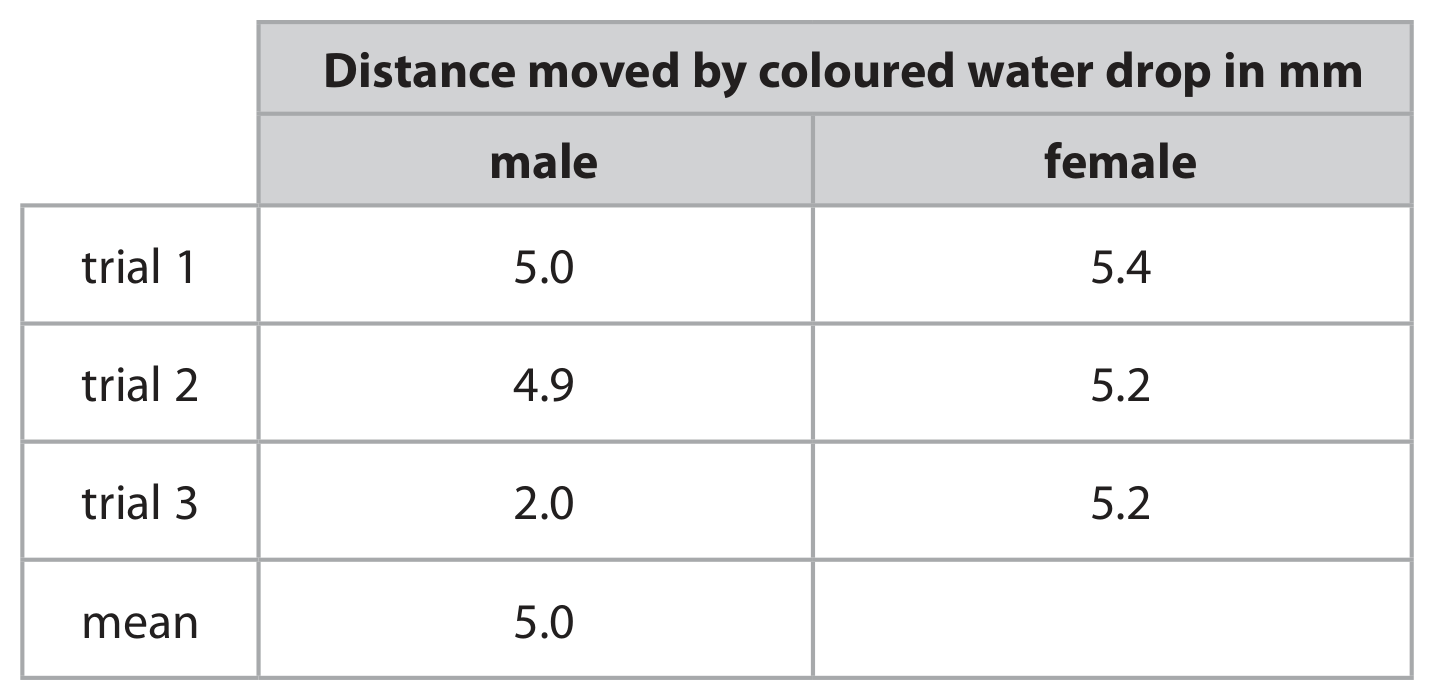
The table shows the student's results.

Table
[ 4 ]

Question 6(c)(i)

(i)

Complete the table by giving the missing mean value.

[ 1 ]

Question 6(c)(ii)

(ii)

Comment on the reliability of the data in the table.

[ 3 ]

Question 5(b)

[Maximum number: 2]

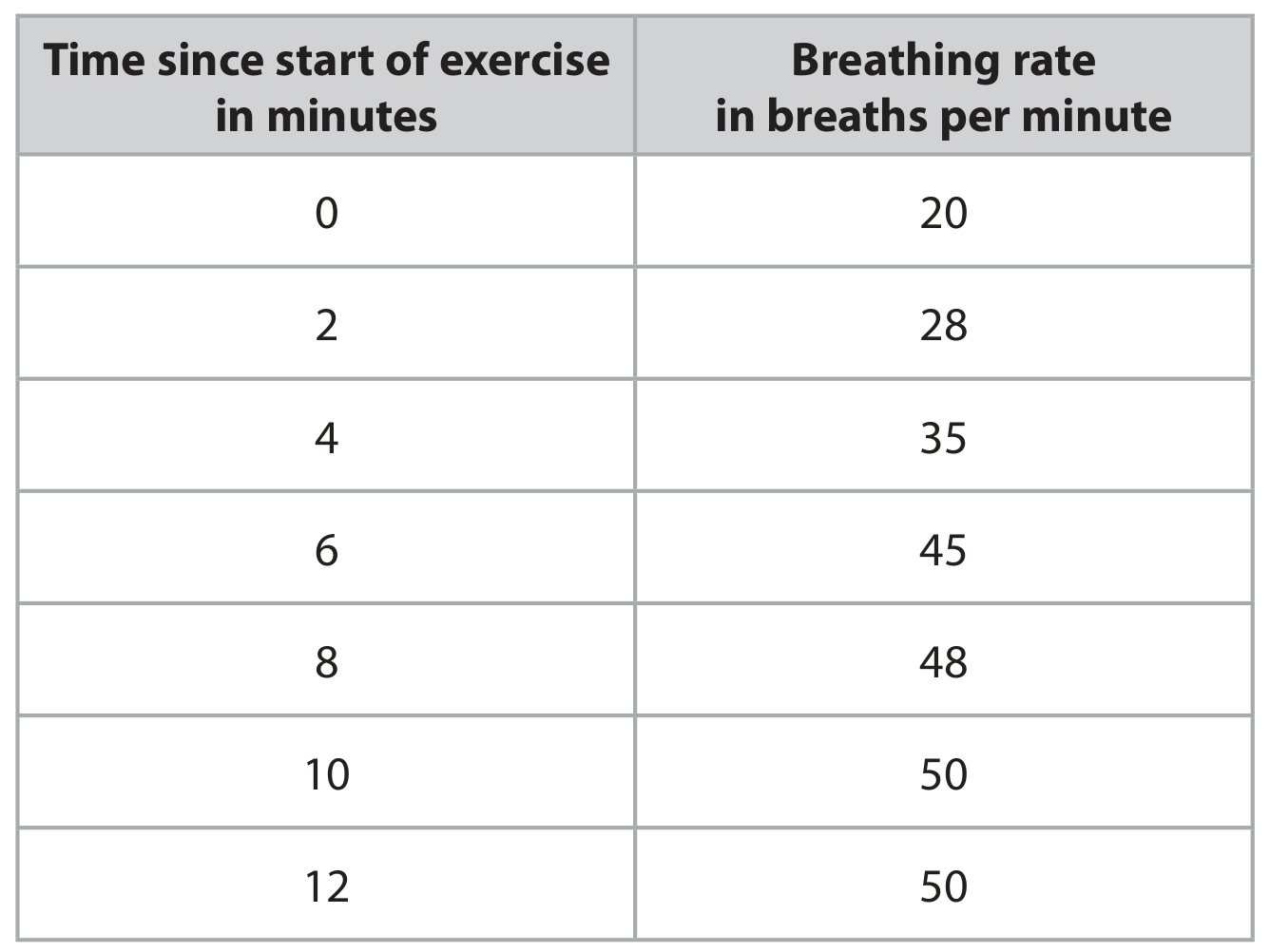
Scientists can investigate the effect of exercise on breathing rate.
An athlete wears a face mask that covers their nose and mouth. The mask contains electronic sensors that measure and record the athlete's breathing rate as they exercise.

An investigation using this mask produces these results.

Table

Explain why the breathing rate would remain high for a few minutes after the exercise has finished.

0 selected