EduNinja

IB Chemistry SL1.5 Ideal gasesQuestion Bank

Question 1

[Maximum number: 1]

Chlorine undergoes many reactions.

Question 1(b)

(a)

2.67 g of manganese(IV) oxide was added to 200.0 cm3200.0 \mathrm{~cm}^{3} of 2.00moldmm3HCl2.00 \mathrm{moldm} \mathrm{m}^{-3} \mathrm{HCl}.

MnO2( s)+4HCl(aq)Cl2( g)+2H2O(l)+MnCl2(aq)\mathrm{MnO}_{2}(\mathrm{~s})+4 \mathrm{HCl}(\mathrm{aq}) \rightarrow \mathrm{Cl}_{2}(\mathrm{~g})+2 \mathrm{H}_{2} \mathrm{O}(\mathrm{l})+\mathrm{MnCl}_{2}(\mathrm{aq})
[ 1 ]

Question 1(b)(iv)

(i)

Calculate the volume of chlorine, in dm3\mathrm{dm}^{3}, produced if the reaction is conducted at standard temperature and pressure (STP). Use section 2 of the data booklet.

[ 1 ]

Question 1

[Maximum number: 2]

Lithium reacts with water to form an alkaline solution.

Question 1(b)

(a)

A0.200 g piece of lithium was placed in 500.0 cm3500.0 \mathrm{~cm}^{3} of water.

[ 2 ]

Question 1(b)(ii)

(i)

Calculate the volume of hydrogen gas produced, in cm3\mathrm{cm}^{3}, if the temperature was 22.5C22.5^{\circ} \mathrm{C} and the pressure was 103 kPa . Use sections 1 and 2 of the data booklet.

[ 2 ]

Question 1

[Maximum number: 1]

Phosphine (IUPAC name phosphane) is a hydride of phosphorus, with the formula PH3\mathrm{PH}_{3}.

Question 1(c)

(a)

2.478 g of white phosphorus was used to make phosphine according to the equation:

P4( s)+3OH(aq)+3H2O(l)PH3( g)+3H2PO2(aq)\mathrm{P}_{4}(\mathrm{~s})+3 \mathrm{OH}^{-}(\mathrm{aq})+3 \mathrm{H}_{2} \mathrm{O}(\mathrm{l}) \rightarrow \mathrm{PH}_{3}(\mathrm{~g})+3 \mathrm{H}_{2} \mathrm{PO}_{2}^{-}(\mathrm{aq})
[ 1 ]

Question 1(c)(iv)

(i)

Determine the volume of phosphine, measured in cm3\mathrm{cm}^{3} at standard temperature and pressure, that was produced.

[ 1 ]

Question 1

[Maximum number: 4]

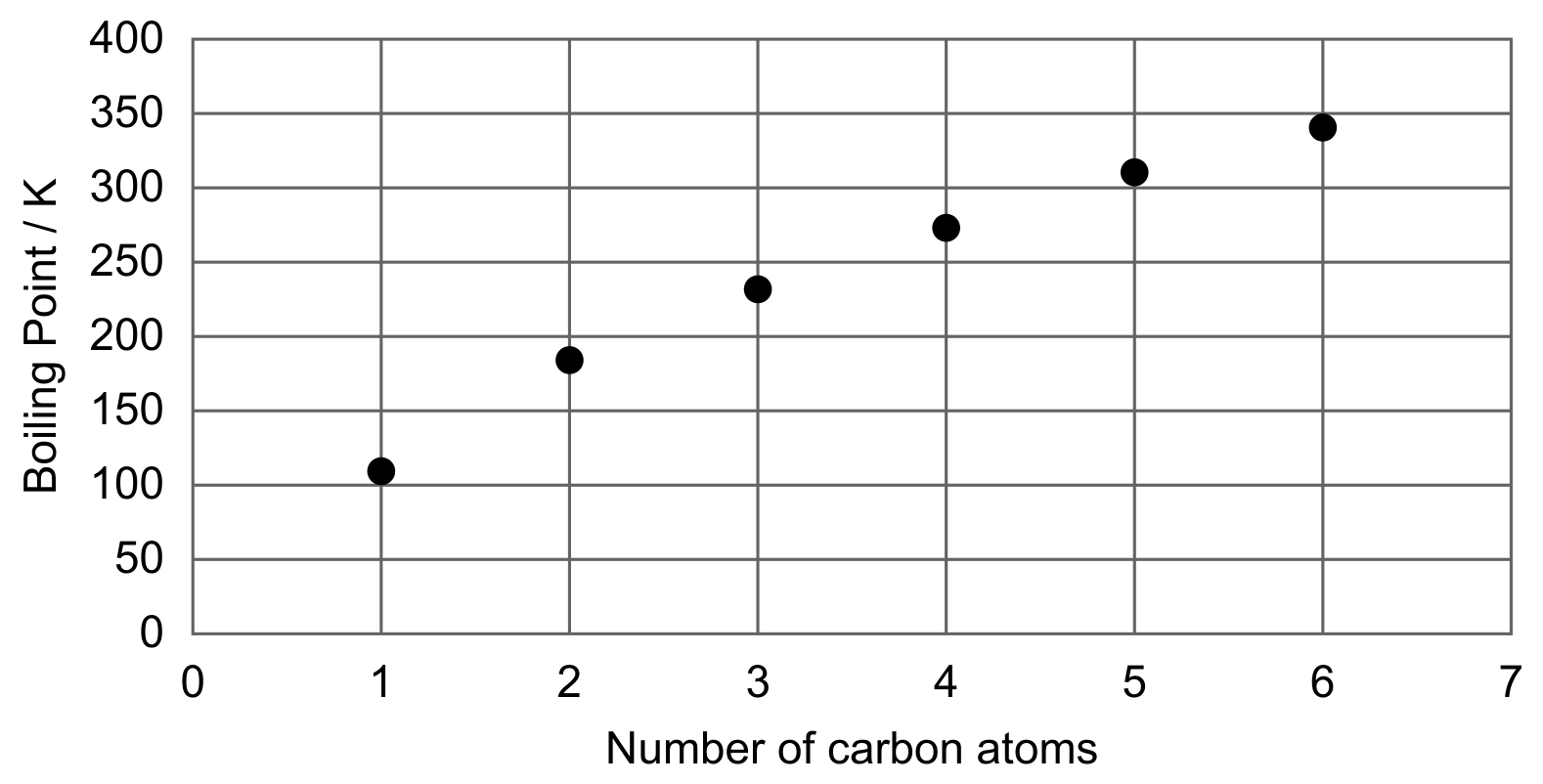
Alkanes are commonly occurring organic compounds.

Question 1(a)

(a)

The first four straight chain alkanes are gases at room temperature.

Boiling points of straight chain alkanes

Boiling points of straight chain alkanes

[ 4 ]

Question 1(a)(iii)

(i)

Calculate the volume, in dm3\mathrm{dm}^{3}, occupied by 6.45 g of propane gas at 100 kPa and 15C15^{\circ} \mathrm{C}.

[ 2 ]

Question 1(a)(iv)

(ii)

Outline why the volume occupied by propane(g) at very high pressure is higher than the value calculated using PV=nRT.

[ 2 ]

Question 1

[Maximum number: 3]

Nitrogen monoxide, NO(g), is produced in internal combustion and jet engines.

Question 1(b)

(a)

Calculate the amount, in moles, of NO in 1.0×10³ m31.0 \times 10^{-3} \mathrm{~m}^{3} of engine exhaust gas which contains 0.10 % NO by volume at 200C200^{\circ} \mathrm{C} and 1.0×10⁵ Pa1.0 \times 10^{5} \mathrm{~Pa}.

Use sections 1 and 2 of the data booklet.

[ 3 ]

Question 1

[Maximum number: 2]

A powder has the following percentage composition by mass:
30.0 % sucrose, C12H22O11\mathrm{C}_{12} \mathrm{H}_{22} \mathrm{O}_{11}
45.0 % citric acid, C6H8O7\mathrm{C}_{6} \mathrm{H}_{8} \mathrm{O}_{7}
25.0 \% sodium hydrogencarbonate, NaHCO3\mathrm{NaHCO}_{3}

In the presence of water, the powder effervesces as the citric acid reacts with the sodium hydrogencarbonate:

3NaHCO3( s)+C6H8O7(aq)Na3(C6H5O7)(aq)+3CO2( g)+3H2O(l)3 \mathrm{NaHCO}_{3}(\mathrm{~s})+\mathrm{C}_{6} \mathrm{H}_{8} \mathrm{O}_{7}(\mathrm{aq}) \rightarrow \mathrm{Na}_{3}\left(\mathrm{C}_{6} \mathrm{H}_{5} \mathrm{O}_{7}\right)(\mathrm{aq})+3 \mathrm{CO}_{2}(\mathrm{~g})+3 \mathrm{H}_{2} \mathrm{O}(\mathrm{l})

Question 1(a)

Question 1(a)(ii)

(a)
(i)

Determine the volume, in dm3\mathrm{dm}^{3} at SATP, of carbon dioxide released in the reaction in (a)(i). Use sections 1 and 2 of the data booklet.

[ 2 ]

Question 1

[Maximum number: 2]

An organic compound, A, has the following composition by mass when its only combustion products, carbon dioxide and water, are analysed.

Table

Question 1(c)

(a)

A sample of the vapour of A at 200.0C200.0^{\circ} \mathrm{C} and 1.00×10⁵ Pa1.00 \times 10^{5} \mathrm{~Pa} has a density of 2.544×10³ g m32.544 \times 10^{3} \mathrm{~g} \mathrm{~m}^{-3}. Determine the molar mass and the molecular formula of A.

[ 2 ]

Question 2

[Maximum number: 1]

The volume of a sample of gas measured at 27C27^{\circ} \mathrm{C} is 10.0dm310.0 \mathrm{dm}^{3}. What is the temperature when the volume is reduced to 9.0dm39.0 \mathrm{dm}^{3} at the same pressure?

A

3.0C-3.0^{\circ} \mathrm{C}

B

24.3C24.3^{\circ} \mathrm{C}

C

29.7C29.7^{\circ} \mathrm{C}

D

57.0C57.0^{\circ} \mathrm{C}

Question 3

Which graph shows the relationship between the volume and pressure of a fixed mass of an ideal gas?

Question image

Question 3

[Maximum number: 1]

The volume occupied by one mole of an ideal gas at 273 K and 1.01×10⁵ Pa1.01 \times 10^{5} \mathrm{~Pa} is 22.4dm322.4 \mathrm{dm}^{3}. What volume, in dm3\mathrm{dm}^{3}, is occupied by 3.20 gO2( g)3.20 \mathrm{~g} \mathrm{O}_{2}(\mathrm{~g}) at 273 K and 1.01×10⁵ Pa1.01 \times 10^{5} \mathrm{~Pa} ?

A

2.24

B

4.48

C

22.4

D

71.7

0 selected