EduNinja

IB Chemistry SL1.1 Introduction to the particulate nature of matterQuestion Bank

Question 1

Which diagram represents a heterogeneous mixture?

A
Question image
B
Question image
C
Question image
D
Question image

Question 1

[Maximum number: 1]

Nitrogen dioxide, NO2\mathrm{NO}_{2}, is a brown, toxic and corrosive gas. It can be made in a school laboratory by heating a group II metal nitrate or by the reaction of copper, Cu , with concentrated nitric acid, HNO3\mathrm{HNO}_{3}.

Question 1(e)

(a)

The initial amount of NO2\mathrm{NO}_{2} was determined by titration. The oxide was first dissolved in water according to the following equation:

2NO2( g)+H2O(l)HNO3(aq)+HNO2(aq)2 \mathrm{NO}_{2}(\mathrm{~g})+\mathrm{H}_{2} \mathrm{O}(\mathrm{l}) \rightarrow \mathrm{HNO}_{3}(\mathrm{aq})+\mathrm{HNO}_{2}(\mathrm{aq})

The solution was made up to 250.0 cm3250.0 \mathrm{~cm}^{3} and 25.0 cm325.0 \mathrm{~cm}^{3} portions of this solution were then titrated against a 0.0500 moldm30.0500 \mathrm{~mol} \mathrm{dm}^{-3} standard solution of sodium hydroxide, NaOH .

[ 1 ]

Question 1(e)(iv)

(i)

Calculate the values for temperature, T , in degrees kelvin, K , and complete the table.

[ 1 ]

Question 1

[Maximum number: 2]

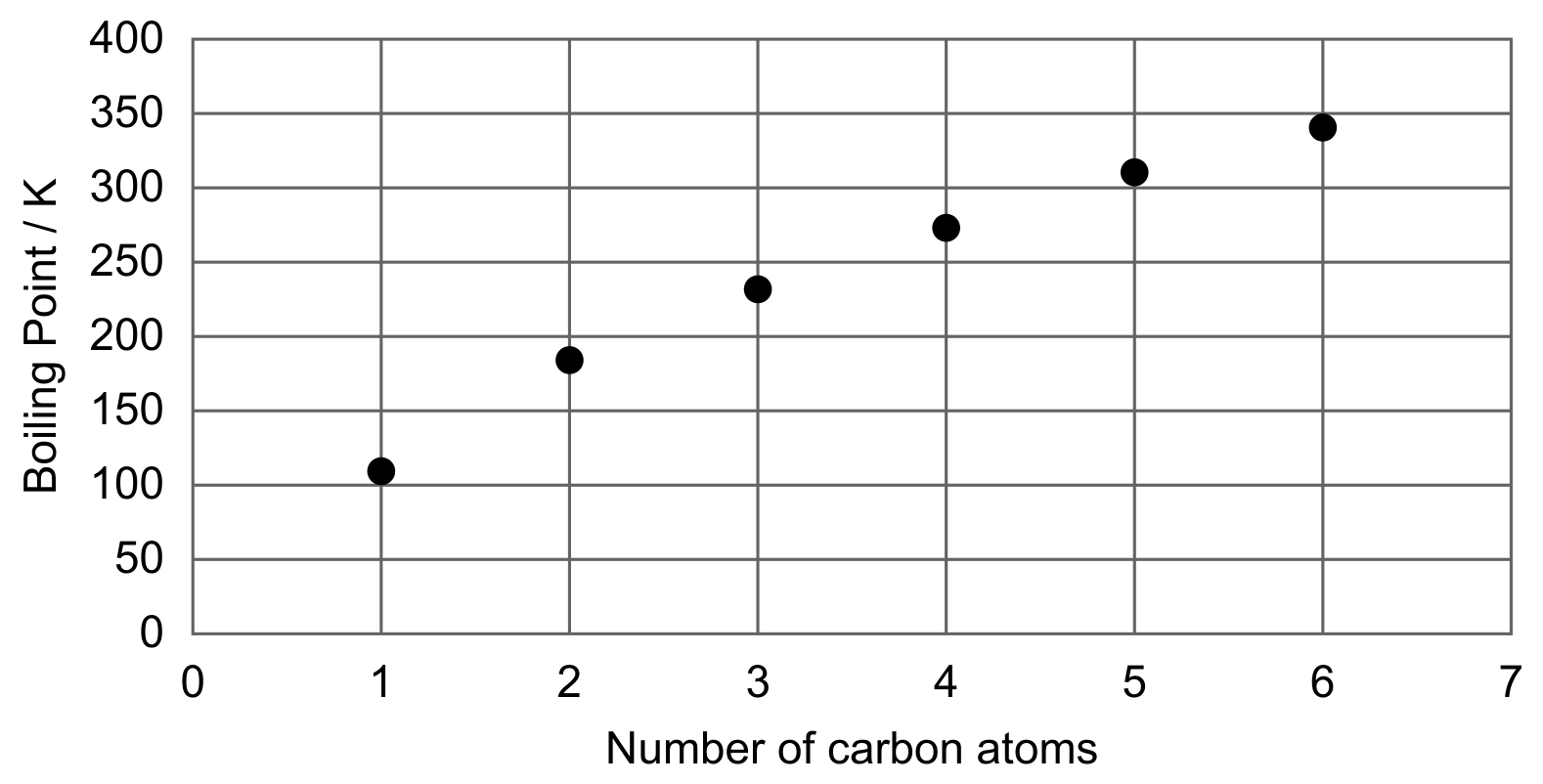
Alkanes are commonly occurring organic compounds.

Question 1(a)

(a)

The first four straight chain alkanes are gases at room temperature.

Boiling points of straight chain alkanes

Boiling points of straight chain alkanes

[ 2 ]

Question 1(a)(ii)

(i)

Explain why the volume occupied by a sample of propane increases sharply when the sample is heated up from 200 to 250 K at constant pressure.

[ 2 ]

Question 1

[Maximum number: 1]

What is the name of this change of state?

CO2( g)CO2( s)\mathrm{CO}_{2}(\mathrm{~g}) \rightarrow \mathrm{CO}_{2}(\mathrm{~s})
A

Condensation

B

Deposition

C

Sublimation

D

Freezing

Question 1

[Maximum number: 1]

Which change of state is exothermic?

A

CO2( s)CO2( g)\mathrm{CO}_{2}(\mathrm{~s}) \rightarrow \mathrm{CO}_{2}(\mathrm{~g})

B

H2O(l)H2O(g)\mathrm{H}_{2} \mathrm{O}(\mathrm{l}) \rightarrow \mathrm{H}_{2} \mathrm{O}(\mathrm{g})

C

NH3( g)NH3(l)\mathrm{NH}_{3}(\mathrm{~g}) \rightarrow \mathrm{NH}_{3}(\mathrm{l})

D

Fe(s)Fe(l)\mathrm{Fe}(\mathrm{s}) \rightarrow \mathrm{Fe}(\mathrm{l})

Question 1

[Maximum number: 1]

Which equation represents sublimation?

A

Al(s)+3I2( g)2AlI3( s)\mathrm{Al}(\mathrm{s})+3 \mathrm{I}_{2}(\mathrm{~g}) \rightarrow 2 \mathrm{AlI}_{3}(\mathrm{~s})

B

HgCl2( s)HgCl2( g)\mathrm{HgCl}_{2}(\mathrm{~s}) \rightarrow \mathrm{HgCl}_{2}(\mathrm{~g})

C

I2( g)I2( s)\mathrm{I}_{2}(\mathrm{~g}) \rightarrow \mathrm{I}_{2}(\mathrm{~s})

D

CaCO3( s)+2HCl(aq)CaCl2(aq)+CO2( g)+H2O(l)\mathrm{CaCO}_{3}(\mathrm{~s})+2 \mathrm{HCl}(\mathrm{aq}) \rightarrow \mathrm{CaCl}_{2}(\mathrm{aq})+\mathrm{CO}_{2}(\mathrm{~g})+\mathrm{H}_{2} \mathrm{O}(\mathrm{l})

Question 1

[Maximum number: 1]

Which descriptions of a chemical compound are correct?

I. Contains atoms of more than one element.
II. Atoms retain their individual properties.
III. Atoms are in fixed ratios.

A

I and II only

B

I and III only

C

II and III only

D

I, II and III

Question 1

[Maximum number: 1]

A test tube contains a mixture of liquid hydrocarbons. What is the type of mixture and the best method of separation?

Type of mixture

Method of separation

homogeneous

distillation

homogeneous

filtration

heterogeneous

distillation

heterogeneous

filtration

Question 1

[Maximum number: 2]

Iron(II) sulfide can be produced by heating powdered iron and sulfur together.

Question 1(a)

(a)

Describe the difference between an element and a compound.

[ 2 ]

Question 1

[Maximum number: 1]

Phosphine (IUPAC name phosphane) is a hydride of phosphorus, with the formula PH3\mathrm{PH}_{3}.

Question 1(b)

(a)

Phosphine is usually prepared by heating white phosphorus, one of the allotropes of phosphorus, with concentrated aqueous sodium hydroxide. The equation for the reaction is:

P4( s)+3OH(aq)+3H2O(l)PH3( g)+3H2PO2(aq)\mathrm{P}_{4}(\mathrm{~s})+3 \mathrm{OH}^{-}(\mathrm{aq})+3 \mathrm{H}_{2} \mathrm{O}(\mathrm{l}) \rightarrow \mathrm{PH}_{3}(\mathrm{~g})+3 \mathrm{H}_{2} \mathrm{PO}_{2}^{-}(\mathrm{aq})
[ 1 ]

Question 1(b)(ii)

(i)

The first reagent is written as P4\mathrm{P}_{4}, not 4P. Describe the difference between P4\mathrm{P}_{4} and 4 P.

[ 1 ]
0 selected