IB Chemistry SL 2.2.7 Covalent Network Structures

Practise comparing diamond, graphite, graphene, fullerenes, silicon and silicon dioxide through their extended covalent structures. Relate coordination, geometry and delocalised…

Syllabus
First assessment 2025
Objective
2.2.7
Level
SL

Exam points

  • identify network geometry and bonding around carbon or silicon atoms from a diagram
  • explain graphite or graphene conductivity through mobile delocalised electrons
  • compare melting or hardness through the number and strength of covalent bonds broken

2.2.7—Covalent network structures question 1

[Maximum number: 2]

Electrolysis and Winkler titrations are both applications of redox reactions.

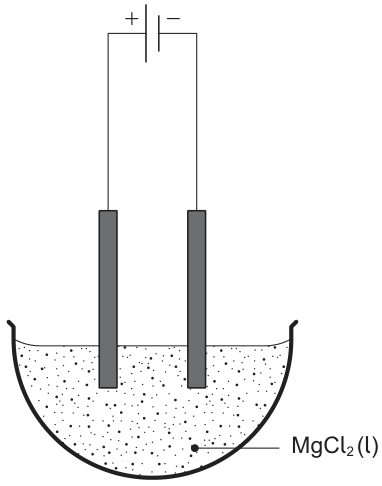
An electrolytic cell was set up using inert electrodes and molten magnesium chloride, MgCl2(l)\mathrm{MgCl}_{2}(\mathrm{l}).

Figure for Question 2.2.7—Covalent network structures question 1 — IB Chemistry SL

Graphite rods are sometimes used as inert electrodes. Describe the structure of graphite and explain why graphite conducts electricity.

All question bank results loaded