Question 1
Reaction kinetics can be investigated using the iodine clock reaction. The equations for two reactions that occur are given below.
Reaction B is much faster than reaction A , so the iodine, , formed in reaction A immediately reacts with thiosulfate ions, , in reaction B , before it can react with starch to form the familiar blue-black, starch-iodine complex.
In one experiment the reaction mixture contained:
of hydrogen peroxide of 1 % aqueous starch
of sulfuric acid of sodium thiosulfate of water with of potassium iodide (KI) dissolved in it.
After 45 seconds this mixture suddenly changed from colourless to blue-black.
Question 1(h)
The colour change occurs when of iodine has been formed. Use the total volume of the solution and the time taken, to calculate the rate of the reaction, including appropriate units.
Question 1(i)
In a second experiment, the concentration of the hydrogen peroxide was decreased to while all other concentrations and volumes remained unchanged. The colour change now occurred after 100 seconds. Explain why the reaction in this experiment is slower than in the original experiment.
Question 1(j)
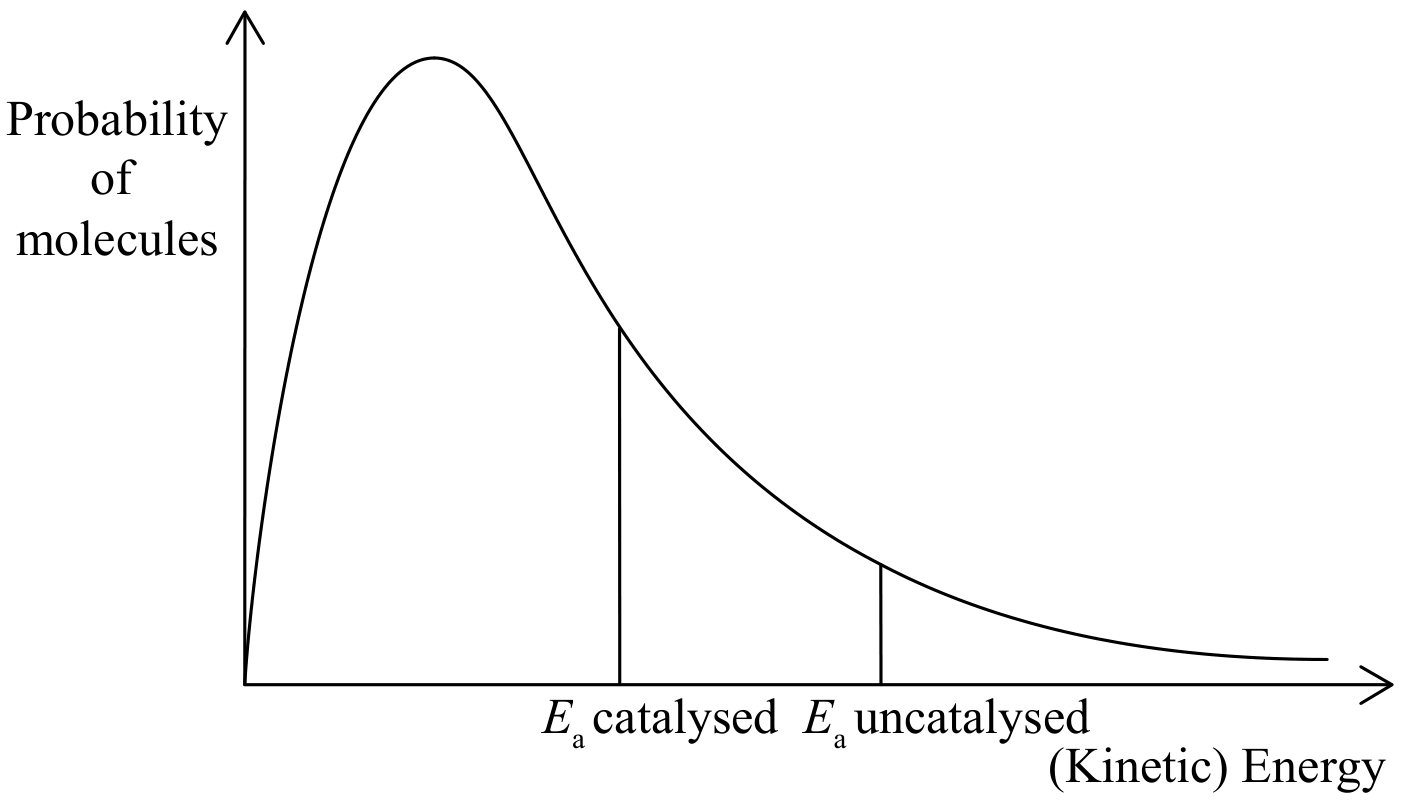
In a third experiment, 0.100 g of a black powder was also added while all other concentrations and volumes remained unchanged. The time taken for the solution to change colour was now 20 seconds. Outline why you think the colour change occurred more rapidly and how you could confirm your hypothesis.
Question 1(k)
Explain why increasing the temperature also decreases the time required for the colour to change.