IB Chemistry SL Reactivity 2.2.1 Rate of Reaction

Practise defining and calculating reaction rate as change in a measured quantity per unit time. Select an observable that follows the reaction, determine average rate over an…

Syllabus
First assessment 2025
Objective
2.2.1
Level
SL

Exam points

  • choose concentration, gas volume, pressure or mass change that tracks reaction progress
  • calculate average rate from a stated interval using change divided by elapsed time
  • draw a tangent at the required time and calculate its gradient with axis-based units

2.2.1—Rate of reaction question 1

[Maximum number: 3]

Iron rusts in the presence of oxygen and water. Rusting is a redox process involving several steps that produces hydrated iron(III) oxide, Fe2O3nH2O\mathrm{Fe}_{2} \mathrm{O}_{3} \bullet \mathrm{nH}_{2} \mathrm{O}, as the final product. The half-equations involved for the first step of rusting are given below.

Half-equation 1: Fe(s)Fe2+(aq)+2e\quad \mathrm{Fe}(\mathrm{s}) \rightarrow \mathrm{Fe}^{2+}(\mathrm{aq})+2 \mathrm{e}^{-}

Half-equation 2: O2(aq)+4e+2H2O(l)4OH(aq)\quad \mathrm{O}_{2}(\mathrm{aq})+4 \mathrm{e}^{-}+2 \mathrm{H}_{2} \mathrm{O}(\mathrm{l}) \rightarrow 4 \mathrm{OH}^{-}(\mathrm{aq})

Question (a)

(a)

Hydrogen peroxide decomposes according to the equation below.

2H2O2(aq)2H2O(l)+O2( g)2 \mathrm{H}_{2} \mathrm{O}_{2}(\mathrm{aq}) \rightarrow 2 \mathrm{H}_{2} \mathrm{O}(\mathrm{l})+\mathrm{O}_{2}(\mathrm{~g})

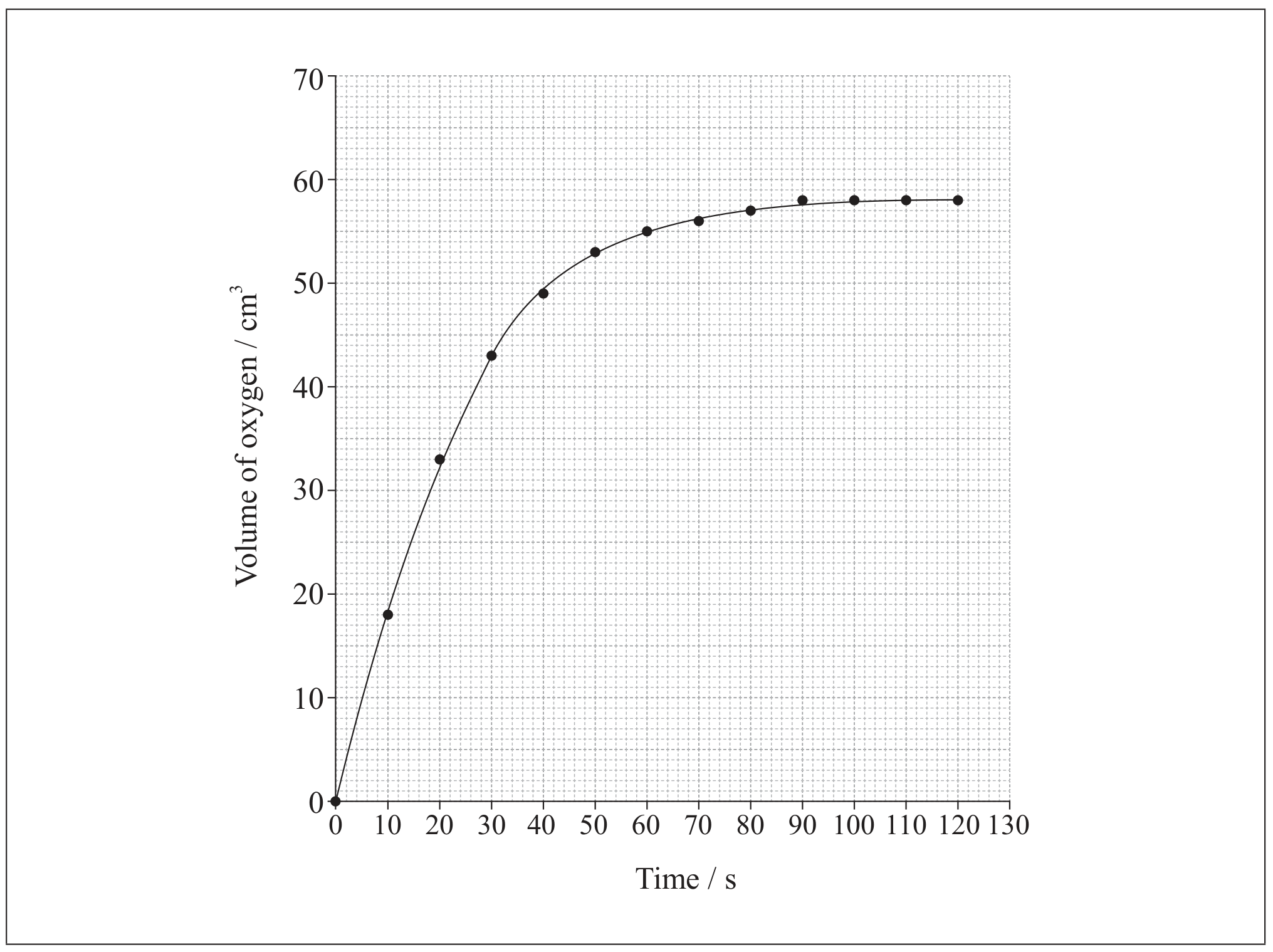
The rate of the decomposition can be monitored by measuring the volume of oxygen gas released. The graph shows the results obtained when a solution of hydrogen peroxide decomposed in the presence of a CuO catalyst.

Figure for Question (a) — IB Chemistry SL
[ 3 ]

Question (i)

(i)

Outline how the initial rate of reaction can be found from the graph.

[ 2 ]

Question (ii)

(ii)

Outline a different experimental procedure that can be used to monitor the decomposition rate of hydrogen peroxide.

[ 1 ]
All question bank results loaded