IB Chemistry SL Reactivity 2.2.3 Factors Affecting Rate

Practise predicting and explaining how concentration, gas pressure, solid surface area, temperature and catalysts alter reaction rate. Link each change to collision frequency or…

Syllabus
First assessment 2025
Objective
2.2.3
Level
SL

Exam points

  • explain concentration, pressure or surface-area effects through collision frequency
  • explain temperature through both collision frequency and the fraction above activation energy
  • sketch a faster progress curve with a steeper start but unchanged final yield when appropriate

2.2.3—Factors affecting rate question 1

[Maximum number: 2]

0.100 g of magnesium ribbon is added to 50.0 cm350.0 \mathrm{~cm}^{3} of 1.00moldm31.00 \mathrm{moldm}^{-3} sulfuric acid to produce hydrogen gas and magnesium sulfate.

Mg( s)+H2SO4(aq)H2( g)+MgSO4(aq)\mathrm{Mg}(\mathrm{~s})+\mathrm{H}_{2} \mathrm{SO}_{4}(\mathrm{aq}) \rightarrow \mathrm{H}_{2}(\mathrm{~g})+\mathrm{MgSO}_{4}(\mathrm{aq})

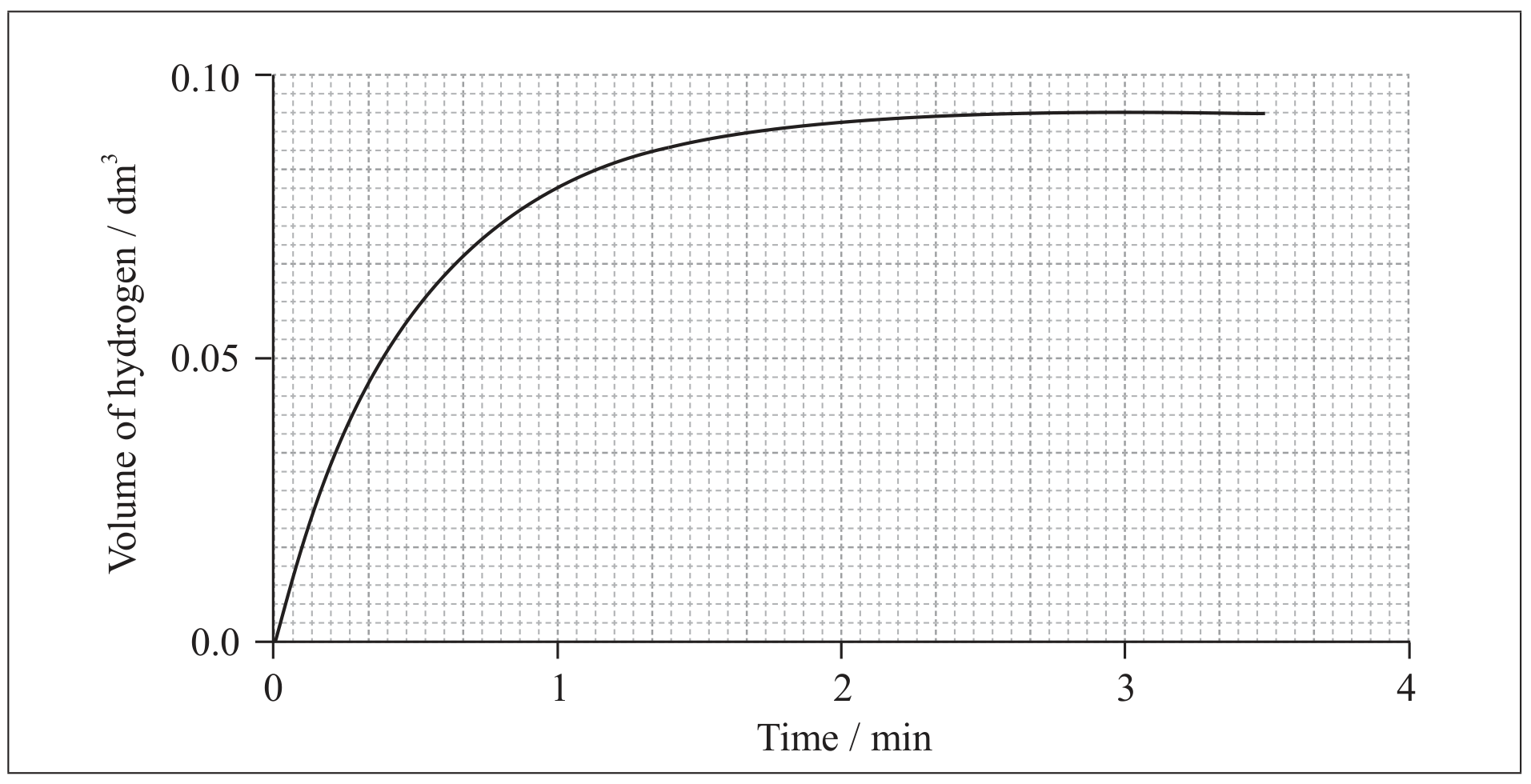
The graph shows the volume of hydrogen produced against time under these experimental conditions.

Figure for Question 2.2.3—Factors affecting rate question 1 — IB Chemistry SL

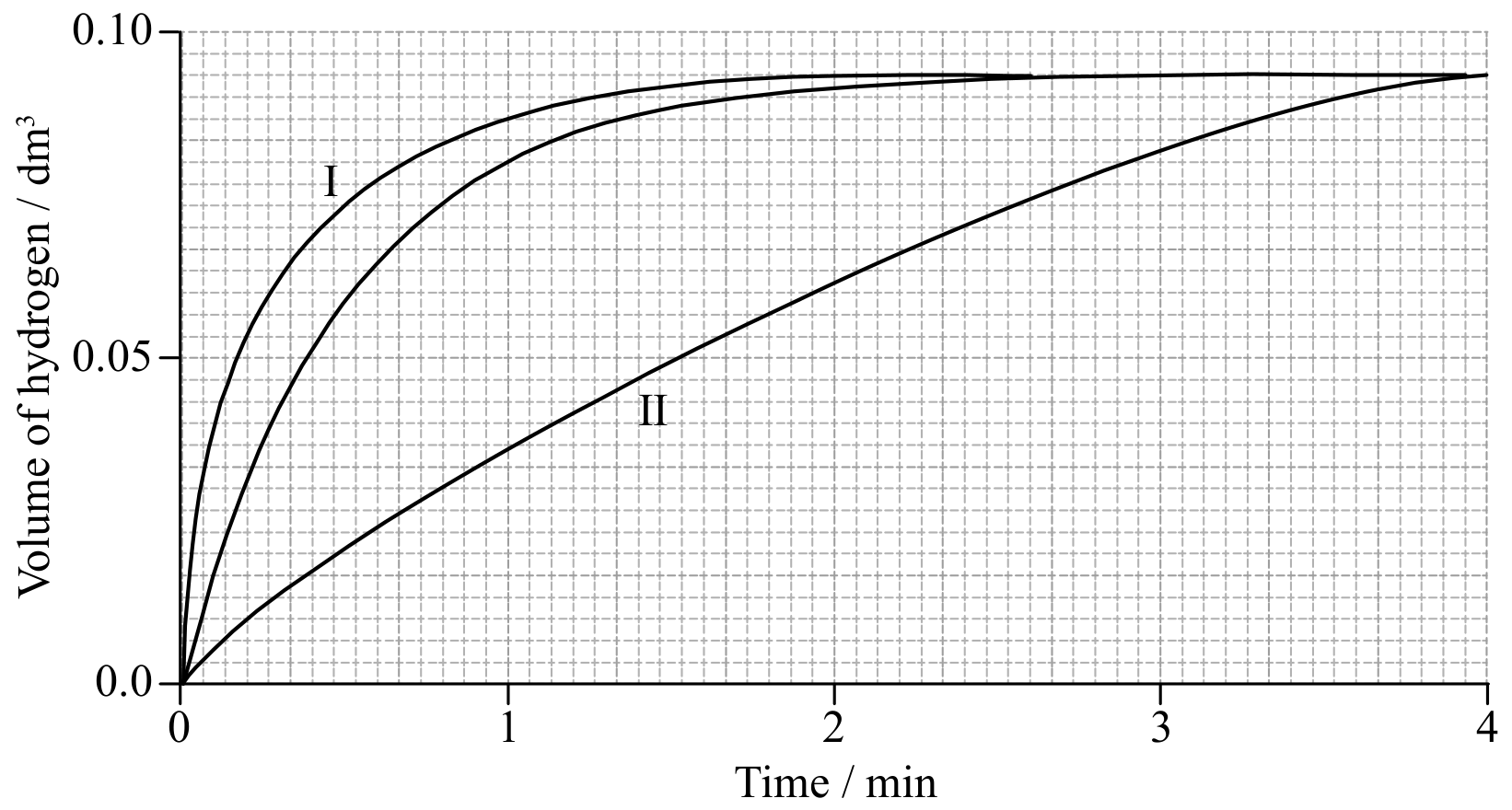
Sketch two curves, labelled I and II, to show how the volume of hydrogen produced (under the same temperature and pressure) changes with time when:

I. using the same mass of magnesium powder instead of a piece of magnesium ribbon;
II. 0.100 g of magnesium ribbon is added to 50 cm350 \mathrm{~cm}^{3} of 0.500moldm30.500 \mathrm{moldm}^{-3} sulfuric acid.

All question bank results loaded