IB Chemistry SL Reactivity 1.3 Energy from Fuels
Practise balancing combustion and fuel-cell equations, comparing fossil and renewable fuels, and evaluating energy output, emissions and land use.
- Syllabus
- First assessment 2025
- Topic
- 1.3
- Level
- SL
Practise balancing combustion and fuel-cell equations, comparing fossil and renewable fuels, and evaluating energy output, emissions and land use.
Ethyne, , reacts with oxygen in welding torches.
Write an equation for the complete combustion of ethyne.
Which products may be formed during incomplete combustion of octane?
and
CO and
CO and
C, CO and
Gasoline (petrol), biodiesel and ethanol are fuels.
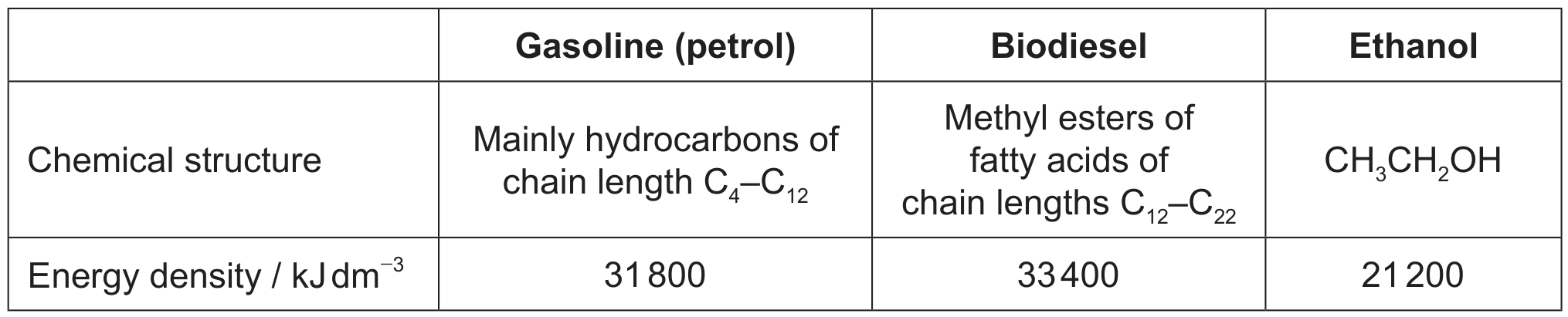
A mixture of gasoline and ethanol is often used as a fuel. Suggest an advantage of such a mixture over the use of pure gasoline. Exclude any discussion of cost.
Methane is another greenhouse gas. Contrast the reasons why methane and carbon dioxide are considered significant greenhouse gases.