IB Chemistry SL Reactivity 1.3.5 Fuel Cells

Practise describing fuel cells as devices that convert a continuous chemical-energy supply directly into electrical energy. Balance oxidation and reduction half-equations for…

Syllabus
First assessment 2025
Objective
1.3.5
Level
SL

Exam points

  • scale oxidation and reduction half-equations until transferred electron numbers match
  • cancel electrons and shared species to obtain a balanced overall fuel-cell equation
  • contrast continuous reactant supply and emissions with a primary cell or combustion engine

1.3.5—Fuel cells question 1

[Maximum number: 1]

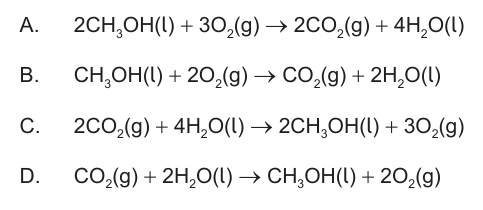
The methanol fuel cell relies on the oxidation of methanol by oxygen. The two half-equations are as follows:

Anode: CH3OH(l)+H2O(l)CO2( g)+6H+(aq)+6e\mathrm{CH}_{3} \mathrm{OH}(\mathrm{l})+\mathrm{H}_{2} \mathrm{O}(\mathrm{l}) \rightarrow \mathrm{CO}_{2}(\mathrm{~g})+6 \mathrm{H}^{+}(\mathrm{aq})+6 \mathrm{e}^{-}

Cathode: 4H+(aq)+O2( g)+4e2H2O(l)4 \mathrm{H}^{+}(\mathrm{aq})+\mathrm{O}_{2}(\mathrm{~g})+4 \mathrm{e}^{-} \rightarrow 2 \mathrm{H}_{2} \mathrm{O}(\mathrm{l})

What is the balanced equation for the overall reaction?

Figure for Question 1.3.5—Fuel cells question 1 — IB Chemistry SL
All question bank results loaded