EduNinja

IB Chemistry SL1.2 Energy cyclesQuestion Bank

Question 1

[Maximum number: 3]

Ethyne, C2H2\mathrm{C}_{2} \mathrm{H}_{2}, reacts with oxygen in welding torches.

Question 1(c)

(a)

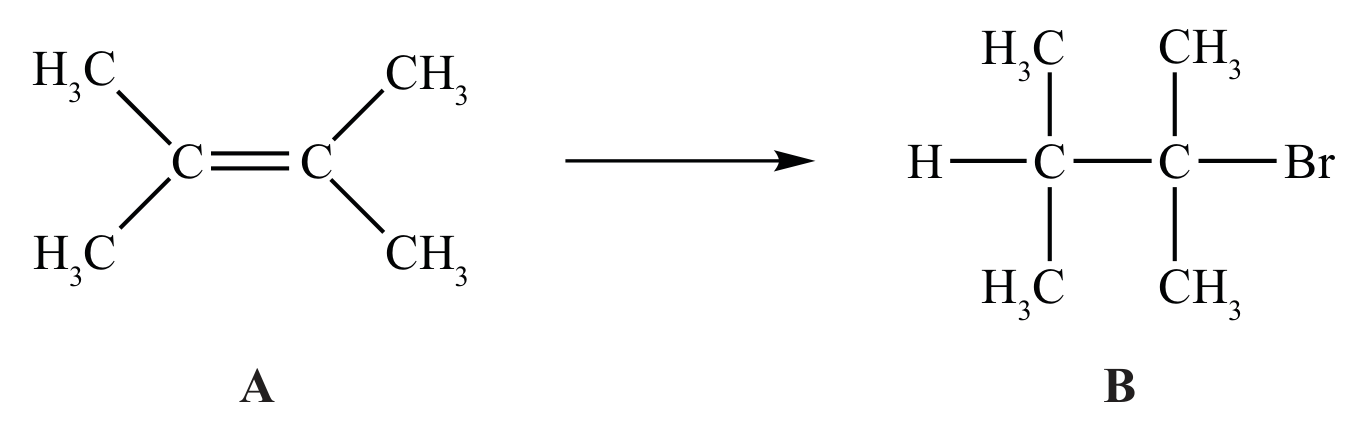
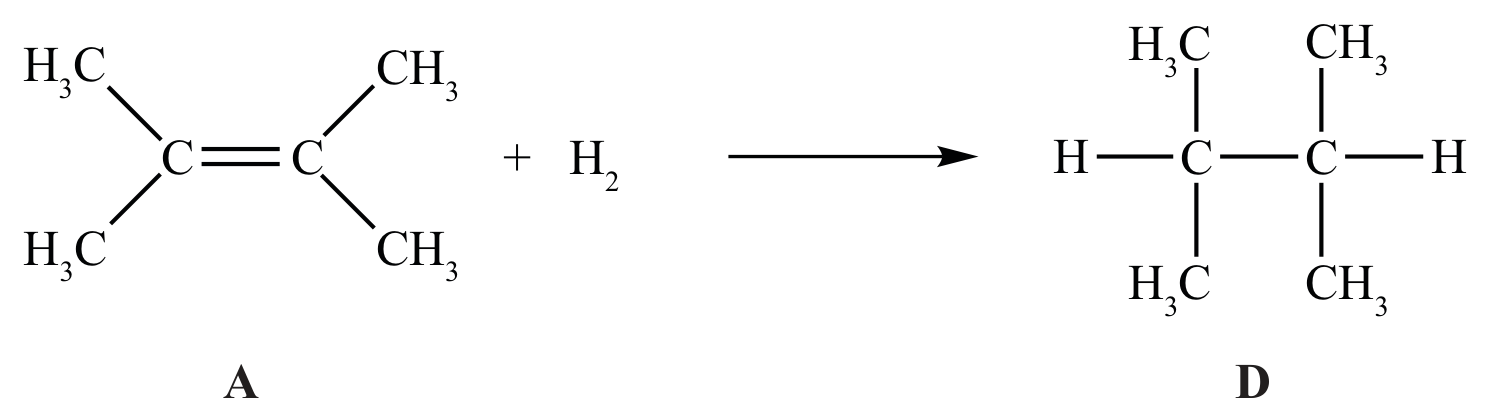
Ethyne reacts with steam.

Two possible products are:

Question image
[ 3 ]

Question 1(c)(iii)

(i)

Determine the enthalpy change for the reaction, in kJ , to produce A using section 11 of the data booklet.

[ 3 ]

Question 1

Question 1(c)

(a)

The students repeated the experiment using 6.16 g of solid hydrated magnesium sulfate, MgSO47H2O(s)\mathrm{MgSO}_{4} \cdot 7 \mathrm{H}_{2} \mathrm{O}(\mathrm{s}), and 50.0 cm350.0 \mathrm{~cm}^{3} of water. They found the enthalpy change, ΔH2\Delta H_{2}, to be +18 kJ mol1+18 \mathrm{~kJ} \mathrm{~mol}^{-1}.

The enthalpy of hydration of solid anhydrous magnesium sulfate is difficult to determine experimentally, but can be determined using the diagram below.

MgSO47H2O( s) water ΔH2Mg2+(aq)+SO42(aq)\mathrm{MgSO}_{4} \cdot 7 \mathrm{H}_{2} \mathrm{O}(\mathrm{~s}) \xrightarrow[\text { water }]{\Delta H_{2}} \mathrm{Mg}^{2+}(\mathrm{aq})+\mathrm{SO}_{4}^{2-}(\mathrm{aq})
[ 1 ]

Question 1(c)(i)

(i)

Determine the enthalpy change, ΔH\Delta H, in kJmol1\mathrm{kJ} \mathrm{mol}^{-1}, for the hydration of solid anhydrous magnesium sulfate, MgSO4\mathrm{MgSO}_{4}.

[ 1 ]

Question 1

[Maximum number: 3]

Ethane-1,2-diol, HOCH2CH2OH\mathrm{HOCH}_{2} \mathrm{CH}_{2} \mathrm{OH}, has a wide variety of uses including the removal of ice from aircraft and heat transfer in a solar cell.

Question 1(a)

(a)

Ethane-1,2-diol can be formed according to the following reaction.

2CO( g)+3H2( g)HOCH2CH2OH( g)2 \mathrm{CO}(\mathrm{~g})+3 \mathrm{H}_{2}(\mathrm{~g}) \rightleftharpoons \mathrm{HOCH}_{2} \mathrm{CH}_{2} \mathrm{OH}(\mathrm{~g})
[ 3 ]

Question 1(a)(iii)

(i)

Calculate the enthalpy change, ΔH\Delta H^{\ominus}, in kJ , for this reaction using section 11 of the data booklet. The bond enthalpy of the carbon-oxygen bond in CO(g) is 1077 kJ mol11077 \mathrm{~kJ} \mathrm{~mol}^{-1}.

[ 3 ]

Question 2

[Maximum number: 3]

Methanoic acid can be produced by the hydrogenation of carbon dioxide according to the equilibrium

CO2( g)+H2( g)HCOOH( g)\mathrm{CO}_{2}(\mathrm{~g})+\mathrm{H}_{2}(\mathrm{~g}) \rightleftharpoons \mathrm{HCOOH}(\mathrm{~g})

Question 2(c)

(a)

Bond enthalpies are a useful way of finding approximate enthalpy changes for reactions.

[ 3 ]

Question 2(c)(i)

(i)

Determine the enthalpy change, ΔH\Delta H^{\ominus}, of this reaction, using section 11 of the data booklet.

[ 3 ]

Question 13

[Maximum number: 1]

What is correct about energy changes during bond breaking and bond formation?

Bond breaking

Bond formation

exothermic and ΔH\Delta H positive

endothermic and ΔH\Delta H negative

exothermic and ΔH\Delta H negative

endothermic and ΔH\Delta H positive

endothermic and ΔH\Delta H positive

exothermic and ΔH\Delta H negative

endothermic and ΔH\Delta H negative

exothermic and ΔH\Delta H positive

Question 13

[Maximum number: 1]

Consider the following reactions:

Fe2O3( s)+CO( g)2FeO( s)+CO2( g)ΔH=3 kJFe( s)+CO2( g)FeO( s)+CO( g)ΔH=+11 kJ\begin{array}{ll} \mathrm{Fe}_{2} \mathrm{O}_{3}(\mathrm{~s})+\mathrm{CO}(\mathrm{~g}) \rightarrow 2 \mathrm{FeO}(\mathrm{~s})+\mathrm{CO}_{2}(\mathrm{~g}) & \Delta H^{\ominus}=-3 \mathrm{~kJ} \\ \mathrm{Fe}(\mathrm{~s})+\mathrm{CO}_{2}(\mathrm{~g}) \rightarrow \mathrm{FeO}(\mathrm{~s})+\mathrm{CO}(\mathrm{~g}) & \Delta H^{\ominus}=+11 \mathrm{~kJ} \end{array}

What is the ΔH\Delta H^{\ominus} value, in kJ , for the following reaction?

Fe2O3( s)+3CO( g)2Fe( s)+3CO2( g)\mathrm{Fe}_{2} \mathrm{O}_{3}(\mathrm{~s})+3 \mathrm{CO}(\mathrm{~g}) \rightarrow 2 \mathrm{Fe}(\mathrm{~s})+3 \mathrm{CO}_{2}(\mathrm{~g})
A

-25

B

-14

C

+8

D

+19

Question 3

[Maximum number: 1]

This question is about compounds of sodium.

Question 3(c)

(a)

Sodium peroxide is used in diving apparatus to produce oxygen from carbon dioxide.

2Na2O2( s)+2CO2( g)2Na2CO3( s)+O2( g)2 \mathrm{Na}_{2} \mathrm{O}_{2}(\mathrm{~s})+2 \mathrm{CO}_{2}(\mathrm{~g}) \rightarrow 2 \mathrm{Na}_{2} \mathrm{CO}_{3}(\mathrm{~s})+\mathrm{O}_{2}(\mathrm{~g})
[ 1 ]

Question 3(c)(ii)

(i)

Outline why bond enthalpy values are not valid in calculations such as that in (c)(i).

[ 1 ]

Question 14

[Maximum number: 1]

Which combination will give you the enthalpy change for the hydrogenation of ethene to ethane, ΔH3\Delta H_{3} ?

2C( s)+3H2( g)ΔH2C2H4( g)+H2( g)ΔH3C2H6( g)+2O2( g)2CO2( g)+3H2( g)+2O2( g)ΔH4\begin{aligned} 2 \mathrm{C}(\mathrm{~s})+ & 3 \mathrm{H}_{2}(\mathrm{~g}) \xrightarrow{\Delta \mathrm{H}_{2}} \mathrm{C}_{2} \mathrm{H}_{4}(\mathrm{~g})+\mathrm{H}_{2}(\mathrm{~g}) \xrightarrow{\Delta \mathrm{H}_{3}} \mathrm{C}_{2} \mathrm{H}_{6}(\mathrm{~g}) \\ & +2 \mathrm{O}_{2}(\mathrm{~g}) \longrightarrow 2 \mathrm{CO}_{2}(\mathrm{~g})+3 \mathrm{H}_{2}(\mathrm{~g}) \xrightarrow[+2 \mathrm{O}_{2}(\mathrm{~g})]{\Delta H_{4}} \end{aligned}
A

ΔH2+ΔH1ΔH4-\Delta H_{2}+\Delta H_{1}-\Delta H_{4}

B

ΔH2ΔH1+ΔH4\Delta H_{2}-\Delta H_{1}+\Delta H_{4}

C

ΔH2+ΔH1ΔH4\Delta H_{2}+\Delta H_{1}-\Delta H_{4}

D

ΔH2ΔH1+ΔH4-\Delta H_{2}-\Delta H_{1}+\Delta H_{4}

Question 14

[Maximum number: 1]

Which combustion reaction releases the least energy per mole of C3H8\mathrm{C}_{3} \mathrm{H}_{8} ?

Approximate bond enthalpy / kJmol1\mathrm{kJ} \mathrm{mol}^{-1}

O=O\mathrm{O}=\mathrm{O}500
C=O\mathrm{C}=\mathrm{O}800
CO\mathrm{C} \equiv \mathrm{O}1000
A

C3H8( g)+5O2( g)3CO2( g)+4H2O(g)\mathrm{C}_{3} \mathrm{H}_{8}(\mathrm{~g})+5 \mathrm{O}_{2}(\mathrm{~g}) \rightarrow 3 \mathrm{CO}_{2}(\mathrm{~g})+4 \mathrm{H}_{2} \mathrm{O}(\mathrm{g})

B

C3H8( g)+92O2( g)2CO2( g)+CO(g)+4H2O(g)\mathrm{C}_{3} \mathrm{H}_{8}(\mathrm{~g})+\frac{9}{2} \mathrm{O}_{2}(\mathrm{~g}) \rightarrow 2 \mathrm{CO}_{2}(\mathrm{~g})+\mathrm{CO}(\mathrm{g})+4 \mathrm{H}_{2} \mathrm{O}(\mathrm{g})

C

C3H8( g)+4O2( g)CO2( g)+2CO(g)+4H2O(g)\mathrm{C}_{3} \mathrm{H}_{8}(\mathrm{~g})+4 \mathrm{O}_{2}(\mathrm{~g}) \rightarrow \mathrm{CO}_{2}(\mathrm{~g})+2 \mathrm{CO}(\mathrm{g})+4 \mathrm{H}_{2} \mathrm{O}(\mathrm{g})

D

C3H8( g)+72O2( g)3CO(g)+4H2O(g)\mathrm{C}_{3} \mathrm{H}_{8}(\mathrm{~g})+\frac{7}{2} \mathrm{O}_{2}(\mathrm{~g}) \rightarrow 3 \mathrm{CO}(\mathrm{g})+4 \mathrm{H}_{2} \mathrm{O}(\mathrm{g})

Question 3

[Maximum number: 3]

The following shows some compounds which can be made from ethene, C2H4\mathrm{C}_{2} \mathrm{H}_{4}.

 ethene (C2H4)C2H5ClC2H6OC2H4O\text { ethene }\left(\mathrm{C}_{2} \mathrm{H}_{4}\right) \rightarrow \mathrm{C}_{2} \mathrm{H}_{5} \mathrm{Cl} \rightarrow \mathrm{C}_{2} \mathrm{H}_{6} \mathrm{O} \rightarrow \mathrm{C}_{2} \mathrm{H}_{4} \mathrm{O}

Question 3(c)

Question 3(c)(ii)

(a)
(i)

Determine the enthalpy of combustion of the organic product in (b), in kJmol1\mathrm{kJ} \mathrm{mol}^{-1}, using data from section 11 of the data booklet.

[ 3 ]
0 selected