

Question 3(c)(i)
A student used a precipitation titration to determine the value of x in the formula of a sample of hydrated barium chloride, .
Procedure
Step 1 Prepare a solution by dissolving 1.57 g of in deionised water, making the solution up to the mark in a volumetric flask and then mixing thoroughly.
Step 2 Use a pipette to transfer of the barium chloride solution into a conical flask.
Add excess sodium sulfate solution and swirl the mixture.
Step 3 Fill a burette with silver nitrate solution.
Step 4 Add three drops of potassium chromate(VI) solution to the conical flask and titrate the contents, while swirling, with the silver nitrate solution.
The end-point is shown by the appearance of a permanent pale red precipitate.
Step 5 Repeat Steps 2 to 4 until concordant results are obtained.
During the titration, two precipitation reactions occur.
Reaction 1 Silver ions react with chloride ions forming silver chloride.
Reaction 2 Once all chloride ions have reacted, silver ions react with chromate(VI) ions to form a red precipitate of silver chromate(VI).
Some data obtained in the experiment are shown.
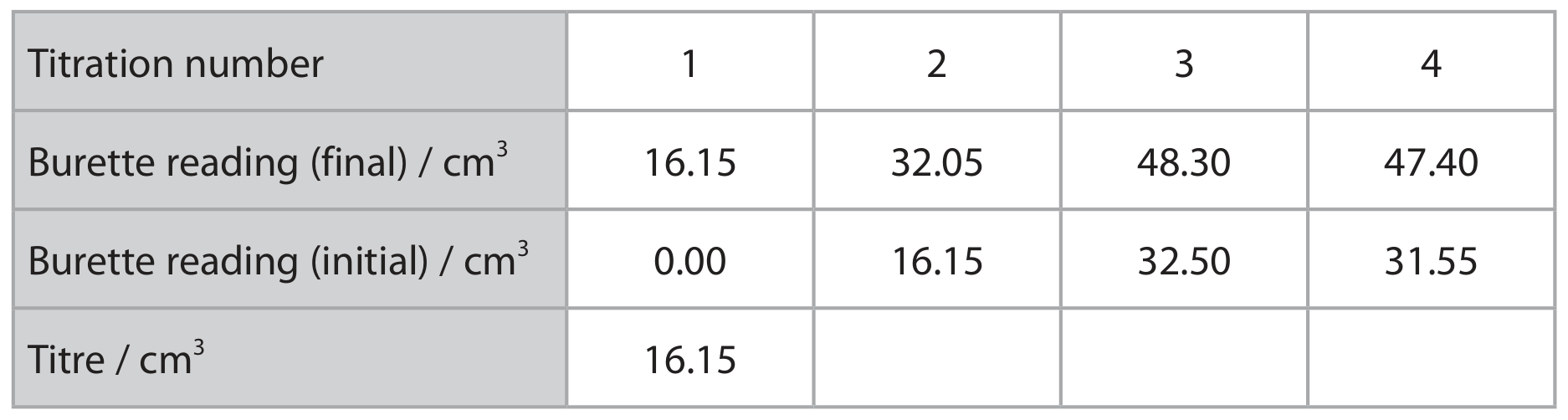
Complete the table and use the concordant results to calculate the mean titre.
(2)