1.3.1—Emission spectra
- Syllabus
- First assessment 2025
- Objective
- 1.3.1
- Level
- SL
An emission photon is released when an electron falls from a higher energy state to a lower energy state. Absorption moves an electron upward and requires photon energy.
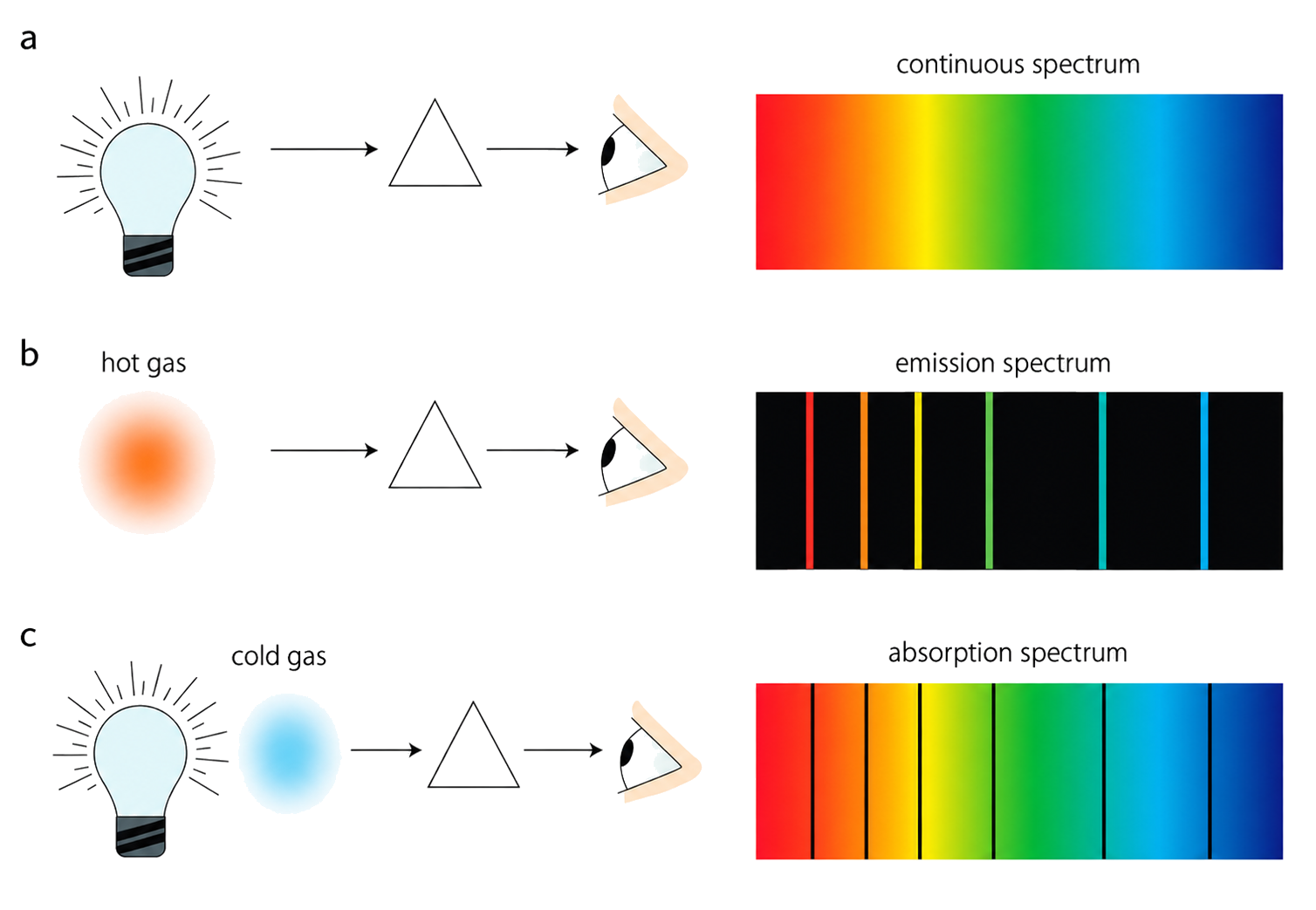
| Spectrum | What it contains | Why |
|---|---|---|
| Line spectrum | Specific wavelengths, frequencies, energies, or colours | Electrons occupy discrete energy levels, so only particular transitions occur |
| Continuous spectrum | A continuous range across the relevant values | The radiation spans the range rather than appearing as separated lines |
Across electromagnetic radiation, shorter wavelength means higher frequency, and higher frequency means higher photon energy. Explain the electron direction and photon exchange when distinguishing absorption from emission.
Read every spectral transition in two directions: absorption raises an electron by ΔE, while a downward transition emits a photon with ΔE = hf = hc/λ. A shorter-wavelength line therefore represents a larger energy gap, not a higher line intensity.
Orient the spectrum before comparing lines: radio → microwave → infrared → visible → ultraviolet → X-ray → gamma is increasing frequency and photon energy, and decreasing wavelength. Within visible light, red has longer wavelength and lower photon energy than violet.
Structured questions ask learners to distinguish absorption from emission by the direction of electron movement and photon transfer, and to distinguish continuous spectra from line spectra by their wavelength or frequency coverage.
distinguish
State the direction of the electron transition and whether a photon is absorbed or emitted, then classify a continuous spectrum as spanning the range and a line spectrum as containing only specific wavelengths, frequencies, energies, or colours.
Reversing absorption and emission, or describing a line spectrum as continuous rather than as discrete allowed wavelengths or frequencies.
Representative question
Distinguish between the processes within the atom that give rise to absorption and emission spectra.
Absorption spectra:
Emission spectra:
Absorption spectra: electrons absorb a photon/light/wavelength/frequency/energy/radiation and move to higher energy level(s);
Marking guidance:
Accept "excited state(s)" for "higher energy level(s)".
Emission spectra:
(excited) electrons move down to lower energy level(s) and release a photon/light/wavelength/frequency/energy/radiation;
Accept "state" for "level" throughout.
Award [1 max] if the movement between energy levels is described correctly but the involvement of a photon/light/wavelength/frequency/energy/radiation is omitted. Accept suitable diagrams.
Retrieve the chain: emission lines reveal discrete levels; capacities, sublevels, orbitals, and spin rules build configurations; first and successive ionization energies then reveal how electrons are held and arranged.
When checking an answer, ask: Did I link a line to a transition? Did I use 2n² and the filling rules? Did I explain an ionization trend or count electrons before a successive-IE jump?