Reactivity 1. What drives chemical reactions?
- Syllabus
- First assessment 2025
- Section
- —
- Level
- HL
| Type | Energy direction | Surroundings temperature |
|---|---|---|
| Endothermic | Absorbed by the system | Decreases |
| Exothermic | Released by the system | Increases |
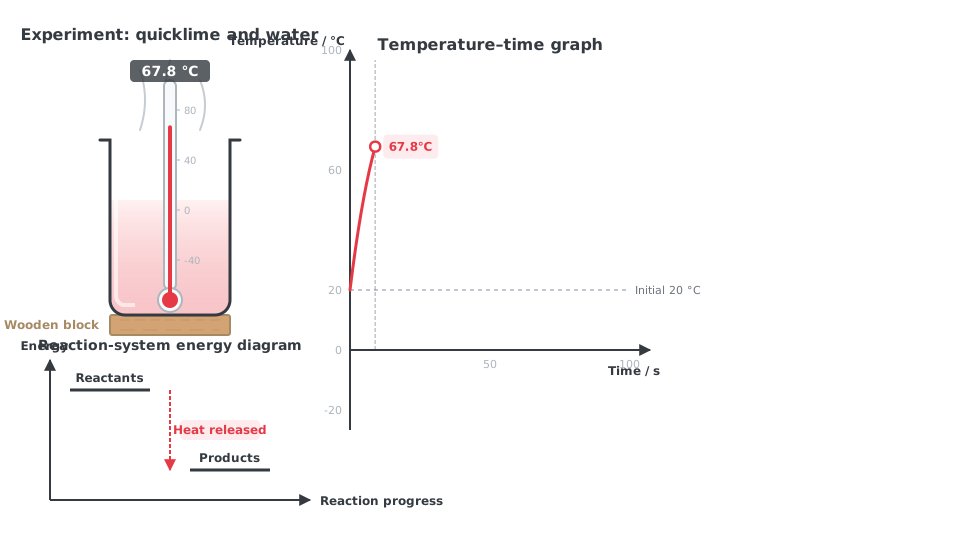
Classify from the direction of energy transfer, then check that the observed temperature change of the surroundings agrees.
Connect three representations: exothermic means energy flows out of the system, the surroundings warm, and ΔH for the system is negative; endothermic gives the opposite pattern and positive ΔH. State the observed part before inferring the reaction type.
Lower relative energy corresponds to greater relative stability. In an exothermic reaction the products are lower in energy than the reactants; in an endothermic reaction the products are higher.
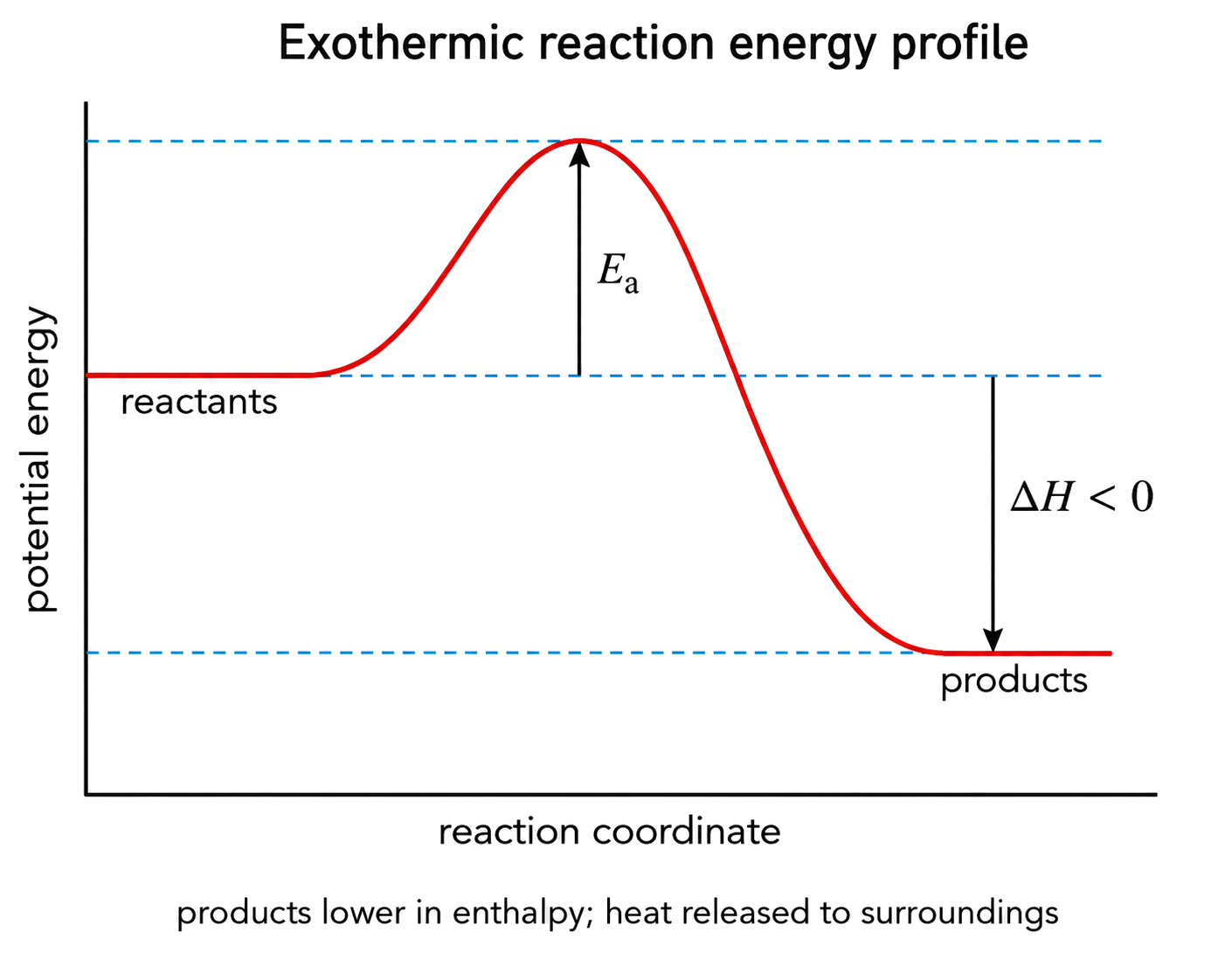
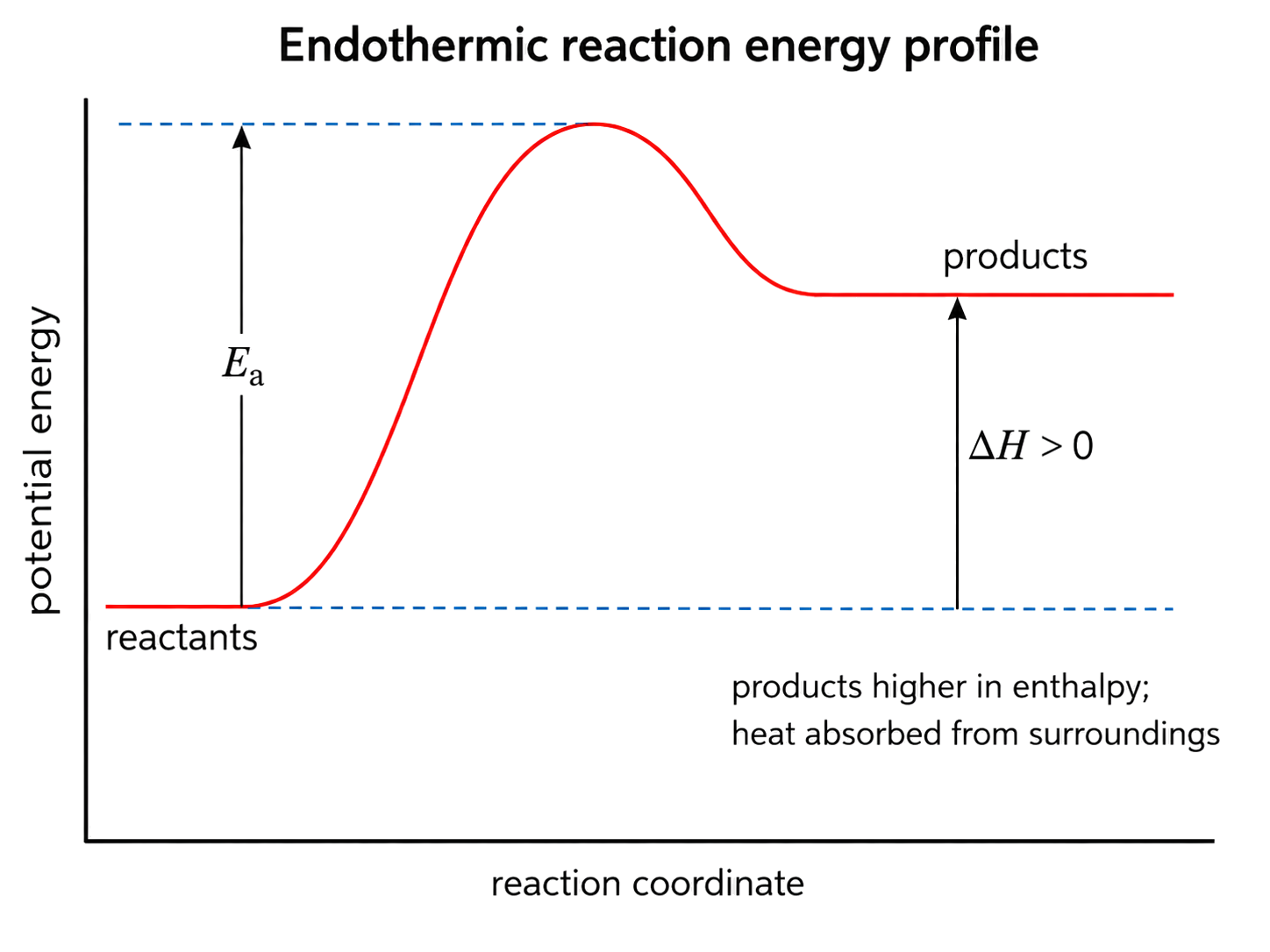
Label the horizontal axis reaction coordinate and the vertical axis potential energy. Then read reactant and product levels, identify the sign and direction of ΔH, and distinguish ΔH from activation energy.
On a profile, ΔH is the vertical difference between product and reactant levels, while activation energy rises from reactants to the peak. A catalyst lowers the peak by changing the pathway but leaves the two energy levels, ΔH and the relative stability of reactants and products unchanged.
An energy profile identifies an activation barrier but does not by itself determine an observed rate: temperature, particle concentrations/collision frequency and the available pathway also matter. Use the diagram to compare energetic barriers only when the profiles and conditions make that comparison valid.
Hess's law states that enthalpy change is independent of reaction pathway. Enthalpy values can therefore be combined through a balanced cycle.
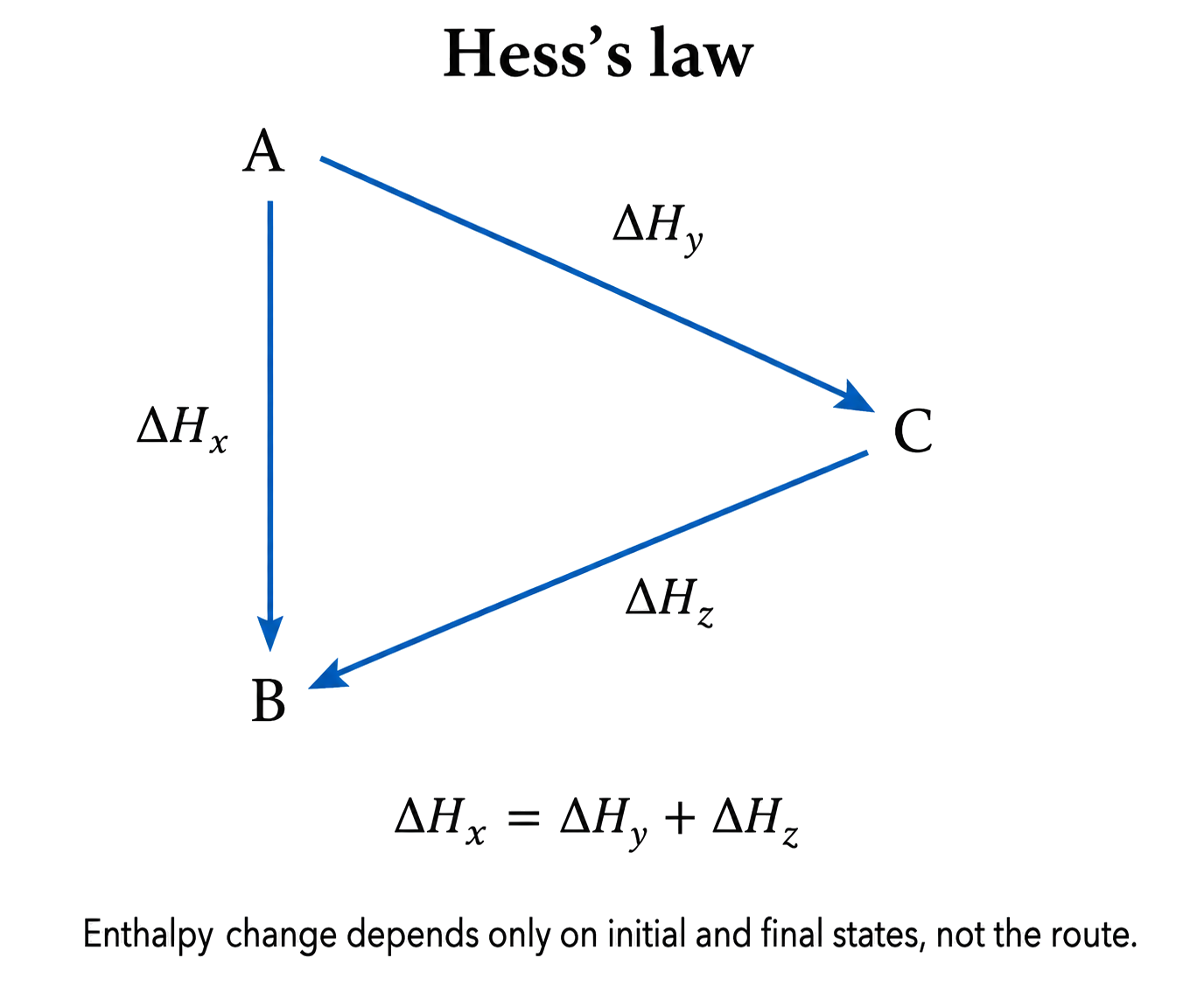
Reverse an entire balanced equation by changing the sign of ΔH; scale every coefficient and ΔH by the same factor; then add equations and cancel identical species in identical physical states. Never change a chemical subscript, formula or state symbol merely to force cancellation. The surviving equation must exactly match the target before enthalpies are summed.
Treat chemical equations like algebra: reverse a step and reverse its ΔH sign; multiply all coefficients and ΔH by the same factor; then add and cancel species. The surviving overall equation must exactly match the target before the enthalpies are summed.
Worked example — Hess's law: target . Use , ; double to give ; reverse methanol combustion to give . After cancelling and , for the target equation.
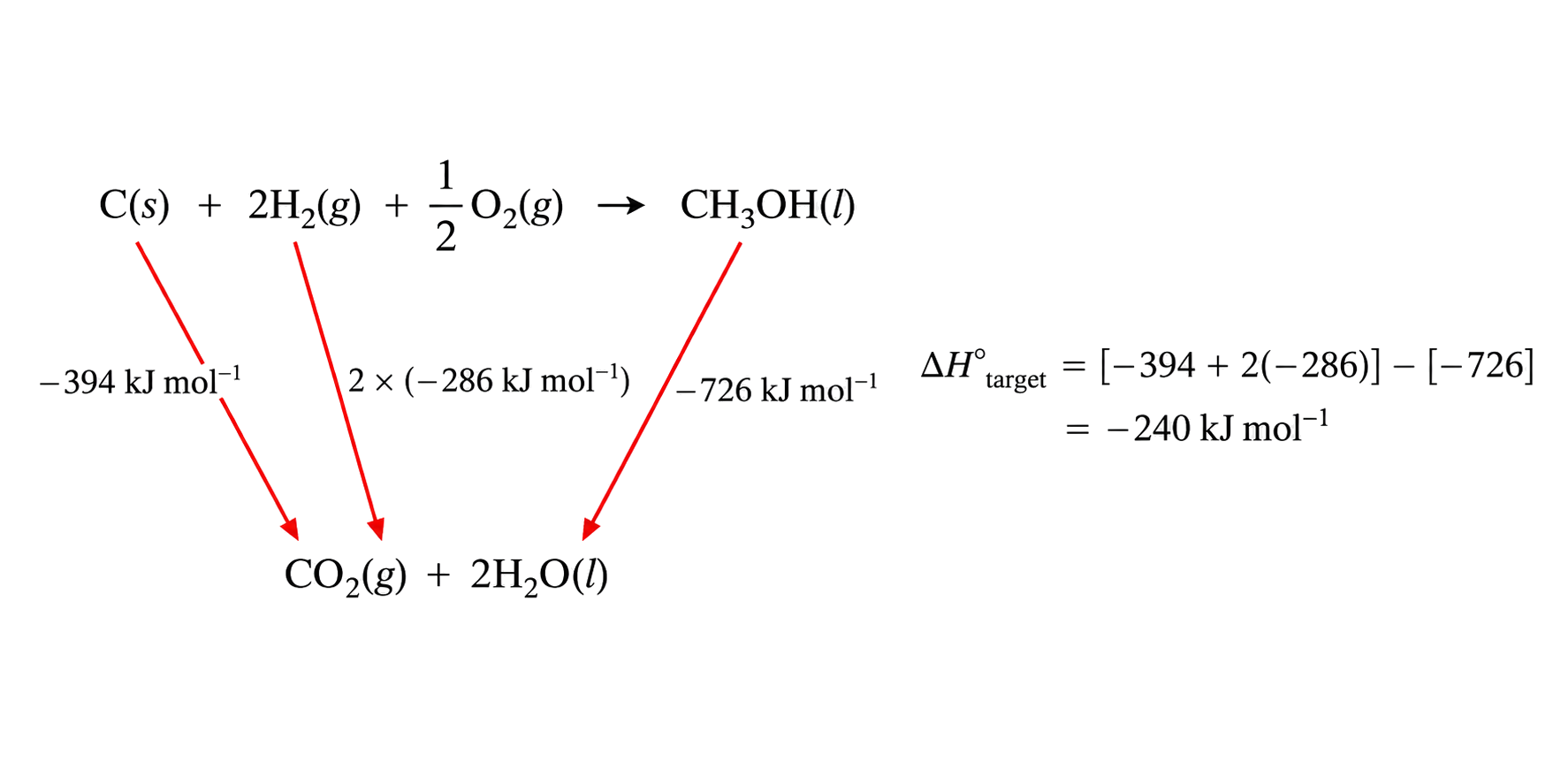
Apply stoichiometric coefficients to every term, preserve signs, and use the formation or combustion formula that matches the supplied data.
For formation data, imagine every reactant and product connected to the same elements: product sums minus reactant sums gives the target. For combustion data the paths run toward common combustion products, reversing the subtraction. Write coefficients beside every tabulated value before calculating.
Worked example — formation data for pentane combustion: . Using , , and , . The negative sign identifies exothermic combustion.
A Born–Haber cycle tracks the energy changes that form an ionic solid from its elements. It includes atomization, ionization, electron affinity, and lattice enthalpy terms with the correct stoichiometry.
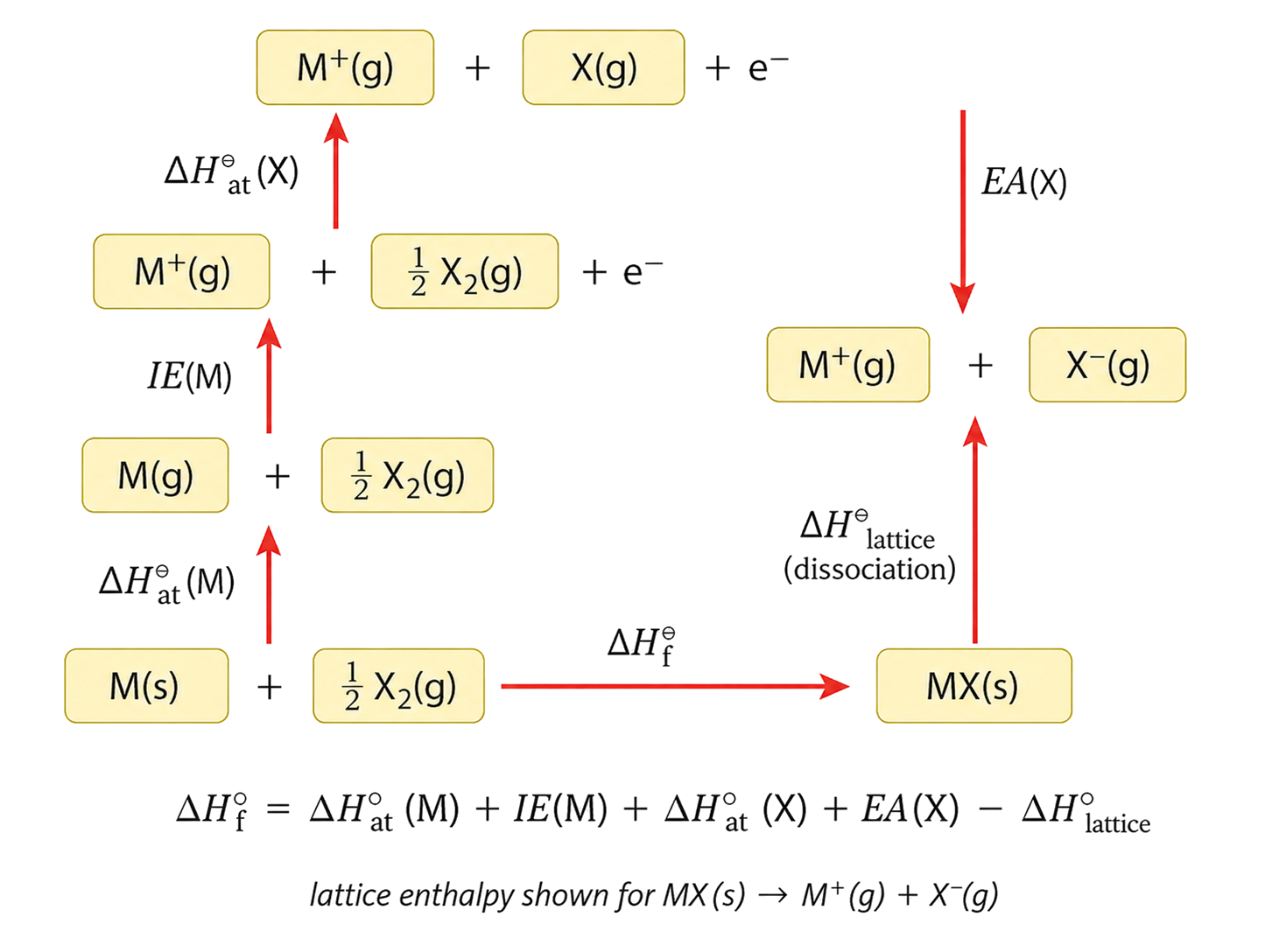
Create a state-and-particle ledger before summing: convert each element from its standard state to the required gaseous atoms (including sublimation/phase change and bond dissociation where needed), apply every ionization-energy and electron-affinity step with its coefficient, then form the lattice. For divalent ions include both electron steps, and fix whether lattice enthalpy means formation or dissociation before assigning its sign.
Build the cycle from physical steps and electron accounting: atomize each element, ionize the metal the required number of times, add electrons to the non-metal, then form the lattice. For a 2− ion include two electron-affinity terms, and confirm whether the supplied lattice enthalpy is defined for formation or dissociation before assigning its sign.
Worked example — KBr lattice enthalpy: use the DP lattice-dissociation convention . Following the alternative path in the local cycle, . The formation enthalpy is reversed, atomization and ionization are positive, and the first electron affinity is negative. The positive result is consistent with separating a solid lattice into gaseous ions.
A fuel cell converts chemical energy from a spontaneous redox reaction directly into electrical energy. Oxidation occurs at the anode and reduction at the cathode.
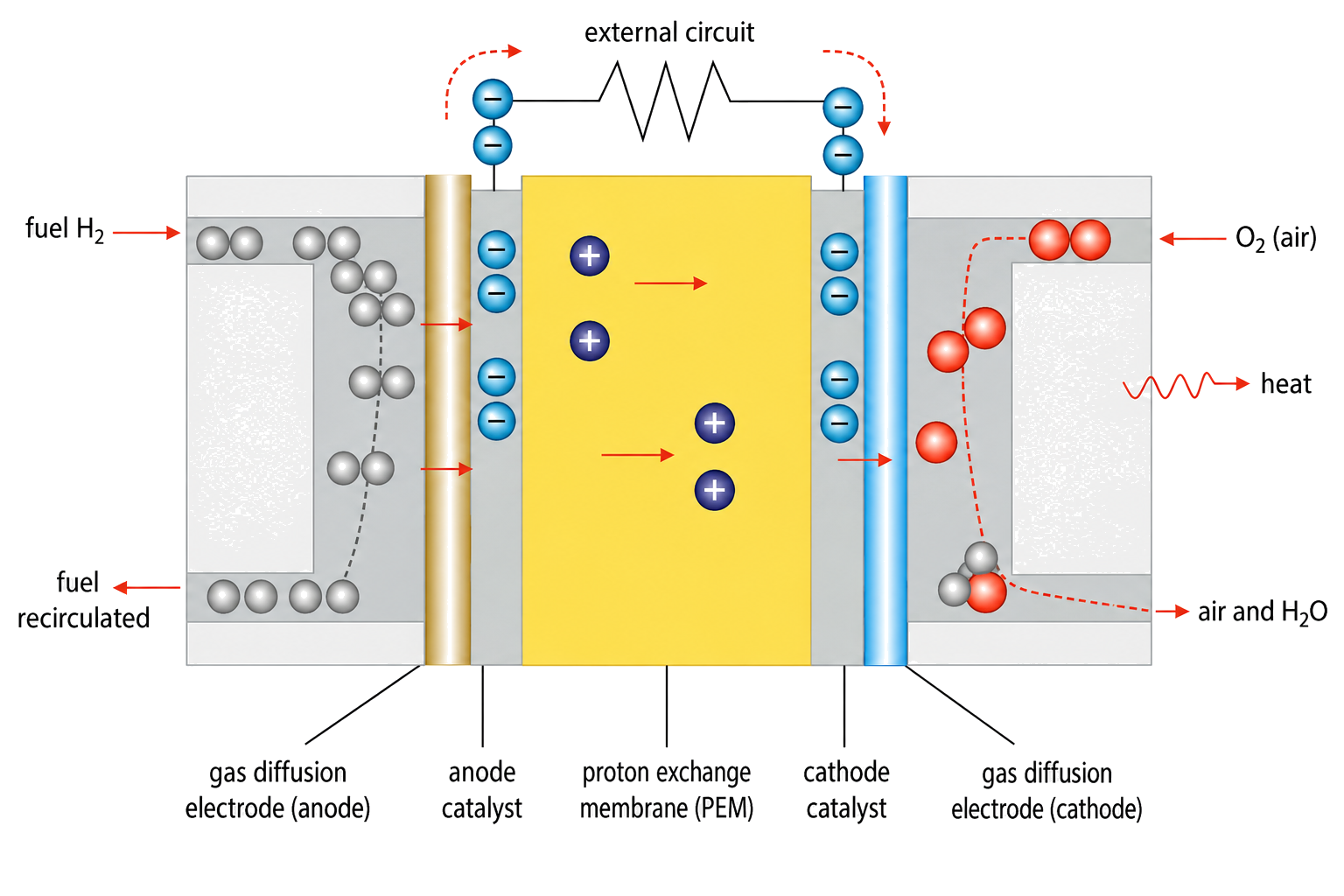
Deduce each half-equation from the fuel-cell reactants and electrolyte context, balance atoms and charge, then add the half-equations to obtain the overall reaction. Hydrogen and methanol cells require different oxidation half-equations.
For a hydrogen fuel cell, oxidation of H₂ supplies electrons at the anode and O₂ gains electrons at the cathode; the half-equations must match the acidic or alkaline electrolyte before they are added to 2H₂ + O₂ → 2H₂O. Direct electrical conversion does not remove the need to evaluate fuel production and storage.
A fuel cell operates while fuel and oxidant are supplied continuously from outside; a conventional battery stores a finite set of reactants internally. Point-of-use water from a hydrogen cell is not a complete environmental assessment—fuel manufacture, transport, storage and electricity source remain inside a lifecycle comparison.
Worked equations — acidic hydrogen cell: anode ; cathode . Double the anode equation before adding, giving . Direct-methanol cell: anode ; cathode . Adding and cancelling gives . Match each half-equation to the stated electrolyte; proton-exchange-membrane construction details are not assessed.
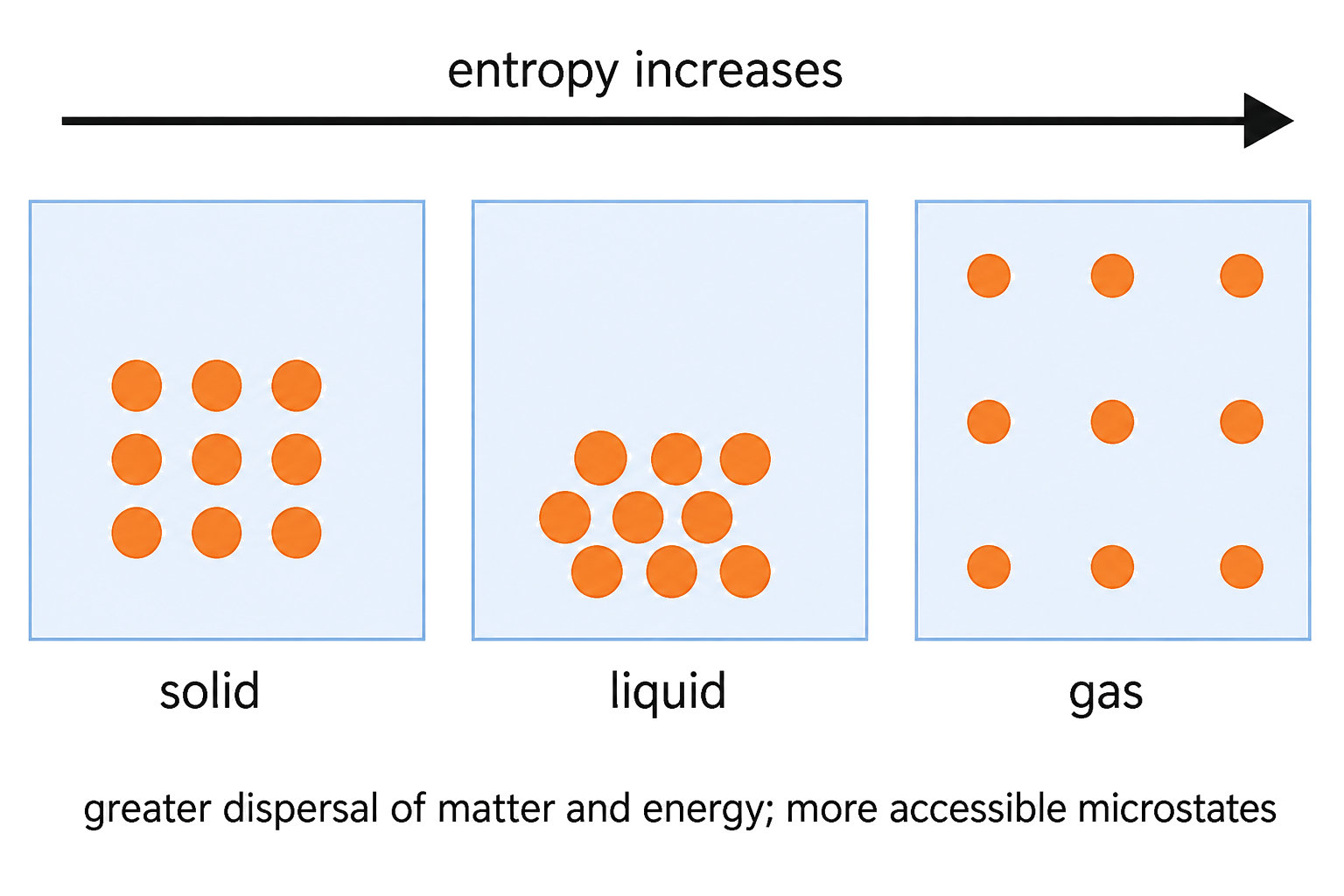
Entropy describes the dispersal of matter and available energy. For the reaction system, calculate ΔS° = ΣS°(products) − ΣS°(reactants), including every coefficient, and report J K⁻¹ mol⁻¹ for the reaction as written. System ΔS° is not the same as total entropy change of system plus surroundings; state the boundary before using entropy to discuss spontaneity.
Use phase and particle count to predict a likely sign before calculating: producing more gas particles usually increases dispersal. Treat that prediction as a check, not a replacement for the standard-entropy sum.
Worked entropy example: for , use , and . . The small positive value is plausible because gas moles are unchanged; the tabulated values, not gas count alone, determine the sign.
| Condition | Meaning |
|---|---|
| ΔG < 0 | spontaneous in the stated direction |
| ΔG = 0 | equilibrium |
| ΔG > 0 | non-spontaneous in the stated direction |
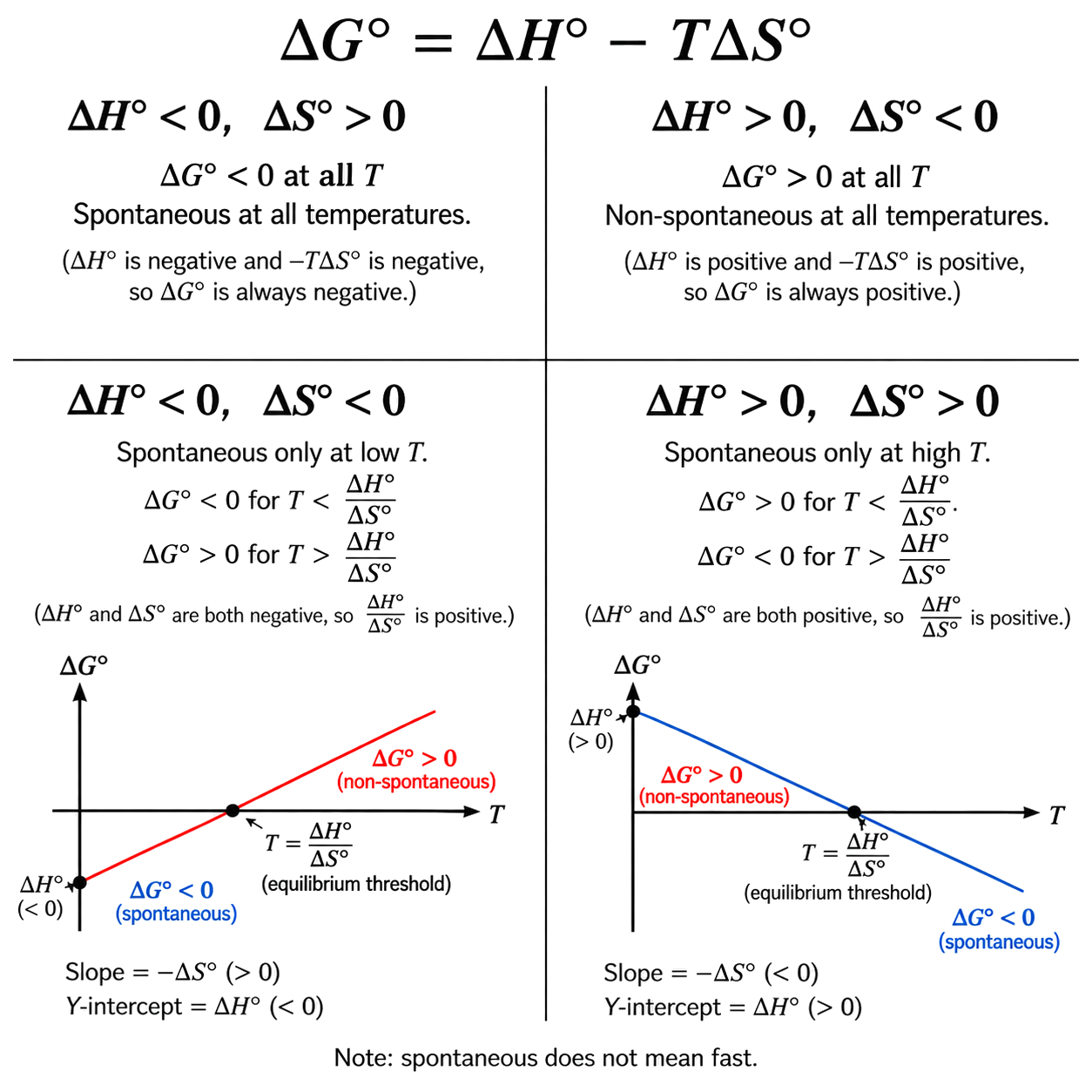
For a temperature-dependent reaction, find the boundary by setting ΔG° = 0 in ΔG° = ΔH° − TΔS°, then use the signs of ΔH° and ΔS° to decide which temperature range is spontaneous.
Use the signs before calculating: ΔH < 0 and ΔS > 0 is favourable at all temperatures, while ΔH > 0 and ΔS < 0 is not; matching signs create a temperature threshold. At T = ΔH/ΔS, first put ΔH and ΔS in consistent units, then test one temperature on each side rather than guessing the inequality.
Worked threshold example: has and . At the boundary, , so . Because both changes are positive, the forward reaction is spontaneous above 949 K and non-spontaneous below it, assuming and are approximately constant.
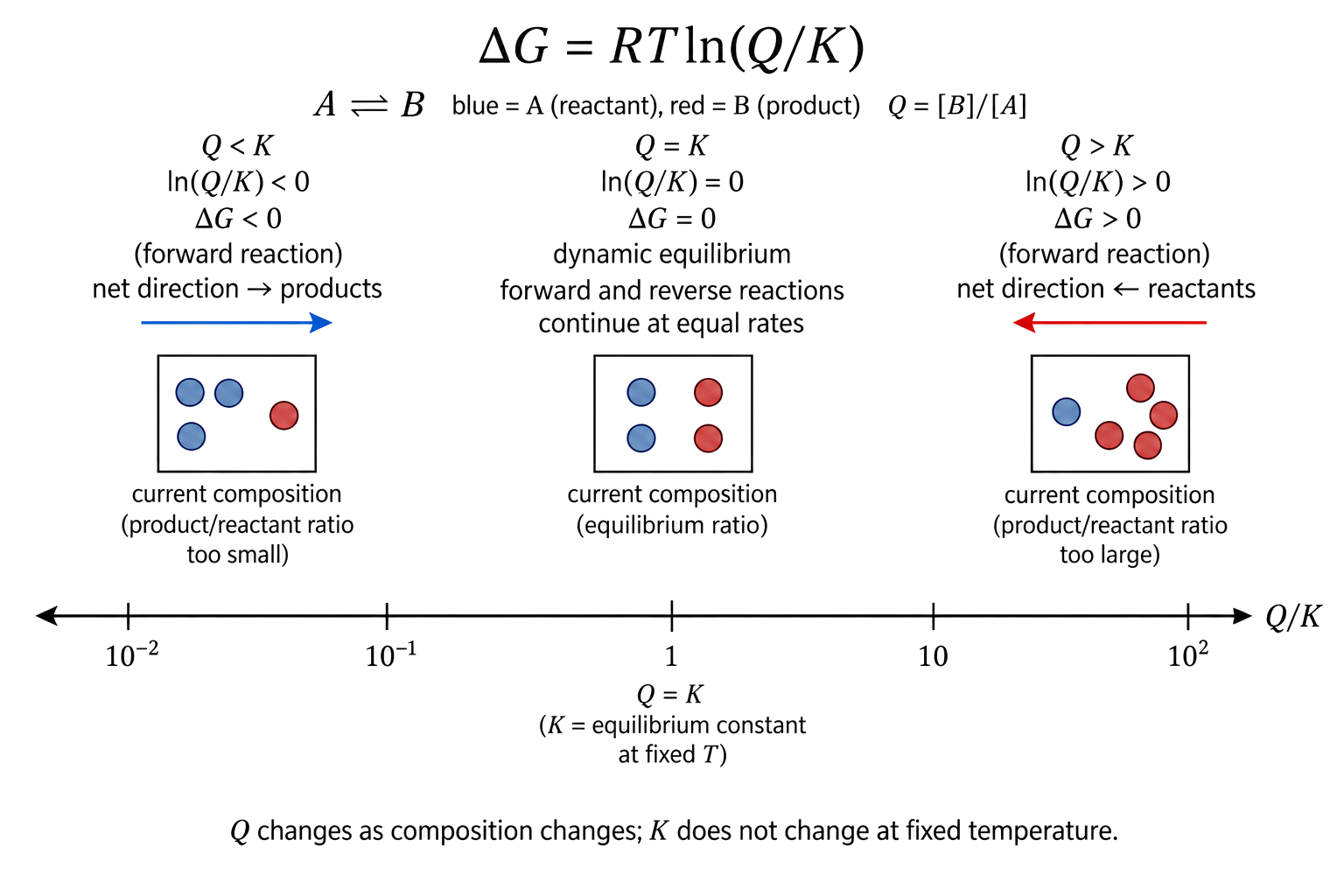
At equilibrium for the stated reaction and temperature, Q = K and the current ΔG = 0. Substitution into ΔG = ΔG° + RT ln Q shows that ΔG° is generally not zero; it equals −RT ln K. Away from equilibrium, Q < K favours the forward direction and Q > K favours the reverse. Compare Q and K only for the same balanced reaction orientation and fixed temperature.
Compare Q with K to predict the immediate direction: Q < K gives ΔG < 0 for the forward reaction, while Q > K gives ΔG > 0 and favours the reverse. Keep ΔG for the current composition distinct from ΔG°, which describes standard-state reactants and products and fixes K at that temperature.
Worked and example: for ammonia synthesis at 298 K, the local course book gives . From , , so products are favoured at equilibrium. If , ; the forward reaction is then non-spontaneous because the current mixture has .
