1.2 Energy cycles

Syllabus
First assessment 2025
Topic
1.2
Level
HL

Average Bond Energies

ΔHΣ(bondsbroken)Σ(bondsformed)ΔH ≈ Σ(bonds broken) − Σ(bonds formed)

Breaking bonds absorbs energy; forming bonds releases energy. Count every bond with its stoichiometric multiplicity before applying the signed sum.

For H₂ + Cl₂ → 2HCl, break one H–H and one Cl–Cl bond, then form two H–Cl bonds. Average bond enthalpies give an estimate because the tabulated value averages that bond across different gaseous molecules.

Worked example — bond enthalpies: for CX2HX4(g)+HBr(g)CX2HX5Br(g)\ce{C2H4(g) + HBr(g) -> C2H5Br(g)}, the local course book gives CH=414\ce{C-H}=414, C=C=614\ce{C=C}=614, HBr=366\ce{H-Br}=366, CC=346\ce{C-C}=346 and CBr=285kJmol1\ce{C-Br}=285\,\mathrm{kJ\,mol^{-1}}. ΔH=[4(414)+614+366][5(414)+346+285]=26362701=65kJmol1\Delta H=[4(414)+614+366]-[5(414)+346+285]=2636-2701=-65\,\mathrm{kJ\,mol^{-1}}. The negative estimate means the bonds formed release more energy than the bonds broken absorb; it remains approximate because the values are gaseous averages.

Calculating from Bond Energies

Assessment in practice

Representative question

Question 1

[Maximum number: 3]

Calculate the enthalpy change for the reaction, ΔH\Delta H. Use section 12 of the data booklet.

Hess's Law

Hess's law states that enthalpy change is independent of reaction pathway. Enthalpy values can therefore be combined through a balanced cycle.
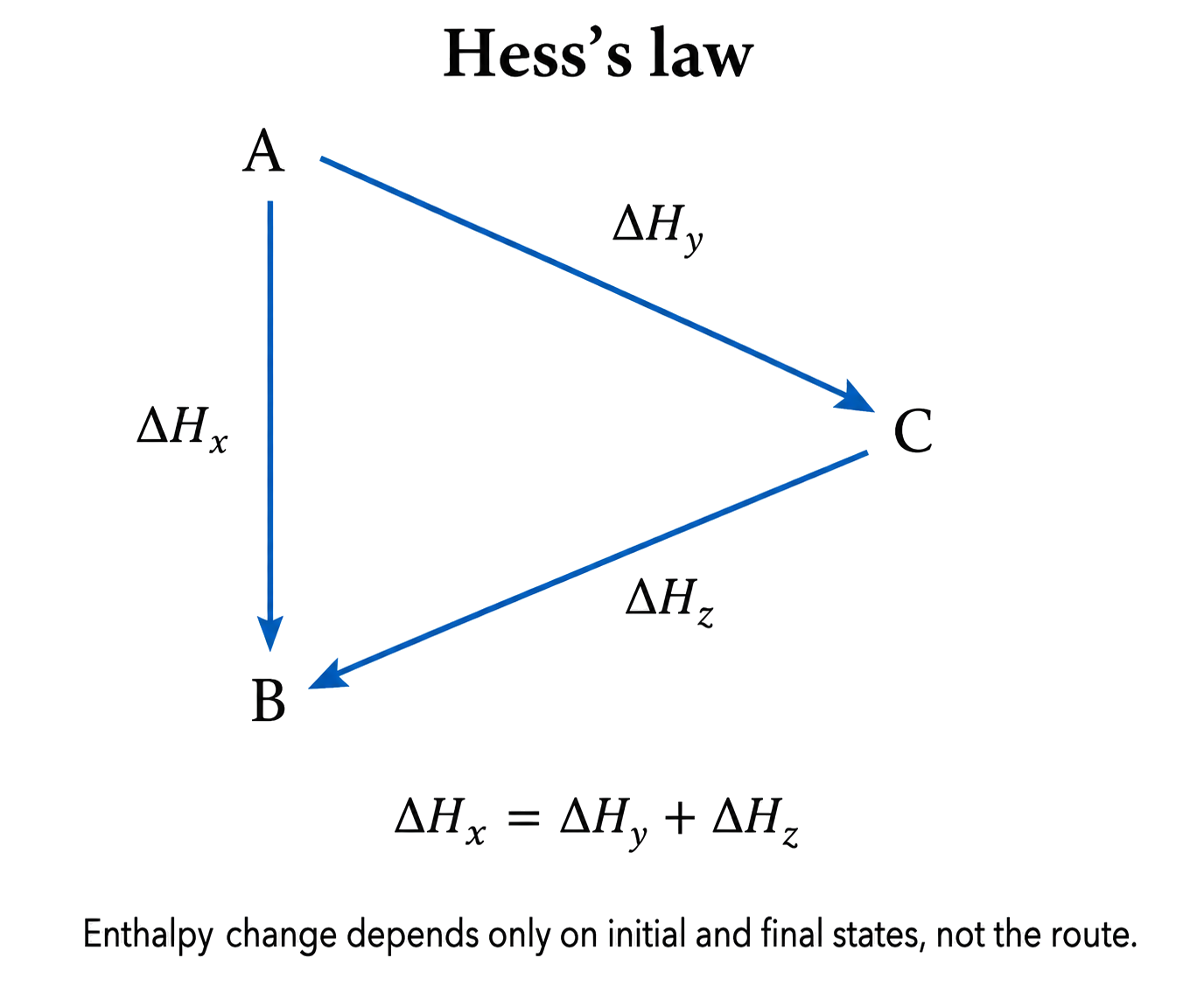
Reverse an entire balanced equation by changing the sign of ΔH; scale every coefficient and ΔH by the same factor; then add equations and cancel identical species in identical physical states. Never change a chemical subscript, formula or state symbol merely to force cancellation. The surviving equation must exactly match the target before enthalpies are summed.

Treat chemical equations like algebra: reverse a step and reverse its ΔH sign; multiply all coefficients and ΔH by the same factor; then add and cancel species. The surviving overall equation must exactly match the target before the enthalpies are summed.

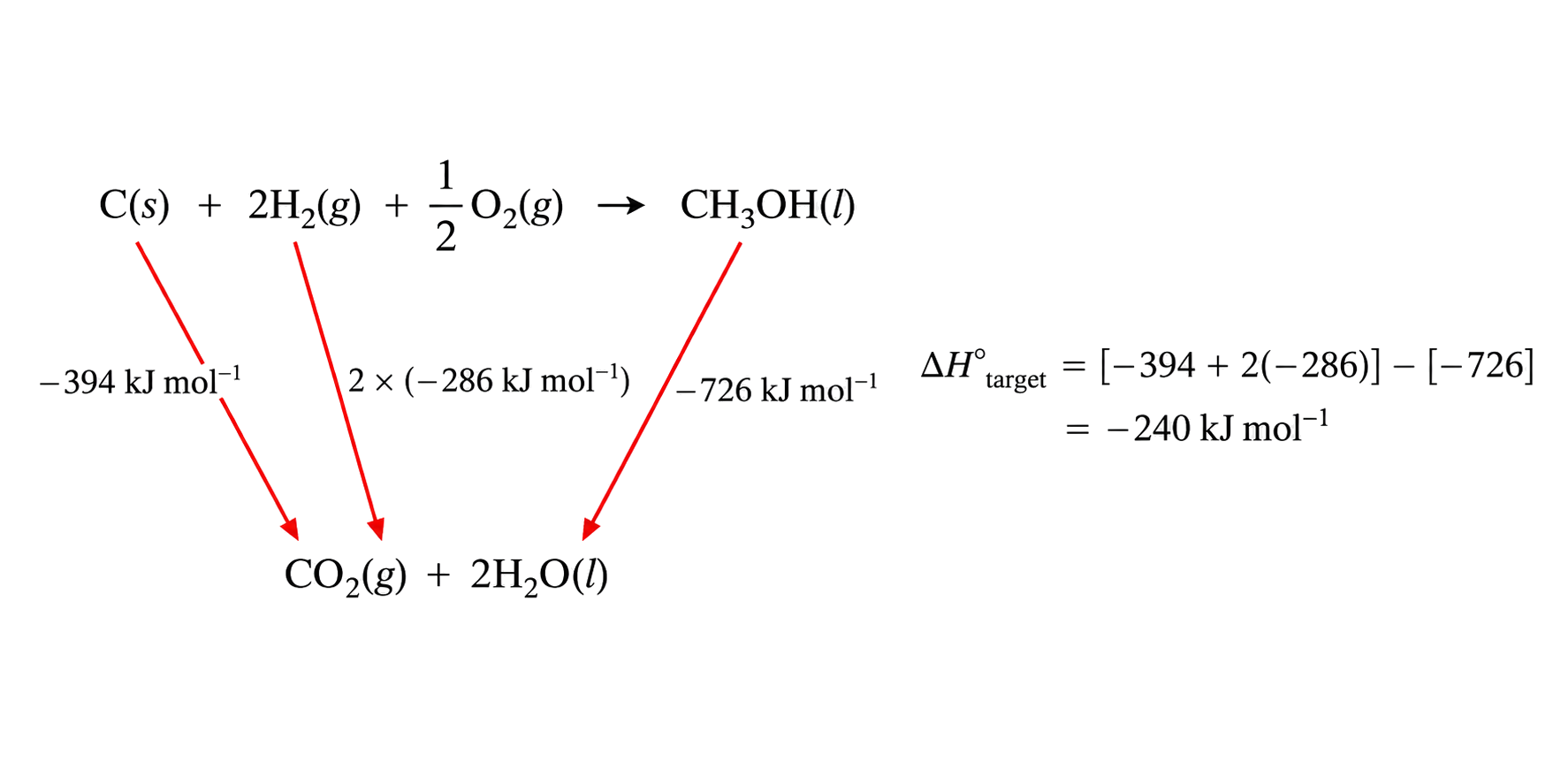
Worked example — Hess's law: target C(s)X2+HX2(g)X1+/2OX2(g)CHX3OH(l)\ce{C(s)+2H2(g)+1/2O2(g)->CH3OH(l)}. Use CX+OX2COX2\ce{C+O2->CO2}, ΔH=394kJmol1\Delta H=-394\,\mathrm{kJ\,mol^{-1}}; double HX2X+1/2OX2HX2O(l)\ce{H2+1/2O2->H2O(l)} to give 572kJmol1-572\,\mathrm{kJ\,mol^{-1}}; reverse methanol combustion to give +726kJmol1+726\,\mathrm{kJ\,mol^{-1}}. After cancelling COX2\ce{CO2} and HX2O\ce{H2O}, ΔH=394572+726=240kJmol1\Delta H=-394-572+726=-240\,\mathrm{kJ\,mol^{-1}} for the target equation.

Solving Hess Cycles

Assessment in practice

Representative question

Question 1

[Maximum number: 1]

Determine the enthalpy change, ΔH\Delta H, in kJmol1\mathrm{kJ} \mathrm{mol}^{-1}, for the hydration of solid anhydrous magnesium sulfate, MgSO4\mathrm{MgSO}_{4}.

Standard Formation and Combustion Enthalpies

HL only
Quantity Equation constraint
ΔHf° Form one mole of compound from elements in standard states
ΔHc° Completely burn one mole of substance in oxygen under standard conditions

Use correct standard states and coefficients; do not mix formation and combustion definitions in one equation.

A formation equation must produce exactly one mole of the compound from elements in their standard states, so fractional coefficients may be necessary. A combustion equation must burn exactly one mole completely in O₂; keep the stated standard state of water because changing H₂O(l) to H₂O(g) changes ΔH°.

Worked scaling example: ΔHc(CX2HX6)=1560kJmol1\Delta H_c^\circ(\ce{C2H6})=-1560\,\mathrm{kJ\,mol^{-1}} refers to complete combustion of one mole of ethane. For the corresponding balanced combustion of two moles, multiply the complete equation and its enthalpy by two: ΔH=2(1560)=3120kJ\Delta H^\circ=2(-1560)=-3120\,\mathrm{kJ}. Do not report kJmol1\mathrm{kJ\,mol^{-1}} for the two-mole equation unless the result is normalized back to one mole.

Writing Standard-Enthalpy Equations

HL only

Assessment in practice

Representative question

Question 1

[Maximum number: 3]

Calculate the enthalpy of reaction, in kJmol1\mathrm{kJ} \mathrm{mol}^{-1}, when 1 mol of potassium reacts with water. Use section 12 of the data booklet. ΔHf\Delta H_{\mathrm{f}} of KOH(aq) is 481.8 kJ mol1-481.8 \mathrm{~kJ} \mathrm{~mol}^{-1}.

Hess-Law Applications

HL only

ΔH°=ΣΔHf°(products)ΣΔHf°(reactants)ΔH°=ΣΔHc°(reactants)ΣΔHc°(products)ΔH° = ΣΔHf°(products) − ΣΔHf°(reactants) ΔH° = ΣΔHc°(reactants) − ΣΔHc°(products)

Apply stoichiometric coefficients to every term, preserve signs, and use the formation or combustion formula that matches the supplied data.

For formation data, imagine every reactant and product connected to the same elements: product sums minus reactant sums gives the target. For combustion data the paths run toward common combustion products, reversing the subtraction. Write coefficients beside every tabulated value before calculating.

Worked example — formation data for pentane combustion: CX5HX12(l)X8+OX2(g)5COX2(g)X6+HX2O(l)\ce{C5H12(l)+8O2(g)->5CO2(g)+6H2O(l)}. Using ΔHf[CX5HX12(l)]=173\Delta H_f^\circ[\ce{C5H12(l)}]=-173, ΔHf[COX2(g)]=394\Delta H_f^\circ[\ce{CO2(g)}]=-394, ΔHf[HX2O(l)]=286\Delta H_f^\circ[\ce{H2O(l)}]=-286 and ΔHf[OX2(g)]=0kJmol1\Delta H_f^\circ[\ce{O2(g)}]=0\,\mathrm{kJ\,mol^{-1}}, ΔH=5(394)+6(286)[173+8(0)]=3513kJmol1\Delta H^\circ=5(-394)+6(-286)-[-173+8(0)]=-3513\,\mathrm{kJ\,mol^{-1}}. The negative sign identifies exothermic combustion.

Calculating with Standard Data

HL only

Assessment in practice

Representative question

Question 1

[Maximum number: 2]

Calculate the standard enthalpy change of formation, ΔHθf\Delta H^{\theta}{ }_{\mathrm{f}}, in kJmol1\mathrm{kJ} \mathrm{mol}^{-1}, of ethyl ethanoate, C4H8O2\mathrm{C}_{4} \mathrm{H}_{8} \mathrm{O}_{2}. Use sections 1 and 13 of the data booklet and the value of 4 kJ mol1-4 \mathrm{~kJ} \mathrm{~mol}^{-1} for the standard enthalpy change of reaction, ΔHθr\Delta H^{\theta}{ }_{\mathrm{r}}.

Born–Haber Cycles

HL only

A Born–Haber cycle tracks the energy changes that form an ionic solid from its elements. It includes atomization, ionization, electron affinity, and lattice enthalpy terms with the correct stoichiometry.
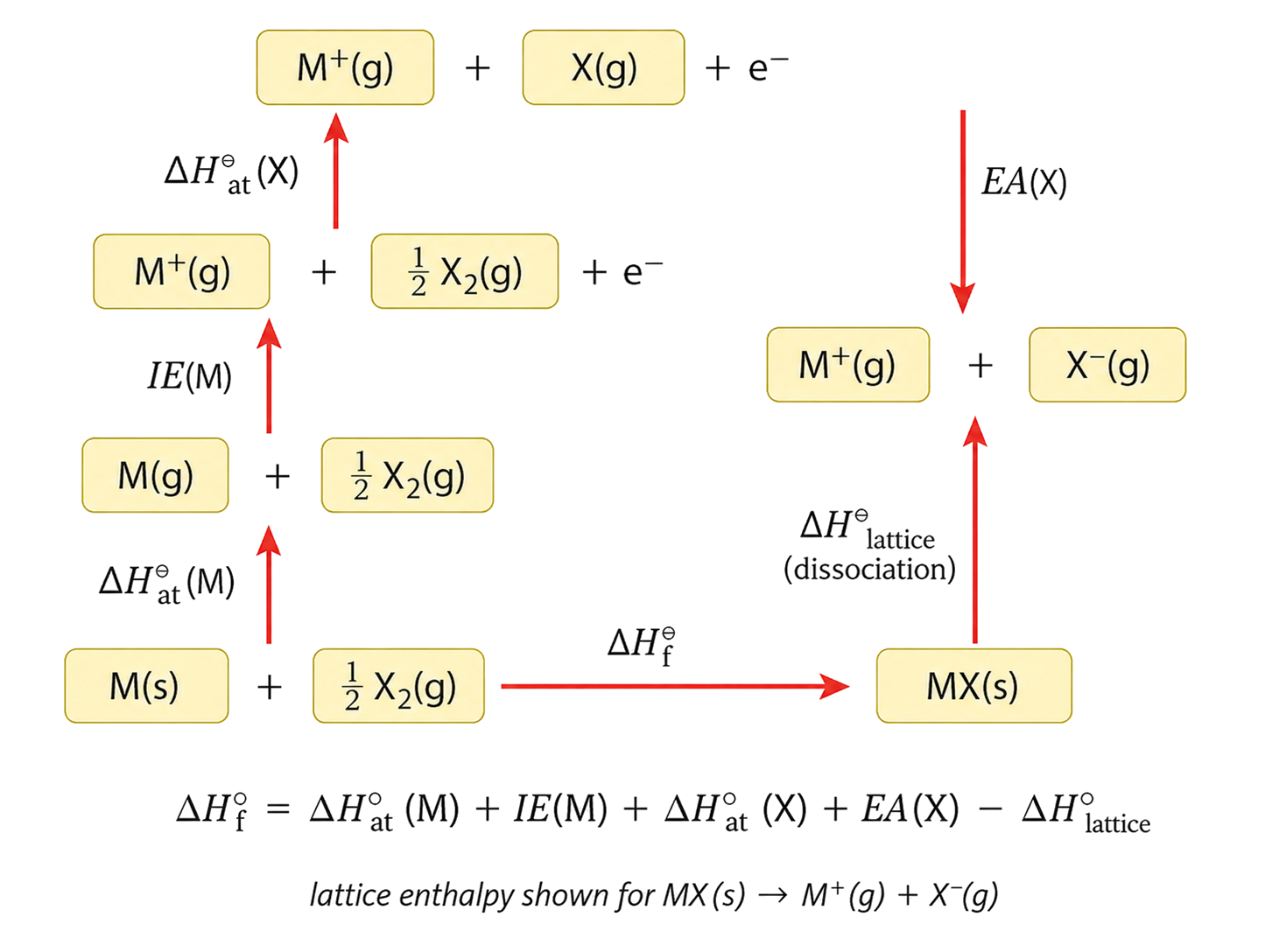
Create a state-and-particle ledger before summing: convert each element from its standard state to the required gaseous atoms (including sublimation/phase change and bond dissociation where needed), apply every ionization-energy and electron-affinity step with its coefficient, then form the lattice. For divalent ions include both electron steps, and fix whether lattice enthalpy means formation or dissociation before assigning its sign.

Build the cycle from physical steps and electron accounting: atomize each element, ionize the metal the required number of times, add electrons to the non-metal, then form the lattice. For a 2− ion include two electron-affinity terms, and confirm whether the supplied lattice enthalpy is defined for formation or dissociation before assigning its sign.

Worked example — KBr lattice enthalpy: use the DP lattice-dissociation convention KBr(s)KX+(g)X+BrX(g)\ce{KBr(s)->K+(g)+Br-(g)}. Following the alternative path in the local cycle, ΔHlattice=(392)+89+419+112325=+687kJmol1\Delta H_\mathrm{lattice}^\circ=-(-392)+89+419+112-325=+687\,\mathrm{kJ\,mol^{-1}}. The formation enthalpy is reversed, atomization and ionization are positive, and the first electron affinity is negative. The positive result is consistent with separating a solid lattice into gaseous ions.

Interpreting Born–Haber Cycles

HL only

Assessment in practice

Representative question

Question 1

[Maximum number: 4]

Determine the standard enthalpy change of formation, ΔHf\Delta H_{\mathrm{f}}^{\ominus}, of NaCl(s), in kJmol1\mathrm{kJ} \mathrm{mol}^{-1}, using a Born-Haber cycle and tables 7, 10 and 13 of the data booklet. The standard enthalpy change of atomization (standard enthalpy change of sublimation), ΔHat \Delta H_{\text {at }}^{\ominus}, of Na(s) is +108 kJ mol1+108 \mathrm{~kJ} \mathrm{~mol}^{-1}.

Energy Cycles Summary

Retrieve the route: count bond breaking/forming, manipulate Hess equations, define standard formation/combustion values, apply product–reactant sums, and track every Born–Haber energy term.

Check equation direction, coefficients, signs, standard states, lattice enthalpy convention, and one-versus-two-electron steps.

Objective notes

5 learning objectives