1.1 Measuring enthalpy changes
- Syllabus
- First assessment 2025
- Topic
- 1.1
- Level
- HL
A chemical reaction transfers energy between the system and surroundings. Total energy is conserved. Heat is energy transferred because of a temperature difference; temperature describes the thermal state.
State which part is the system, which part is the surroundings, and the direction of energy transfer before interpreting a temperature change.
For an exothermic hand-warmer reaction, define the reacting chemicals as the system: energy leaves that system and enters your hand and the air as surroundings. A temperature rise is evidence about the surroundings, while heat names the energy crossing the boundary; neither quantity is 'stored temperature'.
Representative question
Consider a reaction mixture that is in thermal equilibrium with the surroundings. When a reaction takes place, the temperature of the mixture decreases.
Which row correctly shows the changes in energy when the new thermal equilibrium is established?
Energy of system
Energy of surroundings
decreases
decreases
increases
increases
decreases
increases
increases
decreases
D
| Type | Energy direction | Surroundings temperature |
|---|---|---|
| Endothermic | Absorbed by the system | Decreases |
| Exothermic | Released by the system | Increases |
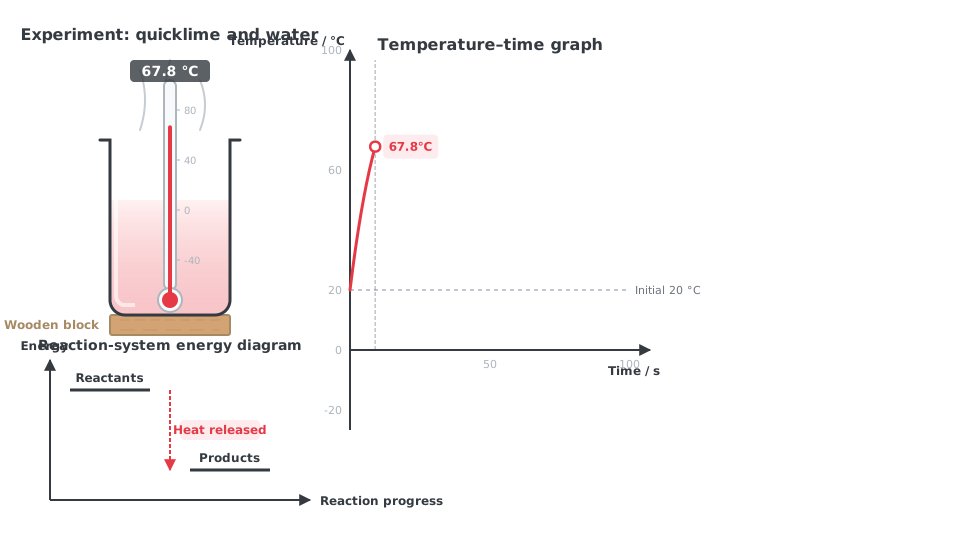
Classify from the direction of energy transfer, then check that the observed temperature change of the surroundings agrees.
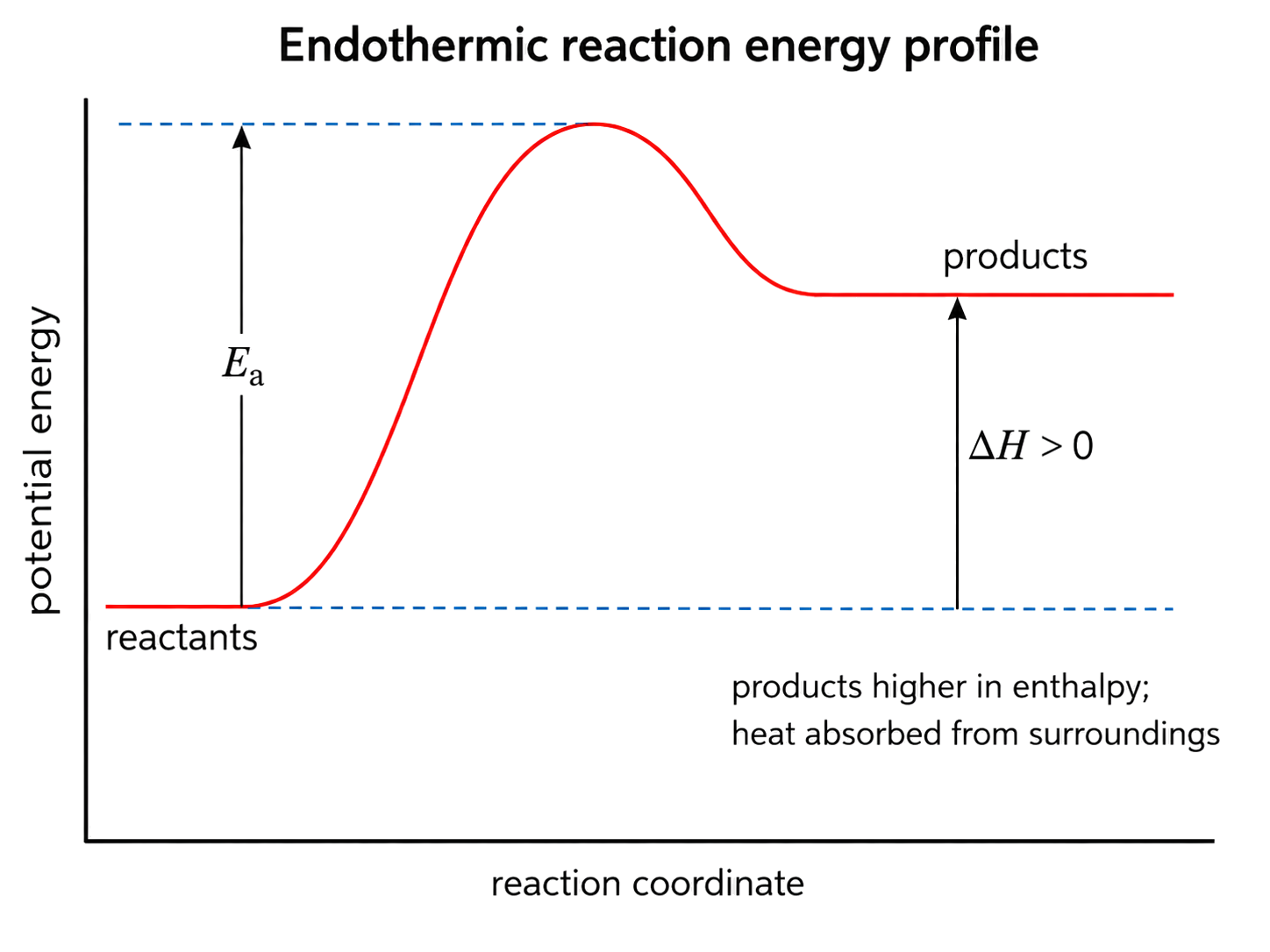
Connect three representations: exothermic means energy flows out of the system, the surroundings warm, and ΔH for the system is negative; endothermic gives the opposite pattern and positive ΔH. State the observed part before inferring the reaction type.
Representative question
Which statement about an exothermic reaction is correct?
Temperature decreases and the products have higher enthalpy than the reactants.
Temperature decreases and the products have lower enthalpy than the reactants.
Temperature increases and the products have higher enthalpy than the reactants.
Temperature increases and the products have lower enthalpy than the reactants.
D
Lower relative energy corresponds to greater relative stability. In an exothermic reaction the products are lower in energy than the reactants; in an endothermic reaction the products are higher.
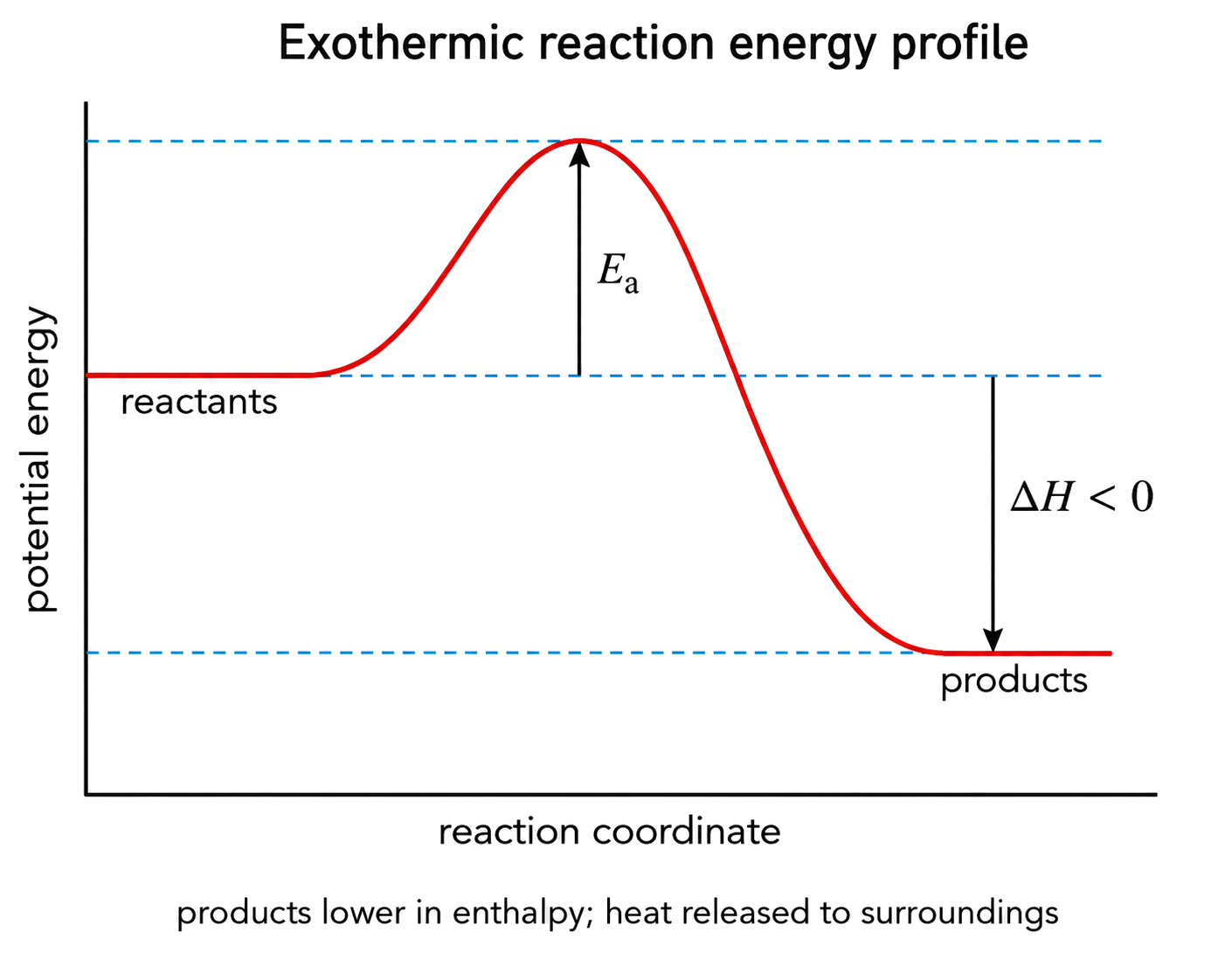
Read reactant and product levels, identify the sign and direction of ΔH, and label the energy profile clearly.
On a profile, ΔH is the vertical difference between product and reactant levels, while activation energy rises from reactants to the peak. A catalyst lowers the peak by changing the pathway but leaves the two energy levels, ΔH and the relative stability of reactants and products unchanged.
An energy profile identifies an activation barrier but does not by itself determine an observed rate: temperature, particle concentrations/collision frequency and the available pathway also matter. Use the diagram to compare energetic barriers only when the profiles and conditions make that comparison valid.
Representative question
The forward reaction is endothermic, uses iron(III) oxide as a catalyst, and takes place at 900 K .
Sketch the energy profile for the reaction, both with and without the catalyst, labelling ΔH and the activation energies.
two curves, each passing through a maximum AND reaching same energy level
endothermic enthalpy change labelled
both activation energies correctly labelled
Do not penalize curve showing multiple steps for the catalysis in M1.
Accept double-headed arrows or lines in M2 and M3, but not arrows pointing down.
Q=mcΔTandΔH=−Q/n
At constant pressure, calculate heat transferred from mass, specific heat capacity, and temperature change, then divide by reacting moles and apply the sign convention. Check standard conditions and units.
If 100.0 g of solution warms by 6.0 K and c = 4.18 J g⁻¹ K⁻¹, q(solution) = +2.51 kJ, so q(reaction) = −2.51 kJ. Divide by moles of the limiting reacting amount for kJ mol⁻¹, and identify heat loss or an ignored calorimeter heat capacity as reasons an experimental magnitude may be too small.
A standard molar enthalpy change belongs to the balanced reaction as written, with substances in their stated standard states under standard conditions. A classroom calorimetry value is an experimental estimate: report its conditions and uncertainty separately from a data-book or theoretical standard value. Heat loss to the surroundings or ignored calorimeter heat capacity commonly makes the measured magnitude too small.
Representative question
What is the standard enthalpy change, ΔHcombustion ⊖, according to the data?
Amount of fuel burned =0.110 mol
Mass of water =200 g
Initial temperature of water =21.0∘C
Final temperature of water =25.0∘C
Specific heat capacity of water, cw=4.18 J g−1 K−1
Q=mcΔT
−2110 kJ mol−1
−30.4 kJ mol−1
+30.4 kJ mol−1
+2110 kJ mol−1
B
Retrieve the route: define system/surroundings transfer, classify endothermic or exothermic, read stability from energy profiles, then calculate Q and ΔH with the correct sign.
Check the energy direction, surroundings temperature, reactant/product levels, moles, units, and ΔH sign.