1.2.5 (HL)—Born-Haber cycle
- Syllabus
- First assessment 2025
- Objective
- 1.2.5
- Level
- HL
A Born–Haber cycle tracks the energy changes that form an ionic solid from its elements. It includes atomization, ionization, electron affinity, and lattice enthalpy terms with the correct stoichiometry.
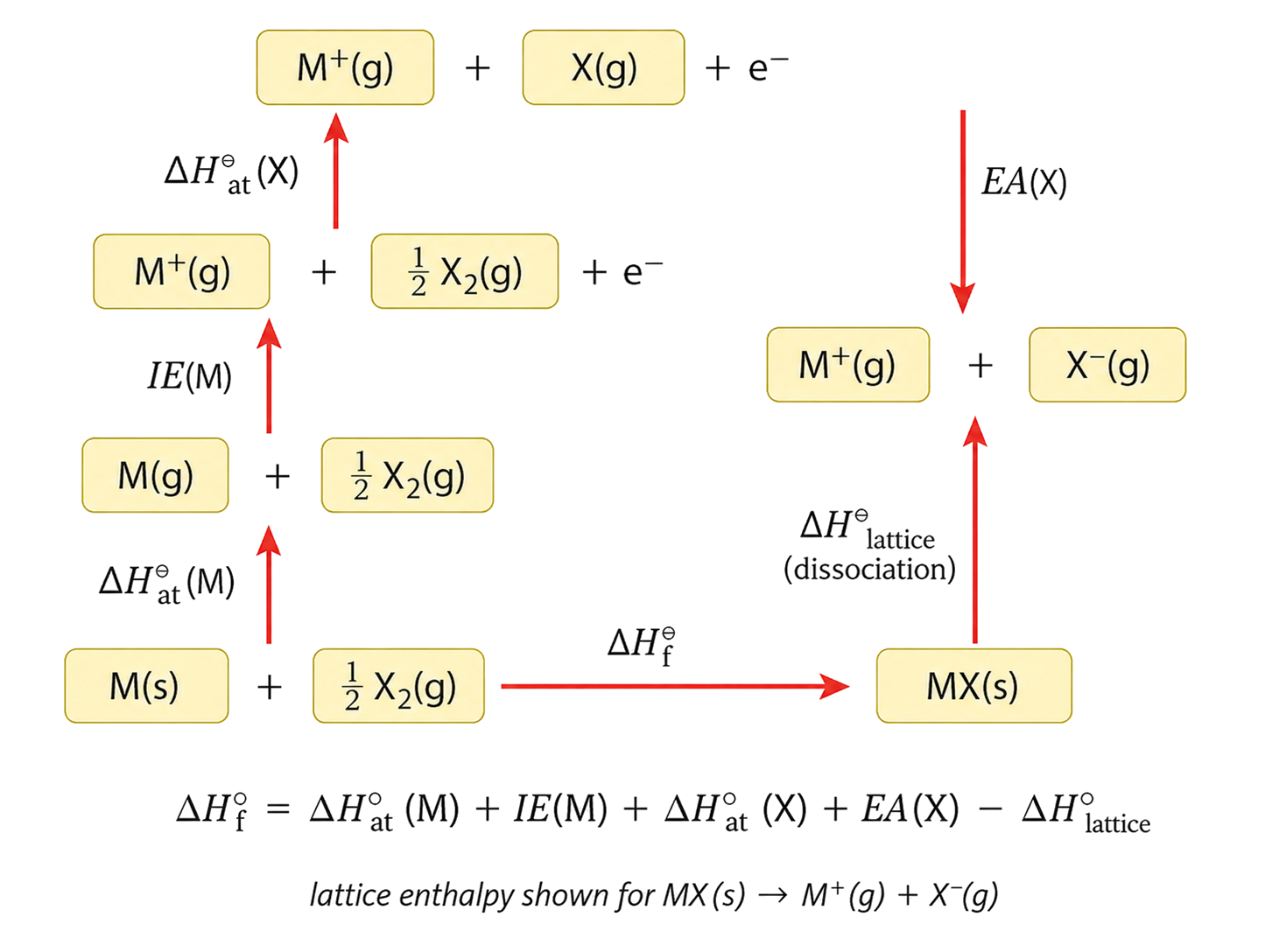
Create a state-and-particle ledger before summing: convert each element from its standard state to the required gaseous atoms (including sublimation/phase change and bond dissociation where needed), apply every ionization-energy and electron-affinity step with its coefficient, then form the lattice. For divalent ions include both electron steps, and fix whether lattice enthalpy means formation or dissociation before assigning its sign.
Build the cycle from physical steps and electron accounting: atomize each element, ionize the metal the required number of times, add electrons to the non-metal, then form the lattice. For a 2− ion include two electron-affinity terms, and confirm whether the supplied lattice enthalpy is defined for formation or dissociation before assigning its sign.
Worked example — KBr lattice enthalpy: use the DP lattice-dissociation convention . Following the alternative path in the local cycle, . The formation enthalpy is reversed, atomization and ionization are positive, and the first electron affinity is negative. The positive result is consistent with separating a solid lattice into gaseous ions.