B4.2.12—Fundamental vs. realized niche
Fundamental niches describe potential roles or ranges, while realized niches are the actual portions occupied after environmental and biotic limits.
- Syllabus
- First assessment 2025
- Objective
- B4.2.12
- Level
- SL
Fundamental niches describe potential roles or ranges, while realized niches are the actual portions occupied after environmental and biotic limits.
Coverage 2010–2020 · Updated 15 Jul 2026
The fundamental niche is the range of conditions and resources a species could use from its adaptations and tolerance limits. The realized niche is the range it actually occupies after competition, predation, mutualism and dispersal act.
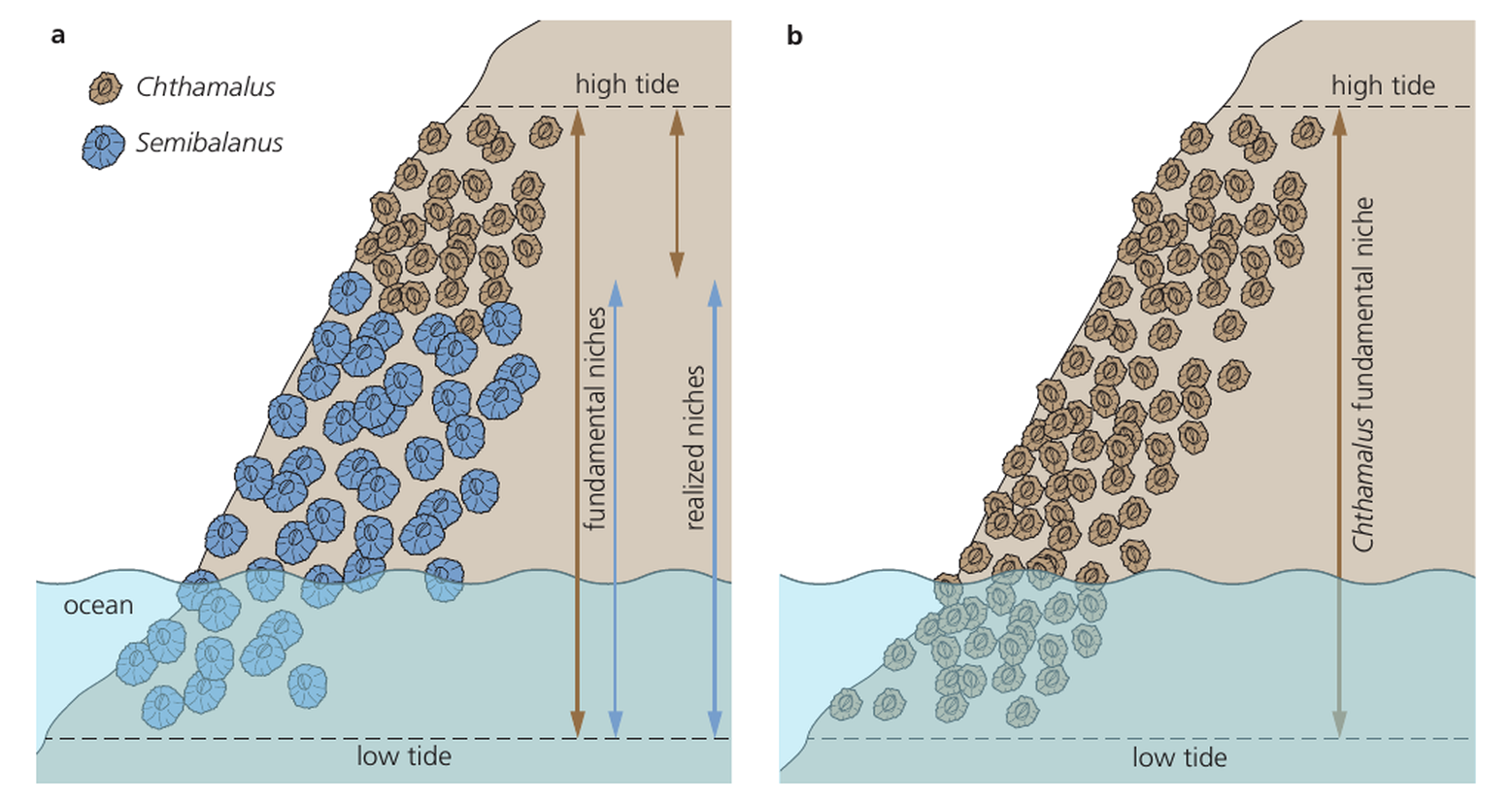
Observe the focal species with the competitor present → remove the competitor while keeping abiotic conditions comparable → observe expansion into previously unoccupied space → infer that competition had narrowed the realized niche.
A realized niche is often narrower than the fundamental niche, but beneficial interactions can also make occupancy possible. Absence alone does not reveal which interaction or dispersal barrier is responsible.
