A4.2 Conservation of biodiversity

Conservation of biodiversity connects biodiversity measurement, human-driven losses, ecosystem evidence, and targeted conservation strategies for protecting species, communities, and evolutionary history.

Syllabus
First assessment 2025
Topic
A4.2
Level
SL

Learning objectives

A4.2.1Biodiversity definition• Biodiversity is the variety of life in its forms, levels, and combinations• It includes ecosystem, species, and genetic diversity• Species diversity depends on richness and evenness; Simpson's reciprocal index compares communitiesA4.2.2Current vs. past biodiversity• About 9 million species are estimated, with many still undescribed• Fossils and radiometric dating give incomplete evidence of past biodiversity• Current species diversity may be higher than in the past, but fossil gaps make this uncertainA4.2.3Anthropogenic species extinction• Human activity is driving a sixth mass extinction• Hunting, habitat change, and resource use caused extinctions such as North Island giant moa• Caribbean monk seal loss shows how removing a top predator can alter food websA4.2.4Ecosystem loss causes• Ecosystem loss is mainly caused by anthropogenic disturbance and habitat conversion• Mixed dipterocarp forests in Borneo are lost through logging and oil palm plantations• Great Barrier Reef loss is linked to climate, pollution, fishing, and other human pressuresA4.2.5Evidence for biodiversity crisis• IPBES reports and repeated biodiversity surveys provide evidence of crisis• Richness, evenness, and Simpson's reciprocal index can compare disturbed and undisturbed habitats• Peer-reviewed studies and citizen science both contribute data, with reliability checks neededA4.2.6Causes of biodiversity crisis• Human population growth increases demand for food, housing, energy, and land• Major drivers include overexploitation, urbanization, deforestation, agriculture, mining, and pollution• Invasive species such as lionfish and water hyacinth can outcompete or disrupt native speciesA4.2.7Conservation approaches• Conservation needs multiple approaches because species and threats differ• In situ conservation uses protected areas, reserve design, corridors, active management, and rewilding• Ex situ conservation uses zoos, captive breeding, botanic gardens, seed banks, and tissue banksA4.2.8EDGE of Existence programme• EDGE prioritizes evolutionarily distinct and globally endangered species• It combines phylogenetic uniqueness with IUCN extinction risk• The goal is to prevent disproportionate loss of evolutionary history

Biodiversity Exists at Three Linked Levels

Biodiversity is the variety of life at genetic, species and ecosystem levels. A community can have the same richness as another yet lower diversity if one species dominates.

Two beetle communities have equal species richness but different evenness; the more even community has greater species diversity.

D=N(N−1)∑n(n−1)D = \frac{N(N-1)}{\sum n(n-1)}

N is the total number of organisms and n is the number in each species. For comparable samples, a larger D indicates greater species diversity.

Present and Past Biodiversity Need Different Evidence

Present biodiversity is estimated from field surveys, species records and DNA-based discovery. Past biodiversity is reconstructed from fossils placed in dated geological contexts.

Parallel evidence pathways show field sampling, records and DNA barcoding for living species, and fossils, strata and radiometric dates for past diversity; both contain sampling gaps.
Claim Main evidence Main limit
about 9 million living species sampled habitats, described species and extrapolation many habitats and species remain unsampled or undescribed
change in diversity through geological time fossils, stratigraphy and radiometric dating fossilisation and discovery are selective and incomplete

Trace Human Pressure to Extinction through Populations

Human activity can raise mortality, remove habitat and shrink populations until recovery is impossible. Small fragmented populations also face inbreeding, genetic drift and chance events.

Two causal chains link hunting and habitat clearance to moa extinction, and hunting plus overfishing to Caribbean monk seal extinction.
Case Human pressure Population effect Wider effect
North Island giant moa hunting and forest clearance mortality rose while habitat fell extinction
Caribbean monk seal hunting and depletion of food by fishing a small population could not recover extinction and loss of a top predator

Ecosystem Loss Breaks Structure and Process

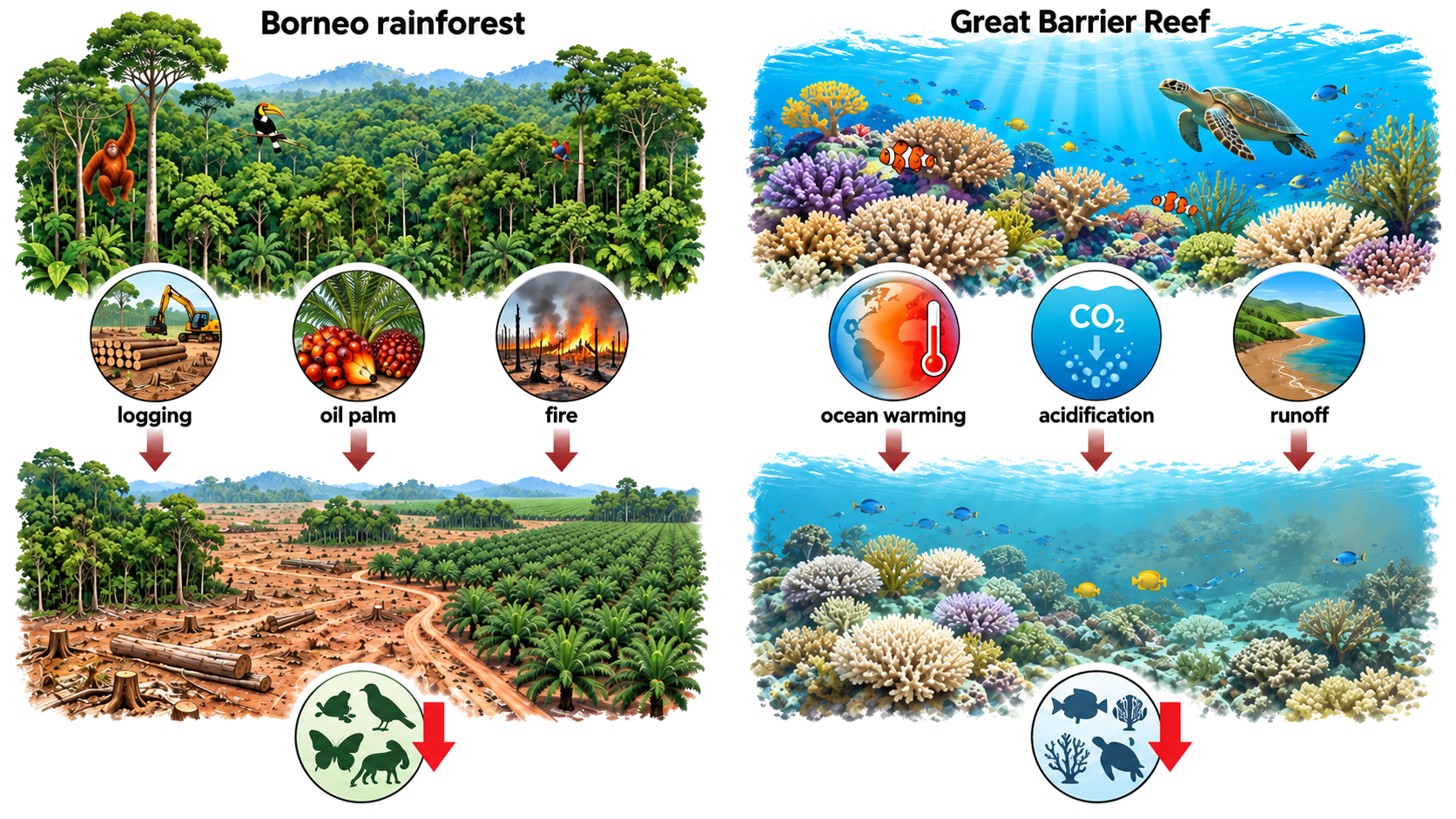
Ecosystem loss includes conversion, degradation and fragmentation. These change habitat structure and abiotic conditions, disrupt interactions and nutrient cycling, and reduce resilience.

Borneo rainforest pressures and Great Barrier Reef pressures lead to loss of terrestrial and marine community structure.
Ecosystem Pressures Biological pathway
Borneo mixed dipterocarp forest logging, fire and oil-palm conversion canopy and habitat loss → fragmentation → decline of forest communities
Great Barrier Reef warming, falling pH, runoff and fishing coral stress and mortality → habitat loss → reef-community decline

A Biodiversity Crisis Is a Trend, Not One Snapshot

A biodiversity crisis is supported by consistent declines across repeated, comparable measurements, not by one low count.

Set a baseline with defined sites, season, method and sampling effort.
Repeat the same protocol and control changes in detectability.
Track richness, evenness, abundance and, where suitable, Simpson reciprocal index.
Compare independent datasets and syntheses such as IPBES reports.

Evidence source Strength Reliability check
peer-reviewed study detailed methods and scrutiny sampling design, replication and uncertainty
citizen science wide spatial and temporal coverage training, validation and correction for reporting bias

Human Demand Acts through Several Biological Drivers

Population size and consumption create pressure through land, food, energy and material demand. Biodiversity changes through the biological mechanism of each driver.

Driver Biological mechanism Useful response to monitor
habitat conversion and urbanisation habitat area and connectivity fall range, occupancy and fragment connectivity
overexploitation mortality exceeds recruitment abundance, age structure and harvest rate
pollution and climate change survival, reproduction or species interactions change reproductive success, mortality and distribution
introduced invasive species competition, predation, disease or habitat change native abundance and invader spread

An alien species occurs outside its natural range through human activity. It is invasive when it spreads and causes ecological or economic harm; alien does not automatically mean invasive.

Conservation Must Match the Threat and the Scale

Conservation works when the intervention removes or reduces the diagnosed threat and protects a viable population, habitat or ecological process.

Reserve-design comparisons show the effects of size, edge shape, isolation and habitat corridors on conservation value.
Approach Best suited to Examples Key condition
in situ protecting species in functioning habitat reserves, corridors, rewilding threats must be controlled in the habitat
ex situ preventing immediate loss or preserving genetic material captive breeding, zoos, botanic gardens, seed and tissue banks genetic diversity and suitable release habitat must be maintained

diagnose threat → select action at the same scale → set a measurable biological target → monitor → adapt management

EDGE Prioritizes Unique Evolutionary History at Risk

EDGE combines Evolutionary Distinctiveness (ED) with Global Endangerment (GE). ED measures how isolated a species is on the tree of life; GE reflects IUCN extinction risk.

A phylogenetic branch and endangerment gauge combine to place a highly distinct, highly threatened frog in the high-EDGE region.

High ED + high GE → high EDGE priority. Protecting such a species avoids losing a disproportionately large amount of evolutionary history.

EDGE is a prioritisation tool, not the whole conservation plan: feasibility, ecosystem role, cost and the causes of decline still shape the intervention.

Summary: Turn Biodiversity Evidence into Action

Focus Measure the state or trend Diagnose the driver Match the action Monitor recovery
genetic diversity allelic variation, heterozygosity, population size isolation, bottleneck or inbreeding reconnect populations or manage breeding genetic diversity and effective population size
species diversity richness, evenness, abundance, extinction risk exploitation, invasive species or habitat change protect, control threats, breed or reintroduce abundance, recruitment and distribution
ecosystem diversity/function habitat extent, condition and process indicators conversion, fragmentation, pollution or climate stress protect, restore and reconnect habitat structure, processes and resilience

Define the level → establish a comparable trend → identify the causal driver → choose an action at the same scale → test whether biological recovery follows.

No single index or intervention is sufficient: species counts can miss evenness, genetic erosion and ecosystem dysfunction, while a reserve can fail without connectivity, enforcement or threat removal.

Biodiversity definition

4 marks

Entire communities need to be conserved in order to preserve biodiversity. Suggest different quantitative methods to measure changes in biodiversity in a community over time.

Anthropogenic species extinction

1 mark

The North Island giant moa (Dinornis novaezealandiae) went extinct some time between the arrival of humans in New Zealand and the 1800s.

What do scientists believe to be the cause of this extinction?

Ecosystem loss causes

1 mark

The satellite images show changes in the area covered by forest, much of which is mixed dipterocarp forest, on the island of Borneo in Southeast Asia.

Which human activities are most likely to have caused the changes shown in the map?

Causes of biodiversity crisis

3 marks

List human actions that could threaten populations of insect pollinators such as bees.

Conservation approaches

4 marks

Discuss in situ and ex situ conservation of endangered species.

EDGE of Existence programme

2 marks

Outline the importance of the EDGE of Existence programme.