Q BankQuestion BankDocsDocuments

A4.2.1—Biodiversity definition

Biodiversity describes variety within and between ecosystems, species, and genes, with species richness, evenness, and Simpson index enabling quantitative comparison.

Syllabus
First assessment 2025
Objective
A4.2.1
Level
SL

Exam analysis

Chance of appearing8%of analysed past papers
Latest appearanceNovember 2024
Most common paperPaper3
Typical marks1–2

Common command terms

  • State
  • Discuss
  • Calculate
  • Analyse
  • Compare
  • Evaluate
  • Distinguish
  • Suggest

Scoring notes

Common mistake
Equating richness with overall biodiversity when evenness also affects diversity.

Recent exam appearances

November 2024Paper3 ["SL"] · TZ112(a)[ 1 ]A4.2.1—Biodiversity definition
May 2024Paper3 ["SL"] · TZ214[ 4 ]A4.2.1—Biodiversity definition
May 2023Paper3 ["SL"] · TZ215(b)[ 2 ]A4.2.1—Biodiversity definition
May 2023Paper3 ["SL"] · TZ215(a)[ 1 ]A4.2.1—Biodiversity definition
November 2020Paper3 ["SL"] · TZ014(a)(ii)[ 1 ]A4.2.1—Biodiversity definition
Practice this objective

Coverage 2010–2024 · Updated 15 Jul 2026

Biodiversity Has Several Levels

Biodiversity is the variety of life, measured at genetic, species and ecosystem levels.

Genetic diversity helps populations respond to change; species diversity describes richness and relative abundance; ecosystem diversity captures different habitats and ecological processes. A place can be rich at one level and poor at another. Use the evidence scale and context before drawing a broad conclusion.

State the level before measuring:

  • genetic variation within a species
  • species richness and evenness
  • ecosystem or habitat variety
  • interactions and functions

A forest may contain many species but little genetic diversity in a bottlenecked tree population, so one metric cannot describe all biodiversity.

Species count alone is not a complete biodiversity measure.

Biodiversity definition

Assessment in practice

1–2 marks
How it is assessed

This objective is assessed through structured response, commonly using State / Discuss / Calculate.

Command terms

State / Discuss / Calculate / Analyse / Compare / Evaluate / Distinguish / Suggest

What earns marks

Build the answer around this relationship: Biodiversity includes ecosystem diversity, species diversity and genetic diversity.

Watch for

Equating richness with overall biodiversity when evenness also affects diversity.

Representative question

Question 1

[Maximum number: 4]

Entire communities need to be conserved in order to preserve biodiversity. Suggest different quantitative methods to measure changes in biodiversity in a community over time.

Build A Conservation Argument

A strong conservation answer follows a chain: define biodiversity, measure evidence of decline, identify human drivers, then justify conservation action. Biodiversity includes ecosystem, species, and genetic diversity; species diversity uses richness and evenness. Evidence comes from estimates, fossils, repeated surveys, IPBES reports, and indices. Drivers include extinction pressure, ecosystem conversion, population-driven resource demand, pollution, and invasive species. Responses include in situ, ex situ, and EDGE prioritization.

  • Define biodiversity across ecosystem, species, and genetic levels.
  • Measure species diversity using richness, evenness, and Simpson’s reciprocal index.
  • Use evidence cautiously: modern estimates, fossil gaps, repeated surveys, IPBES reports, and reliability checks.
  • Explain drivers using named examples: moa, Caribbean monk seal, Borneo, Great Barrier Reef, lionfish, water hyacinth.
  • Choose conservation responses: in situ, ex situ, and EDGE priorities.

Concept essentials

  • Biodiversity includes ecosystem diversity, species diversity and genetic diversity.
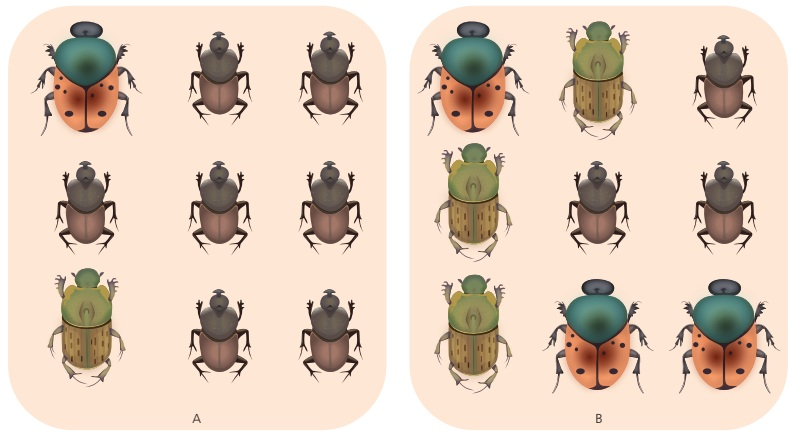
  • Species richness is the number of different species present in a community.
  • Species evenness describes how similar the population sizes of different species are.
  • Simpson reciprocal index allows quantitative comparison of biodiversity between communities or over time.
ConceptIB Biology SL