Molar Absorptivity in A-Level Chemistry: Beer-Lambert Law
Revise molar absorptivity with Beer-Lambert law, absorbance, concentration, path length, units, graphs and A-Level Chemistry practice.
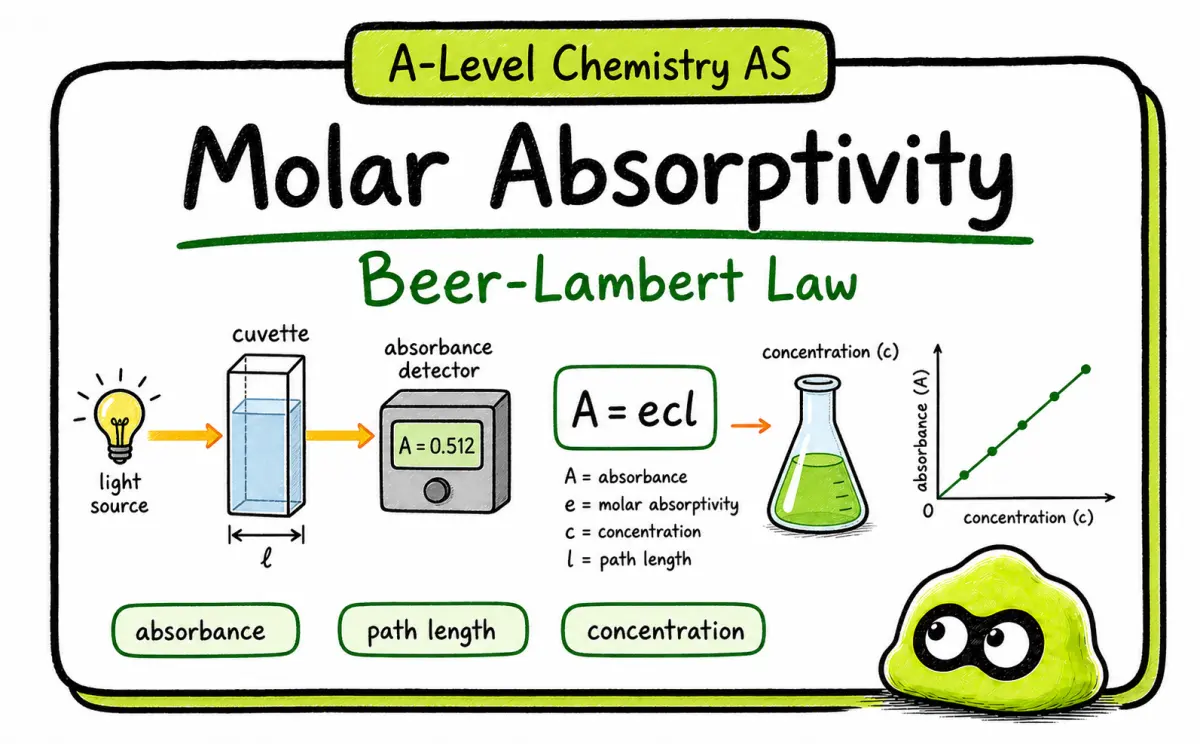
If you search molar absorptivity, the useful exam answer is not just a formula. Molar absorptivity is the Beer-Lambert law term that tells you how strongly a substance absorbs light at a particular wavelength.
This CAIE A-Level Chemistry AS bridge page focuses on A = ecl, absorbance, concentration, path length and graph wording. The closest verified EduNinja Question Bank route is the AS Chemistry data-skills page, so the practice link below uses that broader data-handling context rather than inventing a fake topic URL.
Quick Answer
| Symbol | Meaning | Common unit idea |
|---|---|---|
| A | Absorbance | No unit |
| e | Molar absorptivity | Depends on substance and wavelength |
| c | Concentration | Often mol dm^-3 |
| l | Path length | Often cm |
What Molar Absorptivity Means
Molar absorptivity describes how much light a substance absorbs under defined conditions. A solution with a higher molar absorptivity gives a higher absorbance than another solution of the same concentration and path length, provided the wavelength is the same.
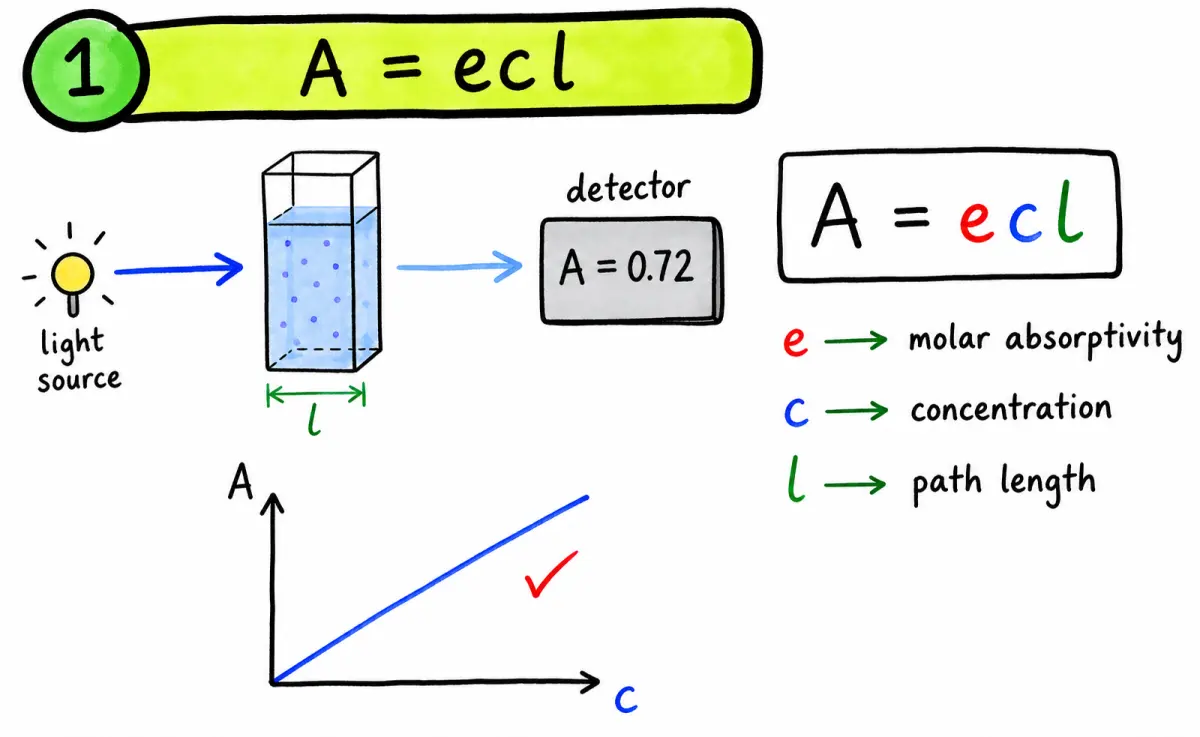
The Beer-Lambert law is commonly written as:
A = ecl
where A is absorbance, e is molar absorptivity, c is concentration and l is path length. Some courses use the Greek letter epsilon for molar absorptivity, but the calculation idea is the same.
Worked Example
Question: A solution has an absorbance of 0.72. The path length is 1.0 cm and the concentration is 0.020 mol dm^-3. Calculate the molar absorptivity.
Method:
A = ecl, so e = A / cl
e = 0.72 / (0.020 x 1.0) = 36
If concentration is in mol dm^-3 and path length is in cm, the unit can be written as dm^3 mol^-1 cm^-1. The exact unit depends on the units used in the question.
Exam-Safe Wording
| What to include | Why it matters |
|---|---|
| Correct equation | Shows the relationship between absorbance and concentration |
| Correct rearrangement | Avoids solving for the wrong variable |
| Units for c and l | Controls the final unit of e |
| Same wavelength | Molar absorptivity depends on wavelength |
| Graph proportionality | A is proportional to c when e and l are constant |
This is also why data and graph questions are good practice for this topic. You need the formula, but you also need control variables and units.
Common Mistakes
| Mistake | Why it loses marks | Better wording |
|---|---|---|
| Treating absorbance as having a unit | Absorbance is a ratio-based value | A has no unit |
| Forgetting path length | l affects absorbance | Include the cuvette length |
| Mixing up e and c | e is a property, c is concentration | Rearrange carefully |
| Ignoring wavelength | e depends on wavelength | Compare values only under the same conditions |
Mini Practice Set
- Rearrange A = ecl to make concentration the subject.
- Explain why a graph of absorbance against concentration can be a straight line.
- State why molar absorptivity values must be compared at the same wavelength.
Practice This Topic
Try this exam-style question:
A sample has absorbance 0.45, path length 1.0 cm and concentration 0.015 mol dm^-3. Calculate the molar absorptivity and state one condition needed for comparing this value with another sample.
Answer guide:
- Use A = ecl and rearrange to e = A / cl.
- Substitute e = 0.45 / (0.015 x 1.0).
- Calculate e = 30 in the corresponding molar absorptivity units.
- Compare values only when wavelength and measurement conditions are controlled.
Practice this exact topic
Practise A-Level Chemistry data skills questions
Some questions may require an EduNinja membership.
Browse broader practice
Browse the full CAIE A-Level Chemistry AS Question Bank
Use this if you want to explore more available practice by topic.
Related Study Links
- Explore the course Study Hub
- CAIE A-Level Chemistry Covalent Bonding: Definition
- Electron Affinity in IB Chemistry: Definition and Trend
- Cambridge IGCSE Chemistry Polymers: Repeat Units
FAQ
What is molar absorptivity?
Molar absorptivity describes how strongly a substance absorbs light at a particular wavelength. In Beer-Lambert law calculations, it is the e term in A = ecl. A larger value means higher absorbance for the same concentration and path length, if conditions are controlled.
Is molar absorptivity the same as absorbance?
No, molar absorptivity and absorbance are different. Absorbance is the measured value for a particular sample, while molar absorptivity is a proportionality factor for the substance at a particular wavelength. The exam trap is treating A and e as interchangeable.
What are the units of molar absorptivity?
The units of molar absorptivity depend on the units used for concentration and path length. If concentration is in mol dm^-3 and path length is in cm, a common unit is dm^3 mol^-1 cm^-1. Always check the units given in the question before writing the final answer.
Why does path length matter in Beer-Lambert law?
Path length matters because light travels through more solution when the cuvette is longer. If concentration and molar absorptivity stay constant, a longer path length gives a higher absorbance. Forgetting l is a common calculation error in A = ecl questions.
What does a straight Beer-Lambert graph show?
A straight absorbance-concentration graph shows that absorbance is proportional to concentration when molar absorptivity and path length are constant. The gradient is linked to el. In exam answers, mention the controlled conditions instead of only saying the graph is linear.
Final Takeaway
For molar absorptivity questions, start with A = ecl, identify the variable, check the units, and remember that e depends on the substance and wavelength.
Put topic practice back into your full A-Level CAIE Chemistry AS study plan.
Return to the complete course overview, or move directly into the most relevant study tool.
Related articles
More course notes, updates and study resources from the EduNinja blog.
London Dispersion Forces Explained for IB Chemistry
Learn London dispersion forces for IB Chemistry with temporary dipoles, induced dipoles, molecular size, boiling point trends, examples and practice.
Transition Metals Explained for IB Chemistry
Revise transition metals in IB Chemistry, including coloured ions, variable oxidation states, complex ions, catalysts and common exam mistakes.
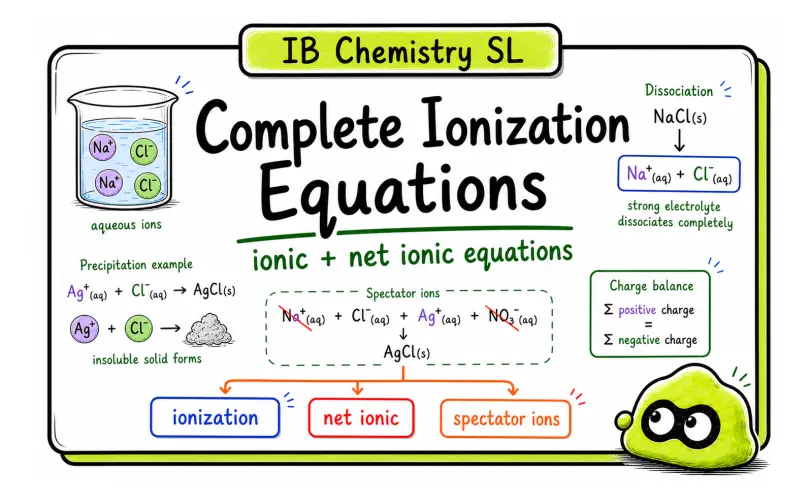
How to Complete Ionization and Net Ionic Equations
Learn complete ionization and net ionic equations for IB Chemistry, with ion charges, state symbols, spectator ions, worked examples and practice.