IB SEHS SL Skeletal System: Bones, Joints, and Movement
Revise IB SEHS SL skeletal system content with bone functions, joint types, movement terms, levers, and exam-ready application.
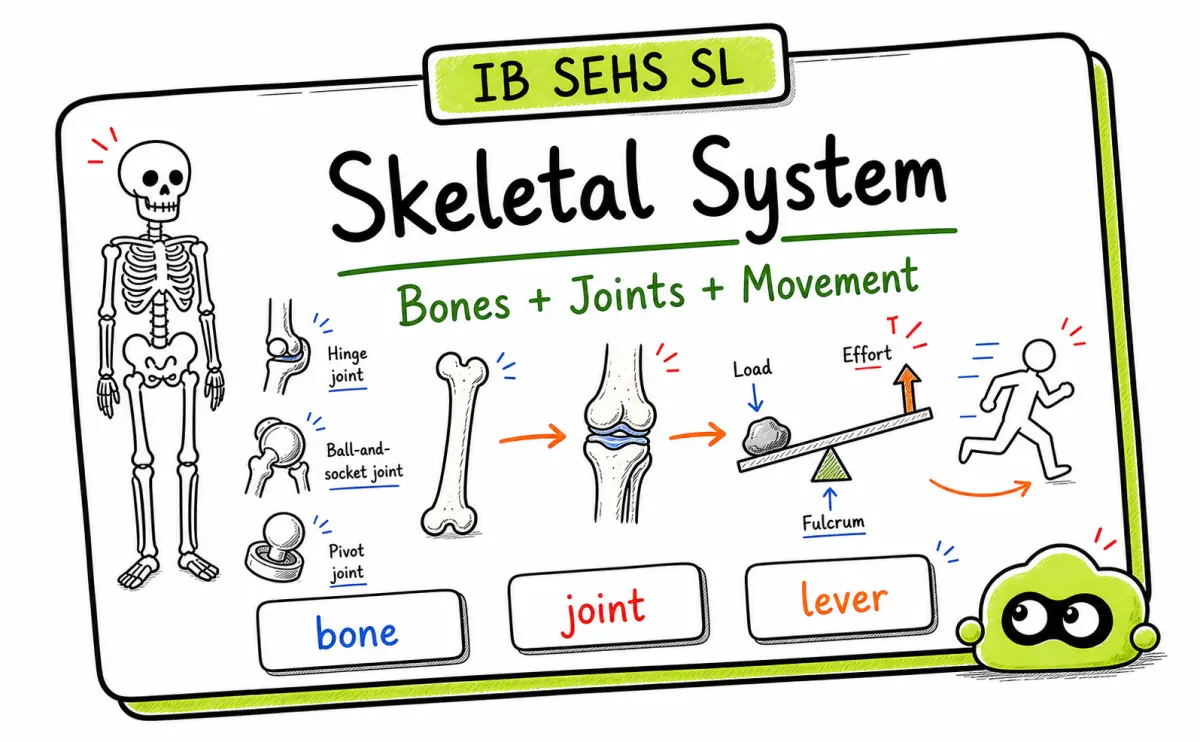
IB SEHS skeletal system questions usually test precise labels rather than long explanations. You need to distinguish axial from appendicular skeleton, name bone types, annotate a long bone, use anatomical terms, and connect joints to the movement they permit.
This guide follows the EduNinja source PDF for IB Sports Exercise and Health Science Notes, specifically the SL Chapter 1 file on the skeletal system. Use it as a PDF-aligned revision page, not a general anatomy article.
Useful starting points:
- IB Sports Exercise and Health Science Notes
- IB Sports Exercise and Health Science Question Bank
- IB Sports Exercise and Health Science Study Library
Quick answer
For IB SEHS SL skeletal system, revise these first:
- The axial skeleton and appendicular skeleton need to be distinguished anatomically and by function.
- Skeletal functions include protection, attachment, support, movement, mineral storage, and blood cell production.
- The four main bone types in the PDF are long, short, flat, and irregular.
- A long bone diagram should include epiphysis, diaphysis, compact bone, spongy bone, articular cartilage, marrow cavity, bone marrow, blood vessel, and periosteum.
- Anatomical terms include proximal, distal, medial, lateral, superior, inferior, anterior, and posterior.
- Connective tissues in this topic are tendons, ligaments, and cartilage.
- A joint is where two bones meet and articulate with each other.
- Joint categories by movement are fibrous, cartilaginous, and synovial.
- Synovial joint features include articular cartilage, synovial fluid, synovial membrane, meniscus, bursae, ligaments, and articular capsule.
- Synovial joint types include hinge, pivot, ball and socket, condyloid, saddle, and gliding joints.
If you only remember one method, answer skeletal system questions as structure plus function plus example. That keeps the wording close to the markscheme.
What the PDF expects you to know
The PDF is organised around IB SEHS assessment statements 1.1.1 to 1.1.10.
| Assessment area | What to learn |
|---|---|
| 1.1.1 | distinguish anatomically between axial and appendicular skeleton |
| 1.1.2 | distinguish axial and appendicular skeleton by function |
| 1.1.3 | state four types of bones |
| 1.1.4 | draw and annotate the structure of a long bone |
| 1.1.5 | apply anatomical terminology to bone location |
| 1.1.6 | outline functions of connective tissue |
| 1.1.7 | define joint |
| 1.1.8 | distinguish joint types by movement permitted |
| 1.1.9 | outline features of a synovial joint |
| 1.1.10 | list types of synovial joints |
This topic is table-heavy for a reason. Most marks come from clear classification, correct examples, and accurate movement terms.
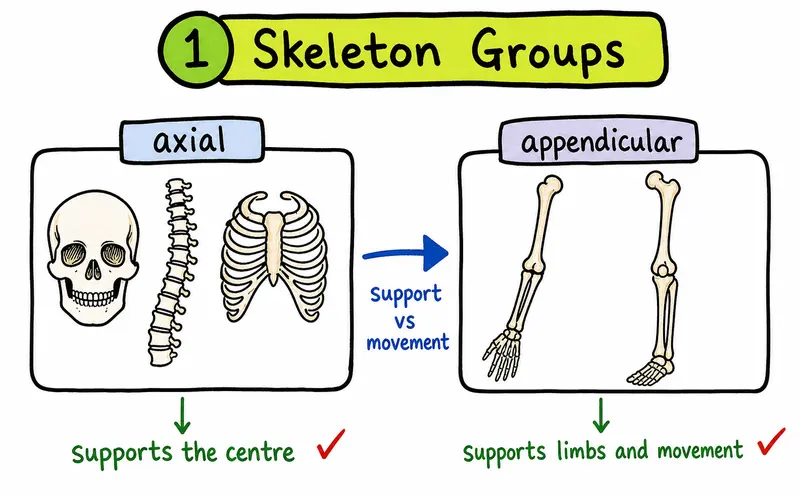
Axial and appendicular skeleton
The PDF asks students to distinguish the axial and appendicular skeleton anatomically, then by function. The axial skeleton is the central skeleton. The appendicular skeleton is linked to the limbs and their attachments.
| Skeleton division | Main function emphasis in the PDF |
|---|---|
| Axial skeleton | protection, attachment, support, movement, red and white blood cell production |
| Appendicular skeleton | attachment, support, movement, mineral storage |
The PDF lists general skeletal functions:
- protection of vital organs
- attachment points for muscles
- support for organs and tissues
- movement through muscle attachment
- mineral storage, such as calcium
- production of red and white blood cells
In an exam answer, do not write only "the skeleton helps movement." Link the function to the division or structure being asked about.
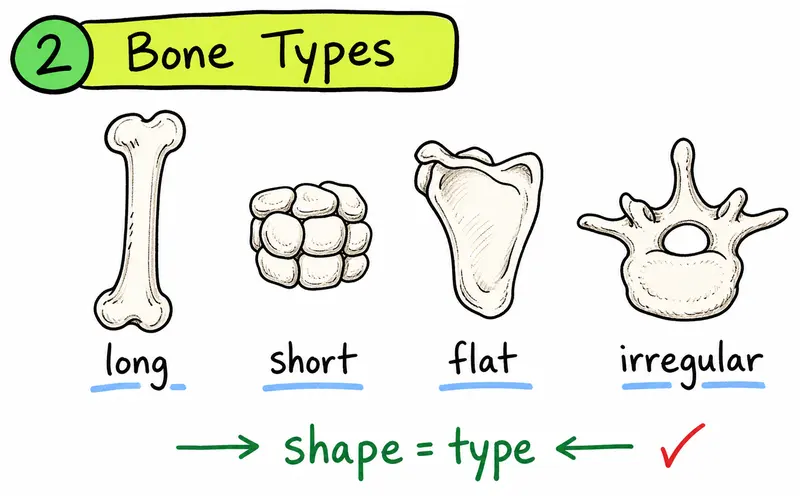
Four types of bone
The PDF limits this point to four main bone types, with examples.
| Bone type | Example |
|---|---|
| Long bone | femur, humerus |
| Short bone | carpals, tarsals |
| Flat bone | ribs, cranium |
| Irregular bone | vertebrae |
The PDF also mentions the patella as a sesamoid example, but the assessment statement says to state four types: long, short, flat, and irregular. For a short-answer question, keep those four as the priority list.
Structure of a long bone
For the long bone diagram, the PDF limits labels to specific structures. Learn the names and one simple function.
| Long bone structure | PDF-aligned function or description |
|---|---|
| Diaphysis | long shaft made of compact bone, covered by periosteum |
| Epiphysis | two end portions made of spongy bone, covered by articular cartilage |
| Articular cartilage | smooth hyaline cartilage that reduces friction and absorbs shock |
| Bone marrow cavity | contains bone marrow |
| Bone marrow | found inside the marrow cavity |
| Compact bone | dense bone in the shaft |
| Spongy bone | bone tissue in the epiphysis |
| Blood vessel or capillaries | supply oxygenated blood |
| Periosteum | protective covering around the bone |
A good annotation does not need a paragraph. It needs a correct label and a short function. For example: "articular cartilage reduces friction and absorbs shock at the end of the bone."
Anatomical terms for bone location
The PDF includes eight location terms. These are easy marks if you pair each one with direction.
| Term | Meaning | PDF example idea |
|---|---|---|
| Proximal | closer to the centre of the body | shoulder is proximal to hand |
| Distal | farther from the centre of the body | hand is distal to shoulder |
| Medial | closer to the midline of the body | coccyx is medial to carpals |
| Lateral | away from the midline | humerus is lateral to sternum |
| Inferior | below or farther from the head | knees are inferior to shoulders |
| Superior | above or nearer to the head | skull is superior to shoulders |
| Posterior | behind or nearer to the back | vertebrae are posterior to sternum |
| Anterior | in front of the body | sternum is anterior to vertebrae |
The common mistake is to use everyday wording such as "near" or "behind" without the anatomical term. Put the term first, then explain it.
Connective tissue: tendons, ligaments, and cartilage
The PDF limits connective tissue here to tendons, ligaments, and cartilage.
| Connective tissue | Function |
|---|---|
| Tendons | strong strips that attach muscles to bones |
| Ligaments | strong bands that connect bones to bones at joints |
| Cartilage | soft cushioning substance covering the ends of bones, acting as a shock absorber and reducing friction |
Do not mix up tendon and ligament. Tendons connect muscle to bone. Ligaments connect bone to bone.
What is a joint?
The PDF defines a joint as where two bones meet to articulate with each other.
That definition is short, but it is useful. In application questions, write:
- "A joint is where two bones meet and articulate, allowing movement depending on the joint type."
This sets up the next distinction: some joints permit no movement, some permit limited movement, and synovial joints permit free movement.
Joint types by movement permitted
| Joint type | Movement permitted |
|---|---|
| Fibrous joint | no movement allowed |
| Cartilaginous joint | limited movement allowed |
| Synovial joint | freely moving joint with synovial fluid in a cavity around articulating bones |
The exam cue is often "distinguish." That means compare movement permitted, not only name the categories.
Features of a synovial joint
The PDF lists the main features of synovial joints.
| Feature | Description |
|---|---|
| Articular cartilage | thin hyaline cartilage that allows joint movement, protects from dislocation, reduces friction, absorbs shock, and protects bones |
| Synovial fluid | liquid that coats and lubricates articular cartilage, preventing friction |
| Synovial membrane | helps maintain lubrication in the joint cavity and reduces friction |
| Meniscus | fibrocartilage pads between some articulating bones, helping bones fit together and cushioning the joint |
| Bursae | small fluid-filled sacs that prevent friction |
| Ligaments | strong bands connecting bone to bone at the joint |
| Articular capsule | capsule enclosing the joint |
A strong answer links the feature to friction reduction, shock absorption, stability, or movement. For example, synovial fluid lubricates articular cartilage and reduces friction during movement.
Types of synovial joints
The PDF lists six types of synovial joints with movements and examples.
| Synovial joint | Movement | Example |
|---|---|---|
| Hinge | flexion and extension | elbow, knee |
| Pivot | rotation of one bone around another | top of neck, radioulnar joint |
| Ball and socket | flexion, extension, adduction, abduction, rotation | shoulder, hip |
| Condyloid | flexion, extension, adduction, abduction, circumduction | wrist between radius and carpal bones |
| Saddle | flexion, extension, adduction, abduction, circumduction | thumb between carpal and metacarpal bone |
| Gliding | gliding movements | tarsal bones, carpal bones |
The highest-value revision move is to pair joint type with both movement and example. "Hinge joint" alone is weaker than "hinge joint permits flexion and extension, such as the elbow or knee."
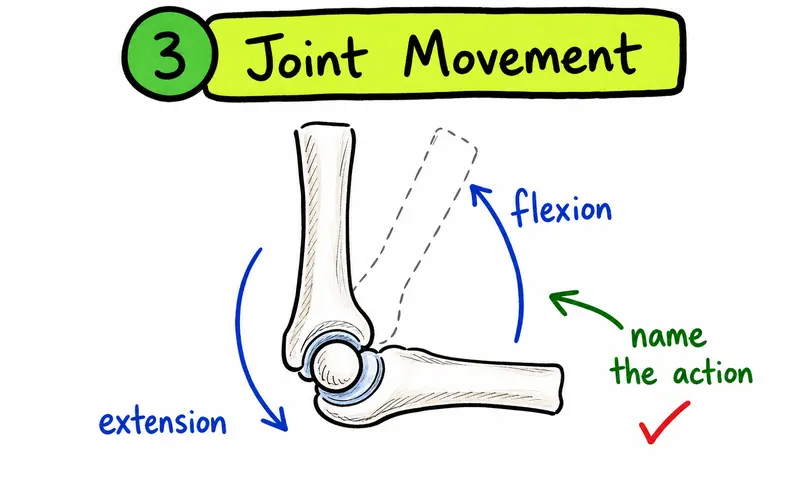
Movement terms in synovial joints
The PDF adds movement terms that often appear in SEHS questions.
| Movement term | Meaning |
|---|---|
| Adduction | movement towards the medial line of the body |
| Abduction | movement away from the medial line |
| Flexion | decrease the angle at a joint |
| Extension | increase the angle at a joint |
| Pronation | rotation of the forearm so the palms face inferiorly |
| Supination | rotation of the forearm so the palms face superiorly |
| Elevation | move a structure superiorly |
| Depression | move a structure inferiorly |
| Rotation | turning a structure around its long axis |
| Circumduction | combination of flexion, extension, abduction, and adduction |
| Eversion | turning the ankle so the plantar surface faces laterally |
| Inversion | turning the ankle so the plantar surface faces medially |
| Plantar flexion | movement of the foot towards the plantar surface, as in standing on toes |
| Dorsiflexion | movement of the foot towards the shin, as in walking on heels |
These terms are not decorative vocabulary. They let you describe movement without using vague everyday language.
Common mistakes that cost marks
| Mistake | Better answer habit |
|---|---|
| Mixing axial and appendicular function | link the skeleton division to the function named in the PDF |
| Listing bone types without examples | pair long, short, flat, and irregular with examples |
| Labelling long bone diagrams with missing structures | include epiphysis, diaphysis, cartilage, marrow cavity, and periosteum |
| Confusing tendon and ligament | tendon is muscle to bone; ligament is bone to bone |
| Saying all joints move freely | distinguish fibrous, cartilaginous, and synovial joints |
| Naming synovial joint type without movement | include movement and example |
| Using "towards" or "away" without anatomical term | write adduction or abduction |
A 30-minute revision route
| Time | Task |
|---|---|
| 0-5 min | Write the six skeletal functions from memory |
| 5-9 min | Compare axial and appendicular skeleton |
| 9-13 min | List four bone types with examples |
| 13-18 min | Label and annotate a long bone diagram |
| 18-22 min | Test anatomical location terms |
| 22-26 min | Compare fibrous, cartilaginous, and synovial joints |
| 26-30 min | Match six synovial joint types to movements and examples |
Use EduNinja Notes to rebuild the list, then test yourself with the IB Sports Exercise and Health Science Question Bank. The goal is to recall exact terms without needing the PDF open.
Weak answer vs mark-worthy answer
Weak:
- A tendon joins things together.
Better:
- A tendon is a strong strip of connective tissue that attaches muscle to bone.
Weak:
- A hinge joint bends.
Better:
- A hinge joint permits flexion and extension, such as at the elbow or knee.
Weak:
- Synovial fluid helps the joint.
Better:
- Synovial fluid coats and lubricates articular cartilage, reducing friction during joint movement.
Weak:
- Abduction is moving away.
Better:
- Abduction is movement away from the medial line of the body.
Related Study Links
FAQ
What is the difference between the axial and appendicular skeleton in IB SEHS?
The axial skeleton is the central skeleton and is linked strongly with protection, attachment, support, movement, and blood cell production. The appendicular skeleton is linked to attachment, support, movement, and mineral storage. In exam answers, distinguish them by both anatomy and function.
What are the four types of bones in the skeletal system?
The PDF limits the four main bone types to long, short, flat, and irregular. Examples include femur and humerus for long bones, carpals and tarsals for short bones, ribs and cranium for flat bones, and vertebrae for irregular bones.
What is the difference between tendons and ligaments?
Tendons attach muscles to bones. Ligaments connect bones to bones at joints. Cartilage is different again: it cushions the ends of bones, absorbs shock, and reduces friction.
What are the three joint types by movement?
Fibrous joints allow no movement, cartilaginous joints allow limited movement, and synovial joints are freely moving. Synovial joints contain synovial fluid in a cavity around articulating bones.
What synovial joint types should I know for IB SEHS?
Know hinge, pivot, ball and socket, condyloid, saddle, and gliding joints. For each one, learn the movement permitted and an example, such as hinge joints at the elbow and knee or ball and socket joints at the shoulder and hip.
Related study links
- Review IB Sports Exercise and Health Science Notes
- Practise with the IB Sports Exercise and Health Science Question Bank
- Use the IB Sports Exercise and Health Science Study Library
- Connect movement language with IB Physics mechanics revision guide
Choose a course and continue studying.
Pick your curriculum and subject, then continue into the right question bank or notes.