IB Psychology SL Reconstructive Memory: Study and Evaluation Guide
Revise IB Psychology SL reconstructive memory with schema theory, distortion, study use, methodology, and evaluation wording.
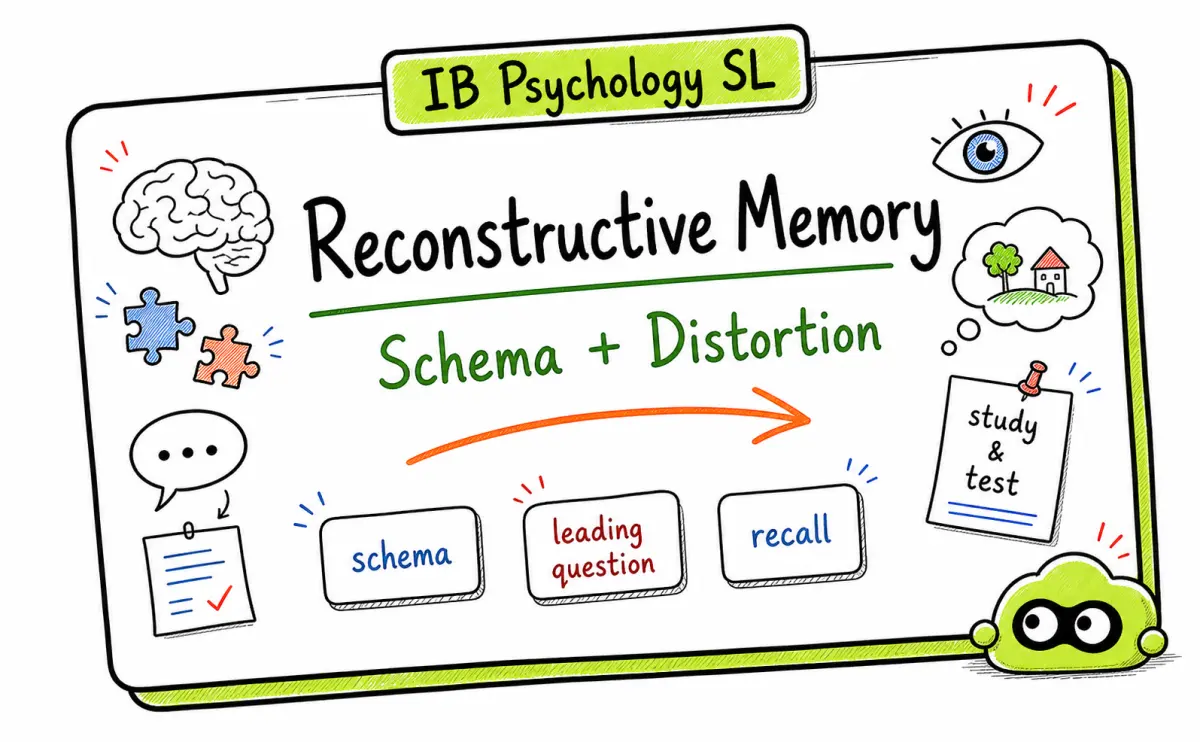
IB Psychology reconstructive memory is easiest to revise through one clear chain: theory, study, result, evaluation. The source PDF is an Internal Assessment style report on reconstructive memory, based on Loftus and Palmer's work on leading questions and speed estimates.
This guide follows that PDF closely. It explains the theory, the replicated study design, the variables, procedure, results, statistics, ethics, and evaluation points students can turn into exam or IA-style writing.
Useful starting points:
Quick answer
For IB Psychology reconstructive memory, revise these first:
- Reconstructive memory means recall is rebuilt rather than replayed exactly.
- Bartlett argued that recall can be influenced by cognitive processes, prior knowledge, and schemas.
- Loftus argued that post-event information can distort memory.
- Leading questions can affect recall because wording may suggest different interpretations of an event.
- Loftus and Palmer (1974) tested whether changing the verb in a critical question changed speed estimates after a car crash video.
- The PDF replication used two verbs: "bumped" and "smashed."
- The independent variable was the verb used in the critical question.
- The dependent variable was memory operationalised as a speed estimate in km/h.
- The replication used an independent measures design with 20 pre-IB students.
- The replication found no significant difference between the two groups, so the null hypothesis was retained.
If you only remember one exam habit, do not write "memory is unreliable" as the whole answer. Explain how post-event information or schemas can influence recall.
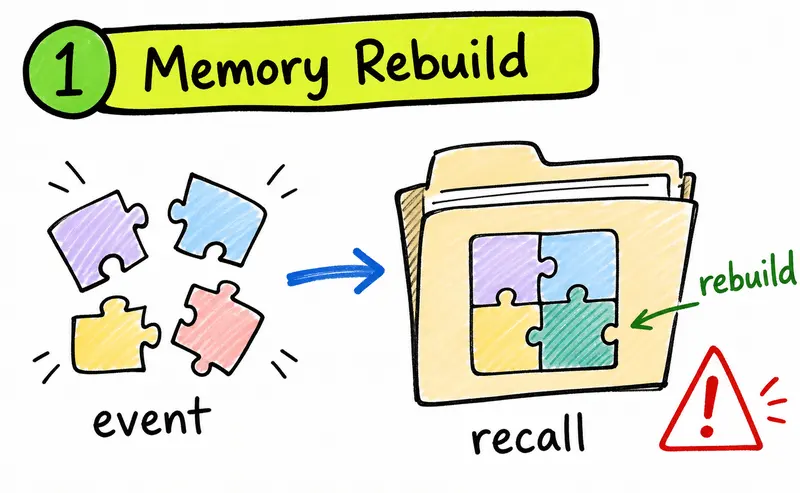
What reconstructive memory means
The PDF introduces reconstructive memory through cognitive psychology. Memory is not treated as a complete, reliable recording. Recall can be influenced by cognitive processes, prior knowledge, and schemas.
| Term | PDF-aligned meaning |
|---|---|
| Reconstructive memory | memory is rebuilt during recall rather than retrieved as a perfect copy |
| Schema | simplified mental representation that can influence memory |
| Post-event information | information encountered after the event that can alter later recall |
| Eyewitness testimony | a legal account given by someone who witnessed an event |
| Leading question | a question that suggests or guides an answer |
The key idea is that recall can change after the event. A witness may not simply report what was seen. The wording of later questions may shape how the event is reconstructed.
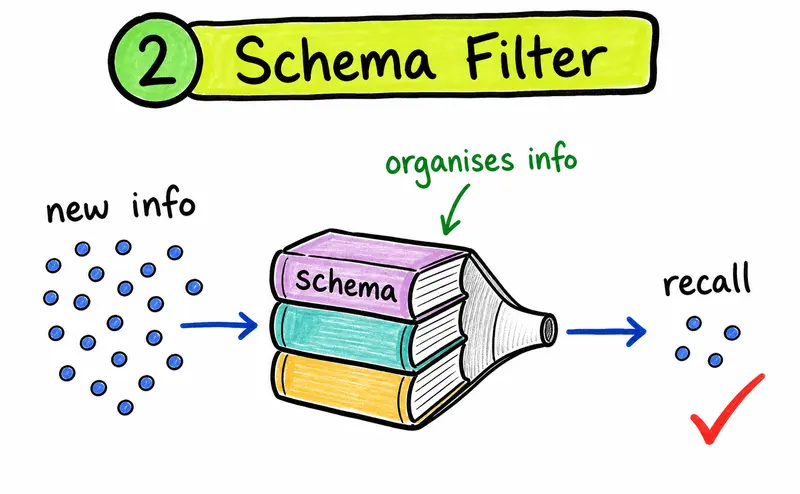
Bartlett, schemas, and recall
The PDF cites Bartlett as support for the idea that memory is reconstructive. Bartlett's theory suggests that recall can be influenced by prior knowledge and schemas.
Use this in an answer:
- "According to Bartlett, memory is reconstructive because recall is influenced by schemas and prior knowledge."
Do not overclaim. The PDF also notes a limitation: reconstructive theory does not fully explain exactly how memory is reconstructed or where schemas are located.
Loftus and Palmer as the key study
The PDF uses Loftus and Palmer (1974), often described as the "Automobile Reconstruction" study, as the main supporting study. The original study investigated whether replacing one word in a critical question could influence speed estimates after a car crash video.
| Study detail | What the PDF says |
|---|---|
| Researchers | Loftus and Palmer |
| Year | 1974 |
| Aim | test whether post-event information would alter memory |
| Participants | 45 participants in the original study |
| Task | watch car crash videos and answer a questionnaire |
| Critical question | asked how fast the cars were going when they hit each other |
| Verb manipulation | "smashed", "collided", "bumped", "hit", "contacted" |
| Finding | stronger verbs such as "smashed" led to higher speed estimates than weaker verbs such as "contacted" |
| Conclusion | question wording influenced recall |
This supports reconstructive memory because the participants' memory representation of the crash could be distorted by cues in the question.
The PDF replication: aim and hypotheses
The IA report replicated the Loftus and Palmer idea in a simplified form. The aim was to test reconstructive memory by investigating how post-event information given to eyewitnesses affects memory for the event.
The replication simplified the original study:
- two verbs instead of five
- one video instead of multiple videos
- a smaller sample of 20 students
- the two verb conditions were "bumped" and "smashed"
| Variable | PDF-aligned wording |
|---|---|
| Independent variable | the verb used in the critical question |
| Dependent variable | memory operationalised as speed estimate in km/h |
| Experimental hypothesis | participants asked with a higher-intensity verb would give higher speed estimates |
| Null hypothesis | no significant difference between the speed estimates of the two verb groups |
The study matters for IB Psychology because it connects a cognitive theory to a clear experimental method.
Design and sampling
The PDF reports an independent measures design. Participants were randomly allocated into two groups, so each participant took part in only one condition.
| Design choice | Strength | Limitation |
|---|---|---|
| Independent measures | avoids order effects | individual differences may affect results |
| Random allocation | helps make groups more equivalent | does not remove every participant difference |
| Convenience/opportunity sample | practical and easy to access | not representative of the wider population |
The sample consisted of 20 pre-IB students from a school in Holbaek, Denmark. They were aged 15 to 17. The PDF notes they were chosen because they were convenient and because they were unlikely to know the study or the subject.
The sample limitation is important. The participants were young, not necessarily representative, and did not have driving licences, which may have affected speed estimation.
Procedure in the replication
The PDF procedure can be turned into a clear exam-style sequence:
- Participants were asked whether they were willing to take part.
- Consent forms were signed. Participants under 16 had parental consent.
- Participants were randomly divided into "bumped" and "smashed" conditions.
- One group left the room so they could not hear the other condition.
- Standardised instructions were given.
- Each group watched the car crash video once.
- Participants completed a questionnaire containing either the verb "bumped" or "smashed."
- The four questions were handed in separately to reduce the chance of later questions changing earlier answers.
- After both groups finished, participants were debriefed.
This is more useful than memorising the whole IA. For an exam paragraph, you can summarise the procedure in two or three sentences, then explain why the design tests reconstructive memory.
Ethics and controls
The PDF includes several ethical safeguards and control decisions.
| Area | What the PDF says |
|---|---|
| Consent | participants signed consent forms |
| Withdrawal | participants could withdraw at any stage |
| Confidentiality | responses were confidential and anonymous |
| Deception | exact aim was not revealed before the experiment |
| Debriefing | participants were debriefed after the session |
| Harm | the report states no harm was involved |
The study also tried to control confounding variables:
- extra questions were used to reduce demand characteristics
- video sound was removed because it might influence speed estimates
- questions were handed in separately to reduce answer changes caused by later questions
- standardised instructions were used
These points are useful for evaluation. They show an attempt to improve internal validity, even though the study still had limitations.
Results and statistical conclusion
The replication did not produce the expected Loftus and Palmer pattern. According to the PDF:
- the median speed estimate for both "smashed" and "bumped" groups was 65
- there was no significant difference between the two groups
- the result contradicted the experimental hypothesis
- the null hypothesis was retained
The PDF explains that median and semi-interquartile range were used because the data was non-parametric, ordinal, and affected by strong deviations from normality.
| Statistical point | PDF detail |
|---|---|
| Central tendency | median used instead of mean |
| Spread | semi-interquartile range used |
| Outliers | examples included 20 km/h and 110 km/h |
| Inferential test | Mann-Whitney U test |
| Reported result | , |
| Significance rule | required for significance |
| Conclusion | no significant difference, null hypothesis retained |
The important interpretation is cautious: the replication did not support the experimental hypothesis, but that does not automatically disprove reconstructive memory.
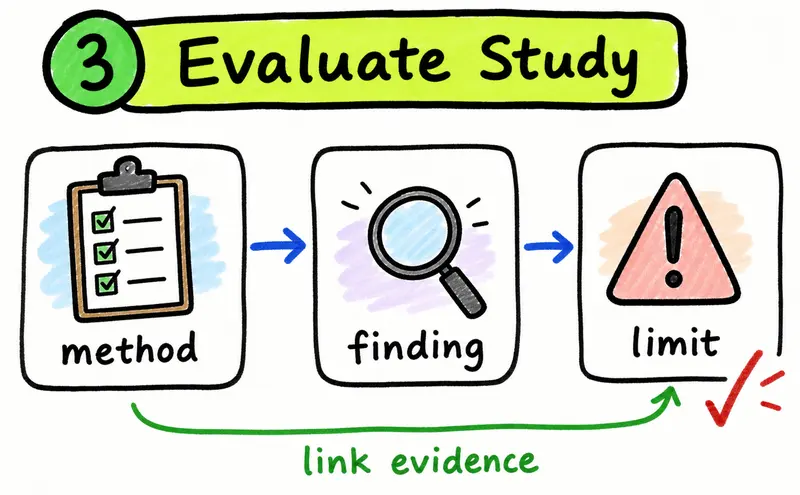
Evaluation: why the replication differed
The PDF evaluation explains several reasons the replication may not have matched the original Loftus and Palmer results.
| Evaluation point | How it affects interpretation |
|---|---|
| Small sample | 20 participants reduces generalisability and statistical power |
| Only two conditions | "bumped" and "smashed" may not create the same range as the original five verbs |
| One video | less stimulus variation than the original study |
| No driving licences | participants may have had weak real-world speed estimation |
| Language proficiency | non-native speakers may have misunderstood or ignored verb intensity |
| Outliers | extreme values may have affected the distribution |
| Ecological validity | watching a clip is different from witnessing a real accident |
| Cultural context | participants came from varied backgrounds |
The PDF also contrasts lab-based memory studies with real-world eyewitness memory. It mentions Yuille and Cutshall (1986), who found that misleading information did not alter memory in a robbery witness case. This challenges simple claims that misleading questions always distort recall.
What this means for reconstructive memory
The PDF's conclusion is nuanced. The replication did not support the original findings, but it does not necessarily contradict reconstructive memory theory. Instead, it suggests that post-event information does not always affect recall in the same way.
This is useful for IB Psychology evaluation:
- Loftus and Palmer supports reconstructive memory.
- The replication shows that results can be difficult to reproduce.
- Laboratory control can help isolate variables.
- Artificial tasks may reduce ecological validity.
- Participant characteristics and wording intensity can affect outcomes.
That is the kind of balanced conclusion examiners usually reward.
Common mistakes that cost marks
| Mistake | Better answer habit |
|---|---|
| Saying memory is always false | say recall can be influenced by schemas and post-event information |
| Retelling Loftus and Palmer without linking it to theory | explain how verb wording affected recall |
| Ignoring the replication's null result | state that the PDF replication found no significant difference |
| Saying the theory is disproved | say the replication did not support the hypothesis but does not necessarily disprove the theory |
| Using generic evaluation | mention sample size, two verb conditions, one video, driving experience, language, outliers, and ecological validity |
| Forgetting ethics | include consent, withdrawal, confidentiality, deception, and debriefing |
A paragraph structure for IB Psychology
Use this structure for a reconstructive memory study paragraph:
- Define reconstructive memory.
- State the study aim.
- Identify the independent and dependent variables.
- Summarise the procedure briefly.
- State the finding.
- Link the finding to reconstructive memory.
- Add one specific evaluation point.
Example:
- "Loftus and Palmer investigated whether post-event information could alter memory by changing the verb in a question about a car crash. Stronger verbs led to higher speed estimates, suggesting that question wording can distort recall. This supports reconstructive memory because participants did not simply retrieve a fixed memory; their recall was influenced by later verbal cues."
For the PDF replication, the final link changes:
- "The replication found no significant difference between the 'bumped' and 'smashed' groups, so it did not support the experimental hypothesis. This may reflect the smaller sample, fewer verb conditions, one video, or participant factors rather than disproving reconstructive memory."
Related Study Links
FAQ
What is reconstructive memory in IB Psychology?
Reconstructive memory means recall is rebuilt rather than replayed as an exact record. The PDF explains that recall can be influenced by prior knowledge, schemas, and post-event information, especially when leading questions suggest a certain interpretation of an event.
How does Loftus and Palmer support reconstructive memory?
Loftus and Palmer showed that changing one verb in a critical question affected participants' speed estimates after a car crash video. Stronger wording such as "smashed" produced higher estimates than weaker wording such as "contacted," suggesting that post-event information can distort recall.
What did the PDF replication find?
The replication compared "bumped" and "smashed" conditions with 20 pre-IB students. The median speed estimate was 65 for both groups, and the Mann-Whitney U test was not significant. The null hypothesis was retained.
What are good evaluation points for reconstructive memory studies?
Strong evaluation points include ecological validity, sample size, participant driving experience, language proficiency, number of conditions, number of videos, outliers, use of deception, consent, confidentiality, and debriefing.
Does the replication disprove reconstructive memory?
No. The replication did not support its experimental hypothesis, but the PDF states that this does not necessarily contradict reconstructive memory theory. It shows that post-event information does not always affect recall in the same way and that psychology findings can be difficult to replicate.
Related study links
- Review IB Psychology Notes
- Practise with the IB Psychology Question Bank
- Use the IB Psychology Study Library
Continue your full IB Psychology SL study plan.
Return to the complete course overview, or move directly into the most relevant study tool.