IB Global Politics SL Human Rights: Concepts and Examples
Revise IB Global Politics SL human rights through universality, enforcement, sovereignty, case examples, and evaluation language.
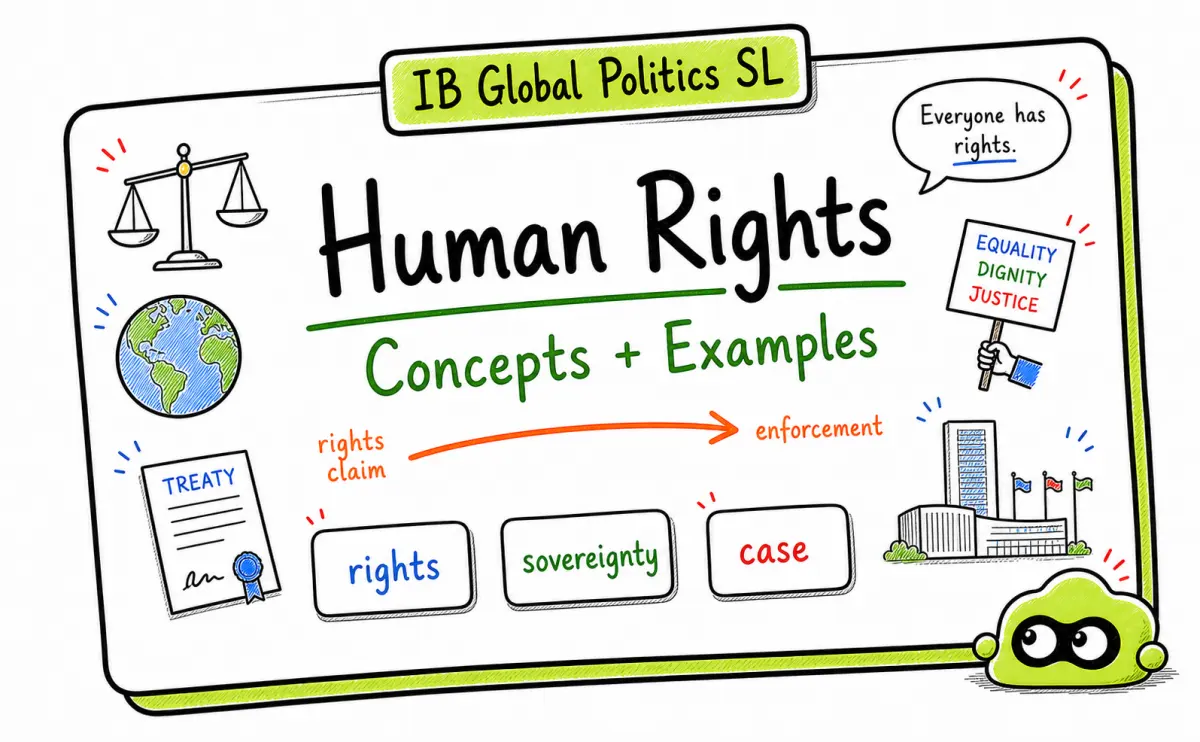
IB Global Politics human rights questions are usually not asking for a slogan. They are asking whether you can define rights, explain the principles behind them, and then evaluate why protection is difficult in real political contexts.
If you only remember one thing: human rights are basic claims and entitlements that people have because they are human. The hard part in Global Politics is not only naming rights, but explaining how universal claims meet state power, limited resources, security threats, and disagreement about culture.
Useful starting points:
- IB Global Politics Notes
- IB Global Politics Question Bank
- IB Global Politics Study Library
This guide follows the local SL notes for Topic 2.1 Human Rights. It also uses the IB Global Politics guide to keep the answer style close to Paper 1: define the concept, use source evidence, connect to a political issue, and evaluate competing perspectives.
This is a concept-focused guide based on the local Human Rights notes. Add country examples only when they come from your teacher, a source paper, or your class case studies.
Quick answer
- Human rights are claims and entitlements people have because of their humanity.
- The Universal Declaration of Human Rights was adopted by the UN in 1948 and is treated in the notes as a key global reference point.
- Human rights are often described as universal, interdependent, indivisible, and inalienable.
- Negative rights require those in power to avoid interference, such as freedom from torture or arbitrary detention.
- Positive rights require action by those in power, such as providing education or a fair judicial system.
- Positive rights can be harder for less economically developed countries to deliver quickly, which is why the notes use the idea of progressive realization.
- Human rights debates often connect to sovereignty, legitimacy, justice, liberty, equality, culture, and enforcement.
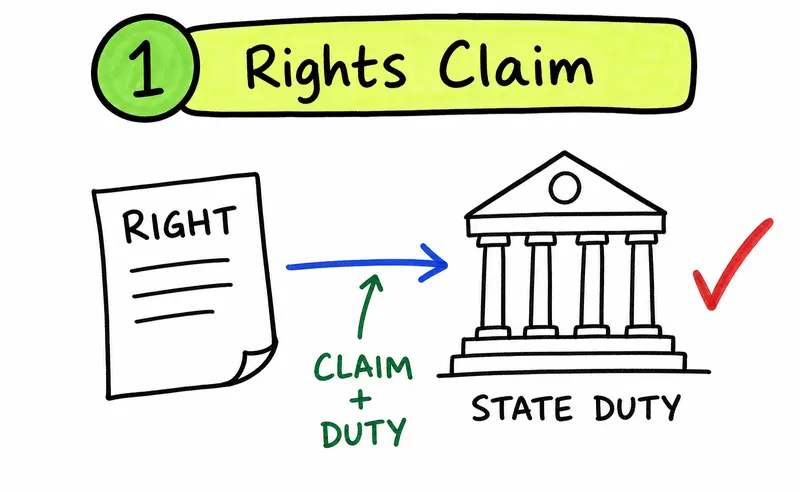
What are human rights?
The SL notes define human rights as rights that all human beings are entitled to by their humanity, without discrimination. The notes also say the elements of human rights cannot simply be separated from one another.
In an IB Global Politics answer, a clean definition might be:
Human rights are basic claims and entitlements that all people should hold because they are human, regardless of nationality, gender, faith, language, ethnicity, or other identity markers.
That definition gives you three useful exam moves:
| Part of the definition | Why it matters in an answer |
|---|---|
| Basic claims and entitlements | Shows that rights are not just preferences |
| All people | Links to universality and non-discrimination |
| Because they are human | Links to inherent dignity and the basis of rights |
Do not only write "everyone has rights". In Global Politics, you need to show why the claim matters politically.
UDHR and the global consensus on rights
The notes identify the United Nations Universal Declaration of Human Rights as a key document that sets out a global consensus on human rights. It was adopted after World War II in 1948.
For revision, use the UDHR as a reference point, not as your whole answer. A stronger answer explains that the UDHR helped formalize discussion of human rights around the world, while also recognizing that implementation and interpretation remain politically contested.
Useful sentence:
The UDHR is important because it gives human rights a shared international language, but states, cultures, and political actors may still disagree over enforcement, priority, and interpretation.
Four principles of human rights
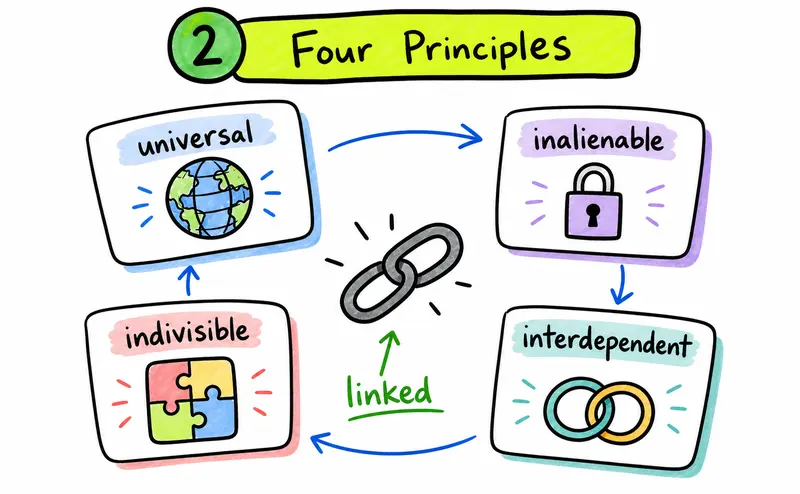
The SL notes give four key principles: universal, interdependent, indivisible, and inalienable.
| Principle | Meaning | Exam use |
|---|---|---|
| Universal | Rights belong to human beings and are not dependent on nationality, age, gender, faith, colour, language, or similar identity markers | Use when discussing whether rights apply across borders and cultures |
| Interdependent | Protecting one right can support other rights, while denying one right can block other rights | Use when explaining why rights cannot be studied one by one in isolation |
| Indivisible | All human rights are of equal importance and should not be arranged into a hierarchy | Use when evaluating whether governments can prioritize some rights over others |
| Inalienable | Rights cannot be taken away or given away; people are entitled to the full package of rights | Use when discussing state abuse, detention, torture, or discrimination |
These four words are useful, but they are not enough by themselves. The mark comes from applying them to a political issue.
Weak:
- Human rights are universal and inalienable.
Better:
- Human rights are described as universal because they apply regardless of identity, but this creates political tension when a state claims that cultural norms or national security should limit certain rights.
Negative rights
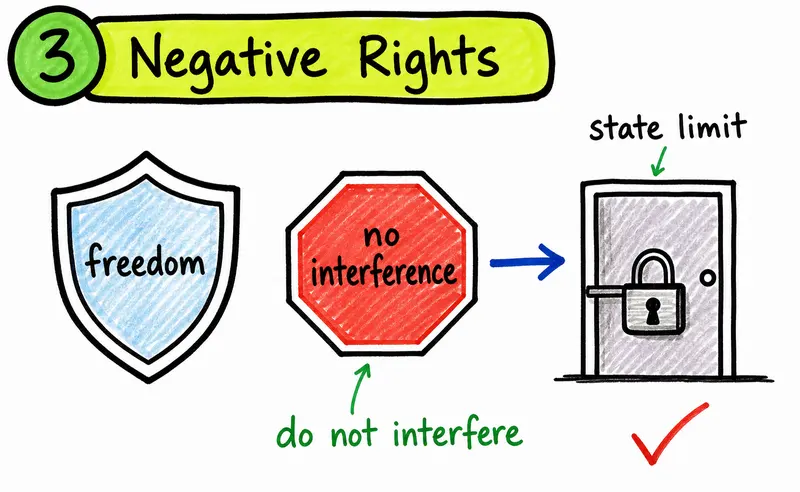
The notes define negative rights as rights that require those in power to step back and allow people to be free from interference.
Examples from the notes include:
- freedom from torture
- freedom from arbitrary arrest
- freedom from arbitrary detention
The notes define torture as the deliberate use of extreme physical violence to force someone to say or do something against their own wish.
Negative rights are protected mainly through restraint. A government, police force, military, or other authority must not interfere in ways that violate the right.
This matters because negative rights should, in theory, be protectable even when a government has limited financial resources. Not torturing people does not require a large education budget or a new hospital system. However, the notes also warn that these rights might be at risk when governments face a security threat.
Security threats and negative rights
A security threat is a threat to the peace and safety of a state or a group of people. In human rights debates, security threats often become a test of whether a state respects negative rights when under pressure.
A strong answer does not simply say "security is bad for rights". It explains the trade-off:
| Political pressure | Human rights risk |
|---|---|
| Terrorism, war, public disorder, or emergency politics | Governments may justify detention, surveillance, coercion, or restrictions |
| Desire to protect citizens | Authorities may claim that limiting rights is necessary |
| Weak accountability | Temporary restrictions may become long-term abuse |
Use cautious wording. A state may argue that security measures are necessary, but Global Politics evaluation asks whether those measures are legitimate, proportionate, and compatible with human rights principles.
Positive rights
The notes define positive rights as rights that require positive action by those in power.
Examples from the notes include:
- the right to free education
- adequate schools
- teachers
- classrooms
- learning materials
- a judicial system
- a fair and effective hearing by a tribunal
Positive rights need government intervention. Without that intervention, the notes say these rights cannot be delivered and would become meaningless.
That makes positive rights politically difficult. They require planning, institutions, budgets, trained workers, infrastructure, and public capacity.
Progressive realization
The notes use progressive realization to explain why not all governments can deliver positive rights as quickly as others. This is especially important for less economically developed countries.
Progressive realization does not mean a government can ignore human rights. It means that some rights may require gradual implementation because the state has limited resources or institutional capacity.
A good exam answer can use this distinction:
| Right type | What protection may require |
|---|---|
| Negative right | Restraint by those in power |
| Positive right | Active provision of services, institutions, and resources |
For example, freedom from torture requires authorities not to torture. Free education requires schools, teachers, classrooms, materials, funding, and administration.
Human rights and sovereignty
The syllabus defines sovereignty as a state's independence and control over territory and population. Human rights create a challenge for sovereignty because they make claims about how states should treat people inside their borders.
This is a core Global Politics tension:
- Sovereignty gives states authority.
- Human rights set limits on how authority should be used.
- International norms may criticize state behaviour.
- States may resist external pressure by appealing to independence, culture, or security.
A balanced answer should not treat sovereignty as automatically good or bad. Instead, explain how it can protect self-determination while also making enforcement of human rights more difficult.
Human rights, legitimacy and enforcement
The syllabus connects legitimacy to the rightfulness of rule. A government that claims legitimacy may be judged partly by how it treats the people under its authority.
Human rights can therefore affect legitimacy:
| Situation | Possible political effect |
|---|---|
| A state protects rights and provides fair institutions | It may strengthen legitimacy |
| A state uses torture, arbitrary detention, or discrimination | It may weaken legitimacy |
| A state claims security reasons for limiting rights | Its legitimacy may depend on whether limits are justified and proportionate |
Enforcement remains difficult. Human rights may be recognized internationally, but implementation often depends on states, courts, international organizations, civil society, and political pressure.
Human rights, justice, liberty and equality
The syllabus places human rights near other key concepts, especially justice, liberty, and equality.
Justice is often connected to fairness and to what people are owed. A rights-based approach to justice asks what individuals should be entitled to and whether institutions protect those entitlements.
Liberty is connected to freedom and autonomy. Negative liberty means freedom from external coercion. Positive liberty means having the autonomy to carry out one's rational will. Human rights debates often involve both.
Equality is linked to the idea that people or groups have the same intrinsic value. If rights are universal, then discrimination becomes a direct challenge to equality.
These concepts help you avoid a flat answer. Instead of saying "human rights are important", explain which political value is at stake.
Universality and cultural relativism
The syllabus notes that critics argue human rights can be seen as a Western or culturally relative concept. This is one of the most important evaluation points in human rights.
The universality claim says that rights apply to all people because they are human.
The cultural relativist challenge says that values, traditions, political systems, and social norms differ, so a single rights framework may be contested.
In an IB answer, do not reduce this to "the West versus the rest". A stronger answer evaluates the tension:
- Universal rights create a standard for criticizing abuse.
- Cultural relativism warns against imposing one political or moral framework without context.
- The challenge is deciding when respect for difference becomes an excuse for rights violations.
How to write a Paper 1 style answer on human rights
The IB guide emphasizes understanding source material, using evidence, and evaluating perspectives. For human rights, a good Paper 1 style answer usually follows this order:
- Define the concept.
- Use the source or example.
- Link to a key political issue.
- Add evaluation.
Short template:
Source evidence -> human rights concept -> political tension -> short evaluation.
For example:
Weak:
- Human rights are universal, but governments do not always follow them.
Better:
- Human rights are described as universal because they apply to all people regardless of identity. However, a state facing a security threat may restrict negative rights such as freedom from arbitrary detention. This creates a tension between state security and the inalienable nature of rights.
That answer is stronger because it uses the concept, the example, and the political tension.
Concept map for revision
| Concept | Human rights link |
|---|---|
| Sovereignty | States control territory and population, but human rights set limits on treatment of people |
| Legitimacy | Rights protection can strengthen or weaken the perceived rightfulness of rule |
| Justice | Rights can define what individuals are owed |
| Liberty | Negative and positive freedom connect to different types of rights |
| Equality | Universal rights oppose discrimination and unequal treatment |
| Security | Threats may put rights under pressure |
| Development | Less economically developed countries may face capacity limits in delivering positive rights |
This table is useful for planning essays. Pick two or three concepts, then connect them to one concrete right or policy issue.
Common mistakes
| Mistake | Better habit |
|---|---|
| Listing the four principles without explaining them | Define one principle and apply it to a political problem |
| Treating rights as only legal rules | Explain claims, entitlements, institutions, power, and enforcement |
| Saying positive rights are "better" than negative rights | Explain that they require different types of state action |
| Ignoring resources | Use progressive realization when discussing positive rights |
| Using sovereignty as a one-word evaluation | Explain how sovereignty both protects state authority and complicates enforcement |
| Adding random country examples | Use examples only when they help answer the question |
| Forgetting source evidence in Paper 1 | Quote or paraphrase the source, then explain its political meaning |
Related Study Links
FAQ
What are human rights in IB Global Politics?
Human rights are basic claims and entitlements that people have because they are human. In the SL notes, they are linked to humanity, non-discrimination, and the idea that rights cannot simply be separated from one another.
What are the four principles of human rights?
The four principles are universal, interdependent, indivisible, and inalienable. They mean rights apply to all humans, affect one another, should not be ranked into a simple hierarchy, and cannot be taken away or given away.
What is the difference between positive and negative rights?
Negative rights require those in power not to interfere, such as freedom from torture or arbitrary detention. Positive rights require action by those in power, such as providing education or a fair judicial system.
Why are positive rights harder to protect?
Positive rights often need money, institutions, workers, buildings, legal systems, and administration. Less economically developed countries may not be able to provide these as quickly, which is why the notes use the idea of progressive realization.
How does sovereignty affect human rights?
Sovereignty gives states authority over territory and population. Human rights can challenge sovereignty because they create standards for how states should treat people, even inside their own borders.
How should I evaluate human rights in Paper 1?
Use the source first, then connect it to a concept such as universality, sovereignty, security, justice, liberty, or equality. A strong answer explains both the rights claim and the political difficulty of protecting it.
Related study links
- IB Global Politics Notes
- IB Global Politics Question Bank
- IB Global Politics Study Library
Choose a course and continue studying.
Pick your curriculum and subject, then continue into the right question bank or notes.