IB Economics SL Exchange Rates: Diagrams and Evaluation Guide
Revise IB Economics SL exchange rates with appreciation, depreciation, demand and supply diagrams, current account effects, and evaluation.
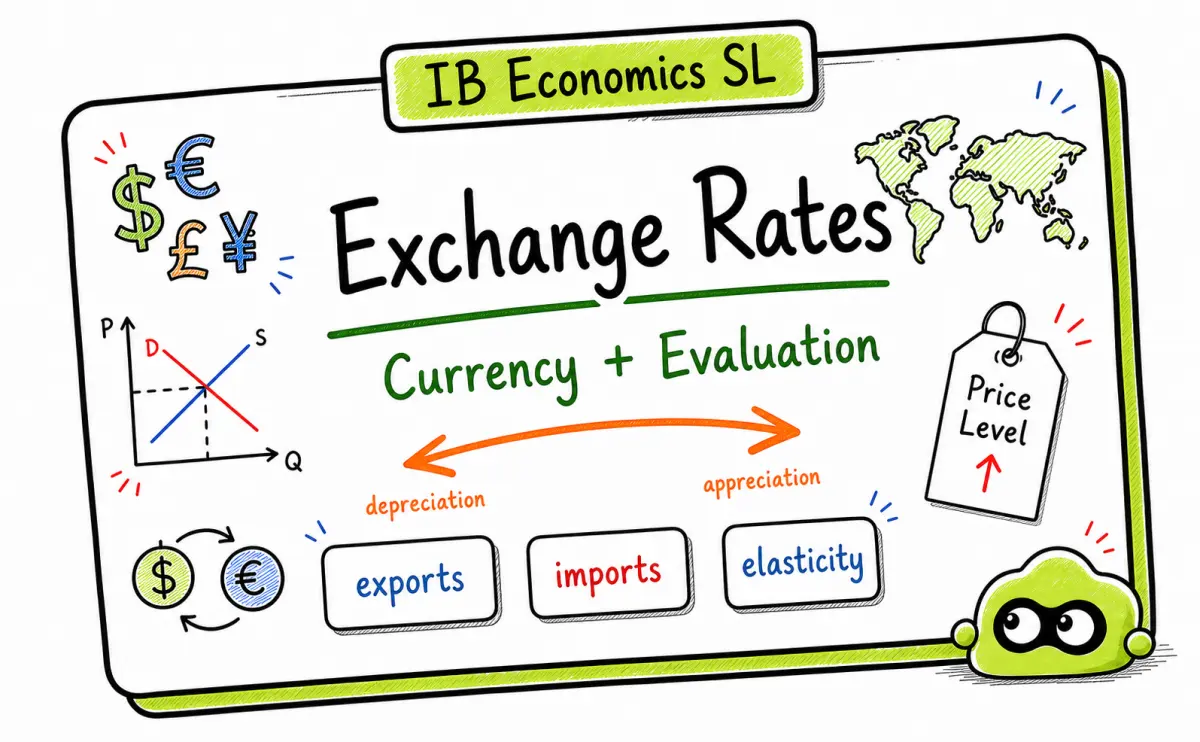
Students often know the vocabulary for Economics but lose marks because the answer stops one step too early. The exam usually wants a definition, a mechanism, and a clear link to the question.
This guide turns the draft notes into a cleaner revision route. Use it as a short active-recall page: read the core rule, answer the worked examples, then check whether your own wording is specific enough for marks.
Use the relevant EduNinja course pages as your base:
Do not open every link at once. Start with the notes or topic page, then move into question practice and use any PDF resource only when it helps clarify the exact idea you are revising.
Quick Answer
- An exchange rate is the price of one currency in terms of another.
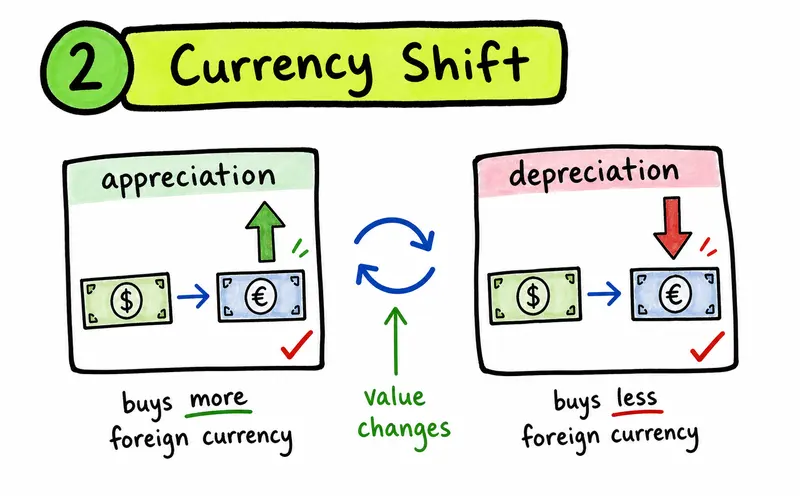
- Appreciation can make exports more expensive and imports cheaper.
- Depreciation can improve export competitiveness but may raise import costs.
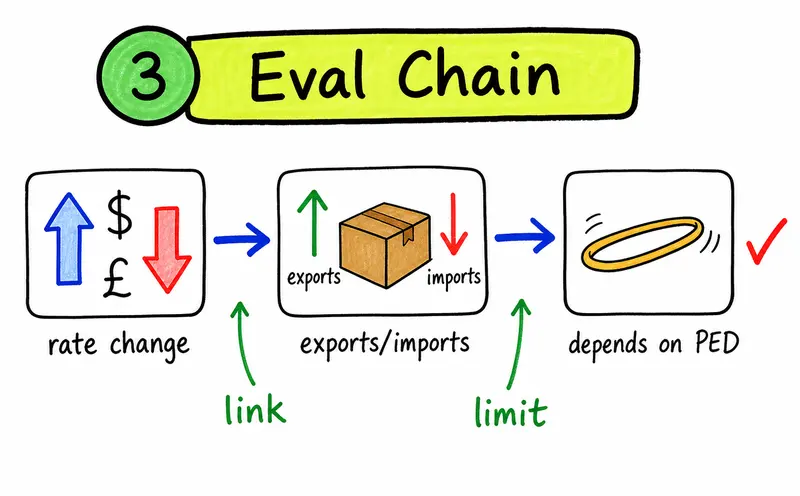
- Evaluation should mention elasticity, time lags, inflation, and stakeholder effects.
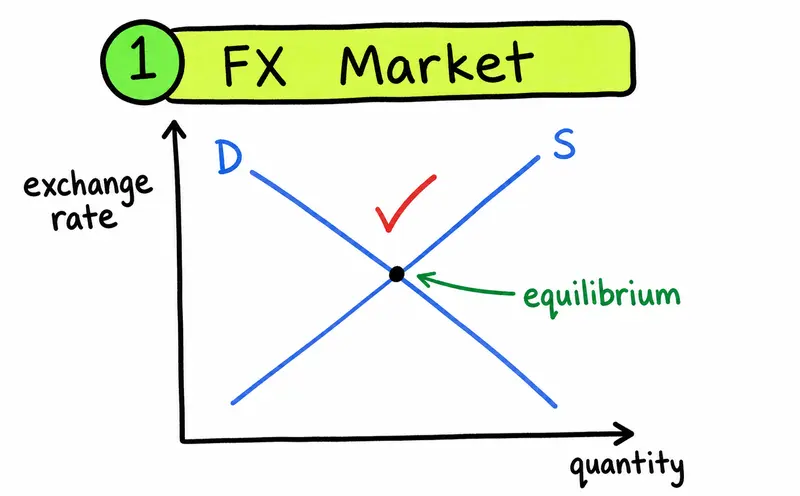
Core Concept That Gets Marks
The core skill is turning a remembered fact into a usable answer. For Exchange Rates, that means naming the idea, applying it to the situation, and explaining why it matters.
| Idea | What it means | How it earns marks |
|---|---|---|
| Appreciation | Currency rises in value | Exports dearer, imports cheaper. |
| Depreciation | Currency falls in value | Exports cheaper, imports dearer. |
| Current account | Trade flows matter | Depends on price elasticity of demand. |
| Evaluation | Conditions and limits | Use time period and stakeholders. |
Weak Answer vs Mark-Worthy Answer
| Weak answer habit | Better answer move |
|---|---|
| Names the topic but does not apply it. | Use the exact term, then connect it to the question scenario. |
| Gives a memorised sentence with no evidence. | Add one data point, example, diagram feature, or calculation step. |
| Evaluates with vague wording. | State the condition that would make the answer stronger or weaker. |
Worked Example 1
Question: Explain one effect of depreciation.
Mark-worthy answer: Depreciation lowers the foreign-currency price of exports, which may increase export demand if demand is price elastic.
Why this scores: It does not only name the topic. It shows the mechanism and makes the link to the command term visible.
Worked Example 2
Question: Why might depreciation not fix a deficit?
Mark-worthy answer: If demand for exports and imports is price inelastic in the short run, trade values may not improve quickly and import costs can increase.
Why this scores: It uses precise vocabulary, keeps the answer in context, and avoids drifting into a generic study note.
Question-Type Breakdown
| Question type | First move | What to avoid |
|---|---|---|
| Define or state | Give the exact term first | Long explanations that blur the definition |
| Explain | Use because, therefore, or so that | Listing facts without a causal link |
| Compare | Pair both sides in the same sentence | Describing only one side |
| Evaluate | Weigh strengths and limits | Generic phrases such as "it depends" |
| Apply | Refer directly to the context | Rewriting memorised notes unchanged |
Topic-Specific Revision Route
- Appreciate: write one exact sentence that uses this idea in an exam answer.
- Depreciate: write one exact sentence that uses this idea in an exam answer.
- Diagram: write one exact sentence that uses this idea in an exam answer.
- Evaluate: write one exact sentence that uses this idea in an exam answer.
After that, do one question without notes. Mark only the missing wording, not the whole page. The correction should be short enough to become a flashcard.
Common Mistakes That Cost Marks
- Mixing appreciation and depreciation.
- Drawing demand and supply shifts without explaining cause.
- Forgetting elasticity.
- Evaluating with vague phrases instead of conditions.
Exam-Ready Mini Checklist
- Did I define the key term accurately?
- Did I apply it to the exact scenario in the question?
- Did I include the mechanism, calculation step, diagram feature, or evidence?
- Did I avoid unsupported claims or over-general statements?
- Did I finish with a clear mark-worthy conclusion?
How EduNinja Helps
Use EduNinja as a practice loop, not just a reading library. Start with Study Notes to rebuild the idea, move into the Questionbank for topic-specific practice, then turn repeated errors into flashcards.
For Economics, the strongest routine is simple: one concept, one question set, one correction list. That keeps revision active and stops the notes from becoming another folder you never test.
Exam Answer Upgrade: Exchange Rates
An exchange-rate answer should not stop at "exports become cheaper" or "imports become expensive." State whose currency changes and from whose perspective. If the domestic currency depreciates, exports may become cheaper for foreign buyers, while imports become more expensive for domestic consumers and firms.
For diagram questions, label the currency market clearly and explain whether demand or supply of the currency changes. Then connect the movement to one outcome, such as export competitiveness, import prices, inflationary pressure or the current account.
Evaluation needs conditions. The effect depends on price elasticity of demand, how quickly contracts adjust, whether firms rely on imported raw materials and the state of the economy. A strong conclusion says the direction is likely, but the size of the effect depends on these conditions.
Teacher Check: Diagram Plus Explanation
For exchange-rate diagrams, the diagram earns limited value unless the written explanation follows it. After drawing the shift, state whether the currency appreciates or depreciates. Then explain one export effect, one import effect and one possible macroeconomic consequence. For evaluation, add a condition: elasticities, import dependence, spare capacity, inflation or time lag. This structure helps the answer move from diagram skill to economic judgement.
FAQ
How should I revise Economics SL quickly?
Start with one narrow topic and write the answer chain from memory. Then answer a short exam-style question and mark whether your response included the mechanism, evidence, and conclusion.
Are notes enough for this topic?
Notes are useful for rebuilding understanding, but they are not enough on their own. You need question practice to check whether you can retrieve the idea and apply it under exam wording.
How do I stop losing marks when I know the content?
Look for the missing sentence. Most repeated errors come from a missing link between the term and the context, a missing unit or diagram feature, or an evaluation point that is too vague.
Related Study Links
- Explore the course Study Hub
- EduNinja Blog
- EduNinja Question Banks
- EduNinja Study Notes
- IB Business marketing strategy guide
Closing
Exchange Rates becomes easier when every note is converted into an answer move. Define the idea, apply it carefully, and make the reasoning visible enough for the markscheme.
Continue your full IB Economics SL study plan.
Return to the complete course overview, or move directly into the most relevant study tool.