IB Biology SL Enzymes: Active Sites, Rate Factors, and Exam Answers
A source-backed IB Biology guide for IB Biology enzymes, using EduNinja PDF notes, worked examples, and markscheme-style answers.
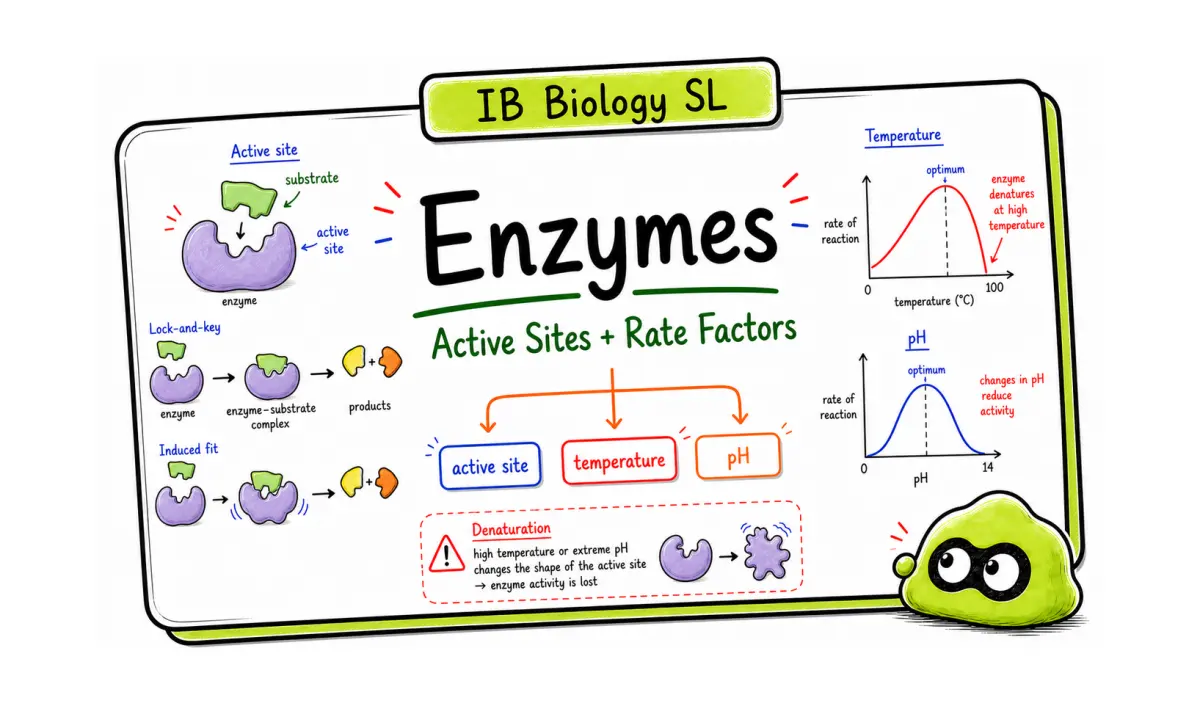
IB Biology SL enzyme answers need active-site wording. "Enzymes speed up reactions" is true, but it rarely carries enough marks by itself.
For the 2025 syllabus, enzymes sit around metabolism, active sites, enzyme-substrate complexes, reaction rate and factors that affect enzyme activity. This guide is for revision and exam wording. It is not an official IB syllabus document, so use your teacher's guide for the exact assessment detail.
The main rule is simple: name the molecule-level event. Substrates collide with active sites, enzyme-substrate complexes form, activation energy is lowered, and the product leaves the active site.
Useful starting points:
Start with notes if the vocabulary feels loose. Move into questions once you can explain active site, substrate, enzyme-substrate complex and denaturation without looking.
Quick answer
- Enzymes are biological catalysts.
- Enzymes lower activation energy.
- The substrate binds to the enzyme's active site.
- The active site is specific because its shape and chemical properties match the substrate.
- The enzyme-substrate complex forms before product is released.
- Increasing temperature raises rate at first because particles have more kinetic energy.
- Above the optimum temperature, the enzyme denatures and the active site changes shape.
- Extreme pH can change charges and bonds that maintain enzyme shape.
- Increasing substrate concentration raises rate until active sites become saturated.
- Increasing enzyme concentration can increase rate if substrate is not limiting.
- Immobilised lactase breaks lactose into glucose and galactose and can be reused.
- For enzyme graph questions, describe the trend, quote data if given, then explain the active-site reason.
Use this chain in explanations: collision, active site, enzyme-substrate complex, activation energy, product.
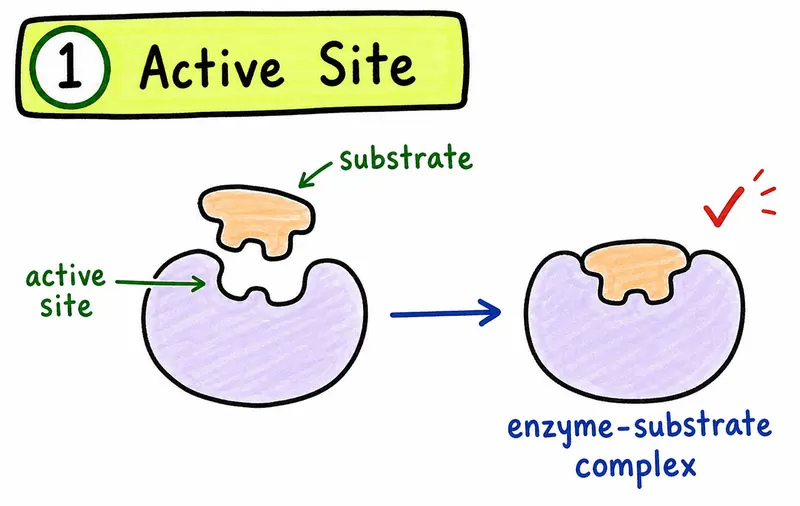
Enzyme specificity: active site language
Enzymes are specific because the active site has a shape and chemical environment that fit a particular substrate. A good answer should not sound as if the enzyme "chooses" a substrate. The fit depends on molecular shape and interactions.
| Term | Meaning |
|---|---|
| Enzyme | Biological catalyst that speeds up a reaction |
| Substrate | Reactant that binds to the enzyme |
| Active site | Region of the enzyme where the substrate binds |
| Enzyme-substrate complex | Temporary complex formed when substrate binds |
| Product | Molecule or molecules released after the reaction |
The induced-fit model adds one more detail: the active site changes shape slightly as the substrate binds. This helps the reaction occur.
Activation energy: what enzymes actually lower
Enzymes increase reaction rate by lowering activation energy. Activation energy is the minimum energy needed for a reaction to start.
Do not write that enzymes "give energy" to the reaction. A better answer is:
- Enzymes provide an alternative pathway with lower activation energy.
- More collisions have enough energy to lead to a reaction.
- The enzyme is not used up and can catalyse another reaction.
This wording helps in explain questions because it links the enzyme to reaction rate.
Worked example 1: enzyme specificity
Question: Explain why enzymes are specific.
Mark-worthy answer:
The active site has a shape and chemical properties that are complementary to a particular substrate. The substrate binds to the active site to form an enzyme-substrate complex. Other substrates do not fit or do not interact correctly, so they are not catalysed by that enzyme.
Why it works:
The answer uses active site, substrate and enzyme-substrate complex. It explains specificity at the molecular level.
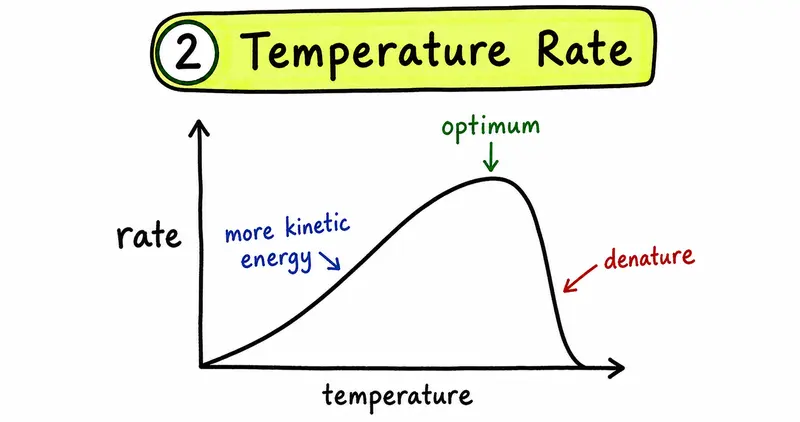
Temperature and enzyme rate
Temperature questions usually have two parts: before the optimum and after the optimum.
| Temperature range | What happens | Explanation |
|---|---|---|
| Low temperature | Low rate | Particles have less kinetic energy and collide less often |
| Increasing temperature before optimum | Rate increases | More frequent successful collisions with active sites |
| Optimum temperature | Highest rate | Active site shape is suitable and kinetic energy is high |
| Above optimum | Rate falls | Bonds maintaining enzyme shape are disrupted; active site changes shape |
The word denaturation matters. Denaturation means the enzyme's three-dimensional shape changes so the active site no longer binds the substrate effectively.
Worked example 2: temperature graph
Question: A student's enzyme rate rises with temperature and then falls sharply. Explain the pattern.
Mark-worthy answer:
As temperature rises, molecules have more kinetic energy and collide more often with active sites. This increases the number of enzyme-substrate complexes formed. Above the optimum temperature, bonds maintaining the enzyme's shape are disrupted. The active site changes shape, fewer substrates bind successfully, and the rate falls.
Why it works:
The answer separates the rising part of the graph from the falling part. It uses collisions before the optimum and denaturation after the optimum.
pH and enzyme activity
pH affects enzyme activity because changes in hydrogen ion concentration can affect charges and bonds in the enzyme. This can alter the active site's shape.
Each enzyme has an optimum pH. A small change away from the optimum may reduce activity. An extreme pH can denature the enzyme.
| pH condition | Effect |
|---|---|
| Optimum pH | Active site shape is most suitable |
| Away from optimum | Fewer enzyme-substrate complexes form |
| Extreme pH | Active site shape may change permanently |
Do not write that pH "kills" the enzyme. Use active site shape, charges, bonds and denaturation.
Substrate concentration and saturation
When substrate concentration increases, reaction rate increases at first because more substrate particles collide with active sites.
The rate eventually plateaus. At that point, active sites are saturated. Most active sites are occupied, so adding more substrate does not increase the rate unless more enzyme is added.
| Part of graph | Explanation |
|---|---|
| Initial rise | More substrate collisions with active sites |
| Plateau | Active sites are saturated |
| Adding more enzyme | More active sites are available, so rate can increase |
This graph is a common place to lose marks. The plateau is not because the enzyme is denatured. It is because active sites are occupied.
Temperature, pH, substrate and enzyme concentration: do not mix the mechanisms
Different rate factors affect enzymes in different ways. Do not use denaturation for every graph.
| Factor | What happens | Correct explanation |
|---|---|---|
| Temperature below optimum | Rate increases | Particles have more kinetic energy and collide with active sites more often |
| Temperature above optimum | Rate decreases | Bonds maintaining enzyme shape are disrupted, so the active site changes shape |
| pH away from optimum | Rate decreases | Charges and bonds in the enzyme can change, altering the active site |
| Substrate concentration | Rate rises then plateaus | More enzyme-substrate complexes form at first, then active sites become saturated |
| Enzyme concentration | Rate can increase | More active sites are available, if substrate is not limiting |
This table helps stop a common mistake: using denaturation to explain the substrate concentration plateau. That plateau is usually active-site saturation, not enzyme damage.
Worked example 3: substrate concentration graph
Question: Explain why the rate of an enzyme reaction plateaus when substrate concentration keeps increasing.
Mark-worthy answer:
At high substrate concentration, most active sites are occupied. The enzymes are saturated, so adding more substrate does not increase the number of enzyme-substrate complexes formed per second. The rate stays constant unless more enzyme is added.
Why it works:
The answer explains the plateau using active site saturation, not denaturation.
Worked example 4: enzyme concentration graph
Question: A student increases enzyme concentration while substrate concentration stays high. The reaction rate increases. Explain why.
Mark-worthy answer:
Increasing enzyme concentration provides more active sites. More substrate molecules can bind at the same time, so more enzyme-substrate complexes form per second. The rate increases as long as substrate is still available and not limiting.
Why it works:
The answer explains the graph using active-site availability. It also includes the condition that substrate must not be limiting.
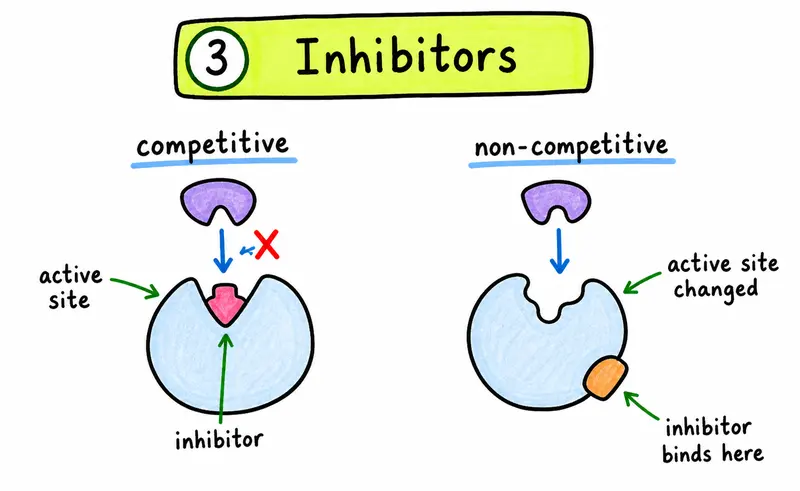
Inhibitors: competitive and non-competitive
Inhibitors reduce enzyme activity, but the mechanism depends on the type of inhibitor.
| Inhibitor type | Where it binds | Effect |
|---|---|---|
| Competitive inhibitor | Active site | Competes with substrate and reduces substrate binding |
| Non-competitive inhibitor | Away from active site | Changes enzyme shape so active site works less effectively |
Increasing substrate concentration can reduce the effect of a competitive inhibitor because more substrate molecules compete for the active site. It does not fix non-competitive inhibition in the same way because the inhibitor binds elsewhere.
Immobilised lactase: link the benefit to the method
Immobilised lactase is often trapped in alginate beads or attached to a support. Milk can pass over the immobilised enzyme. Lactose binds to lactase's active site and is hydrolysed into glucose and galactose.
This is useful because:
- the enzyme can be reused
- the enzyme is easier to separate from the product
- the product is less likely to contain enzyme contamination
- a continuous process can be run
- glucose and galactose are sweeter and more soluble than lactose
Do not only write "immobilised enzymes are useful in industry". Name lactase, lactose, glucose and galactose.
Controlled variables in enzyme experiments
When enzyme experiments compare one rate factor, other variables should be controlled.
| Investigation | Independent variable | Variables to control |
|---|---|---|
| Temperature and enzyme rate | Temperature | pH, enzyme concentration, substrate concentration, reaction time |
| pH and enzyme rate | pH | Temperature, enzyme concentration, substrate concentration |
| Substrate concentration and rate | Substrate concentration | Temperature, pH, enzyme concentration |
| Inhibitor effect | Inhibitor presence or concentration | Temperature, pH, enzyme and substrate concentration |
A good evaluation answer should say why the control matters. For example, pH must be controlled in a temperature investigation because pH can also change active-site shape and affect rate.
Enzyme graph questions: use trend, evidence, reason
For enzyme graphs, describe the visible trend before explaining the biology.
A strong answer usually follows this order:
- State the trend.
- Quote data if numbers are provided.
- Explain the molecular reason.
Weak:
- The enzyme works best at the optimum.
Better:
- The rate increases from 10 to 40 degrees Celsius because particles have more kinetic energy and collide with active sites more often. Above 40 degrees Celsius, the rate falls because the enzyme denatures and the active site changes shape.
Use the correct mechanism for the graph. Temperature graphs often need kinetic energy and denaturation. Substrate concentration graphs need collision frequency and active-site saturation. pH graphs need charges, bonds and active-site shape.
Common mistakes that cost marks
- Saying enzymes are "used up" in the reaction.
- Saying enzymes kill substrates.
- Saying enzymes work because they are alive.
- Explaining temperature without collisions before the optimum.
- Explaining high temperature without denaturation.
- Treating pH and temperature graphs as the same mechanism.
- Saying substrate concentration plateau is caused by denaturation.
- Mixing up competitive and non-competitive inhibition.
- Describing a graph without explaining active sites.
The repair is to add the missing molecular phrase. For example: "fewer enzyme-substrate complexes form because the active site changes shape."
Exam question types
| Question type | First move | What to include |
|---|---|---|
| Define enzyme | State biological catalyst | Not used up; lowers activation energy |
| Explain specificity | Name active site | Complementary substrate and enzyme-substrate complex |
| Temperature graph | Split before and after optimum | Collisions, kinetic energy, denaturation |
| pH graph | Identify optimum pH | Active site shape, charges, bonds |
| Substrate concentration graph | Identify rise and plateau | Collisions and saturation |
| Inhibition | Identify inhibitor type | Binding site and effect on active site |
| Application | Name enzyme and product | Immobilised lactase, lactose-free milk |
Do not stop at the graph shape. IB Biology explanation marks usually sit in the molecular reason.
A short revision route
- Define enzyme, substrate and active site.
- Explain specificity using enzyme-substrate complex.
- Practise one temperature graph answer.
- Practise one pH graph answer.
- Practise one substrate concentration graph answer.
- Compare competitive and non-competitive inhibition.
- Write one immobilised lactase application answer.
This order keeps the topic close to exam wording instead of turning it into a list of definitions.
How to use EduNinja for this topic
Use notes to rebuild the vocabulary, then use the question bank for graph and application questions. Keep an error log for missing active-site language.
Good next links:
- IB Biology Notes
- IB Biology Question Bank
- IB Biology SL question bank
- IB Biology Study Library
Related Study Links
FAQ
What is the induced-fit model in IB Biology?
The induced-fit model says the active site changes shape slightly as the substrate binds. This helps form the enzyme-substrate complex and allows the reaction to be catalysed.
Why does enzyme activity fall after the optimum temperature?
High temperature disrupts bonds that maintain the enzyme's three-dimensional shape. The active site changes shape, so substrates bind less successfully and the reaction rate falls.
Why does substrate concentration increase enzyme rate at first?
More substrate molecules collide with active sites, so more enzyme-substrate complexes form per second.
Why does an enzyme rate graph plateau?
The active sites become saturated. Adding more substrate does not increase the rate because most active sites are already occupied.
What is the difference between competitive and non-competitive inhibition?
Competitive inhibitors bind to the active site and compete with the substrate. Non-competitive inhibitors bind elsewhere and change the enzyme's shape.
How does enzyme concentration affect reaction rate?
Increasing enzyme concentration can increase reaction rate because more active sites are available. This only continues if substrate concentration is high enough and substrate is not limiting.
Why are immobilised enzymes useful?
Immobilised enzymes can be reused, separated more easily from the product and used in continuous processes. Immobilised lactase is used to hydrolyse lactose into glucose and galactose.
What variables should be controlled in an enzyme experiment?
Temperature, pH, enzyme concentration, substrate concentration and reaction time are common control variables. The exact controls depend on which factor is being tested.
How should I answer enzyme graph questions?
Describe the visible trend first, then explain each part using molecular motion, collision frequency, active-site saturation or denaturation.
Closing
Enzyme questions become easier when every answer returns to the active site. Explain the collision, the enzyme-substrate complex, the change in activation energy and the reason the rate changes.
Put exam skill back into your full IB Biology SL study plan.
Return to the complete course overview, or move directly into the most relevant study tool.
Related articles
More course notes, updates and study resources from the EduNinja blog.
IB Biology Cellular Respiration Equation, ATP and Exam Mistakes
Revise the IB Biology cellular respiration equation, ATP role, aerobic vs anaerobic respiration, and common markscheme mistakes with exam-style guidance.
IB Biology Scientific Investigation Guide: How to Build a Strong 24-Mark IA
A practical IB Biology guide to the 24-mark Scientific Investigation: choose a workable research question, control variables, process data, draw a supported conclusion and evaluate limitations with specific improvements.

IB Biology SL Assessment and Grade Boundaries: How 55 + 50 + 24 Marks Become Your Final Grade
Learn how IB Biology SL Paper 1, Paper 2 and the scientific investigation combine through weighted assessment, how grade boundaries work and how to plan component-level revision.