
IB Biology Ecology Revision Guide: Species, Energy Flow, Carbon Cycle and Climate Change
A rewritten IB Biology ecology guide based on a supplied PDF, covering ecosystems, energy flow, carbon cycling, climate change, and exam-style answers.
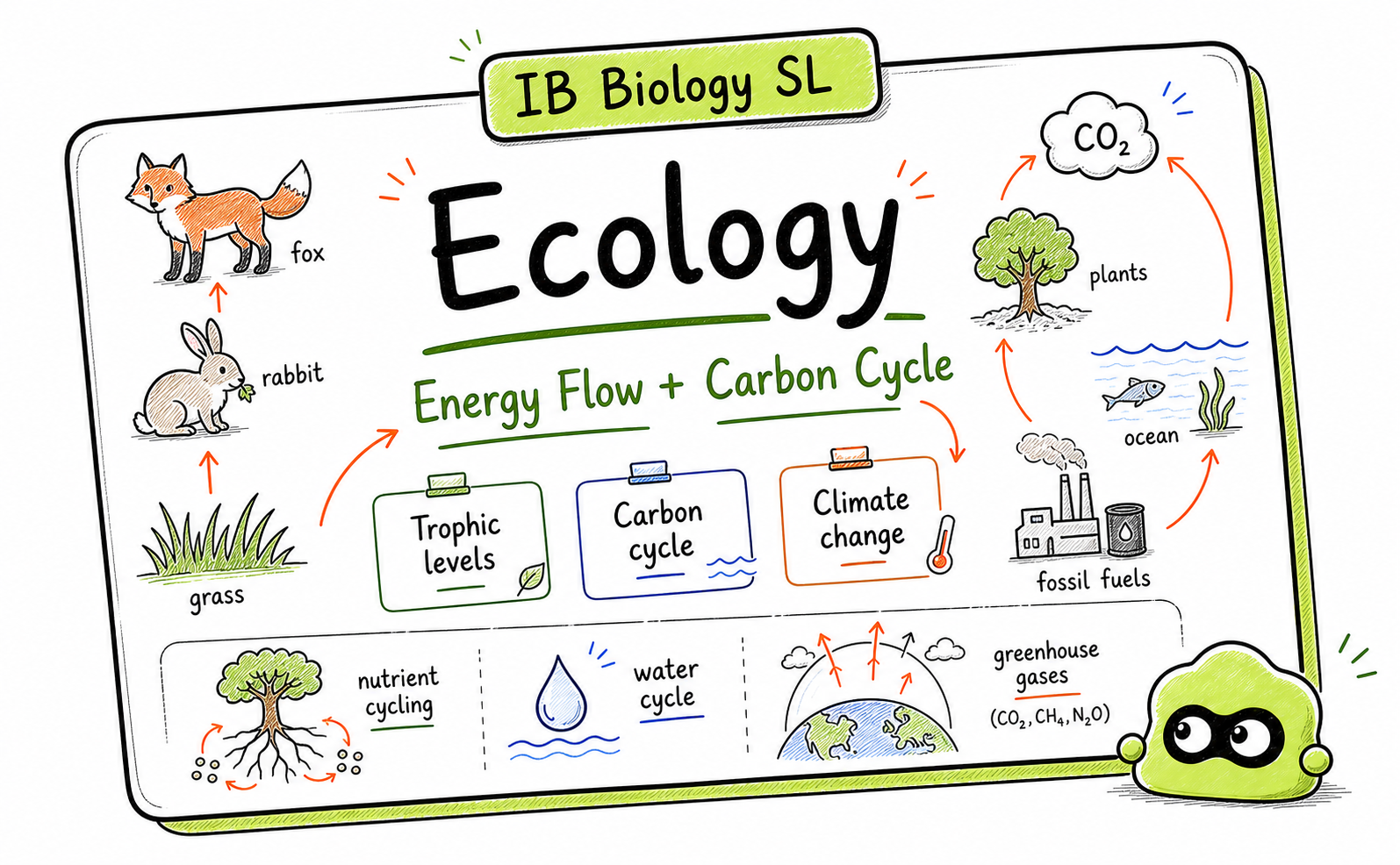
Ecology can feel like a vocabulary chapter until a question asks you to connect the terms. A good IB Biology answer is rarely just "species", "ecosystem", or "carbon cycle". It usually needs a chain: define the idea, place it in a system, then explain what changes when energy, nutrients, or human activity move through that system.
This guide rewrites and upgrades a supplied ecology PDF into an exam-focused blog. The original notes covered species and ecosystems, nutrition, quadrat sampling, energy flow, carbon cycling, greenhouse gases, climate change, ocean acidification, biomagnification, and the precautionary principle. Here, those ideas are reorganised into a cleaner revision route.
Quick Answer
For IB Biology ecology, revise in this order:
- Learn the core levels: species, population, community, habitat, ecosystem.
- Separate nutrition terms: autotroph, heterotroph, consumer, detritivore, saprotroph.
- Practise energy flow with food chains, trophic levels, energy loss, and pyramids of energy.
- Rebuild the carbon cycle as movement between atmosphere, organisms, oceans, and fossil stores.
- Connect greenhouse gases to climate change using mechanism, not slogans.
- Finish with applied topics: ocean acidification, biomagnification, ecological sampling, and the precautionary principle.
Species, Populations, Communities, Habitats, Ecosystems
Start with the hierarchy. A species is a group of organisms that can interbreed and produce fertile offspring. A population is members of one species living in the same area at the same time. A community is all the interacting populations in that area. A habitat is where an organism normally lives. An ecosystem combines the community with the abiotic environment.
The exam mistake is mixing the level. If a question asks for a population, do not describe every organism in the forest. If it asks for an ecosystem, include both living organisms and abiotic factors such as light, water, temperature, soil, or dissolved gases.
Nutrition Terms Without Confusion
Autotrophs make their own organic molecules from simple inorganic substances. Photoautotrophs use light as the energy source. Heterotrophs obtain organic molecules from other organisms. Consumers feed on living or recently living organisms; detritivores ingest dead organic material; saprotrophs digest externally and absorb the products.
For markscheme wording, be precise:
| Term | Strong revision wording |
|---|---|
| Autotroph | Produces organic molecules from inorganic substances |
| Heterotroph | Obtains organic molecules from other organisms |
| Detritivore | Ingests dead organic matter |
| Saprotroph | Secretes enzymes externally and absorbs digested products |
| Mixotroph | Can use more than one nutrition mode depending on conditions |
Energy Flow: Food Chains, Trophic Levels, and Energy Loss
Energy usually enters ecosystems as light and is converted to chemical energy by photosynthesis. Producers occupy the first trophic level, primary consumers feed on producers, secondary consumers feed on primary consumers, and tertiary consumers feed higher in the chain.
Energy transfer is inefficient. Energy is lost through respiration, movement, heat transfer, egestion, excretion, and uneaten biomass. That is why food chains are usually short and why pyramids of energy normally narrow at higher trophic levels.
Worked Example 1
Question: Explain why a food chain rarely has many trophic levels.
Markscheme-style answer: Energy is lost at each trophic transfer through respiration, heat loss, movement, waste, and uneaten material. Because less energy is available to the next trophic level, there is usually not enough energy to support many higher-level consumers.
Why it works: The answer does not only say "energy is lost". It names routes of energy loss and links them to fewer supported organisms at higher trophic levels.
Carbon Cycling: The System Students Need To Draw
The carbon cycle is a movement problem. Carbon dioxide is removed from the atmosphere by photosynthesis. Carbon moves through feeding when consumers eat producers or other consumers. Respiration returns carbon dioxide to the atmosphere or water. Decomposition releases carbon compounds as dead organisms and waste are broken down. Some carbon can be stored long-term in fossil fuels, limestone, shells, or sediments.
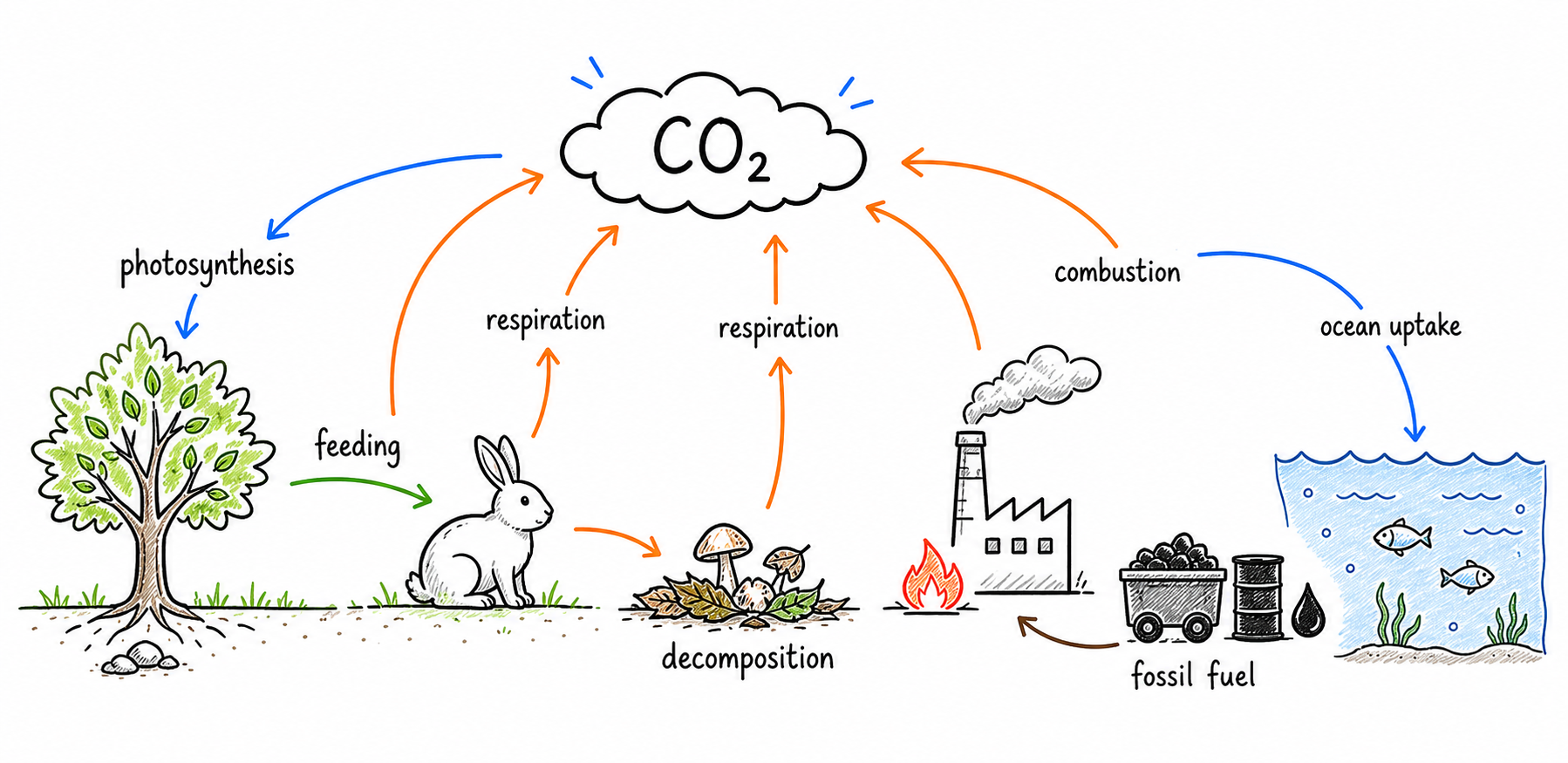
For a short-answer question, write the process and the direction:
- Photosynthesis: carbon dioxide into organic compounds.
- Feeding: carbon compounds move through food chains.
- Respiration: organic carbon back to carbon dioxide.
- Decomposition: dead organic material broken down and carbon returned.
- Combustion: fossil fuels or biomass release carbon dioxide.
Greenhouse Gases and Climate Change
A greenhouse gas absorbs outgoing infrared radiation and re-emits energy, reducing heat loss from Earth. Carbon dioxide, methane, water vapour, and nitrous oxide can all contribute, but they differ in concentration, atmospheric lifetime, and warming potential.
Students often write climate-change answers too generally. A stronger answer follows this chain:
increased greenhouse gas -> more infrared radiation absorbed -> more energy retained -> average temperature changes -> climate effects
Climate change can alter rainfall, temperature, sea level, species distributions, ecosystem productivity, and extinction risk. The best answers separate evidence, mechanism, and consequence.
Ocean Acidification
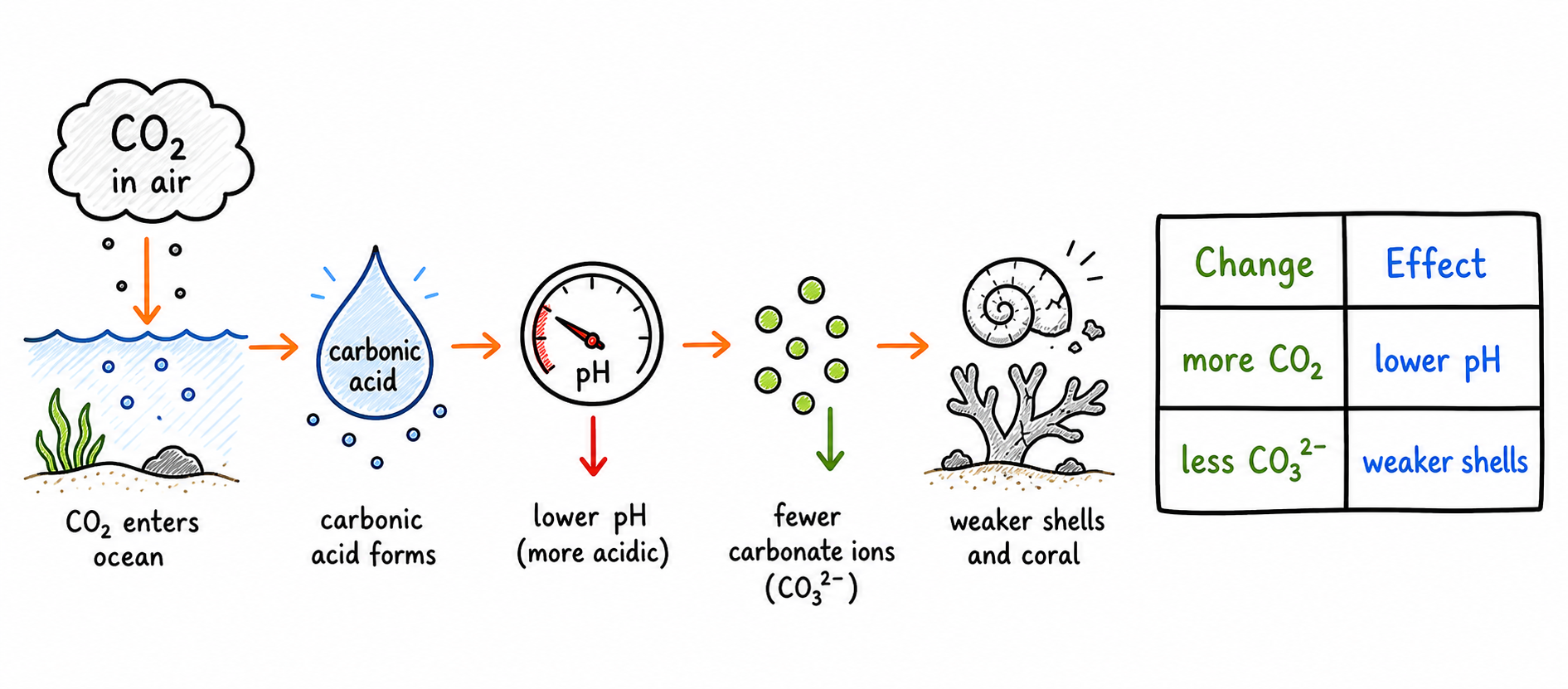
When carbon dioxide dissolves in seawater, it can form carbonic acid and shift carbonate chemistry. Lower carbonate ion availability can make it harder for organisms such as corals and shellfish to build calcium carbonate structures.
Worked Example 2
Question: Explain how increased atmospheric carbon dioxide can affect marine organisms with calcium carbonate shells.
Markscheme-style answer: More carbon dioxide dissolves in seawater and forms carbonic acid, lowering pH. This reduces carbonate ion availability, making it more difficult for organisms to form or maintain calcium carbonate shells or skeletons.
Why it works: It includes the chemical link and the biological consequence.
Sampling, Niches, and Applied Ecology
Quadrats are used to estimate abundance or distribution of sessile organisms such as plants. Random sampling reduces bias, while repeated samples improve reliability. A niche describes the role of a species in an ecosystem, including where it lives, what it eats, how it interacts, and the conditions it tolerates.
Biomagnification is another common applied idea. If a persistent toxin is not easily broken down or excreted, it can become more concentrated at higher trophic levels. A top predator can therefore carry a much higher toxin concentration than organisms lower in the food chain.
Common Mistakes
| Mistake | Fix |
|---|---|
| Defining ecosystem as only living organisms | Include the abiotic environment |
| Saying energy is recycled | Energy flows; nutrients cycle |
| Drawing carbon cycle arrows without process names | Label photosynthesis, respiration, feeding, decomposition, combustion |
| Treating all greenhouse gases as identical | Compare concentration, lifetime, and warming potential |
| Explaining ocean acidification as only "pollution" | Link dissolved CO2, pH, carbonate ions, and shells |
A 30-Minute Ecology Study Routine
- Draw the ecology hierarchy from species to ecosystem.
- Make a two-column table for autotrophs and heterotrophs.
- Draw one food chain and annotate where energy is lost.
- Draw the carbon cycle from memory with five labelled arrows.
- Answer one climate-change question using mechanism and consequence.
- Mark your answer for missing process words.
EduNinja Links To Use Next
- IB Biology SL Notes
- IB Biology Question Bank
- IB Biology Photosynthesis Guide
- IB Biology Cell Respiration Guide
FAQ
What is the difference between energy flow and nutrient cycling?
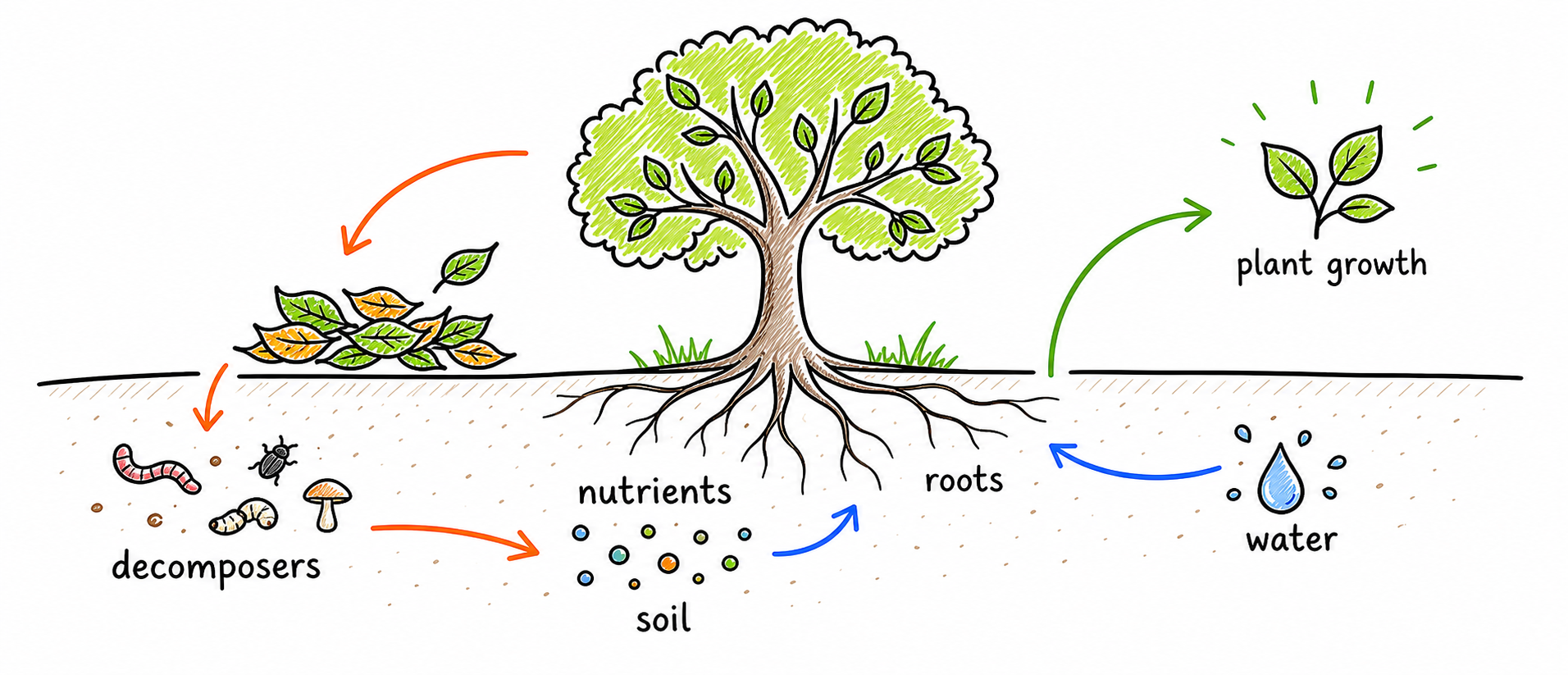
Energy flows through ecosystems and is eventually lost as heat. Nutrients are recycled through organisms, waste, dead matter, decomposers, soil, water, and the atmosphere.
Why are pyramids of energy usually upright?
Energy is lost at each trophic level, so less energy is available to support the next level. This makes higher trophic levels smaller in available energy.
What should I memorise for the carbon cycle?
Memorise the process arrows: photosynthesis, feeding, respiration, decomposition, fossilisation or storage, and combustion. Then practise explaining the direction of carbon movement.
How do I answer climate change questions better?
Use mechanism first. Explain how greenhouse gases affect infrared radiation, then connect that to temperature, climate patterns, sea level, ecosystems, or species distribution.
Are diagrams enough for ecology revision?
No. Diagrams help you organise the system, but exam marks usually come from the labels, processes, and explanation attached to the arrows.
Editorial Review
Prepared by the EduNinja Editorial Team from a supplied ecology PDF and rewritten into original study guidance. The extracted diagrams are used as source-supported teaching visuals and should be reviewed for rights before final publication if the PDF is not owned or licensed by EduNinja.
Related articles
More course notes, updates and study resources from the Eduninja blog.
IGCSE Biology Coordination: Nerves, Hormones, Reflexes
A practical IGCSE Biology revision guide with quick answers, mistakes, EduNinja internal links, and real PDF resources.
IB Biology Enzymes: Revision Guide for Active Sites and Inhibition
A practical IB Biology revision guide for Enzymes, with quick answers, common mistakes, a study routine, EduNinja internal links, and real PDF resources.
IB Biology Cell Respiration: ATP and Exam Mistakes
A practical IB Biology revision guide for Cell Respiration, with quick answers, common mistakes, a study routine, EduNinja internal links, and real PDF resources.