IB Chemistry Calculations: Mole Ratios, Concentration, and Titration Practice
A source-backed IB Chemistry guide for IB Chemistry calculations, using EduNinja PDF notes, worked examples, and markscheme-style answers.
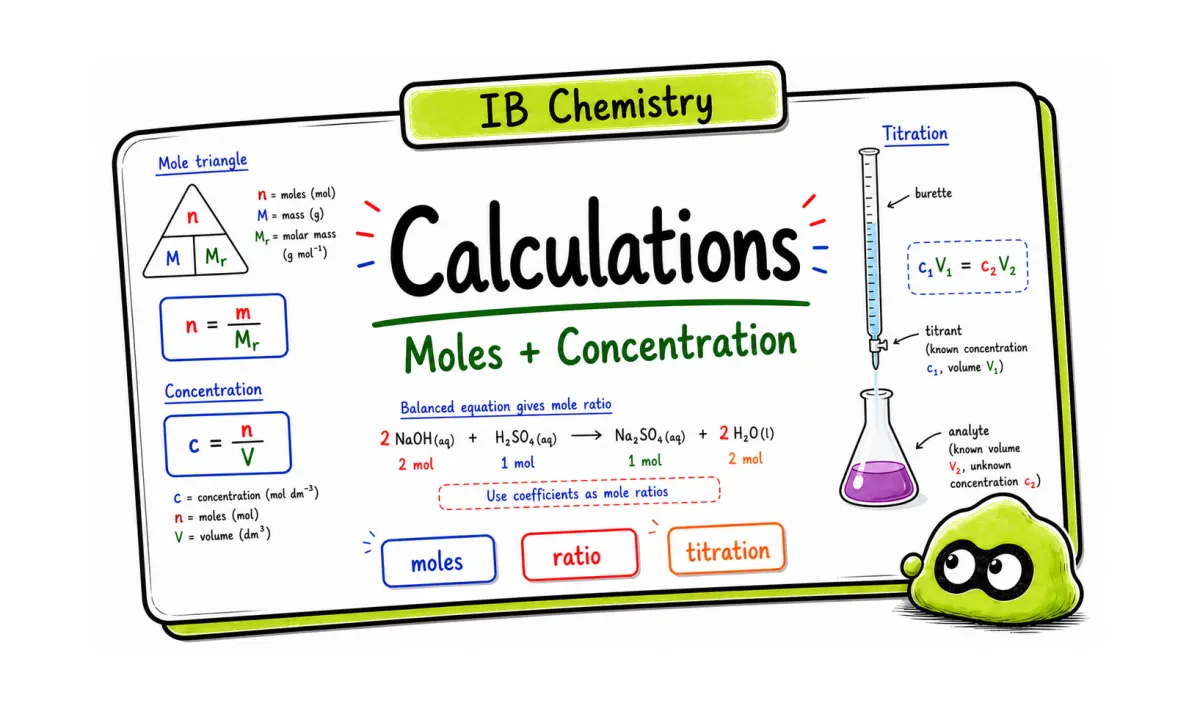
IB Chemistry calculations usually go wrong before the arithmetic gets hard. Students mix mass, moles, concentration and volume in the same line, then the balanced equation ratio gets lost.
The safer route is boring, which is why it works: convert the given quantity to moles, use the balanced equation mole ratio, then convert to the quantity the question asks for. This applies to mass calculations, concentration questions and titration practice.
This guide is aligned with IB Chemistry first assessment 2025 quantitative work around amount of substance, stoichiometry, concentration and reaction calculations. Treat it as a student revision guide, not an official IB syllabus document.
Useful starting points:
- IB Chemistry Notes
- IB Chemistry Question Bank
- IB Chemistry SL question bank
- IB Chemistry Study Library
Start with the notes if the formulae feel scattered. Move to question practice once you can write the calculation route before touching the calculator.
Quick answer
- Amount of substance is measured in moles.
- Moles from mass: n = m / Mr.
- Moles from solution: n = c x V, where V must be in dm3.
- To convert cm3 to dm3, divide by 1000.
- Balanced equation coefficients give mole ratios, not mass ratios.
- In titration questions, calculate moles of the known solution first.
- Use the mole ratio before calculating the unknown concentration.
- Keep extra figures during working and round at the end.
- In titration, the titre is the volume delivered from the burette, not always the volume in the flask.
- For non-1:1 reactions, apply the balanced equation ratio before finding concentration or mass.
- Limiting reagent questions require moles of both reactants, not just the larger or smaller mass.
Write the route before the numbers: given quantity to moles, mole ratio, final quantity.
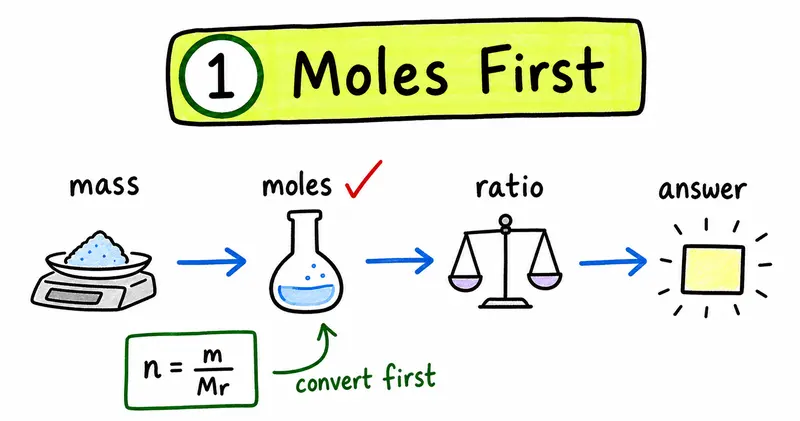
The core routine: moles first
Most IB Chemistry calculation questions become manageable when you start with moles.
| Given information | Formula | Check before substituting |
|---|---|---|
| Mass and Mr | n = m / Mr | Mass in grams |
| Concentration and volume | n = c x V | Volume in dm3 |
| Gas volume | n = V / molar volume | Conditions and units stated |
| Particles | n = number of particles / Avogadro constant | Use the value given in the question or data booklet |
After finding moles, read the balanced equation. The coefficients compare moles of substances. They do not compare masses, concentrations or volumes directly unless the question gives a special condition.
Formula map for IB Chemistry calculations
| Quantity needed | Useful formula | Watch out for |
|---|---|---|
| Moles from mass | n = m / Mr | Mass should be in grams |
| Mass from moles | m = n x Mr | Use the correct Mr from the formula |
| Moles from concentration | n = c x V | V must be in dm3 |
| Concentration | c = n / V | Convert cm3 to dm3 first |
| Gas moles | n = V / molar volume | Use the molar volume and conditions given |
| Particles | N = n x L | Use Avogadro constant if given |
This table is not a shortcut around the balanced equation. In reaction questions, the mole ratio still sits between the known substance and the unknown substance.
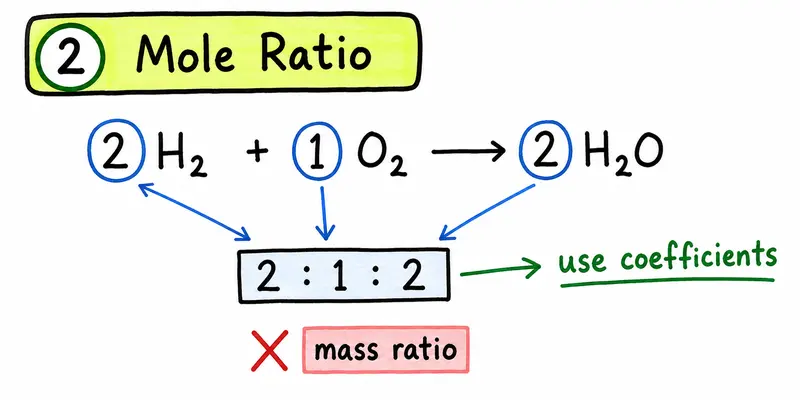
Mole ratios: use the balanced equation
For a reaction such as:
2Mg + O2 -> 2MgO
The ratio Mg : O2 : MgO is 2 : 1 : 2 in moles.
If the question gives moles of Mg and asks for moles of MgO, the ratio is 2 : 2, so the mole amounts are equal. If it asks for O2, the ratio Mg : O2 is 2 : 1, so O2 has half as many moles as Mg.
Weak:
- The equation says 2, so multiply everything by 2.
Better:
- The mole ratio Mg : O2 is 2 : 1, so 0.40 mol Mg reacts with 0.20 mol O2.
Worked example 1: mass to moles
Question: Calculate the amount of substance in 5.60 g of calcium oxide, CaO. Mr of CaO = 56.1.
Mark-worthy answer:
n = m / Mr
n = 5.60 / 56.1 = 0.0998 mol
Why it works:
The answer uses mass in grams and divides by Mr. It does not try to use equation coefficients before finding moles.
Worked example 2: concentration
Question: A solution contains 0.250 mol in 0.500 dm3. Calculate the concentration.
Mark-worthy answer:
c = n / V
c = 0.250 / 0.500 = 0.500 mol dm-3
Why it works:
The volume is already in dm3, so it can go straight into the formula.
cm3 and dm3: the small conversion that breaks answers
IB Chemistry concentration uses mol dm-3, so volume must be in dm3.
| Given volume | Volume in dm3 |
|---|---|
| 25.0 cm3 | 0.0250 dm3 |
| 50.0 cm3 | 0.0500 dm3 |
| 250 cm3 | 0.250 dm3 |
| 1000 cm3 | 1.000 dm3 |
The conversion is:
dm3 = cm3 / 1000
If you put 25.0 directly into c = n / V, your answer will be 1000 times too small.
Worked example 3: concentration with cm3
Question: 25.0 cm3 of sodium hydroxide contains 0.00250 mol NaOH. Calculate the concentration in mol dm-3.
Mark-worthy answer:
25.0 cm3 = 0.0250 dm3
c = n / V
c = 0.00250 / 0.0250 = 0.100 mol dm-3
Why it works:
The answer converts cm3 to dm3 before using the concentration formula.
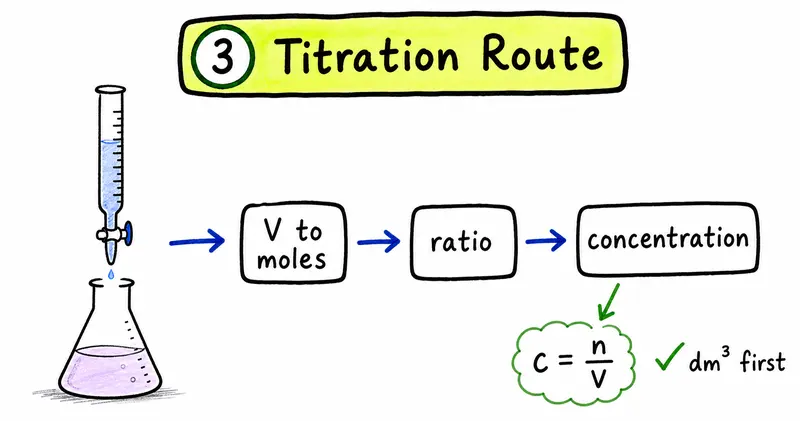
Titration questions: a safe route
Titration questions usually give you a concentration and volume for one solution, then ask for the concentration of another solution.
Use this order:
- Write the balanced equation.
- Convert the known volume from cm3 to dm3.
- Calculate moles of the known solution using n = c x V.
- Use the balanced equation mole ratio.
- Convert moles of the unknown into concentration using c = n / V.
Do not start by dividing one concentration by another. The equation ratio sits between the two solutions.
Worked example 4: titration concentration
Question: 25.0 cm3 of 0.100 mol dm-3 NaOH neutralises 20.0 cm3 of HCl. The equation is NaOH + HCl -> NaCl + H2O. Calculate the concentration of HCl.
Mark-worthy answer:
25.0 cm3 = 0.0250 dm3
moles NaOH = c x V = 0.100 x 0.0250 = 0.00250 mol
The mole ratio NaOH : HCl is 1 : 1, so moles HCl = 0.00250 mol.
20.0 cm3 = 0.0200 dm3
concentration HCl = n / V = 0.00250 / 0.0200 = 0.125 mol dm-3
Why it works:
The answer shows the volume conversions and uses the 1 : 1 mole ratio before finding the unknown concentration.
Worked example 5: titration with a 2:1 ratio
Question: 25.0 cm3 of 0.100 mol dm-3 NaOH neutralises 20.0 cm3 of sulfuric acid, H2SO4. The equation is:
2NaOH + H2SO4 -> Na2SO4 + 2H2O
Calculate the concentration of H2SO4.
Mark-worthy answer:
25.0 cm3 = 0.0250 dm3
moles NaOH = c x V = 0.100 x 0.0250 = 0.00250 mol
The mole ratio NaOH : H2SO4 is 2 : 1.
moles H2SO4 = 0.00250 / 2 = 0.00125 mol
20.0 cm3 = 0.0200 dm3
concentration H2SO4 = n / V = 0.00125 / 0.0200 = 0.0625 mol dm-3
Why it works:
The answer applies the 2 : 1 mole ratio before calculating the acid concentration. It does not assume every titration is 1 : 1.
Titration wording traps
Titration questions often hide the error in the wording, not the calculation.
| Wording in question | What to check |
|---|---|
| Mean titre | Use the average of concordant titres, if given |
| Aliquot | This is the measured volume transferred by pipette |
| Burette reading | Use final reading minus initial reading |
| Excess reagent | Do not use it as the limiting reagent |
| Diluted solution | Track whether the concentration belongs to the original or diluted solution |
Before calculating, label the known solution and the unknown solution. Then write the route: known moles -> mole ratio -> unknown moles -> unknown concentration.
Limiting reagent: find moles of both reactants
Limiting reagent questions ask which reactant runs out first. Do not decide from mass alone.
A safe method is:
- Convert each reactant to moles.
- Divide each mole amount by its coefficient in the balanced equation.
- The smaller value identifies the limiting reagent.
- Use the limiting reagent to calculate product amount.
Mass can mislead you because different substances have different molar masses. The balanced equation works in moles.
Worked example 6: limiting reagent
Question: In the reaction 2H2 + O2 -> 2H2O, 0.60 mol H2 reacts with 0.20 mol O2. Identify the limiting reagent.
Mark-worthy answer:
For H2: 0.60 / 2 = 0.30
For O2: 0.20 / 1 = 0.20
O2 gives the smaller value, so O2 is the limiting reagent.
Why it works:
The answer compares mole amounts against the equation coefficients. It does not compare 0.60 and 0.20 directly.
Worked example 7: limiting reagent to product mass
Question: 0.50 mol Mg reacts with 0.20 mol O2 in the equation:
2Mg + O2 -> 2MgO
Find the amount of MgO formed.
Mark-worthy answer:
For Mg: 0.50 / 2 = 0.25
For O2: 0.20 / 1 = 0.20
O2 is limiting because it gives the smaller adjusted value.
The ratio O2 : MgO is 1 : 2, so moles MgO = 0.20 x 2 = 0.40 mol.
Why it works:
The answer identifies the limiting reagent first, then uses it to calculate the product. It does not use the excess Mg amount.
Significant figures and rounding
Keep at least one or two extra figures during working. Round the final answer to a sensible number of significant figures, usually matching the data in the question unless your teacher gives a specific rule.
Do not round moles too early in a multi-step calculation. A rounded intermediate value can push the final answer outside the accepted range.
Include units in the final answer:
| Quantity | Common unit |
|---|---|
| Amount | mol |
| Mass | g |
| Concentration | mol dm-3 |
| Volume | cm3 or dm3, depending on the question |
Common mistakes that cost marks
- Using cm3 directly in c = n / V.
- Treating equation coefficients as mass ratios.
- Skipping the balanced equation.
- Rounding after the first line of working.
- Forgetting units in the final answer.
- Using the volume of the wrong solution in titration.
- Using the excess reactant instead of the limiting reagent.
- Writing a correct formula but substituting the wrong quantity.
The repair is to write the route above the calculation. For example: "NaOH moles -> mole ratio -> HCl moles -> HCl concentration."
Exam question types
| Question type | First move | Common trap |
|---|---|---|
| Mass to moles | Use n = m / Mr | Using the equation first |
| Concentration | Convert volume to dm3 | Leaving volume in cm3 |
| Mole ratio | Write the ratio line | Using mass ratio |
| Titration | Find known moles first | Using the wrong titre or volume |
| Limiting reagent | Find moles of both reactants | Choosing from mass or largest mole value |
| Final mass | Find product moles first | Forgetting to multiply by Mr |
For multi-step questions, one clear line of working is worth more than a memorised shortcut.
A short revision route
- Memorise n = m / Mr and n = c x V.
- Practise converting cm3 to dm3 until it is automatic.
- Do one mass-to-moles question.
- Do one concentration question.
- Do one titration question with a 1 : 1 ratio.
- Do one titration or stoichiometry question with a non-1 : 1 ratio.
- Mark the first wrong step and write it as a correction.
This topic improves through repetition, but only if you mark the route, not just the final number.
How to use EduNinja for this topic
Use the notes page to rebuild the formulae, then use the question bank for short calculation sets. Keep a separate error log for volume conversion, mole ratio, units and rounding.
Good next links:
- IB Chemistry Notes
- IB Chemistry Question Bank
- IB Chemistry SL question bank
- IB Chemistry Study Library
Avoid jumping into unrelated topics before fixing the calculation route. One corrected titration method is worth more than five pages of highlighted notes.
Related Study Links
FAQ
What is the safest order for IB Chemistry mole calculations?
Convert the given information to moles, use the balanced equation mole ratio, then convert to the quantity the question asks for.
Why do I need dm3 for concentration?
Concentration in mol dm-3 uses volume in dm3. If volume is given in cm3, divide by 1000 before using c = n / V.
Are coefficients in equations mass ratios?
No. Coefficients give mole ratios. Convert mass to moles before using the ratio.
How do I solve titration questions?
Calculate moles of the known solution first, use the balanced equation mole ratio, then calculate the concentration of the unknown solution.
How do I solve a non-1:1 titration question?
Calculate moles of the known solution first, then use the balanced equation ratio before calculating the unknown concentration. Do not assume the acid and alkali react in equal moles.
What is the difference between cm3 and dm3 in concentration questions?
1000 cm3 = 1 dm3, so divide cm3 by 1000 before using n = c x V or c = n / V.
How do I know which reactant is limiting?
Convert each reactant to moles and compare each amount with its coefficient in the balanced equation. The reactant that gives the smaller adjusted value is limiting.
When should I round my answer?
Keep extra figures during working and round at the end. Early rounding can change the final answer in multi-step calculations.
How do I avoid rounding errors in IB Chemistry calculations?
Keep extra figures during each step and round only the final answer to a sensible number of significant figures, usually matching the data in the question.
Closing
IB Chemistry calculations become calmer when you stop chasing numbers and write the route first. Convert to moles, use the equation ratio, then convert to the requested unit. That method handles mass, concentration, titration and limiting reagent questions.
Put exam skill back into your full IB Chemistry SL study plan.
Return to the complete course overview, or move directly into the most relevant study tool.
Related articles
More course notes, updates and study resources from the EduNinja blog.
IB Chemistry SL Strong and Weak Acids: Exam Answer Guide
Revise IB Chemistry SL strong and weak acids with pH logic, equilibrium language, Ka, neutralisation, and mark-worthy answer patterns.
IB Chemistry Acids and Bases: pH, Neutralisation, and Common Mistakes
Revise IB Chemistry acids and bases with pH, strong vs weak acids, conjugate pairs, neutralisation, buffers, and markscheme wording. Includes examples and targeted FAQ.
A-Level Chemistry Organic Mechanisms: Curly Arrows Guide
Revise A-Level Chemistry organic mechanisms with curly arrows, nucleophiles, electrophiles, substitution, addition, elimination, and common arrow errors.