A-Level Physics Kinematics: SUVAT and Motion Graphs Guide
Revise A-Level Physics kinematics with SUVAT, motion graphs, gradient, area, sign convention, acceleration, and displacement mistakes. Includes examples and targeted FAQ.
A-Level Physics kinematics is not difficult because there are too many equations. It feels difficult because the question rarely tells you whether to use a graph, a SUVAT equation, a sign convention, or a unit conversion first.
One student sees a velocity-time graph and immediately reaches for a SUVAT formula. Another sees a falling object and forgets that the equations assume constant acceleration. The result is the same: the method is almost right, but one early decision makes the final answer wrong.
This guide gives you a practical way to revise A-Level Physics kinematics: read the clue, choose the method, keep signs and units visible, then practise the exact subtopic.
Use the relevant EduNinja course pages as your base:
- A-Level Physics Question Bank
- A-Level Physics Notes
- AS CIE Physics Notes 2 - Kinematics
- AS CIE Physics chapter notes (handout) - Accelerated-motion
Do not open every link at once. Start with the notes or topic page, then move into question practice and use any PDF resource only when it helps clarify the exact idea you are revising.
Quick Answer
For A-Level Physics kinematics, use this checklist:
- Define what the question is asking for: distance, displacement, speed, velocity, or acceleration.
- If there is a graph, decide whether you need gradient or area.
- If acceleration is constant, choose the SUVAT equation with the missing variable.
- State your positive direction before using signs.
- Keep units beside every value.
- Check whether the motion is one-dimensional, falling under gravity, or projectile-style.
- Practise with the A-Level Physics Question Bank after revising the method.
Kinematics becomes much calmer when you stop hunting for a formula first. Start by identifying the clue.
Core Concept That Gets Marks
Kinematics is a clue-reading topic. Strong answers identify the quantity, graph meaning, direction convention, and constant-acceleration assumption before choosing an equation.
What A-Level Physics Kinematics Includes
In the AS Physics syllabus structure, kinematics includes distance, displacement, speed, velocity, acceleration, graphical methods, area under velocity-time graphs, gradients of displacement-time and velocity-time graphs, equations for uniformly accelerated motion, free fall, and motion where velocity and acceleration are perpendicular.
That is why the topic is both mathematical and conceptual. You are not only calculating. You are deciding what the graph means, what direction is positive, whether acceleration is constant, and whether the final quantity is scalar or vector.
Use A-Level Physics Notes when the definitions feel shaky, then move into the equations of motion topic for exam-style practice.
Distance, Displacement, Speed, Velocity, and Acceleration
The first trap in kinematics is mixing scalar and vector quantities.
| Quantity | Type | Meaning | Common mistake |
|---|---|---|---|
| Distance | Scalar | Total path length travelled | Using it when the question asks for displacement |
| Displacement | Vector | Straight-line change in position | Forgetting direction |
| Speed | Scalar | Rate of change of distance | Treating it as signed |
| Velocity | Vector | Rate of change of displacement | Ignoring negative direction |
| Acceleration | Vector | Rate of change of velocity | Forgetting that it can be negative |
If a question gives a path, curve, or journey with turns, do not rush. Distance is the whole path. Displacement is the direct change from start to finish with direction.
For graph questions, velocity is not just "speed with direction" as a phrase to memorise. It is the gradient of a displacement-time graph. Acceleration is the gradient of a velocity-time graph.
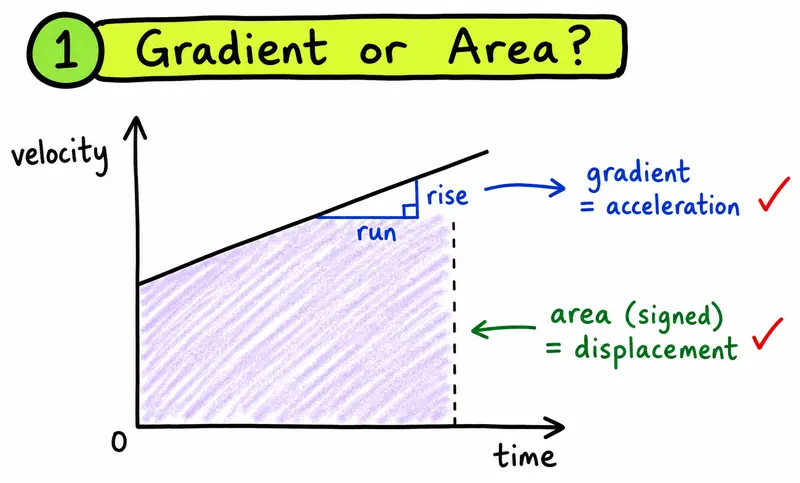
Motion Graphs: Gradient or Area?
Graph questions often become easy once you ask the right question.
| Graph | Gradient gives | Area gives |
|---|---|---|
| Displacement-time | Velocity | Usually not used at AS level |
| Velocity-time | Acceleration | Displacement |
| Acceleration-time | Change in velocity | Less common in basic AS kinematics |
If you see a displacement-time graph, the gradient gives velocity. A steeper gradient means a larger velocity. A curved graph means velocity is changing.
If you see a velocity-time graph, the gradient gives acceleration, and the area under the graph gives displacement. This is why shaded areas matter. A triangle, rectangle, or trapezium under a velocity-time graph is not decoration; it is displacement.
Practise these separately with displacement from the area under a velocity-time graph and acceleration from the gradient of a velocity-time graph.
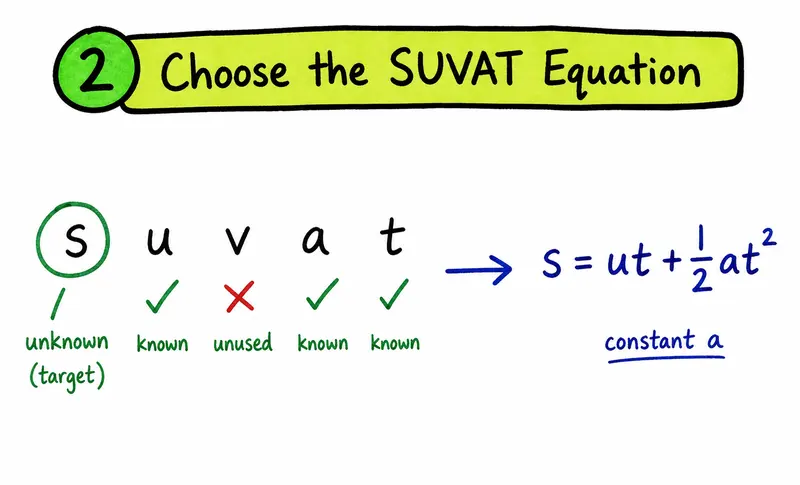
SUVAT Equations: When to Use Them
SUVAT equations are for uniformly accelerated motion in a straight line. Before using one, check that acceleration is constant.
The variables are:
| Symbol | Meaning |
|---|---|
| s | displacement |
| u | initial velocity |
| v | final velocity |
| a | acceleration |
| t | time |
A good method is:
- List the known variables.
- Identify the unknown variable.
- Cross out the variable not involved.
- Choose the equation that uses the remaining four.
- Substitute with units and signs.
For example, if you know initial velocity, acceleration, time, and need final velocity, v = u + at is the natural equation. If you need displacement and do not know final velocity, s = ut + 1/2 at^2 is usually better.
Do not use SUVAT just because you see motion. If acceleration changes, or if the question is asking for a graph interpretation, SUVAT may not be the first tool.
One quick check is to ask whether the question gives a time interval with constant acceleration, or whether it gives a graph that already contains the answer. If the graph has clear axes and a shaded region, interpret the graph before reaching for equations.
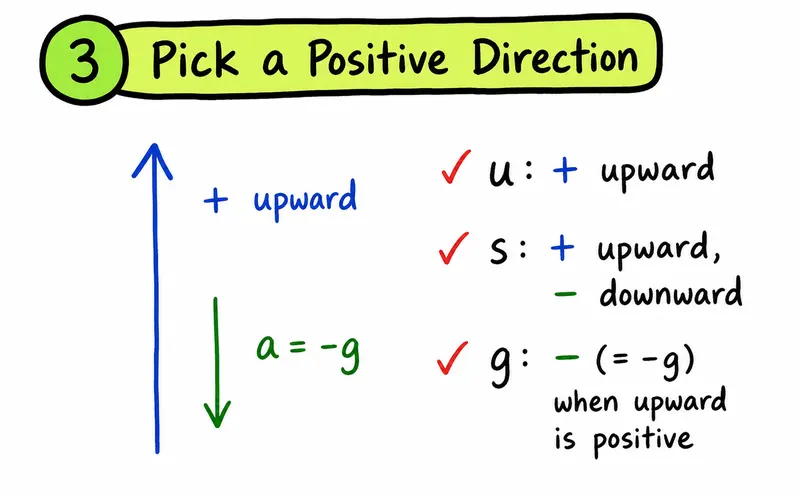
Sign Conventions and Free Fall
A sign convention is simply your chosen positive direction. The problem is that students often use signs without choosing the direction first.
For vertical motion, choose one direction as positive:
- If upward is positive, acceleration due to gravity is usually negative.
- If downward is positive, acceleration due to gravity is usually positive.
- Initial velocity, final velocity, and displacement must follow the same convention.
Free-fall questions often use constant acceleration, so SUVAT can work if air resistance is ignored or not considered. If the question brings in air resistance or terminal velocity, be careful. That becomes a dynamics-style interpretation, not a simple constant-acceleration SUVAT problem.
Common Mistakes That Cost Marks
| Mistake | Why it loses marks | Fix |
|---|---|---|
| Mixing distance and displacement | One is scalar, one is vector | Ask whether direction matters |
| Using area when the graph needs gradient | Graph tools are mixed up | Name the graph axes before calculating |
| Forgetting negative velocity | Direction has been ignored | State the positive direction |
| Using SUVAT when acceleration is not constant | SUVAT assumptions are not met | Check for constant acceleration first |
| Dropping units | The answer becomes ambiguous | Keep units on every line |
The strongest habit is to write a short "clue line" before solving: "This is a velocity-time graph, so area gives displacement and gradient gives acceleration." That one sentence prevents many wrong-method answers.
Topic-Specific Revision Route
Minutes 0-5: definitions. Write distance, displacement, speed, velocity, and acceleration from memory. Mark which are vectors.
Minutes 5-12: graph drill. Draw one displacement-time graph and one velocity-time graph. Label what gradient and area mean.
Minutes 12-20: SUVAT drill. Do three constant-acceleration questions. For each one, list s, u, v, a, and t before choosing the equation.
Minutes 20-27: mixed practice. Use the A-Level Physics Question Bank and choose one graph question and one SUVAT question.
Minutes 27-30: error log. Write the mistake as a rule, such as "On a velocity-time graph, area gives displacement, not acceleration."
This is where EduNinja fits naturally: use Notes to rebuild the idea, Question Bank to test it, and Flashcards to make the repeated mistake visible before the next study session.
How EduNinja Helps
For focused reading, use AS CIE Physics Notes 2 - Kinematics and AS CIE Physics chapter notes - Kinematics. If accelerated motion is the weak point, add AS CIE Physics chapter notes - Accelerated-motion.
For formulas, AS Important Physics Equations can help, but do not treat equations as a substitute for understanding graphs. In kinematics, choosing the correct clue matters as much as substituting into the equation.
Worked Example 1
Worked Example 1: Start With the Physical Model
Question: A Kinematics question gives several values and asks for an unknown. What is the safest first step?
Worked answer: Decide which model the question is testing before choosing an equation. For motion, identify displacement, velocity, acceleration, and time. For forces, draw the free-body diagram and find the resultant force. For circuits, decide whether components are in series or parallel.
Markscheme-style answer: States the relevant model; defines known quantities with units; selects a valid equation; substitutes correctly; gives the answer to a sensible precision.
Worked Example 2: Explain the Direction or Trend
Question: Why do physics explanation marks often require more than a formula?
Worked answer: A formula gives the relationship, but the markscheme often wants the cause. For example, increasing resistance reduces current for the same potential difference because current is inversely proportional to resistance when voltage is constant.
Markscheme-style answer: Names the relationship; states the controlled variable; explains the direction of change; links the explanation back to the physical situation.
Question-Type Breakdown
Kinematics questions become much less confusing when you identify the representation first: words, graph, or SUVAT data.
| Question type | What it is really asking | First move | Common trap |
|---|---|---|---|
| SUVAT calculation | Find one unknown under constant acceleration | List s, u, v, a, and t | Using SUVAT when acceleration is not constant |
| Displacement-time graph | Interpret position over time | Use gradient for velocity | Treating area as distance |
| Velocity-time graph | Interpret motion from velocity | Use gradient for acceleration and area for displacement | Forgetting negative area means negative displacement |
| Acceleration-time graph | Track changing acceleration | Use area for change in velocity | Assuming velocity is the graph height |
| Free fall | Apply vertical motion with gravity | Choose a sign convention before substituting | Switching signs halfway through |
Worked Example 2
Do not start by memorising all equations at once. Use this decision process:
- Write the five variables: s, u, v, a, t.
- Fill in the values given in the question, including signs.
- Circle the unknown.
- Cross out the variable that is not given and not needed.
- Choose the SUVAT equation that does not contain the crossed-out variable.
Weak answer:
- I used this equation because it looked right.
Mark-worthy method:
- The known variables are u, a, and t, and the question asks for s. Since v is not needed, choose the equation that connects s, u, a, and t.
For graph questions, say exactly what you used: "gradient of a velocity-time graph" or "area under a velocity-time graph". That wording is often the difference between a vague answer and a mark-worthy one.
Exam-Ready Mini Checklist
| Check | What good work looks like |
|---|---|
| quantity type chosen | checked before moving on |
| graph method named | checked before moving on |
| SUVAT variables listed | checked before moving on |
| direction stated | checked before moving on |
| units carried through | checked before moving on |
FAQ
When should I use SUVAT equations?
Use SUVAT equations when acceleration is constant and the question gives or asks for displacement, initial velocity, final velocity, acceleration, or time. If acceleration is not constant, use graph or calculus methods instead.
What does gradient mean on a velocity-time graph?
The gradient of a velocity-time graph represents acceleration. A positive gradient means positive acceleration; a negative gradient means acceleration in the opposite direction.
What does area under a velocity-time graph show?
The area under a velocity-time graph gives displacement. If the graph goes below the time axis, that area represents negative displacement, so signs matter.
Why do SUVAT answers often have the wrong sign?
The sign usually goes wrong because the positive direction was not chosen clearly. Define a direction first, then make displacement, velocity, and acceleration consistent with it.
Related Study Links
- Explore the subject Study Hub
- A-Level Physics Notes
- A-Level Physics Question Bank
- Equations of motion
- Velocity-time graph area practice
- Velocity-time graph gradient practice
- Connect motion graphs to forces with A-Level Physics dynamics and Newton's laws
Put kinematics back into your full A-Level CAIE Physics AS study plan.
Return to the complete course overview, or move directly into the most relevant study tool.
Related articles
More course notes, updates and study resources from the EduNinja blog.

IB Physics SL 2025 Syllabus Changes: New Assessment Model
A practical IB Physics SL guide to the 2025 syllabus: the new Paper 1A and 1B structure, Paper 2, scientific investigation, no-options assessment and how to update old notes.
Energy Transformation Examples | Physics
Learn A-Level Physics energy transformations with energy stores, transfer pathways, Sankey diagrams, efficiency and common exam mistakes.
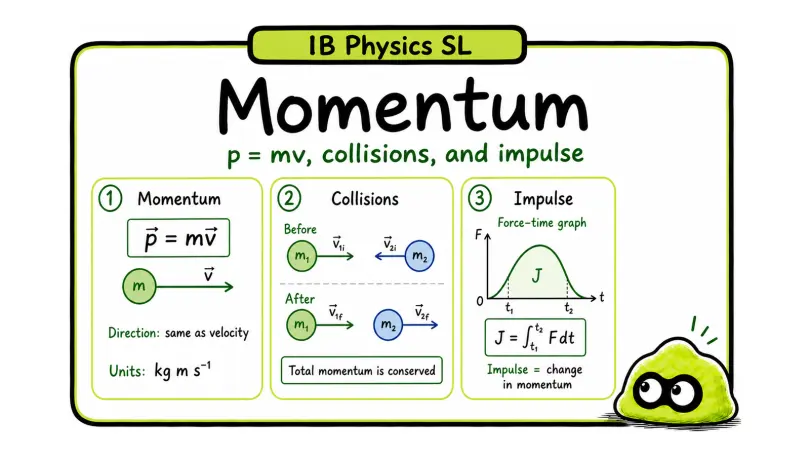
Momentum and Conservation of Momentum | IB Physics SL
Learn IB Physics SL momentum with p = mv, vector direction, conservation in collisions, impulse, force-time graphs and exam practice.