
Question 2(b)(i)
Multiple sclerosis is a condition that can slow down the speed at which electrical impulses travel along neurones.
The time taken for the blink reflex to occur can be used to help diagnose if someone has multiple sclerosis.
The blink reflex causes the eyelid to close.
Air is blown on to the eye and the time taken for the eyelid to close is recorded.
The diagram shows the reflex pathway.
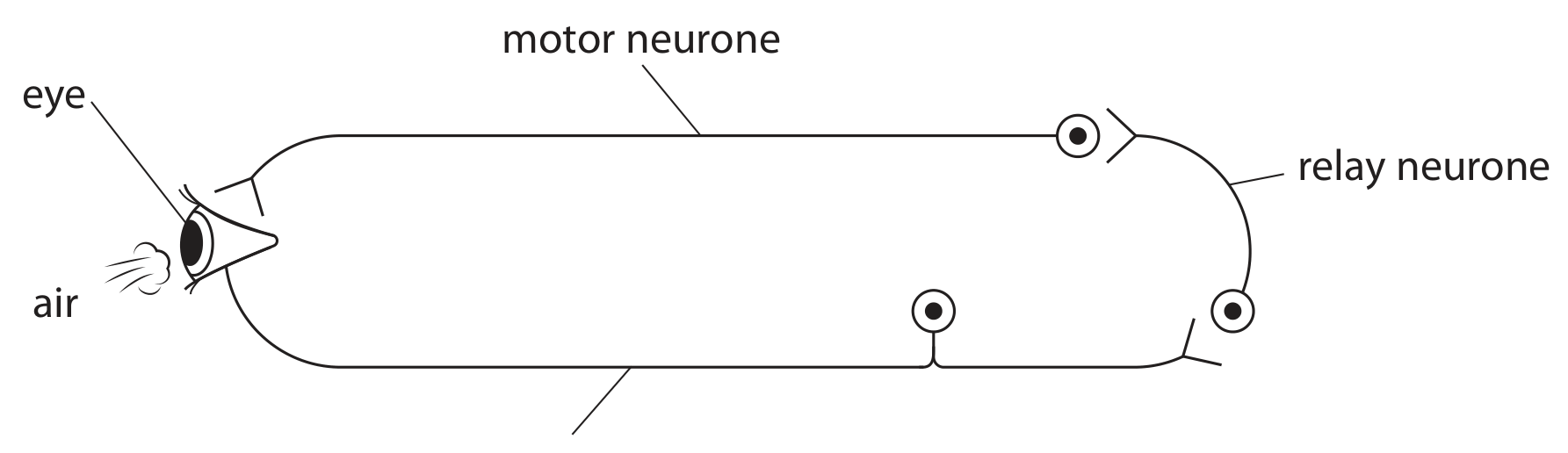
sensory neurone
The speed the impulse moves along the reflex arc consisting of all three neurones in a person without multiple sclerosis is 77 metres per second.
The time taken for the blink reflex to occur in a person with multiple sclerosis is 0.0050 s .
The total length of the neurones in the reflex arc for the person with multiple sclerosis is 25 cm .
Calculate the difference between the speed of impulse for the person with multiple sclerosis and for the person without multiple sclerosis, in metres per second.